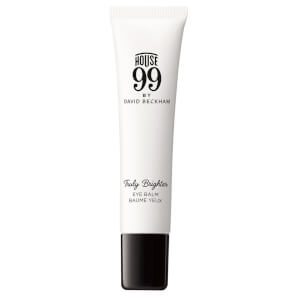
House 99 by David Beckham Truly Brighter Eye Balm
Works for
2 of 2 advertised claims delivered
Anti-aging5 ingredients credited for this claimStrong support
“Enriched with revitalising superfood extracts of Spirulina and Quinoa, plus energising Caffeine, the formula helps to reduce the look of fine lines, wrinkles and dark circles so you can enjoy that fast-paced lifestyle without the visible consequences.”
This product can help reduce and prevent fine lines and wrinkles, improve skin elasticity and firmness because it contains adenosine.
Keep in mind that it typically takes at least 6 weeks to notice any results because the changes that are needed to improve fine lines and elasticity happen in the deeper layers of the skin. No topical anti-aging product can “erase” wrinkles or fully reverse signs of aging.
Moisturizing19 ingredients credited for this claimGood support
“David Beckham's inspiration.”
This product can help improve hydration of the skin with the two types of ingredients.
The first type is called “humectants”:
these ingredients help attract water.
When humectants are on the surface of the skin, they “pull in” the moisture from the outside environment, or from
within deeper layers of the skin. The following ingredients in this product do the job:
glycerin, glycine soja protein.
This product also contains ingredients called “occlusives”. They help reduce the speed with which our skin loses moisture to the outside environment. These ingredients also help soften the upper layer of the skin, so it feels less tight and nicer to the touch. The following ingredients in this product do the job: butyrospermum parkii butter, dimethicone.
Can it cause trouble?
Irritancy4 strong irritants: Alcohol denat., Citrus aurantium dulcis fruit water + 2 more — patch-test recommendedHigh risk
Comedogenic4 ingredients rated 2 or more on the 0–5 pore-clogging scale4 flagged


User reviews
Be the first — your take helps the next person decide.
Ingredients
Filter by role to see what each ingredient is doing.
Water~45–55%
Glycerin~5.7–7%
- Irritation risk
- Low
One of the best moisturizing ingredients. Naturally present in skin. It attracts water to the upper layer of the skin working as a humectant
More about GlycerinDimethicone~4.4–5.3%
- Irritation risk
- Low
A silicone that helps to reduce water loss from the surface of the skin. Can temporarily "fill in" lines and wrinkles, absorb oil, and create a nice product finish
More about DimethiconeAlcohol denat.~3.1–3.8%
- Irritation risk
- High
Produces temporary toning effect. Can help dissolve other ingredients or preserve products
More about Alcohol denat.Theobroma cacao seed butter~2.5–3%
- Irritation risk
- Low
- Comedogenicity
- 3/5
Helps soften the upper layer of the skin and can be helpful in restoring the skin barrier function. Might have some anti-oxidant effect
More about Theobroma cacao seed butterButyrospermum parkii butter~2.1–2.6%
- Irritation risk
- Low
- Comedogenicity
- 3/5
A great moisturising ingredient that softens the skin and reduces water loss from its upper layer. It also can be helpful in protecting skin from free radicals
More about Butyrospermum parkii butterPoly c10-30 alkyl acrylate~1.7–2.1%
- Irritation risk
- Low
Hydrogenated polyisobutene~1.6–1.9%
- Irritation risk
- Low
Used to improve the product consistency and soften the upper layer of the skin
More about Hydrogenated polyisobuteneSucrose stearate~1.3–1.5%
Stearic acid~1–1.3%
- Irritation risk
- Low
Helps oil and water mix together and works as an emollient
More about Stearic acidPalmitic acid~0.7–1.05%
- Irritation risk
- Low
An emollient that is naturally present in skin and helps soften it
More about Palmitic acidHydroxyethylpiperazine ethane sulfonic acid~0.55–0.85%
- Irritation risk
- Medium
Used to regulate product's pH, but can be also used as an exfoliator when included in higher concentrations. There is a controversy about whether it can generate free radicals and induce skin cell damage when used in topical products
More about Hydroxyethylpiperazine ethane sulfonic acidChenopodium quinoa seed extract~0.5–0.75%
- Irritation risk
- Low
Helps soften the upper layer of the skin
More about Chenopodium quinoa seed extractCitrus aurantium dulcis fruit water~0.45–0.7%
- Irritation risk
- High
Tin oxide~0.6–0.9%
- Irritation risk
- Low
A colorant that can add a pearl-like appearance to the formulation
More about Tin oxideSecale cereale seed extract~0.55–0.85%
- Irritation risk
- Medium
Rye seed extract. Helps soften the upper layer of the skin
More about Secale cereale seed extractRosa damascena extract~0.35–0.65%
- Irritation risk
- High
Oil of a very fragrant pink rose used as fragrance in cosmetics. Extensive research has shown it has mixed benefits. In the pro column, inhaling this flower’s scent seems to have relaxing properties and the plant’s petals contain skin-soothing and antioxidant compounds that can benefit skin. On the flipside, the numerous chemicals that create this rose’s distinctive fragrance pose a risk of causing skin aggravation.
More about Rosa damascena extractSaccharum officinarum extract~0.3–0.6%
- Irritation risk
- Low
Sugar extract that helps attract water to the upper layer of the skin
More about Saccharum officinarum extractVaccinium myrtillus fruit extract~0.3–0.55%
- Irritation risk
- Medium
A plant extract that might help neutralize free radicals in skin, but research on its efficacy in skin is lacking
More about Vaccinium myrtillus fruit extractGlycine soja protein~0.3–0.6%
- Irritation risk
- Low
A plant extract that helps to attract water to the upper layer of the skin and soften it. It might be helpful in neutralizing free radicals. It might be somewhat helpful for evening out the skin tone. It might be able to support elastin production but solid research is lacking
More about Glycine soja proteinDimethiconol~0.3–0.55%
- Irritation risk
- Low
A silicone that makes products more spreadable and keeps skin smooth. Helps to add gloss to skin and may visually fill in fine lines/wrinkles for short time
More about DimethiconolCaffeine~0.25–0.45%
- Irritation risk
- Medium
Might be helpful in neutralizing free radicals. Can have a dehydration effect that might somewhat decrease the look of puffy eyes
More about CaffeineSodium citrate~0.25–0.45%
- Irritation risk
- Medium
Helps to control the skin's pH level. Maintains the skin's natural film of amino-lactic acids and oils. Helps to preserve products
More about Sodium citrateSodium cocoyl glutamate~0.35–0.6%
- Irritation risk
- Medium
Helps oil and water mix together
More about Sodium cocoyl glutamateSodium hydroxide~0.25–0.45%
Sodium phosphate~0.25–0.45%
Sodium polyacrylate~0.3–0.5%
- Irritation risk
- Low
Used to create a gel-like product texture, as well as to stabilize emulsions
More about Sodium polyacrylateMyristic acid~0.3–0.55%
- Irritation risk
- Medium
- Comedogenicity
- 3/5
Helps oil and water mix together. Could be comedogenic
More about Myristic acidAdenosine~0.25–0.45%
- Irritation risk
- Low
Might help improve cell turnover and reduce inflammation in skin. One study shows that the ingredients might be able to help reduce dynamic wrinkles (for example, in the corners of the eyes or on the forehead)
More about AdenosineAscorbyl glucoside~0.25–0.45%
- Irritation risk
- Medium
A vitamin C derivative that is more stable but less potent than pure form of vitamin C. Has a potential to boost collagen production, nutralise free radicals and reduce hyperpigmentation, but the required concentration is likely to be much higher than for the pure form of vitamin C, limiting the ingredient's effectiveness in products
More about Ascorbyl glucosideNylon-12~0.3–0.5%
Hydrolyzed linseed extract~0.25–0.45%
- Irritation risk
- Low
Helps soften the upper layer of the skin
More about Hydrolyzed linseed extractAcer saccharum extract~0.25–0.4%
- Irritation risk
- Medium
A plant extract that contains small percentage of AHAs. Is unlikely to have any skin benefit due the small concentration of the active compounds
More about Acer saccharum extractSpirulina platensis extract~0.25–0.45%
- Irritation risk
- Low
- Comedogenicity
- 3/5
An algae extract. Might help to attract water to the upper layer of the skin and have an anti-oxidant effect
More about Spirulina platensis extractCaprylyl glycol~0.25–0.5%
- Irritation risk
- Medium
Helps preserve products and creates a nice product texture
More about Caprylyl glycolVitreoscilla ferment~0.25–0.4%
- Irritation risk
- Low
Citric acid~0.25–0.45%
- Irritation risk
- Medium
Can work as an exfoliant but is typically used to adjust the product pH
More about Citric acidCitrus limon fruit extract~0.25–0.4%
- Irritation risk
- High
Used as a fragrance. Can be irritating and cause photosensitivity
More about Citrus limon fruit extractXanthan gum~0.25–0.5%
- Irritation risk
- Low
Used to create a thicker product consistency
More about Xanthan gumSynthetic wax~0.3–0.55%
- Irritation risk
- Low
Used to stabilize product formulations and thicken product consistency
More about Synthetic waxPentylene glycol~0.3–0.55%
- Irritation risk
- Medium
Used to preserve products, dissolve other ingredients and create a nice product texture
More about Pentylene glycolDextrin~0.25–0.5%
- Irritation risk
- Low
A sugar that is used to stabilize the product formulation. Can help attract water to the upper layer of the skin
More about DextrinEthylhexylglycerin~0.25–0.45%
Acrylates/c10-30 alkyl acrylate crosspolymer~0.25–0.45%
- Irritation risk
- Medium
Maintains the texture of skincare products. Allows the product to spread evenly. Helps oil and water mix together
More about Acrylates/c10-30 alkyl acrylate crosspolymerTocopherol~0.25–0.45%
- Irritation risk
- Low
Pure form of vitamin E. Can help moisturise and protect the skin from free radicals. Often used to help stabilise other ingredients or the formula itself
More about TocopherolPentaerythrityl tetra-di-t-butyl hydroxyhydrocinnamate~0.25–0.45%
- Irritation risk
- Low
Used to increase stability of product formulations
More about Pentaerythrityl tetra-di-t-butyl hydroxyhydrocinnamatePotassium sorbate~0.2–0.35%
Sodium benzoate~0.15–0.3%
Phenoxyethanol~0.15–0.3%
- Irritation risk
- Low
A preservative. It helps prevent bacterial growth in cosmetic products
More about PhenoxyethanolChlorphenesin~0.15–0.3%
Ci 77891~0.15–0.3%
- Irritation risk
- Low
Titanium dioxide~0.1–0.2%
- Irritation risk
- Low
Works as a UV filter when used in high concentrations. It is photostable and is effective mostly against the UVB light, with some protection in the UVA range. In small concentrations, used for its ability to improve the color of cosmetic products. Is usually well tolerated by the skin
More about Titanium dioxideMica~0.1–0.2%
- Irritation risk
- Low
Creates an illusion of smoother and more radiant skin tone. Adds shimmer to the skin by reflecting light
More about MicaIngredient list view
Water, Glycerin, Dimethicone, Alcohol denat., Theobroma cacao seed butter, Butyrospermum parkii butter, Poly c10-30 alkyl acrylate, Hydrogenated polyisobutene, Sucrose stearate, Stearic acid, Palmitic acid, Hydroxyethylpiperazine ethane sulfonic acid, Chenopodium quinoa seed extract, Citrus aurantium dulcis fruit water, Tin oxide, Secale cereale seed extract, Rosa damascena extract, Saccharum officinarum extract, Vaccinium myrtillus fruit extract, Glycine soja protein, Dimethiconol, Caffeine, Sodium citrate, Sodium cocoyl glutamate, Sodium hydroxide, Sodium phosphate, Sodium polyacrylate, Myristic acid, Adenosine, Ascorbyl glucoside, Nylon-12, Hydrolyzed linseed extract, Acer saccharum extract, Spirulina platensis extract, Caprylyl glycol, Vitreoscilla ferment, Citric acid, Citrus limon fruit extract, Xanthan gum, Synthetic wax, Pentylene glycol, Dextrin, Ethylhexylglycerin, Acrylates/c10-30 alkyl acrylate crosspolymer, Tocopherol, Pentaerythrityl tetra-di-t-butyl hydroxyhydrocinnamate, Potassium sorbate, Sodium benzoate, Phenoxyethanol, Chlorphenesin, Ci 77891, Titanium dioxide, Mica
Compare prices
Retailers ranked by price — lowest first.
Affiliate links · prices updated regularly · As an Amazon Associate, WIMJ earns from qualifying purchases.
Worth comparing, line by line.
Match % combines shared ingredients, the first five ingredients, shared actives and hero ingredients, irritancy (lower counts in the alternative's favour), texture and body area. Only products in the same routine step are compared.
| House 99 by David BeckhamTruly Brighter Eye BalmYOUR PRODUCT | Kiehl'sAge Defender Eye Repair | LancômeRenergie Multi-Lift Ultra Eye Cream | VichySlow Âge Eye Cream | |
|---|---|---|---|---|
| Match | — | 64% | 56% | 56% |
| Price | $25.12 | $34.00+$8.88 | $56.05+$30.93 | $25.00 |
| Shared key ingredients | — | 14 of 15 | 8 of 15 | 8 of 15 |
| Key difference | — | Titanium Dioxide | Acetyl Tetrapeptide-9 | Bifida Ferment Lysate |
| Irritancy | High | High | High | Medium |
| Drying alcohol | Contains drying alcohol | Contains drying alcohol | Contains drying alcohol | — |
| View product | Shop | Shop | Shop |

Sources cited in this review
Every concentration estimate and effectiveness label is anchored to one of these 22 studies and safety reviews.
- 1
- 2
- 3Final Report on the Safety Assessment of Dimethicone Copolyoljournals.sagepub.com
- 4
- 5
- 6

Affiliate links · As an Amazon Associate, WIMJ earns from qualifying purchases.