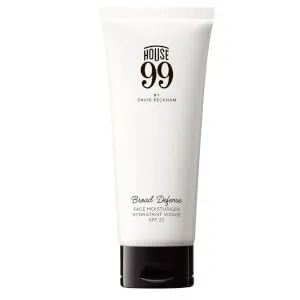
House 99 by David Beckham Broad Defense Moisturiser SPF20
Works for
Sun protectionSPF 20 · 3 UV filters · Broad spectrumWeak protectionSPF under 30
This product offers broad spectrum sun protection, but it is weak. We recommend to use a broad spectrum sunscreen with at least SPF 30.
This product can be considered "reef safe" because it does not contain the UV filters (oxybenzone and octinoxate) that can be harmful to coral reefs when present in the water in high concentrations.
MoisturizingGlycerin, Dimethicone + 10 moreWorks
“Broad Defense Moisturiser SPF20”
This product can help improve hydration of the skin with the two types of ingredients.
The first type is called “humectants”:
these ingredients help attract water.
When humectants are on the surface of the skin, they “pull in” the moisture from the outside environment, or from
within deeper layers of the skin. The following ingredients in this product do the job:
glycerin, thermus thermophillus ferment.
This product also contains ingredients called “occlusives”. They help reduce the speed with which our skin loses moisture to the outside environment. These ingredients also help soften the upper layer of the skin, so it feels less tight and nicer to the touch. The following ingredients in this product do the job: dimethicone, cetearyl alcohol.
Anti-agingSide benefit · Adenosine, Thermus thermophillus ferment + 1 moreWorks well
This product can help reduce and prevent fine lines and wrinkles, improve skin elasticity and firmness because it contains adenosine.
Keep in mind that it typically takes at least 6 weeks to notice any results because the changes that are needed to improve fine lines and elasticity happen in the deeper layers of the skin. No topical anti-aging product can “erase” wrinkles or fully reverse signs of aging.
Can it cause trouble?
Irritancy6 strong irritants: Alcohol denat., Menthoxypropanediol + 4 more — patch-test recommendedHigh risk
Comedogenic2 ingredients rated 2 or more on the 0–5 pore-clogging scale2 flagged

User reviews
Be the first — your take helps the next person decide.
Ingredients
Filter by role to see what each ingredient is doing.
Water~45–55%
Octocrylene~4.9–5.9%
- Irritation risk
- Medium
A weak sunscreen that protects against the sun rays that cause sunburn (UVB) and is somewhat effective against the UVA rays. It is quite stable and can help stabilize other, more vulnerable, sunscreen ingredients like Avobenzone. It is an organic, or so called "chemical" sunscreen
More about OctocryleneAlcohol denat.~4.3–5.3%
- Irritation risk
- High
Produces temporary toning effect. Can help dissolve other ingredients or preserve products
More about Alcohol denat.Ethylhexyl salicylate~3.6–4.4%
- Irritation risk
- Low
Octisalate. A UV filter. It offers some protection against the sun rays that cause sunburn (UVB), but does not protect against the most aging sun rays (UVA). It loses its effectiveness quickly when exposed to sunlight. It is an organic, or so called "chemical" sunscreen
More about Ethylhexyl salicylateIsononyl isononanoate~2.4–3%
- Irritation risk
- Low
Forms a protective film on the surface of the skin to prevent moisture loss. Gives a velvety feel to products while reducing tackiness
More about Isononyl isononanoateGlycerin~2–2.5%
- Irritation risk
- Low
One of the best moisturizing ingredients. Naturally present in skin. It attracts water to the upper layer of the skin working as a humectant
More about GlycerinButyl methoxydibenzoylmethane~2.1–2.6%
- Irritation risk
- Medium
Avobenzone. An organic, or so-called "chemical" UV filter. Protects against both UVA and UVB rays. Needs to be combined with other filters in a formulation to be stable.
More about Butyl methoxydibenzoylmethaneDimethicone~1.5–1.9%
- Irritation risk
- Low
A silicone that helps to reduce water loss from the surface of the skin. Can temporarily "fill in" lines and wrinkles, absorb oil, and create a nice product finish
More about DimethiconeStyrene/acrylates copolymer~1.2–1.5%
- Irritation risk
- Low
Used to create an even product consistency. Can help boost efficiency of sunscreen filters
More about Styrene/acrylates copolymerSilica~1.3–1.6%
Dipropylene glycol~0.7–1.05%
- Irritation risk
- Low
Helps to dissolve other ingredients in a formulation. Slows down the rate of product drying
More about Dipropylene glycolCetearyl alcohol~0.7–1.1%
- Irritation risk
- Low
- Comedogenicity
- 2/5
A non-drying alcohol. Works as an emollient. Helps water and oil mix together and creates a nice product texture
More about Cetearyl alcoholTocopherol~0.6–0.85%
- Irritation risk
- Low
Pure form of vitamin E. Can help moisturise and protect the skin from free radicals. Often used to help stabilise other ingredients or the formula itself
More about TocopherolDiisopropyl sebacate~0.55–0.85%
- Irritation risk
- Low
Helps soften the upper layer of the skin without creatng a greasy finish
More about Diisopropyl sebacateChenopodium quinoa seed extract~0.5–0.75%
- Irritation risk
- Low
Helps soften the upper layer of the skin
More about Chenopodium quinoa seed extractPeg-20~0.5–0.75%
- Irritation risk
- Low
Peg-8 laurate~0.5–0.75%
Carbomer~0.45–0.7%
- Irritation risk
- Low
Helps create a thicker or gel-like product texture. It is not a surfactant but can be used in gentle cleansing formulations
More about CarbomerTriethanolamine~0.45–0.65%
- Irritation risk
- Medium
Used to adjust pH of the product and can help improve the product's smell
More about TriethanolamineCetearyl glucoside~0.4–0.6%
- Irritation risk
- Medium
Helps water and oil in the product mix well together and improves product texture
More about Cetearyl glucosideSodium carrageenan~0.35–0.65%
Sodium citrate~0.3–0.6%
- Irritation risk
- Medium
Helps to control the skin's pH level. Maintains the skin's natural film of amino-lactic acids and oils. Helps to preserve products
More about Sodium citrateSodium phosphate~0.3–0.55%
Maris sal~0.3–0.55%
- Irritation risk
- Medium
Used to thicken the product formulation and might help to add minerals to the surface of the skin. It is used in scrubs as a physical exfoliant. Can increase sensitivity to other ingredients if left on the skin or used in high concentration
More about Maris salInulin lauryl carbamate~0.3–0.6%
Adenosine~0.3–0.55%
- Irritation risk
- Low
Might help improve cell turnover and reduce inflammation in skin. One study shows that the ingredients might be able to help reduce dynamic wrinkles (for example, in the corners of the eyes or on the forehead)
More about AdenosineAmmonium acryloyldimethyltaurate/vp copolymer~0.3–0.55%
- Irritation risk
- Low
Increases thickness of a product. Texture enhancer for oil-in-water emulsions
More about Ammonium acryloyldimethyltaurate/vp copolymerDisodium edta~0.3–0.55%
Disodium stearoyl glutamate~0.5–0.75%
- Irritation risk
- Medium
Helps oil and water mix together and workd as a cleanser
More about Disodium stearoyl glutamateThermus thermophillus ferment~0.3–0.55%
- Irritation risk
- Medium
Might be helpful in neutralising free radicals in skin and have some hydration properties
More about Thermus thermophillus fermentSpirulina platensis extract~0.3–0.55%
- Irritation risk
- Low
- Comedogenicity
- 3/5
An algae extract. Might help to attract water to the upper layer of the skin and have an anti-oxidant effect
More about Spirulina platensis extractVitreoscilla ferment~0.3–0.5%
- Irritation risk
- Low
Xanthan gum~0.3–0.55%
- Irritation risk
- Low
Used to create a thicker product consistency
More about Xanthan gumMenthoxypropanediol~0.3–0.5%
Scutellaria baicalensis root extract~0.25–0.45%
- Irritation risk
- High
A plant extract that might contain a compound baicalin that could be helpful in neutralizing free radicals and reducing inflammation in skin. The baicalin concentration in skincare products is often too low for an effective action. Can be used for its fragrant properties
More about Scutellaria baicalensis root extractDextrin~0.25–0.5%
- Irritation risk
- Low
A sugar that is used to stabilize the product formulation. Can help attract water to the upper layer of the skin
More about DextrinT-butyl alcohol~0.2–0.35%
- Irritation risk
- Medium
Used to dissolve other ingredients and to improve smell of products. It could be irritating
More about T-butyl alcoholPotassium sorbate~0.2–0.35%
Phenoxyethanol~0.15–0.3%
- Irritation risk
- Low
A preservative. It helps prevent bacterial growth in cosmetic products
More about PhenoxyethanolChlorphenesin~0.1–0.2%
Linalool~0.15–0.25%
Citral~0.15–0.25%
Citronellol~0.1–0.15%
Parfum~0.1–0.15%
- Irritation risk
- High
An aromatic blend of unspecified and possibly irritating ingredients
More about ParfumIngredient list view
Water, Octocrylene, Alcohol denat., Ethylhexyl salicylate, Isononyl isononanoate, Glycerin, Butyl methoxydibenzoylmethane, Dimethicone, Styrene/acrylates copolymer, Silica, Dipropylene glycol, Cetearyl alcohol, Tocopherol, Diisopropyl sebacate, Chenopodium quinoa seed extract, Peg-20, Peg-8 laurate, Carbomer, Triethanolamine, Cetearyl glucoside, Sodium carrageenan, Sodium citrate, Sodium phosphate, Maris sal, Inulin lauryl carbamate, Adenosine, Ammonium acryloyldimethyltaurate/vp copolymer, Disodium edta, Disodium stearoyl glutamate, Thermus thermophillus ferment, Spirulina platensis extract, Vitreoscilla ferment, Xanthan gum, Menthoxypropanediol, Scutellaria baicalensis root extract, Dextrin, T-butyl alcohol, Potassium sorbate, Phenoxyethanol, Chlorphenesin, Linalool, Citral, Citronellol, Parfum
Compare prices
Retailers ranked by price — lowest first.

Worth comparing, line by line.
Match % combines shared ingredients, the first five ingredients, shared actives and hero ingredients, irritancy (lower counts in the alternative's favour), texture and body area. Only products in the same routine step are compared.
| House 99 by David BeckhamBroad Defense Moisturiser SPF20YOUR PRODUCT | CetaphilDaily Facial Moisturizer SPF 35 | UriageAge Lift Protective Smoothing Day Cream SPF30 | Farm StayDaily UV Protect Sun Stick SPF50+ PA++++ | |
|---|---|---|---|---|
| Match | — | 61% | 59% | 59% |
| Price | — | $24.43 | $31.85 | — |
| Shared key ingredients | — | 5 of 8 | 6 of 8 | 5 of 8 |
| Key difference | — | Niacinamide | Retinyl Palmitate | Tinosorb S |
| Irritancy | High | Medium | Medium | Medium |
| SPF | SPF 20 | SPF 35 | SPF 30 | SPF 50 |
| Drying alcohol | Contains drying alcohol | — | — | — |
| View product | Shop | Shop | Shop |


More alternatives: La Roche-Posay Hydraphase HA UV SPF25 RichRéVive Soleil Superiéur SPF 50 PA++++ by Révive
Product summary
"House 99 by David Beckham - Broad Defense Moisturiser SPF20" offers broad spectrum protection. It means that it protects from both UVA and UVB rays (you can remember UVB as "burning" sunlight - they cause sunburn. You can remember UVA rays as "aging" - they do not lead to sunburn, but they cause photodamage and contribute to early signs of skin aging and hyperpigmentation). On the negative side, the SPF of this moisturizer is not high enough. We recommend to use a sunscreen with at least SPF 30 daily.
This moisturizer should also be hydrating enough to use without an additional moisturizer during the day. Like all broad-spectrum sunscreens, this product has an anti-aging benefit.
Sunscreen filters
This is a so-called "chemical" sunscreen. It means that it uses organic UV filters. They typically offer good sun protection and rarely leave a white cast, but they can be irritating for some people with sensitive skin. Here are the exact UV filters in this sunscreen: avobenzone 2.10% - 2.60%, octisalate 3.60% - 4.40% and octocrylene 4.90% - 5.90%.
Irritation risk
This moisturizer contains a bunch of common irritants, including ingredients that do not provide any known benefit for the skin. It might not be the best choice if your skin is sensitive. We assess the overall irritancy of this moisturizer to be high. For a detailed overview of all potential irritants: click here
You can see the detailed formula review with the breakdown of all actives in the product and the full ingredient list with estimated concentrations in the tables below.
Price
The product retails for 22.00£ in the United Kingdom.
For a detailed price comparison: click here.
Sources cited in this review
Every concentration estimate and effectiveness label is anchored to one of these 13 studies and safety reviews.
- 1
- 2
- 3Final Report on the Safety Assessment of Dimethicone Copolyoljournals.sagepub.com
- 4
- 5Vitamin E in dermatologyncbi.nlm.nih.gov
- 6Vitamin E and Skin Healthlpi.oregonstate.edu

Affiliate links · As an Amazon Associate, WIMJ earns from qualifying purchases.