Works for:
based on ingredients and %- Moisturizing
Doesn't work for:
based on ingredients and %- Anti-aging
- Evens skin tone
Can it cause trouble?
- Irritation risk: medium
- Comedogenic risk ingredients: 0
Key actives

Product Summary
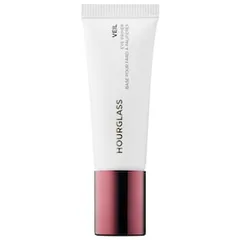
"Hourglass - Veil Eye Primer" could be helpful for: Moisturizing, but its actives are not the most effective or are not well-studied.
About the brand
According to Cruelty-Free Kitty "Hourglass" is cruelty free, but its parent company is not.
Price
The product retails for 30.00$ in the United States and from 27.00£ up to 33.06£ in the United Kingdom.
For a detailed price comparison: click here.
Moisturizing
What does the product description say?
Nourishing delicate skin with vitamins E and C, it keeps skin moisturized and reduces the look of age spots and sun damage.
Source: Bluemercury
This product can help soften the skin and reduce its moisture loss with emollients and occlusives: dimethicone, helianthus annuus seed wax.
Keep in mind that this product does not contain effective ingredients to attract water to the upper layer of the skin. This is why an additional product with humectants like glycerin or hyaluronic acid can be helpful (apply it before this product for the best results).
A silicone that helps to reduce water loss from the surface of the skin. Can temporarily "fill in" lines and wrinkles, absorb oil, and create a nice product finish
Helps soften the upper layer of the skin
Helps soften the upper layer of the skin
Helps soften the upper layer of the skin and support skin's barrier function while creating a thicker product consistency
An emollient that helps soften the skin and can decrease moisture loss. Helps create a nice product texture
Helps soften the upper layer of the skin and improve the product texture
Helps soften the upper layer of the skin
Is used to dissolve other ingredients and create nice product texture
Anti-aging
What does the product description say?
Thanks to Viamerine WH60, the primer even targets lines and wrinkles by deeply hydrating the skin.
Source: Lookfantastic
Effective ingredients missing or their concentration is too low.
Being a lipid soluble form of vitamin C, it is more stable than ascorbic acid, but still degrades quickly and needs to be stabilized in a formulation with another ingredient. It is claimed to penetrate skin better than pure vitamin C and have the the similar benefits, but solid studies of its effectiveness are lacking. Is likely to require a higher concentration in a product than pure vitamin C to be effective. It might be able to help reduce pore clogging.
Evens skin tone
What does the product description say?
Nourishing delicate skin with vitamins E and C, it keeps skin moisturized and reduces the look of age spots and sun damage.
Source: Bluemercury
Effective ingredients missing or their concentration is too low
Being a lipid soluble form of vitamin C, it is more stable than ascorbic acid, but still degrades quickly and needs to be stabilized in a formulation with another ingredient. It is claimed to penetrate skin better than pure vitamin C and have the the similar benefits, but solid studies of its effectiveness are lacking. Is likely to require a higher concentration in a product than pure vitamin C to be effective. It might be able to help reduce pore clogging.
How honest is this product?
| Promise | Can it deliver? |
|---|---|
| Moisturizing | |
| Anti-aging | |
| Evens skin tone |
Total Promises Fulfilled score: 25/100.
We receive a small commission for purchases made through these links at no cost for you. Thank you for your support! Learn more
Potential irritants
Comedogenic ingredients
No comedogenic ingredients detected
User reviews (0)
Averages from community submissions.
No reviews yet for this product.
Be the first to share your experience!
Tried this product?
Help capture what the ingredient list can't—texture, finish, pilling, scent, and more. Answer what you can, skip the rest.
Takes ~30 seconds.
Reviews are shown in aggregate. No personal details.
Key Actives
A silicone that helps to reduce water loss from the surface of the skin. Can temporarily "fill in" lines and wrinkles, absorb oil, and create a nice product finish
Helps soften the upper layer of the skin and support skin's barrier function while creating a thicker product consistency
Helps soften the upper layer of the skin
Helps soften the upper layer of the skin
Potential irritants
Used to help oil and water mix together. Can be irritating
Used to improve the product adherence to the skin, for example, to pro-long the protective effect of sunscreens. Can be irritating to very sensitive skin
Being a lipid soluble form of vitamin C, it is more stable than ascorbic acid, but still degrades quickly and needs to be stabilized in a formulation with another ingredient. It is claimed to penetrate skin better than pure vitamin C and have the the similar benefits, but solid studies of its effectiveness are lacking. Is likely to require a higher concentration in a product than pure vitamin C to be effective. It might be able to help reduce pore clogging.
A more stable but less bio-available form of vitamin E compared to Tocopherol. Might help moisturize and protect the skin from free radicals, but mostly used in low concentrations to stabilize other ingredients.
Comedogenic ingredients
We couldn't find any comedogenic ingredients in this product
All ingredients
An emollient that helps soften the skin and can decrease moisture loss. Helps create a nice product texture
Creates an illusion of smoother and more radiant skin tone. Adds shimmer to the skin by reflecting light
A type of silicone that helps create a nice product consistency and support the delivery of other ingredients
A type of clay that is used to thicken the product consistency
Helps soften the upper layer of the skin and support skin's barrier function while creating a thicker product consistency
Helps soften the upper layer of the skin and improve the product texture
Used to help oil and water mix together. Can be irritating
Used to improve the product adherence to the skin, for example, to pro-long the protective effect of sunscreens. Can be irritating to very sensitive skin
A silicone that helps to reduce water loss from the surface of the skin. Can temporarily "fill in" lines and wrinkles, absorb oil, and create a nice product finish
Is used to dissolve other ingredients and create nice product texture
A preservative. It helps prevent bacterial growth in cosmetic products
Being a lipid soluble form of vitamin C, it is more stable than ascorbic acid, but still degrades quickly and needs to be stabilized in a formulation with another ingredient. It is claimed to penetrate skin better than pure vitamin C and have the the similar benefits, but solid studies of its effectiveness are lacking. Is likely to require a higher concentration in a product than pure vitamin C to be effective. It might be able to help reduce pore clogging.
A more stable but less bio-available form of vitamin E compared to Tocopherol. Might help moisturize and protect the skin from free radicals, but mostly used in low concentrations to stabilize other ingredients.
Works as a UV filter when used in high concentrations. It is photostable and is effective mostly against the UVB light, with some protection in the UVA range. In small concentrations, used for its ability to improve the color of cosmetic products. Is usually well tolerated by the skin
An umbrella term for the following three colorants: CI 77491, CI 77492, CI 77499. They might be able to offer some protection against visible light, but the degree of the protection is not clear
Ingredient list view
Isododecane, Talc, Mica, C13-14 alkane, Trimethylsiloxysilicate, Disteardimonium hectorite, Helianthus annuus seed wax, Trihydroxystearin, Hydroxystearic/linolenic/oleic polyglycerides, Triethylhexanoin, Sorbitan sesquioleate, Calcium carbonate, Vp/eicosene copolymer, Dimethicone, Propylene carbonate, Synthetic beeswax, Peg-40 stearate, Phenoxyethanol, Tetrahexyldecyl ascorbate, Tocopheryl acetate, Titanium dioxide, Ci 77163, Iron oxides
- Effect of Olive and Sunflower Seed Oil on the Adult Skin Barrier: Implications for Neonatal Skin Care
- Amended Safety Assessment of Triglycerides as Used in Cosmetics
- Sorbitan sesquioleate, a common emulsifier in topical corticosteroids, is an important contact allergen
- Safety Assessment of Vinylpyrrolidone Polymers as Used in Cosmetics
- Dimethicone as a protective ingredient in topical medications
- Final Report on the Safety Assessment of Dimethicone Copolyol
- Double-blind, half-face study comparing topical vitamin C and vehicle for rejuvenation of photodamage
- Application of tetra-isopalmitoyl ascorbic acid in cosmetic formulations: Stability studies and in vivo efficacy