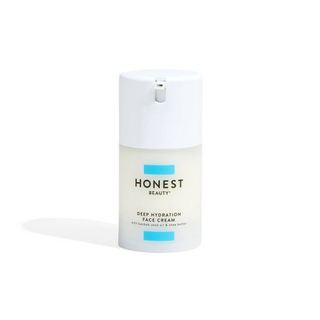
Honest Beauty Deep Hydration Face Cream
Works for
1 of 1 advertised claim delivered
Moisturizing18 ingredients credited for this claimGood support
“Deep Hydration Face Cream”
This product can help improve hydration of the skin with the two types of ingredients.
The first type is called “humectants”:
these ingredients help attract water.
When humectants are on the surface of the skin, they “pull in” the moisture from the outside environment, or from
within deeper layers of the skin. The following ingredients in this product do the job:
glycerin, hydrolyzed hyaluronic acid.
This product also contains ingredients called “occlusives”. They help reduce the speed with which our skin loses moisture to the outside environment. These ingredients also help soften the upper layer of the skin, so it feels less tight and nicer to the touch. The following ingredients in this product do the job: beeswax, butyrospermum parkii butter.
Can it cause trouble?
Irritancy13 strong irritants: Calendula officinalis flower extract, Parfum + 11 more — patch-test recommendedHigh risk
Comedogenic3 ingredients rated 2 or more on the 0–5 pore-clogging scale3 flagged
User reviews
Be the first — your take helps the next person decide.
Ingredients
Filter by role to see what each ingredient is doing.
Water~45–55%
Ethylhexyl stearate~4.9–6%
- Irritation risk
- Low
Helps soften the upper layer of the skin
More about Ethylhexyl stearateGlycerin~4.2–5.1%
- Irritation risk
- Low
One of the best moisturizing ingredients. Naturally present in skin. It attracts water to the upper layer of the skin working as a humectant
More about GlycerinRaphanus sativus seed oil~3.1–3.8%
- Irritation risk
- Low
Jojoba esters~2.4–2.9%
- Irritation risk
- Medium
An emollient made of jojoba oil. Helps soften the skin and support its barrier function
More about Jojoba estersButyrospermum parkii butter~2–2.4%
- Irritation risk
- Low
- Comedogenicity
- 3/5
A great moisturising ingredient that softens the skin and reduces water loss from its upper layer. It also can be helpful in protecting skin from free radicals
More about Butyrospermum parkii butterSorbitol~1.6–1.9%
- Irritation risk
- Low
Helps attract water to the upper layer of the skin and improves the product texture
More about SorbitolDimethicone~1.5–1.8%
- Irritation risk
- Low
A silicone that helps to reduce water loss from the surface of the skin. Can temporarily "fill in" lines and wrinkles, absorb oil, and create a nice product finish
More about DimethiconeGlyceryl stearate se~1.2–1.4%
- Irritation risk
- Low
- Comedogenicity
- 2/5
Used to stabilize the product formulations and works as an emollient
More about Glyceryl stearate seCetyl alcohol~1–1.3%
- Irritation risk
- Low
A non-drying alcohol that works to soften the skin and stabilize product formulations helping oil and water mix together
More about Cetyl alcoholCaprylic/capric triglyceride~0.75–1.1%
- Irritation risk
- Medium
A good mix of fatty acids that forms a protective layer on the skin. Improves the shelf life of products. Derived from coconut and glycerin
More about Caprylic/capric triglycerideBeeswax~0.6–0.95%
- Irritation risk
- Low
Forms a protective barrier that holds water and keeps dry skin hydrated. Keeps an emulsion from separating into its oil and liquid components, and increases the thickness of a product. Can be an allergen
More about BeeswaxCera alba~0.6–0.95%
- Irritation risk
- Medium
Forms a protective barrier that holds water and keeps dry skin hydrated. Keeps an emulsion from separating into its oil and liquid components, and increases the thickness of a product. Can be an allergen
More about Cera albaCandelilla/jojoba/rice bran polyglyceryl-3 esters~0.45–0.7%
- Irritation risk
- Medium
Help oil and water mix together
More about Candelilla/jojoba/rice bran polyglyceryl-3 estersGlyceryl stearate~0.45–0.7%
- Irritation risk
- Low
An emollient that softens the skin and forms a protective layer on its surface. Helps water and oil mix together
More about Glyceryl stearateMaltodextrin~0.45–0.65%
- Irritation risk
- Low
Used to stabilize the product formulation and can help absorb oil
More about MaltodextrinMalpighia glabra fruit extract~0.35–0.65%
- Irritation risk
- Medium
A plant extract that might help neutralize free radicals in skin, but research on its effectiveness is lacking
More about Malpighia glabra fruit extractCalendula officinalis flower extract~0.3–0.55%
- Irritation risk
- High
A plant extract that has some anti-oxidant and anti-bacterial properties. Can be irritating
More about Calendula officinalis flower extractChamomilla recutita flower extract~0.3–0.55%
- Irritation risk
- High
Plant extract that can have healing and anti-inflammatory properties. It is a potential allergen and can be irritating
More about Chamomilla recutita flower extractAdansonia digitata seed oil~0.3–0.6%
- Irritation risk
- Medium
Helps soften the upper layer of the skin
More about Adansonia digitata seed oilParfum~0.25–0.5%
- Irritation risk
- High
An aromatic blend of unspecified and possibly irritating ingredients
More about ParfumAroma~0.3–0.5%
Abies sibirica oil~0.25–0.4%
- Irritation risk
- Low
Anthemis nobilis flower oil~0.25–0.4%
- Irritation risk
- High
An essential oil that is used as a fragrance and can be irritating. It might have some anti-oxidant effect in skin
More about Anthemis nobilis flower oilCymbopogon martini oil~0.25–0.45%
- Irritation risk
- High
Aromatic plant oil used in cosmetics as a fragrance. A likely irritant
More about Cymbopogon martini oilLavandula angustifolia oil~0.25–0.5%
- Irritation risk
- High
An essential oil. Potential allergen and can be irritating. It has some anti-bacterial properties
More about Lavandula angustifolia oilLavandula hybrida oil~0.25–0.5%
- Irritation risk
- High
Plant extract that can be irritating and is a known allergen
More about Lavandula hybrida oilPelargonium graveolens flower oil~0.25–0.5%
- Irritation risk
- High
An essential oil. Can be irritating. Can become an allergen with oxidation
More about Pelargonium graveolens flower oilPogostemon cablin leaf oil~0.25–0.5%
Citric acid~0.25–0.45%
- Irritation risk
- Medium
Can work as an exfoliant but is typically used to adjust the product pH
More about Citric acidSodium phytate~0.25–0.5%
Alcohol~0.25–0.5%
- Irritation risk
- High
Can be drying and contribute to skin irritation. Used in formulars to dissolve other ingredients, create a thinner product consistency or for its antibacterial properties
More about AlcoholSodium stearoyl lactylate~0.25–0.5%
- Irritation risk
- Medium
Helps oil and water mix together
More about Sodium stearoyl lactylateCetearyl alcohol~0.3–0.55%
- Irritation risk
- Low
- Comedogenicity
- 2/5
A non-drying alcohol. Works as an emollient. Helps water and oil mix together and creates a nice product texture
More about Cetearyl alcoholLecithin~0.3–0.55%
- Irritation risk
- Low
Used mostly for creating emulsions - helping oil and water mix together. Helps soften the upper layer of the skin
More about LecithinTocopherol~0.25–0.5%
- Irritation risk
- Low
Pure form of vitamin E. Can help moisturise and protect the skin from free radicals. Often used to help stabilise other ingredients or the formula itself
More about TocopherolFagus sylvatica bud extract~0.25–0.45%
- Irritation risk
- Low
Benzyl alcohol~0.2–0.4%
- Irritation risk
- High
A preservative. Can be used to mask unpleasant smell. Can be irritating
More about Benzyl alcoholAlaria esculenta extract~0.25–0.45%
- Irritation risk
- Low
Works as a humectant helping to attract water to the upper layer of the skin and might be effective as an anti-oxidant.
More about Alaria esculenta extractOpuntia ficus-indica extract~0.25–0.45%
- Irritation risk
- Low
Potassium sorbate~0.25–0.4%
Hydrolyzed hyaluronic acid~0.2–0.4%
- Irritation risk
- Low
One of the best moisturizing ingredients. Attracts water into the upper layer of the skin. A version of it is naturally present in skin
More about Hydrolyzed hyaluronic acidXanthan gum~0.2–0.4%
- Irritation risk
- Low
Used to create a thicker product consistency
More about Xanthan gumBenzoic acid~0.15–0.3%
Sodium benzoate~0.1–0.2%
Citronellol~0.15–0.25%
Geraniol~0.1–0.2%
Limonene~0.1–0.15%
- Irritation risk
- High
A common frangrance that can easily irritate skin, especially if exposed to air, light or heat
More about LimoneneLinalool~0.05–0.15%
Ingredient list view
Water, Ethylhexyl stearate, Glycerin, Raphanus sativus seed oil, Jojoba esters, Butyrospermum parkii butter, Sorbitol, Dimethicone, Glyceryl stearate se, Cetyl alcohol, Caprylic/capric triglyceride, Beeswax, Cera alba, Candelilla/jojoba/rice bran polyglyceryl-3 esters, Glyceryl stearate, Maltodextrin, Malpighia glabra fruit extract, Calendula officinalis flower extract, Chamomilla recutita flower extract, Adansonia digitata seed oil, Parfum, Aroma, Abies sibirica oil, Anthemis nobilis flower oil, Cymbopogon martini oil, Lavandula angustifolia oil, Lavandula hybrida oil, Pelargonium graveolens flower oil, Pogostemon cablin leaf oil, Citric acid, Sodium phytate, Alcohol, Sodium stearoyl lactylate, Cetearyl alcohol, Lecithin, Tocopherol, Fagus sylvatica bud extract, Benzyl alcohol, Alaria esculenta extract, Opuntia ficus-indica extract, Potassium sorbate, Hydrolyzed hyaluronic acid, Xanthan gum, Benzoic acid, Sodium benzoate, Citronellol, Geraniol, Limonene, Linalool
Compare prices
Retailers ranked by price — lowest first.
.png)
Sources cited in this review
Every concentration estimate and effectiveness label is anchored to one of these 16 studies and safety reviews.
- 1
- 2
- 3Final Report on the Safety Assessment of Dimethicone Copolyoljournals.sagepub.com
- 4
- 5
- 6

Affiliate links · As an Amazon Associate, WIMJ earns from qualifying purchases.