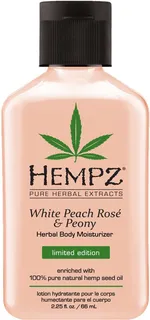
Hempz White Peach Rosé & Peony Herbal Body Moisturizer

Hempz White Peach Rosé & Peony Herbal Body Moisturizer

Efficacy75/100IrritancyHigh

Works for

Moisturizing
Glycerin, Butyrospermum parkii butter + 10 more
Works
What the product description says
“White Peach Rosé & Peony Herbal Body Moisturizer”
From product name

This product can help improve hydration of the skin with the two types of ingredients.

The first type is called “humectants”:
these ingredients help attract water. When humectants are on the surface of the skin, they “pull in” the moisture from the outside environment, or from within deeper layers of the skin. The following ingredients in this product do the job: glycerin.

This product also contains ingredients called “occlusives”. They help reduce the speed with which our skin loses moisture to the outside environment. These ingredients also help soften the upper layer of the skin, so it feels less tight and nicer to the touch. The following ingredients in this product do the job: butyrospermum parkii butter, cocos nucifera oil.

GlycerinKey active· HumectantEffect: HighOne of the best moisturizing ingredients. Naturally present in skin. It attracts water to the upper layer of the skin working as a humectant~3–3.7%
Butyrospermum parkii butterKey active· Emollient, OcclusiveEffect: HighA great moisturising ingredient that softens the skin and reduces water loss from its upper layer. It also can be helpful in protecting skin from free radicals~2–2.5%
DimethiconeKey active· Emollient, OcclusiveEffect: HighA silicone that helps to reduce water loss from the surface of the skin. Can temporarily "fill in" lines and wrinkles, absorb oil, and create a nice product finish~1.7–2.1%
Cannabis sativa seed oilKey active· EmollientEffect: HighA plant oil that due to its high linoleic acid content can help strengthen skin's barrier function and soften its upper layer~0.65–0.95%
Helianthus annuus seed oilKey active· Emollient, OcclusiveEffect: HighA great emollient due to its high linoleic acid content. One of the most effective plant oils in helping skin hydration and repairing skin barrier function~0.55–0.85%
Carthamus tinctorius seed oilKey active· EmollientEffect: HighAn emollient that helps soften the skin and might help calm down inflammation~0.4–0.6%
Cocos nucifera oilKey active· Emollient, OcclusiveEffect: HighAn emollient. Found to be as effective as a moisturizer for dry skin as mineral oil. Could be comedogenic~0.35–0.6%
Cetyl alcoholKey active· EmollientEffect: MediumA non-drying alcohol that works to soften the skin and stabilize product formulations helping oil and water mix together~0.35–0.65%
Isopropyl palmitate· EmollientEffect: LowHelps soften the upper layer of the skin and create a thicker product consistency~4.1–5.1%
Stearic acid· EmollientEffect: LowHelps oil and water mix together and works as an emollient~1.6–1.9%
Glyceryl stearate· EmollientEffect: LowAn emollient that softens the skin and forms a protective layer on its surface. Helps water and oil mix together~0.75–1.15%
Aloe barbadensis leaf juiceEffect: Low, below effective doseTraditionally used to treat sunburns, dermatitis and inflammation, but evidence for its effectiveness is lacking. The extract can contain humectants that help attract water into the skin~0.5–0.75%
Anti-aging
Not advertised by the brand · Retinyl palmitate, Butyrospermum parkii butter + 2 more
May help

This product contains retinyl palmitate. This ingredient might be able to help reduce and prevent fine lines and wrinkles, improve skin elasticity and firmness, but there is not enough evidence that it actually works.

Retinyl palmitateKey activeEffect: MediumThree steps removed from the active form of vitamin A - retinoic acid. To have an effect in the skin, it first needs to be converted twice to become the retinoic acid. This means it is less potent than retinol, but could also be less irritating. Once converted to the retinoic acid in the skin, it helps against all signs of aging, improves skin cell turnover and helps fight blemishes and clogged pores. However, in many cosmetic formulations, it is used in a concentration that is too low to have the full effect~0.5–0.7%
Butyrospermum parkii butterEffect: LowA great moisturising ingredient that softens the skin and reduces water loss from its upper layer. It also can be helpful in protecting skin from free radicals~2–2.5%
Aloe barbadensis leaf juiceEffect: Low, below effective doseTraditionally used to treat sunburns, dermatitis and inflammation, but evidence for its effectiveness is lacking. The extract can contain humectants that help attract water into the skin~0.5–0.75%
Ascorbic acidUnder-dosedThe most well-researched antioxidant that works in skin. Helps neutralize free radicals supporting collagen production, helping to even out the skin tone and preventing early signs of aging~0.05–0.15%
Evens skin tone
Not advertised by the brand · Retinyl palmitate, Ascorbic acid
May help

The following ingredient (ingredients) in this product might be helpful, but there is no evidence to confirm that it actually works: retinyl palmitate.

Retinyl palmitateKey activeEffect: MediumThree steps removed from the active form of vitamin A - retinoic acid. To have an effect in the skin, it first needs to be converted twice to become the retinoic acid. This means it is less potent than retinol, but could also be less irritating. Once converted to the retinoic acid in the skin, it helps against all signs of aging, improves skin cell turnover and helps fight blemishes and clogged pores. However, in many cosmetic formulations, it is used in a concentration that is too low to have the full effect~0.5–0.7%
Ascorbic acidUnder-dosedThe most well-researched antioxidant that works in skin. Helps neutralize free radicals supporting collagen production, helping to even out the skin tone and preventing early signs of aging~0.05–0.15%

Can it cause trouble?

Irritancy
12 strong irritants: Parfum, Retinyl palmitate + 10 more — patch-test recommended
High risk
We flagged 26 ingredients with irritancy potential. Severity depends on your sensitivity threshold; the table lists the worst offenders first.
IngredientFunctionIrritationEst. amount
ParfumAn aromatic blend of unspecified and possibly irritating ingredientsHigh~1.2–1.4%est.
Retinyl palmitateThree steps removed from the active form of vitamin A - retinoic acid. To have an effect in the skin, it first needs to be converted twice to become the retinoic acid. This means it is less potent than retinol, but could also be less irritating. Once converted to the retinoic acid in the skin, it helps against all signs of aging, improves skin cell turnover and helps fight blemishes and clogged pores. However, in many cosmetic formulations, it is used in a concentration that is too low to have the full effectHigh~0.5–0.7%est.
Prunus persica fruit extractA fruit extact. Might have some anti-oxidant propertiesHigh~0.6–0.95%est.
Vanilla planifolia fruit extractA plant extract used as a fragrance. Can be irritatingHigh~0.45–0.65%est.
Zingiber officinale root extractA plant extract that can contain an irritating essential oil. Might have some anti-oxidant effect, but evidence is lackingHigh~0.25–0.45%est.
Butylphenyl methylpropionalA fragrance. Can trigger allergic reactions and be irritatingHigh~0.25–0.45%est.
LimoneneA common frangrance that can easily irritate skin, especially if exposed to air, light or heatHigh~0.25–0.45%est.
Alpha-isomethyl iononeA fragrance. Potential allergen and can be irritatingHigh~0.25–0.4%est.
LinaloolA fragrance. Can be irritatingHigh~0.2–0.4%est.
CitronellolA fragrance. Can be irritatingHigh~0.2–0.35%est.
Hydroxyisohexyl 3-cyclohexene carboxaldehydeA fragrance. Can be irritatingHigh~0.15–0.3%est.
Ci 15985A colorantHigh~0.15–0.3%est.
MethylisothiazolinoneA preservative. Is a frequent allergenHigh~0.00075–0.0015%est.
CoumarinA fragrance. Is a likely skin allergen and can be irritatingHigh~0.15–0.25%est.
Ascorbic acidThe most well-researched antioxidant that works in skin. Helps neutralize free radicals supporting collagen production, helping to even out the skin tone and preventing early signs of agingHigh~0.05–0.15%est.
Isopropyl palmitateHelps soften the upper layer of the skin and create a thicker product consistencyMedium~4.1–5.1%est.
Cannabis sativa seed oilA plant oil that due to its high linoleic acid content can help strengthen skin's barrier function and soften its upper layerMedium~0.65–0.95%est.
Aloe barbadensis leaf juiceTraditionally used to treat sunburns, dermatitis and inflammation, but evidence for its effectiveness is lacking. The extract can contain humectants that help attract water into the skinMedium~0.5–0.75%est.
Tocopheryl acetateA more stable but less bio-available form of vitamin E compared to Tocopherol. Might help moisturize and protect the skin from free radicals, but mostly used in low concentrations to stabilize other ingredients.Medium~0.4–0.65%est.
Fragaria vesca fruit extractA plant extract that might help neutralize free radicals in skin, but research on its effectiveness is lackingMedium~0.3–0.55%est.
Citric acidCan work as an exfoliant but is typically used to adjust the product pHMedium~0.3–0.55%est.
Leuconostoc/radish root ferment filtrateA preservative that comes from radishes fermented by a bacteria. New research suggests that the preservation properties in the ingredient come from an ammonium salt that is not present naturally in radish root but used in its cultivation. Is problematic because the exact amount of the preservative agents is difficult to determineMedium~0.3–0.55%est.
Polysorbate 40Helps oil and water mix togetherMedium~0.3–0.6%est.
Disodium edtaStabilizes the product formulationMedium~0.3–0.5%est.
Ci 14700A colorantMedium~0.15–0.25%est.
ChlorphenesinA preservativeMedium~0.1–0.2%est.
Comedogenic
3 ingredients rated 2 or more on the 0–5 pore-clogging scale
3 flagged
These ingredients have a comedogenic rating of 2 or more on a 0–5 scale; the table shows each one's rating. In leave-on products they can clog pores in acne-prone skin.
IngredientFunctionRatingEst. amount
Isopropyl palmitateHelps soften the upper layer of the skin and create a thicker product consistency3/5~4.1–5.1%est.
Butyrospermum parkii butterA great moisturising ingredient that softens the skin and reduces water loss from its upper layer. It also can be helpful in protecting skin from free radicals3/5~2–2.5%est.
Cocos nucifera oilAn emollient. Found to be as effective as a moisturizer for dry skin as mineral oil. Could be comedogenic3/5~0.35–0.6%est.

User reviews

Would you recommend?
No community reviews yet.

Be the first — your take helps the next person decide.

Ingredients

Filter by role to see what each ingredient is doing.

Water~45–55%
Formula
Irritation risk
Low

Plain old water

More about Water
Propanediol~4.7–5.8%
Formula
Irritation risk
Low

Acts as a solvent for other ingredients. Speeds up the absorption of other ingredients into the skin

More about Propanediol
Isopropyl palmitate~4.1–5.1%
Comedogenic 3/5Irritant · medium
Irritation risk
Medium
Comedogenicity
3/5
Works for
Moisturizing

Helps soften the upper layer of the skin and create a thicker product consistency

More about Isopropyl palmitate
Glycerin~3–3.7%
Key active
Irritation risk
Low
Works for
Moisturizing

One of the best moisturizing ingredients. Naturally present in skin. It attracts water to the upper layer of the skin working as a humectant

More about Glycerin
Sorbitan stearate~2.3–2.8%
Formula
Irritation risk
Low
Works for
Cleansing

Helps water and oil mix together

More about Sorbitan stearate
Butyrospermum parkii butter~2–2.5%
Key activeComedogenic 3/5
Irritation risk
Low
Comedogenicity
3/5
Works for
MoisturizingAnti-oxidationAnti-aging

A great moisturising ingredient that softens the skin and reduces water loss from its upper layer. It also can be helpful in protecting skin from free radicals

More about Butyrospermum parkii butter
Dimethicone~1.7–2.1%
Key active
Irritation risk
Low
Works for
MoisturizingMattifying

A silicone that helps to reduce water loss from the surface of the skin. Can temporarily "fill in" lines and wrinkles, absorb oil, and create a nice product finish

More about Dimethicone
Stearic acid~1.6–1.9%
Formula
Irritation risk
Low
Works for
CleansingMoisturizing

Helps oil and water mix together and works as an emollient

More about Stearic acid
Parfum~1.2–1.4%
Irritant · high
Irritation risk
High

An aromatic blend of unspecified and possibly irritating ingredients

More about Parfum
Peg-100 stearate~1.1–1.3%
Formula
Irritation risk
Low
Works for
Cleansing

Helps oil and water mix togehter and creates a nice product texture

More about Peg-100 stearate
Glyceryl stearate~0.75–1.15%
Formula
Irritation risk
Low
Works for
CleansingMoisturizing

An emollient that softens the skin and forms a protective layer on its surface. Helps water and oil mix together

More about Glyceryl stearate
Cannabis sativa seed oil~0.65–0.95%
Key activeIrritant · medium
Irritation risk
Medium
Works for
Moisturizing

A plant oil that due to its high linoleic acid content can help strengthen skin's barrier function and soften its upper layer

More about Cannabis sativa seed oil
Wine extract~0.55–0.85%
Formula
Irritation risk
Low
More about Wine extract
Helianthus annuus seed oil~0.55–0.85%
Key active
Irritation risk
Low
Works for
Moisturizing

A great emollient due to its high linoleic acid content. One of the most effective plant oils in helping skin hydration and repairing skin barrier function

More about Helianthus annuus seed oil
Retinyl palmitate~0.5–0.7%
Key activeIrritant · high
Irritation risk
High
Works for
Anti-agingEvens skin toneAnti-blemishExfoliation

Three steps removed from the active form of vitamin A - retinoic acid. To have an effect in the skin, it first needs to be converted twice to become the retinoic acid. This means it is less potent than retinol, but could also be less irritating. Once converted to the retinoic acid in the skin, it helps against all signs of aging, improves skin cell turnover and helps fight blemishes and clogged pores. However, in many cosmetic formulations, it is used in a concentration that is too low to have the full effect

More about Retinyl palmitate
Aloe barbadensis leaf juice~0.5–0.75%
Irritant · medium
Irritation risk
Medium
Works for
MoisturizingAnti-inflammatoryReduces rednessReduces irritationAntibacterialAnti-agingAnti-blemish

Traditionally used to treat sunburns, dermatitis and inflammation, but evidence for its effectiveness is lacking. The extract can contain humectants that help attract water into the skin

More about Aloe barbadensis leaf juice
Prunus persica fruit extract~0.6–0.95%
Irritant · high
Irritation risk
High
Works for
Anti-oxidation

A fruit extact. Might have some anti-oxidant properties

More about Prunus persica fruit extract
Vanilla planifolia fruit extract~0.45–0.65%
Irritant · high
Irritation risk
High

A plant extract used as a fragrance. Can be irritating

More about Vanilla planifolia fruit extract
Tocopheryl acetate~0.4–0.65%
Irritant · medium
Irritation risk
Medium
Works for
Anti-oxidation

A more stable but less bio-available form of vitamin E compared to Tocopherol. Might help moisturize and protect the skin from free radicals, but mostly used in low concentrations to stabilize other ingredients.

More about Tocopheryl acetate
Cocos nucifera oil~0.35–0.6%
Key activeComedogenic 3/5
Irritation risk
Low
Comedogenicity
3/5
Works for
Moisturizing

An emollient. Found to be as effective as a moisturizer for dry skin as mineral oil. Could be comedogenic

More about Cocos nucifera oil
Carthamus tinctorius seed oil~0.4–0.6%
Key active
Irritation risk
Low
Works for
MoisturizingAnti-oxidation

An emollient that helps soften the skin and might help calm down inflammation

More about Carthamus tinctorius seed oil
Fragaria vesca fruit extract~0.3–0.55%
Irritant · medium
Irritation risk
Medium
Works for
Anti-oxidation

A plant extract that might help neutralize free radicals in skin, but research on its effectiveness is lacking

More about Fragaria vesca fruit extract
Citric acid~0.3–0.55%
Irritant · medium
Irritation risk
Medium

Can work as an exfoliant but is typically used to adjust the product pH

More about Citric acid
Potassium metabisulfite~0.3–0.6%
Formula
Zingiber officinale root extract~0.25–0.45%
Irritant · high
Irritation risk
High
Works for
Anti-oxidation

A plant extract that can contain an irritating essential oil. Might have some anti-oxidant effect, but evidence is lacking

More about Zingiber officinale root extract
Leuconostoc/radish root ferment filtrate~0.3–0.55%
Irritant · medium
Irritation risk
Medium

A preservative that comes from radishes fermented by a bacteria. New research suggests that the preservation properties in the ingredient come from an ammonium salt that is not present naturally in radish root but used in its cultivation. Is problematic because the exact amount of the preservative agents is difficult to determine

More about Leuconostoc/radish root ferment filtrate
Phenoxyethanol~0.3–0.6%
Formula
Irritation risk
Low

A preservative. It helps prevent bacterial growth in cosmetic products

More about Phenoxyethanol
Cetyl alcohol~0.35–0.65%
Key active
Irritation risk
Low
Works for
CleansingMoisturizing

A non-drying alcohol that works to soften the skin and stabilize product formulations helping oil and water mix together

More about Cetyl alcohol
Polysorbate 40~0.3–0.6%
Irritant · medium
Irritation risk
Medium
Works for
Cleansing

Helps oil and water mix together

More about Polysorbate 40
Nylon-12~0.3–0.6%
Formula
Irritation risk
Low

Used to create a nice product consistency

More about Nylon-12
Carbomer~0.3–0.55%
Formula
Irritation risk
Low
Works for
Cleansing

Helps create a thicker or gel-like product texture. It is not a surfactant but can be used in gentle cleansing formulations

More about Carbomer
Aminomethyl propanol~0.3–0.55%
Formula
Irritation risk
Low

Used to adjust the pH in formulations

More about Aminomethyl propanol
Butylphenyl methylpropional~0.25–0.45%
Irritant · high
Irritation risk
High

A fragrance. Can trigger allergic reactions and be irritating

More about Butylphenyl methylpropional
Disodium edta~0.3–0.5%
Irritant · medium
Irritation risk
Medium

Stabilizes the product formulation

More about Disodium edta
Limonene~0.25–0.45%
Irritant · high
Irritation risk
High

A common frangrance that can easily irritate skin, especially if exposed to air, light or heat

More about Limonene
Alpha-isomethyl ionone~0.25–0.4%
Irritant · high
Irritation risk
High

A fragrance. Potential allergen and can be irritating

More about Alpha-isomethyl ionone
Linalool~0.2–0.4%
Irritant · high
Irritation risk
High

A fragrance. Can be irritating

More about Linalool
Citronellol~0.2–0.35%
Irritant · high
Irritation risk
High

A fragrance. Can be irritating

More about Citronellol
Hydroxyisohexyl 3-cyclohexene carboxaldehyde~0.15–0.3%
Irritant · high
Irritation risk
High

A fragrance. Can be irritating

More about Hydroxyisohexyl 3-cyclohexene carboxaldehyde
Ci 15985~0.15–0.3%
Irritant · high
Irritation risk
High

A colorant

More about Ci 15985
Methylisothiazolinone~0.00075–0.0015%
Irritant · high
Irritation risk
High

A preservative. Is a frequent allergen

More about Methylisothiazolinone
Coumarin~0.15–0.25%
Irritant · high
Irritation risk
High

A fragrance. Is a likely skin allergen and can be irritating

More about Coumarin
Ci 14700~0.15–0.25%
Irritant · medium
Irritation risk
Medium

A colorant

More about Ci 14700
Ascorbic acid~0.05–0.15%
Under-dosedIrritant · high
Irritation risk
High
Works for
Anti-oxidationEvens skin toneAnti-aging

The most well-researched antioxidant that works in skin. Helps neutralize free radicals supporting collagen production, helping to even out the skin tone and preventing early signs of aging

More about Ascorbic acid
Chlorphenesin~0.1–0.2%
Irritant · medium
Irritation risk
Medium

A preservative

More about Chlorphenesin
Ingredient list view

Water, Propanediol, Isopropyl palmitate, Glycerin, Sorbitan stearate, Butyrospermum parkii butter, Dimethicone, Stearic acid, Parfum, Peg-100 stearate, Glyceryl stearate, Cannabis sativa seed oil, Wine extract, Helianthus annuus seed oil, Retinyl palmitate, Aloe barbadensis leaf juice, Prunus persica fruit extract, Vanilla planifolia fruit extract, Tocopheryl acetate, Cocos nucifera oil, Carthamus tinctorius seed oil, Fragaria vesca fruit extract, Citric acid, Potassium metabisulfite, Zingiber officinale root extract, Leuconostoc/radish root ferment filtrate, Phenoxyethanol, Cetyl alcohol, Polysorbate 40, Nylon-12, Carbomer, Aminomethyl propanol, Butylphenyl methylpropional, Disodium edta, Limonene, Alpha-isomethyl ionone, Linalool, Citronellol, Hydroxyisohexyl 3-cyclohexene carboxaldehyde, Ci 15985, Methylisothiazolinone, Coumarin, Ci 14700, Ascorbic acid, Chlorphenesin

Compare prices

Retailers ranked by price — lowest first.

No pricing data available yet for this product.

Worth comparing, line by line.

Match % combines shared ingredients, the first five ingredients, shared actives and hero ingredients, irritancy (lower counts in the alternative's favour), texture and body area. Only products in the same routine step are compared.

Side-by-side comparison of this product against its closest alternatives
HempzWhite Peach Rosé & Peony Herbal Body MoisturizerYOUR PRODUCTCetaphilSkin Activator Hydrating & Firming LotionFenty SkinButta Drop Whipped Oil Hydrating Body CreamAlba BotanicaAlba coconut Moisturizing Lotion
Match—36%35%35%
Price—$12.29—$22.50
Shared key ingredients—4 of 85 of 85 of 8
Key difference—PanthenolCaprylic/Capric TriglycerideBeeswax
Irritancy High Low Medium Medium
Drying alcohol——— Contains drying alcohol
View product Shop Shop Shop

More alternatives: Evereden Kids Multi-Vitamin Body LotionNivea Cocoa Butter Body Lotion

Cheaper alternatives? Browse formulas in the same category.
We compare ingredient profiles across our catalog — pick the closest match for your budget.
Open dupe finder
Hempz White Peach Rosé & Peony Herbal Body Moisturizer
HempzWhite Peach Rosé & Peony Herbal Body Moisturizer

Affiliate links · As an Amazon Associate, WIMJ earns from qualifying purchases.

As an Amazon Associate, WIMJ earns from qualifying purchases.