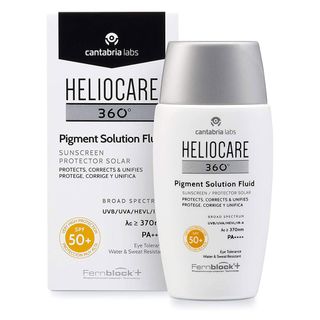
Heliocare 360 Pigment Solution Fluid
Works for
3 of 3 advertised claims delivered
Sun protectionSPF 50 · 7 UV filtersBroad spectrum
This product offers a good level of protection against both UVB and UVA rays.
This sunscreen uses organic (so-called "chemical") sunscreen filters. Organic, or "chemical" filters usually provide reliable sun protection and rarely leave a white cast. Sunscreens with organic filters can sting eyes.
This product can be considered "reef safe" because it does not contain the UV filters (oxybenzone and octinoxate) that can be harmful to coral reefs when present in the water in high concentrations.
MoisturizingUrea, Polymethylsilsesquioxane + 21 moreStrong evidence
“Protects against damage caused by UVA, UVB, visible light and infrared-A Helps to lift and prevent hyperpigmentation Subtle tint for an even complexion Hydrating, silky fluid Quick absorption Silky finish Non-comedogenic Tested on sensitive skin and around sensitive eyes Sweat and water resistant Key Ingredients.”
This product contains good ingredients to attract water to the upper layer of the skin. These ingredients are called "humectants": glycerin, sodium hyaluronate.
When humectants are on the surface of the skin, they “pull in” the moisture from the outside environment, or from within deeper layers of the skin. If the air is dry, humectants can speed up the moisture loss from the skin. This is why it is a good idea to use another product on top of this one to help "seal in" the moisture (look for ingredients like dimethicone, squalane, oils and butters).
The following ingredients in this product are especially good for supporting the skin barrier and helping with the hydration level: urea
Evens skin tonePolypodium leucotomos leaf extract, Ascorbic acidStrong evidence
“A light fluid that not only provides high levels of protection, but also features a Depigmenting System to help lift and prevent hyperpigmentation.”
This product offers broad spectrum sun protection. It means that it can prevent hyperpigmentation and help keep the skin tone even (sun damage is the main factor causing age spots, darkening of post-acne marks and other discolorations).
Anti-agingNot advertised by the brand · Serine, Tocopherol + 2 moreStrong evidence
This product can help prevent early signs of skin aging because it offers a good level of broad spectrum sun protection. Sun damage is the main cause of premature skin aging, and protecting your skin from the sun is the best anti-aging strategy.
These ingredients in the product might also be helpful for reducing and preventing fine lines, wrinkles, and skin elasticity, even though there is no conclusive evidence for their effectiveness: serine.
Can it cause trouble?
Irritancy3 strong irritants: Parfum, Linalool + 1 more — patch-test recommendedHigh risk
Comedogenic2 ingredients rated 2 or more on the 0–5 pore-clogging scale2 flagged


User reviews
Ingredients
Filter by role to see what each ingredient is doing.
Water~45–55%
Isododecane~6.3–7.7%
- Irritation risk
- Low
An emollient that helps soften the skin and can decrease moisture loss. Helps create a nice product texture
More about IsododecaneCyclopentasiloxane~4.5–5.5%
- Irritation risk
- Low
A silicone that helps improve the product texture and spreadability. Can absorb oil creating a short-term mattifying effect on the skin
More about CyclopentasiloxaneDiisopropyl adipate~3.1–3.8%
- Irritation risk
- Low
Helps soften the upper layer of the skin
More about Diisopropyl adipateTrisiloxane~2.3–2.9%
Zinc oxide~2.7–3.3%
- Irritation risk
- Low
A broad spectrum sunblock (protects from both UVA and UVB rays). Is suitable for most sensitive skins. In small concentrations, can be used as a colorant
More about Zinc oxideCaprylyl methicone~1.6–2%
- Irritation risk
- Low
A type of silicone that helps to soften the upper layer of the skin and create a nice product finish on the skin
More about Caprylyl methiconeEthylhexyl salicylate~1.9–2.3%
- Irritation risk
- Low
Octisalate. A UV filter. It offers some protection against the sun rays that cause sunburn (UVB), but does not protect against the most aging sun rays (UVA). It loses its effectiveness quickly when exposed to sunlight. It is an organic, or so called "chemical" sunscreen
More about Ethylhexyl salicylateTitanium dioxide~1.5–1.9%
- Irritation risk
- Low
Works as a UV filter when used in high concentrations. It is photostable and is effective mostly against the UVB light, with some protection in the UVA range. In small concentrations, used for its ability to improve the color of cosmetic products. Is usually well tolerated by the skin
More about Titanium dioxideButylene glycol~0.8–1.2%
- Irritation risk
- Low
Used to create a nice product texture and help delivery of other ingredients. Might be somewhat helpful in attracting water to the upper layer of the skin
More about Butylene glycolDiethylhexyl carbonate~0.7–1.05%
- Irritation risk
- Low
Helps soften the upper layer of the skin
More about Diethylhexyl carbonatePhenethyl benzoate~0.55–0.85%
Peg-9 polydimethylsiloxyethyl dimethicone~0.5–0.75%
- Irritation risk
- Medium
A type of silicone that helps water and oil mix together
More about Peg-9 polydimethylsiloxyethyl dimethiconeTris-biphenyl triazine~0.45–0.7%
- Irritation risk
- Medium
Tinosorb A2B. A UV filter. It is effective against both UVA and UVB rays. It is photostable. Soluble in water, which helps to create lighter sunscreen formulations. Unfortunately, not approved by the FDA in the US yet
More about Tris-biphenyl triazineCetyl peg/ppg-10/1 dimethicone~0.4–0.6%
- Irritation risk
- Low
A type of silicone that helps water and oil mix together. Can help to soften upper layer of the skin
More about Cetyl peg/ppg-10/1 dimethiconeIsononyl isononanoate~0.4–0.65%
- Irritation risk
- Low
Forms a protective film on the surface of the skin to prevent moisture loss. Gives a velvety feel to products while reducing tackiness
More about Isononyl isononanoateStyrene/acrylates copolymer~0.35–0.6%
- Irritation risk
- Low
Used to create an even product consistency. Can help boost efficiency of sunscreen filters
More about Styrene/acrylates copolymerBis-ethylhexyloxyphenol methoxyphenyl triazine~0.5–0.75%
- Irritation risk
- Medium
Tinosorb S. One of the most effective broad spectrum sunscreen ingredients. Protects from both UVA and UVB rays. It is photostable. Unfortunately, not approved by FDA (US) yet.
More about Bis-ethylhexyloxyphenol methoxyphenyl triazineDiethylamino hydroxybenzoyl hexyl benzoate~0.5–0.75%
- Irritation risk
- Medium
Uvinul A Plus. A new generation broad spectrum sunscreen that offers an effective protection especially in the UVA range. It is stable in formulations. Unfortunately, is not approved by the FDA (US) yet
More about Diethylamino hydroxybenzoyl hexyl benzoatePolymethylsilsesquioxane~0.3–0.55%
- Irritation risk
- Low
A silicone that improves product texture and helps dissolve other ingredients. Can form a non-greasy film on the skin to prevent moisture loss
More about PolymethylsilsesquioxanePolypodium leucotomos leaf extract~0.25–0.45%
- Irritation risk
- Medium
A plant extract that has been shown to be effective in helping boost skin's ability to protect against UV radiation and reduce hyperpigmentation when taken orally. No conclusive evidence for its effectiveness and effective concentration in topical application
More about Polypodium leucotomos leaf extractPolyglyceryl-3 polydimethylsiloxyethyl dimethicone~0.25–0.45%
- Irritation risk
- Low
Plankton extract~0.2–0.4%
- Irritation risk
- Medium
- Comedogenicity
- 3/5
Can help attract water to the upper layer of the skin
More about Plankton extractUrea~0.2–0.4%
- Irritation risk
- Low
Naturally present in skin (urea makes up about 7% of natural moisturizing factors in skin). Attracts water to the upper layer of the skin. Also has a positive effect on the skin barrier beyond the humectant action. Can enhance penetration of other ingredients. Is an exfoliating ingredient when used in high concentrations
More about UreaTrehalose~0.2–0.4%
- Irritation risk
- Low
A sugar that attracts water to the upper layer of the skin
More about TrehaloseSerine~0.2–0.4%
- Irritation risk
- Low
An amino-acid that helps to attract water to the upper layer of the skin. In combination with other amino-acids, might help to reduce fine lines and wrinkles
More about SerineSodium hyaluronate~0.2–0.4%
- Irritation risk
- Low
One of the best moisturizing ingredients. Attracts water into the upper layer of the skin
More about Sodium hyaluronateGlycerin~0.25–0.45%
- Irritation risk
- Low
One of the best moisturizing ingredients. Naturally present in skin. It attracts water to the upper layer of the skin working as a humectant
More about GlycerinAlgin~0.2–0.4%
- Irritation risk
- Low
- Comedogenicity
- 3/5
Used to thicken product formulation. Can help attract water to the upper layer of the skin
More about AlginPullulan~0.25–0.45%
- Irritation risk
- High
Creates a thin drying film on the skin resulting in a short-term tightening effect
More about PullulanDisteardimonium hectorite~0.2–0.4%
- Irritation risk
- Low
A type of clay that is used to thicken the product consistency
More about Disteardimonium hectoriteEthylhexyl triazone~0.4–0.65%
- Irritation risk
- Medium
Uvinul T. A UV filter. Effective against UVB rays. It is photostable. Can increase water resistance properties of the sunscreen. Unfortunately, not approved by the FDA (US) yet
More about Ethylhexyl triazonePhenylpropanol~0.2–0.4%
- Irritation risk
- High
Helps mask the smell of other ingredients and helps preserve the product formulation
More about PhenylpropanolMagnesium sulfate~0.25–0.45%
Propylene glycol~0.2–0.4%
- Irritation risk
- High
Helps oil and water mix together and can enhance the penetration of other ingredients into the skin. It can be irritating
More about Propylene glycolAluminum hydroxide~0.25–0.45%
- Irritation risk
- Low
Is used to add opaque (non-transparent) appearance to formulations. Can be used to coat other ingredients for even dispersion. This is a different ingredient compared to the ones used in antipersperants (aluminium chloride and aluminium chlorohydrate)
More about Aluminum hydroxideStearic acid~0.35–0.6%
- Irritation risk
- Low
Helps oil and water mix together and works as an emollient
More about Stearic acidCaprylyl glycol~0.25–0.45%
- Irritation risk
- Medium
Helps preserve products and creates a nice product texture
More about Caprylyl glycolPropanediol~0.25–0.45%
- Irritation risk
- Low
Acts as a solvent for other ingredients. Speeds up the absorption of other ingredients into the skin
More about PropanediolPropylene carbonate~0.25–0.45%
- Irritation risk
- Low
Is used to dissolve other ingredients and create nice product texture
More about Propylene carbonateTocopheryl acetate~0.25–0.45%
- Irritation risk
- Medium
A more stable but less bio-available form of vitamin E compared to Tocopherol. Might help moisturize and protect the skin from free radicals, but mostly used in low concentrations to stabilize other ingredients.
More about Tocopheryl acetatePentylene glycol~0.25–0.5%
- Irritation risk
- Medium
Used to preserve products, dissolve other ingredients and create a nice product texture
More about Pentylene glycolTriethoxycaprylylsilane~0.2–0.4%
- Irritation risk
- Low
A type of silicone that helps oil and water mix well together. Helps to disperse other ingredients, e.g. pigments, evenly in a formulation
More about TriethoxycaprylylsilaneDisodium edta~0.2–0.4%
Peg-8~0.2–0.4%
- Irritation risk
- Medium
Used to create a nice product consistency
More about Peg-8Disodium phosphate~0.25–0.4%
- Irritation risk
- Low
Helps adjust the product pH and stabilize the formulation
More about Disodium phosphateGlyceryl polyacrylate~0.25–0.45%
- Irritation risk
- Low
Helps to create a nice product texture and spread the product more easily on the skin
More about Glyceryl polyacrylateTocopherol~0.25–0.4%
- Irritation risk
- Low
Pure form of vitamin E. Can help moisturise and protect the skin from free radicals. Often used to help stabilise other ingredients or the formula itself
More about TocopherolLecithin~0.25–0.5%
- Irritation risk
- Low
Used mostly for creating emulsions - helping oil and water mix together. Helps soften the upper layer of the skin
More about LecithinPotassium phosphate~0.25–0.4%
Ascorbyl palmitate~0.2–0.4%
- Irritation risk
- Medium
Being a lipid soluble form of vitamin C, it is more stable and can penetrate the skin better than L-Ascorbic acid. It is effective in protecting the skin from free radicals, as well as evening the skin tone, but is less effective in stimulating collagen production compared to L-Ascorbic acid.
More about Ascorbyl palmitateAscorbic acid~0.2–0.4%
- Irritation risk
- High
The most well-researched antioxidant that works in skin. Helps neutralize free radicals supporting collagen production, helping to even out the skin tone and preventing early signs of aging
More about Ascorbic acidCitric acid~0.2–0.35%
- Irritation risk
- Medium
Can work as an exfoliant but is typically used to adjust the product pH
More about Citric acidCi 77492~0.2–0.35%
Ci 77491~0.15–0.3%
- Irritation risk
- Low
A red colorant made of iron oxide. Typically is not irritating
More about Ci 77491Ci 77499~0.15–0.25%
Phenoxyethanol~0.15–0.3%
- Irritation risk
- Low
A preservative. It helps prevent bacterial growth in cosmetic products
More about PhenoxyethanolParfum~0.1–0.25%
- Irritation risk
- High
An aromatic blend of unspecified and possibly irritating ingredients
More about ParfumLinalool~0.1–0.15%
Limonene~0.05–0.15%
- Irritation risk
- High
A common frangrance that can easily irritate skin, especially if exposed to air, light or heat
More about LimoneneIngredient list view
Water, Isododecane, Cyclopentasiloxane, Diisopropyl adipate, Trisiloxane, Zinc oxide, Caprylyl methicone, Ethylhexyl salicylate, Titanium dioxide, Butylene glycol, Diethylhexyl carbonate, Phenethyl benzoate, Peg-9 polydimethylsiloxyethyl dimethicone, Tris-biphenyl triazine, Cetyl peg/ppg-10/1 dimethicone, Isononyl isononanoate, Styrene/acrylates copolymer, Bis-ethylhexyloxyphenol methoxyphenyl triazine, Diethylamino hydroxybenzoyl hexyl benzoate, Polymethylsilsesquioxane, Polypodium leucotomos leaf extract, Polyglyceryl-3 polydimethylsiloxyethyl dimethicone, Plankton extract, Urea, Trehalose, Serine, Sodium hyaluronate, Glycerin, Algin, Pullulan, Disteardimonium hectorite, Ethylhexyl triazone, Phenylpropanol, Magnesium sulfate, Propylene glycol, Aluminum hydroxide, Stearic acid, Caprylyl glycol, Propanediol, Propylene carbonate, Tocopheryl acetate, Pentylene glycol, Triethoxycaprylylsilane, Disodium edta, Peg-8, Disodium phosphate, Glyceryl polyacrylate, Tocopherol, Lecithin, Potassium phosphate, Ascorbyl palmitate, Ascorbic acid, Citric acid, Ci 77492, Ci 77491, Ci 77499, Phenoxyethanol, Parfum, Linalool, Limonene
Compare prices
Retailers ranked by price — lowest first.
Affiliate links · prices updated regularly · As an Amazon Associate, WIMJ earns from qualifying purchases.
Worth comparing, line by line.
Match % combines shared ingredients, the first five ingredients, shared actives and hero ingredients, irritancy (lower counts in the alternative's favour), texture and body area. Only products in the same routine step are compared.
| Heliocare360 Pigment Solution FluidYOUR PRODUCT | The OrdinaryMineral UV Filters SPF 30 with Antioxidants | MuradSPF Environmental Shield: City Skin Age Defense Broad Spectrum SPF50 | BOGIKASmart Sunscreen SPF50+ | |
|---|---|---|---|---|
| Match | — | 55% | 54% | 53% |
| Price | $22.71 | $6.70−$16.01 | — | — |
| Shared key ingredients | — | 9 of 15 | 7 of 15 | 9 of 15 |
| Key difference | — | Linoleic Acid | Vitamin C | Ectoin |
| Irritancy | High | Medium | Medium | Low |
| SPF | SPF 50 | SPF 30 | SPF 50 | SPF 50 |
| Drying alcohol | — | — | — | — |
| View product | Shop | Shop | Shop |


Product summary
Based on the ingredient list, we assess that "Heliocare - 360 Pigment Solution Fluid" can provide reliable sun protection. It can protect from both UVA and UVB rays. This is great news because not all sunscreens with SPF ratings give UVA protection. (UVA rays do not cause sunburn, but still damage our skin and lead to early aging).
It contains good moisturizing ingredients and can double as a hydrating day cream. Like all broad-spectrum sunscreens, this product helps prevent early signs of aging.
Sunscreen filters
This is a "mixed" sunscreen in the sense that it uses both mineral and organic (so-called "chemical") sun filters. Here are the organic filters this product uses: tinosorb s, uvinul a plus, octisalate, uvinul t and tinosrob a2b. As for the mineral filters, this sunscreen uses both titanium dioxide and zinc oxide.
Irritation risk
This moisturizer contains a bunch of common irritants, including ingredients that do not provide any known benefit for the skin. It might not be the best choice if your skin is sensitive. We assess the overall irritancy of this moisturizer to be high. For a detailed overview of all potential irritants: click here
You can see the detailed formula review with the breakdown of all actives in the product and the full ingredient list with estimated concentrations in the tables below.
Price
The product retails for 35.89$ in the United States and from 20.68£ up to 31.99£ in the United Kingdom.
For a detailed price comparison: click here.
Sources cited in this review
Every concentration estimate and effectiveness label is anchored to one of these 20 studies and safety reviews.
- 1A review of inorganic UV filters zinc oxide and titanium dioxideonlinelibrary.wiley.com
- 2
- 3
- 4
- 5
- 6

Affiliate links · As an Amazon Associate, WIMJ earns from qualifying purchases.