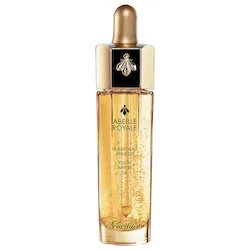
GUERLAIN Huile-en-eau anti-âge jeunesse Abeille Royale
Works for
1 of 1 advertised claim delivered
Moisturizing13 ingredients credited for this claimGood support
“Extracted from bees and sourced sustainably, rich in exceptional nutrients and a natural source of carbohydrates, proteins, lipids, and vitamins to nurture skin.”
This product contains good ingredients to attract water to the upper layer of the skin. These ingredients are called "humectants": glycerin, mannitol.
When humectants are on the surface of the skin, they “pull in” the moisture from the outside environment, or from within deeper layers of the skin. If the air is dry, humectants can speed up the moisture loss from the skin. This is why it is a good idea to use another product on top of this one to help "seal in" the moisture (look for ingredients like dimethicone, squalane, oils and butters).
Can it cause trouble?
Irritancy10 strong irritants: Alcohol, Parfum + 8 more — patch-test recommendedHigh risk
ComedogenicClean of flagged comedogenic ingredientsNone flagged
User reviews
Be the first — your take helps the next person decide.
Ingredients
Filter by role to see what each ingredient is doing.
Water~45–55%
Glycerin~4.4–5.3%
- Irritation risk
- Low
One of the best moisturizing ingredients. Naturally present in skin. It attracts water to the upper layer of the skin working as a humectant
More about GlycerinPentylene glycol~4.1–5%
- Irritation risk
- Medium
Used to preserve products, dissolve other ingredients and create a nice product texture
More about Pentylene glycolPolyglycerin-3~2.9–3.6%
- Irritation risk
- Low
Helps to attract water to the upper layer of the skin
More about Polyglycerin-3Methyl gluceth-20~2.2–2.7%
- Irritation risk
- Low
Helps attract water to the upper layer of the skin and soften it
More about Methyl gluceth-20Alcohol~1.8–2.2%
- Irritation risk
- High
Can be drying and contribute to skin irritation. Used in formulars to dissolve other ingredients, create a thinner product consistency or for its antibacterial properties
More about AlcoholRoyal jelly~1.5–1.8%
- Irritation risk
- High
Helps attract water to the upper layer of the skin
More about Royal jellyPpg-26-buteth-26~1.3–1.6%
Phenoxyethanol~0.5–1%
- Irritation risk
- Low
A preservative. It helps prevent bacterial growth in cosmetic products
More about PhenoxyethanolMannitol~0.75–1.15%
- Irritation risk
- Low
Helps to attract water to the upper layer of the skin
More about MannitolPeg-40 hydrogenated castor oil~0.65–0.95%
- Irritation risk
- Medium
Helps oil and water mix together
More about Peg-40 hydrogenated castor oilCellulose~0.65–0.95%
- Irritation risk
- Low
Can be used to help absorb oil as well as add volume and imporve texture of products.
More about CelluloseHoney~0.45–0.65%
- Irritation risk
- Low
Helps attract water to the skin and might have some anti-bacterial properties. Can be an allergen
More about HoneyParfum~0.4–0.6%
- Irritation risk
- High
An aromatic blend of unspecified and possibly irritating ingredients
More about ParfumPolyacrylate crosspolymer-6~0.4–0.6%
- Irritation risk
- Low
Sodium citrate~0.35–0.6%
- Irritation risk
- Medium
Helps to control the skin's pH level. Maintains the skin's natural film of amino-lactic acids and oils. Helps to preserve products
More about Sodium citrateGlyceryl polymethacrylate~0.4–0.6%
- Irritation risk
- Low
Used to create a nice product texture
More about Glyceryl polymethacrylateTocopheryl acetate~0.3–0.55%
- Irritation risk
- Medium
A more stable but less bio-available form of vitamin E compared to Tocopherol. Might help moisturize and protect the skin from free radicals, but mostly used in low concentrations to stabilize other ingredients.
More about Tocopheryl acetateCaprylic/capric triglyceride~0.35–0.6%
- Irritation risk
- Medium
A good mix of fatty acids that forms a protective layer on the skin. Improves the shelf life of products. Derived from coconut and glycerin
More about Caprylic/capric triglycerideCitric acid~0.25–0.45%
- Irritation risk
- Medium
Can work as an exfoliant but is typically used to adjust the product pH
More about Citric acidPeg-8~0.25–0.45%
- Irritation risk
- Medium
Used to create a nice product consistency
More about Peg-8Acrylates/ammonium methacrylate copolymer~0.25–0.45%
- Irritation risk
- Low
Synthetic fluorphlogopite~0.25–0.45%
- Irritation risk
- Low
A mineral that is used as an optical filter (makes the skin looks nicer through light reflection) and to improve the texture of cosmetic products
More about Synthetic fluorphlogopiteCommiphora mukul resin extract~0.2–0.4%
- Irritation risk
- High
A plant extract might be helpful in neutralizing free radicals and reducing inflammation in skin
More about Commiphora mukul resin extractLimonene~0.2–0.35%
- Irritation risk
- High
A common frangrance that can easily irritate skin, especially if exposed to air, light or heat
More about LimoneneCaramel~0.2–0.4%
- Irritation risk
- Low
Triethyl citrate~0.2–0.35%
Benzyl salicylate~0.2–0.35%
Ci 77891~0.2–0.35%
- Irritation risk
- Low
Titanium dioxide~0.3–0.55%
- Irritation risk
- Low
Works as a UV filter when used in high concentrations. It is photostable and is effective mostly against the UVB light, with some protection in the UVA range. In small concentrations, used for its ability to improve the color of cosmetic products. Is usually well tolerated by the skin
More about Titanium dioxideSodium metabisulfite~0.1–0.2%
Ci 77492~0.2–0.4%
Iron oxides~0.2–0.35%
- Irritation risk
- Low
An umbrella term for the following three colorants: CI 77491, CI 77492, CI 77499. They might be able to offer some protection against visible light, but the degree of the protection is not clear
More about Iron oxidesGeraniol~0.2–0.35%
Hydroxycitronellal~0.2–0.35%
- Irritation risk
- High
A fragrance. A likely allergen and can be irritating
More about HydroxycitronellalSodium lactate~0.2–0.35%
- Irritation risk
- Medium
Helps attract water to the upper layer of the skin. Is often used to adjust the pH level of the product
More about Sodium lactateAlpha-isomethyl ionone~0.15–0.3%
- Irritation risk
- High
A fragrance. Potential allergen and can be irritating
More about Alpha-isomethyl iononeCitronellol~0.15–0.3%
Ci 77491~0.2–0.35%
- Irritation risk
- Low
A red colorant made of iron oxide. Typically is not irritating
More about Ci 77491Iron oxides~0.15–0.3%
- Irritation risk
- Low
An umbrella term for the following three colorants: CI 77491, CI 77492, CI 77499. They might be able to offer some protection against visible light, but the degree of the protection is not clear
More about Iron oxidesHydroxypropyl methylcellulose~0.15–0.3%
- Irritation risk
- Medium
Used to create a thicker product consistency and stabilize the formulation
More about Hydroxypropyl methylcelluloseLinalool~0.1–0.2%
Tin oxide~0.25–0.45%
- Irritation risk
- Low
A colorant that can add a pearl-like appearance to the formulation
More about Tin oxideBht~0.1–0.2%
Tocopherol~0.1–0.2%
- Irritation risk
- Low
Pure form of vitamin E. Can help moisturise and protect the skin from free radicals. Often used to help stabilise other ingredients or the formula itself
More about TocopherolCi 14700~0.05–0.1%
Palmitoyl hexapeptide-12~0.05–0.1%
- Irritation risk
- Low
A type of peptide. Peptides are excellent moisturizers and might be able support collagen production reducing fine lines and wrinkles
More about Palmitoyl hexapeptide-12Ingredient list view
Water, Glycerin, Pentylene glycol, Polyglycerin-3, Methyl gluceth-20, Alcohol, Royal jelly, Ppg-26-buteth-26, Phenoxyethanol, Mannitol, Peg-40 hydrogenated castor oil, Cellulose, Honey, Parfum, Polyacrylate crosspolymer-6, Sodium citrate, Glyceryl polymethacrylate, Tocopheryl acetate, Caprylic/capric triglyceride, Citric acid, Peg-8, Acrylates/ammonium methacrylate copolymer, Synthetic fluorphlogopite, Commiphora mukul resin extract, Limonene, Caramel, Triethyl citrate, Benzyl salicylate, Ci 77891, Titanium dioxide, Sodium metabisulfite, Ci 77492, Iron oxides, Geraniol, Hydroxycitronellal, Sodium lactate, Alpha-isomethyl ionone, Citronellol, Ci 77491, Iron oxides, Hydroxypropyl methylcellulose, Linalool, Tin oxide, Bht, Tocopherol, Ci 14700, Palmitoyl hexapeptide-12
Compare prices
Retailers ranked by price — lowest first.
Sources cited in this review
Every concentration estimate and effectiveness label is anchored to one of these 10 studies and safety reviews.
- 1
- 2
- 3
- 4
- 5
- 6

Affiliate links · As an Amazon Associate, WIMJ earns from qualifying purchases.