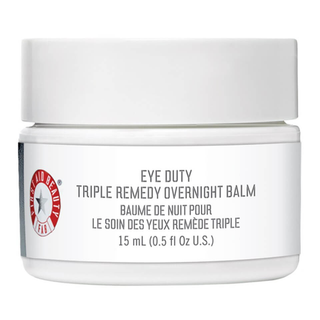
First Aid Beauty Eye Duty Triple Remedy Overnight Balm
Works for
2 of 2 advertised claims delivered
Anti-aging7 ingredients credited for this claimStrong support
“The formula is enriched with a bevy of powerful ingredients to nourish and restore a youthful and revitalized appearance to the entire orbital eye area.”
This product can help reduce and prevent fine lines and wrinkles, improve skin elasticity and firmness because it contains palmitoyl hexapeptide-12.
These ingredients in the product can also be helpful, even though there is less evidence for their effectiveness: palmitoyl tetrapeptide-7.
Keep in mind that it typically takes at least 6 weeks to notice any results because the changes that are needed to improve fine lines and elasticity happen in the deeper layers of the skin. No topical anti-aging product can “erase” wrinkles or fully reverse signs of aging.
Moisturizing21 ingredients credited for this claimStrong support
“With its 360° approach, Eye Duty Triple Remedy Overnight Balm envelops the entire orbital area in a soft, cushiony cocoon, gradually absorbing into the skin and locking in key moisture and nutrients overnight.”
This product can help improve hydration of the skin with the two types of ingredients.
The first type is called “humectants”:
these ingredients help attract water.
When humectants are on the surface of the skin, they “pull in” the moisture from the outside environment, or from
within deeper layers of the skin. The following ingredients in this product do the job:
algae extract, glycerin.
This product also contains ingredients called “occlusives”. They help reduce the speed with which our skin loses moisture to the outside environment. These ingredients also help soften the upper layer of the skin, so it feels less tight and nicer to the touch. The following ingredients in this product do the job: butyrospermum parkii butter, caprylic/capric triglyceride.
The following ingredients in this product are especially good for supporting the skin barrier and helping with the hydration level: palmitoyl hexapeptide-12, palmitoyl tetrapeptide-7
Anti-oxidationNot advertised by the brand · 3 ingredients credited for this claimModerate support
This product contains antioxidants (camellia sinensis leaf extract) that might be able to help neutralize free radicals in skin to lessen the damage it gets from the UV light (sun). There is not enough evidence to confirm their effectiveness in skin though.
Can it cause trouble?
Irritancy1 strong irritant: Chrysanthemum parthenium extractMedium risk
Comedogenic3 ingredients rated 2 or more on the 0–5 pore-clogging scale3 flagged


User reviews
Be the first — your take helps the next person decide.
Ingredients
Filter by role to see what each ingredient is doing.
Water~45–55%
Glycerin~4.7–5.8%
- Irritation risk
- Low
One of the best moisturizing ingredients. Naturally present in skin. It attracts water to the upper layer of the skin working as a humectant
More about GlycerinButyrospermum parkii butter~4.2–5.2%
- Irritation risk
- Low
- Comedogenicity
- 3/5
A great moisturising ingredient that softens the skin and reduces water loss from its upper layer. It also can be helpful in protecting skin from free radicals
More about Butyrospermum parkii butterCaprylic/capric triglyceride~3.2–3.9%
- Irritation risk
- Medium
A good mix of fatty acids that forms a protective layer on the skin. Improves the shelf life of products. Derived from coconut and glycerin
More about Caprylic/capric triglycerideDimethicone~2.4–3%
- Irritation risk
- Low
A silicone that helps to reduce water loss from the surface of the skin. Can temporarily "fill in" lines and wrinkles, absorb oil, and create a nice product finish
More about DimethiconeC10-18 triglycerides~2–2.4%
- Irritation risk
- Low
Helps soften the skin and attract water to its upper layer. Helps create nice product texture
More about C10-18 triglyceridesEthylhexyl palmitate~1.7–2%
- Irritation risk
- Low
- Comedogenicity
- 3/5
An emollient that helps soften the skin and create a nice product texture
More about Ethylhexyl palmitateCetyl alcohol~1.5–1.9%
- Irritation risk
- Low
A non-drying alcohol that works to soften the skin and stabilize product formulations helping oil and water mix together
More about Cetyl alcoholAluminum starch octenylsuccinate~1.2–1.5%
- Irritation risk
- Medium
Used to thicken the product's consistency
More about Aluminum starch octenylsuccinateGlyceryl stearate~1–1.3%
- Irritation risk
- Low
An emollient that softens the skin and forms a protective layer on its surface. Helps water and oil mix together
More about Glyceryl stearateNiacinamide~0.7–1.05%
- Irritation risk
- Low
Is proven to be effective in reducing blemishes, evening out skin tone and helping to improve lines and wrinkles. It helps the skin to repair sun damage, calm down inflammation and keep maintain good levels of moisture. The concentration of about 2% is effective for supporting the skin barrier and evening out the skin tone. Concentration of 4-6% is better for helping with acne and balancing the sebum production
More about NiacinamideChrysanthemum parthenium extract~0.55–0.85%
- Irritation risk
- High
Could have anti-inflammatory effect on skin, but can be irritating as well. Can be added to products for its smell
More about Chrysanthemum parthenium extractSpilanthes acmella flower extract~0.5–0.8%
- Irritation risk
- High
Plant extract that might hep calm down inflammation in skin
More about Spilanthes acmella flower extractAcacia decurrens flower wax~0.5–0.75%
Camellia sinensis leaf extract~0.5–0.7%
- Irritation risk
- Low
Can contain potent anti-oxidant compounds (abbreviated ECG, GCG, EGC, and EGCG) that might help protect the skin from free radicals. Can help calm down inflammation and has some anti-bacterial properties. Unfortunately, these antioxidants are unstable and lose their effectiveness very quickly in products. The concentration of the antioxidant compounds in the extract also tends to be low to be effective in topical formulation
More about Camellia sinensis leaf extractGlycyrrhiza glabra root extract~0.4–0.6%
- Irritation risk
- Medium
A plant extract that can help lighten the skin and calm down inflammation. Might be helpful in neutralizing free radicals
More about Glycyrrhiza glabra root extractJojoba esters~0.5–0.7%
- Irritation risk
- Medium
An emollient made of jojoba oil. Helps soften the skin and support its barrier function
More about Jojoba estersPalmitoyl hexapeptide-12~0.4–0.6%
- Irritation risk
- Low
A type of peptide. Peptides are excellent moisturizers and might be able support collagen production reducing fine lines and wrinkles
More about Palmitoyl hexapeptide-12Palmitoyl tetrapeptide-7~0.4–0.65%
- Irritation risk
- Low
A type of peptide. Peptides are excellent moisturizers and might be able support collagen production reducing fine lines and wrinkles
More about Palmitoyl tetrapeptide-7Algae extract~0.45–0.65%
- Irritation risk
- Low
- Comedogenicity
- 3/5
Plant extract that helps the skin to attract water and make it more smooth for touch. Also shows promise of anti-aging properties, but research is not extensive yet
More about Algae extractCarbomer~0.3–0.55%
- Irritation risk
- Low
Helps create a thicker or gel-like product texture. It is not a surfactant but can be used in gentle cleansing formulations
More about CarbomerHyaluronic acid~0.3–0.55%
- Irritation risk
- Low
One of the best moisturizing ingredients. Attracts water into the upper layer of the skin. Naturally present in skin. Typically has large molecule size unless advertised otherwise on the product label. Helps support skin's barrier function and may help to reduce inflammation
More about Hyaluronic acidHelianthus annuus seed wax~0.3–0.55%
- Irritation risk
- Low
Helps soften the upper layer of the skin and support skin's barrier function while creating a thicker product consistency
More about Helianthus annuus seed waxPeg-75 stearate~0.3–0.55%
Caprylyl glycol~0.3–0.55%
- Irritation risk
- Medium
Helps preserve products and creates a nice product texture
More about Caprylyl glycolCeteth-20~0.4–0.65%
Steareth-20~0.35–0.65%
Acrylates/c10-30 alkyl acrylate crosspolymer~0.25–0.5%
- Irritation risk
- Medium
Maintains the texture of skincare products. Allows the product to spread evenly. Helps oil and water mix together
More about Acrylates/c10-30 alkyl acrylate crosspolymerXanthan gum~0.25–0.5%
- Irritation risk
- Low
Used to create a thicker product consistency
More about Xanthan gumButylene glycol~0.25–0.45%
- Irritation risk
- Low
Used to create a nice product texture and help delivery of other ingredients. Might be somewhat helpful in attracting water to the upper layer of the skin
More about Butylene glycolLeuconostoc/radish root ferment filtrate~0.25–0.45%
- Irritation risk
- Medium
A preservative that comes from radishes fermented by a bacteria. New research suggests that the preservation properties in the ingredient come from an ammonium salt that is not present naturally in radish root but used in its cultivation. Is problematic because the exact amount of the preservative agents is difficult to determine
More about Leuconostoc/radish root ferment filtratePolyglycerin-3~0.25–0.45%
- Irritation risk
- Low
Helps to attract water to the upper layer of the skin
More about Polyglycerin-3Sodium lactate~0.2–0.4%
- Irritation risk
- Medium
Helps attract water to the upper layer of the skin. Is often used to adjust the pH level of the product
More about Sodium lactatePolysorbate 20~0.25–0.4%
Palmitic acid~0.2–0.4%
- Irritation risk
- Low
An emollient that is naturally present in skin and helps soften it
More about Palmitic acidSodium hydroxide~0.15–0.3%
Tetrasodium edta~0.15–0.25%
Edta~0.1–0.2%
Citric acid~0.05–0.1%
- Irritation risk
- Medium
Can work as an exfoliant but is typically used to adjust the product pH
More about Citric acidPhenoxyethanol~0.1–0.2%
- Irritation risk
- Low
A preservative. It helps prevent bacterial growth in cosmetic products
More about PhenoxyethanolIngredient list view
Water, Glycerin, Butyrospermum parkii butter, Caprylic/capric triglyceride, Dimethicone, C10-18 triglycerides, Ethylhexyl palmitate, Cetyl alcohol, Aluminum starch octenylsuccinate, Glyceryl stearate, Niacinamide, Chrysanthemum parthenium extract, Spilanthes acmella flower extract, Acacia decurrens flower wax, Camellia sinensis leaf extract, Glycyrrhiza glabra root extract, Jojoba esters, Palmitoyl hexapeptide-12, Palmitoyl tetrapeptide-7, Algae extract, Carbomer, Hyaluronic acid, Helianthus annuus seed wax, Peg-75 stearate, Caprylyl glycol, Ceteth-20, Steareth-20, Acrylates/c10-30 alkyl acrylate crosspolymer, Xanthan gum, Butylene glycol, Leuconostoc/radish root ferment filtrate, Polyglycerin-3, Sodium lactate, Polysorbate 20, Palmitic acid, Sodium hydroxide, Tetrasodium edta, Edta, Citric acid, Phenoxyethanol
Compare prices
Retailers ranked by price — lowest first.
Worth comparing, line by line.
Match % combines shared ingredients, the first five ingredients, shared actives and hero ingredients, irritancy (lower counts in the alternative's favour), texture and body area. Only products in the same routine step are compared.
| First Aid BeautyEye Duty Triple Remedy Overnight BalmYOUR PRODUCT | 3LABWW Eye Cream | ReplenixAll-Trans-Retinol Enriched Eye Repair | Dr Dennis GrossC + Collagen Brighten + Firm Eye Cream | |
|---|---|---|---|---|
| Match | — | 81% | 80% | 80% |
| Price | $38.00 | $330.00+$292.00 | $92.00+$54.00 | $65.00+$27.00 |
| Shared key ingredients | — | 7 of 15 | 5 of 15 | 5 of 15 |
| Key difference | — | Adenosine | Vitamin C | Dipeptide-2 |
| Irritancy | Medium | Medium | Medium | Medium |
| Drying alcohol | — | — | — | — |
| View product | Shop | Shop | Shop |

Product summary
"First Aid Beauty - Eye Duty Triple Remedy Overnight Balm" has a good moisturizing formula. The formulation is based on a combination of good humectants and emollients. Both are needed to increase the skin hydration level. Algae extract, glycerin, hyaluronic acid, polyglycerin-3 and sodium lactate in this product (humectants) attract water molecules to the upper layer of the skin (the water comes from the outside air or from the deeper layers of the skin if the air is dry). Palmitoyl tetrapeptide-7, algae extract, helianthus annuus seed wax, jojoba esters and butyrospermum parkii butter in this product help decrease the water evoporation from the skin, so that it stays hydrated for longer. These ingredients also soften the skin and take away the feeling of tightness and dryness.
Ingredient callouts
- This moistruizer also contains peptides (palmitoyl tetrapeptide-7 0.40% - 0.65% and palmitoyl hexapeptide-12 0.40% - 0.60%). Peptides is a very big group of ingredients. They all consist of a different combination of amino-acids. Our skin produces peptides naturally. Some of them work as natural anti-biotics, promote wound-healing and production of collagen. The scientists are still studying how effective the topical application of peptides is, but it is very likely that peptides in skincare are helpful. They might be able to support skin barrier restoration and even have an anti-aging benefit. At the very least, they certainly help attract water to the skin and support the hydration in this way.
Irritation risk
This formulation includes some common irritants, including ingredients that do not provide a benefit for the skin. We assess the overall irritancy of this moisturizer to be medium. For a detailed overview of all potential irritants: click here
You can see the detailed formula review with the breakdown of all actives in the product and the full ingredient list with estimated concentrations in the tables below.
Price
The product retails for 38.00$ in the United States.
For a detailed price comparison: click here.
Sources cited in this review
Every concentration estimate and effectiveness label is anchored to one of these 10 studies and safety reviews.
- 1
- 2
- 3Final Report on the Safety Assessment of Dimethicone Copolyoljournals.sagepub.com
- 4
- 5
- 6

Affiliate links · As an Amazon Associate, WIMJ earns from qualifying purchases.