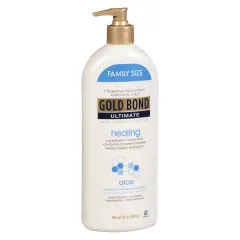
Works for:
based on ingredients and %- Moisturizing
Can it cause trouble?
- Irritation risk: high
- Comedogenic risk ingredients: 1
Key actives

Product Summary
"Gold Bond Ultimate - Healing Skin Therapy Lotion" is effective for: Moisturizing
Ingredient callouts
- this product includes a form of Retinoids (vitamin A) - retinyl palmitate 0.10% - 0.40%, but this type of vitamin A is not very effective. It could in theory help with fine lines and wrinkles, but the effect is most likely minimal.
- Humectants (hydrolyzed collagen 0.15% - 0.60% and glycerin 4.10% - 6.10%). These ingredients help attract water to the upper layer of the skin and improve the skin hydration.
Price
The product retails for 76.19A$ in Australia, from 1.29$ up to 14.99$ in the United States and for 18.18£ in the United Kingdom.
For a detailed price comparison: click here.
Works for
Moisturizing
What does the product description say?
Hydrate and nourish dry skin for a full 24 hours with Gold Bond Healing Skin Therapy Lotion with aloe.
Source: Walgreens
This product can help improve hydration of the skin with the two types of ingredients.
The first type is called “humectants”:
these ingredients help attract water.
When humectants are on the surface of the skin, they “pull in” the moisture from the outside environment, or from
within deeper layers of the skin. The following ingredients in this product do the job:
glycerin, hydrolyzed collagen.
This product also contains ingredients called “occlusives”. They help reduce the speed with which our skin loses moisture to the outside environment. These ingredients also help soften the upper layer of the skin, so it feels less tight and nicer to the touch. The following ingredients in this product do the job: dimethicone, hydrolyzed collagen.
The following ingredients in this product are especially good for supporting the skin barrier and helping with the hydration level: petrolatum
An emollient made of jojoba oil. Helps soften the skin and support its barrier function
One of the most effective and the most studied occlusive ingredients that creates a protective layer on top of the skin preventing moisture loss
One of the best moisturizing ingredients. Naturally present in skin. It attracts water to the upper layer of the skin working as a humectant
A typically plant-derived compound that is supposed mimic human collagen. Cannot penetrate the skin barrier so is not particularly useful in skincare products beyond attracting water to the upper layer of the skin
Helps soften the upper layer of the skin
A silicone that helps to reduce water loss from the surface of the skin. Can temporarily "fill in" lines and wrinkles, absorb oil, and create a nice product finish
A non-drying alcohol that works to soften the skin and stabilize product formulations helping oil and water mix together
A non-drying alcohol. Works as an emollient. Helps water and oil mix together and creates a nice product texture
Helps attract water to the upper layer of the skin and soften it
Helps oil and water mix together and can enhance the penetration of other ingredients into the skin. It can be irritating
An emollient that softens the skin and forms a protective layer on its surface. Helps water and oil mix together
Traditionally used to treat sunburns, dermatitis and inflammation, but evidence for its effectiveness is lacking. The extract can contain humectants that help attract water into the skin
How honest is this product?
| Promise | Can it deliver? |
|---|---|
| Moisturizing |
Total Promises Fulfilled score: 100/100.
We receive a small commission for purchases made through these links at no cost for you. Thank you for your support! Learn more
Potential irritants
Comedogenic ingredients
User reviews (0)
Averages from community submissions.
No reviews yet for this product.
Be the first to share your experience!
Tried this product?
Help capture what the ingredient list can't—texture, finish, pilling, scent, and more. Answer what you can, skip the rest.
Takes ~30 seconds.
Reviews are shown in aggregate. No personal details.
| Product | Similarity | Price | Irritancy |
|---|---|---|---|
 Gold Bond Ultimate Healing Skin Therapy Lotion | Current | $1.29 | |
 Gold Bond Cracked Skin Relief Hand And Body Lotions | 63% | $5.99 | |
 Cortizone 10 Intensive Healing Cream | 60% | $6.99 | |
 Up&Up Extra Repair Lotion | 55% | $1.99 | |
 Neutrogena Oil-Free Daily Sensitive Skin Face Moisturizer Fragrance-Free | 52% | $11.49 | |
 Walgreens Beauty Oil-Free Moisturizing Facial Lotion | 52% | $6.79 |
Key Actives
Three steps removed from the active form of vitamin A - retinoic acid. To have an effect in the skin, it first needs to be converted twice to become the retinoic acid. This means it is less potent than retinol, but could also be less irritating. Once converted to the retinoic acid in the skin, it helps against all signs of aging, improves skin cell turnover and helps fight blemishes and clogged pores. However, in many cosmetic formulations, it is used in a concentration that is too low to have the full effect
A silicone that helps to reduce water loss from the surface of the skin. Can temporarily "fill in" lines and wrinkles, absorb oil, and create a nice product finish
One of the best moisturizing ingredients. Naturally present in skin. It attracts water to the upper layer of the skin working as a humectant
One of the most effective and the most studied occlusive ingredients that creates a protective layer on top of the skin preventing moisture loss
An emollient made of jojoba oil. Helps soften the skin and support its barrier function
A typically plant-derived compound that is supposed mimic human collagen. Cannot penetrate the skin barrier so is not particularly useful in skincare products beyond attracting water to the upper layer of the skin
Helps soften the upper layer of the skin
Potential irritants
Helps oil and water mix together and can enhance the penetration of other ingredients into the skin. It can be irritating
Plant extract that can have healing and anti-inflammatory properties. It is a potential allergen and can be irritating
Three steps removed from the active form of vitamin A - retinoic acid. To have an effect in the skin, it first needs to be converted twice to become the retinoic acid. This means it is less potent than retinol, but could also be less irritating. Once converted to the retinoic acid in the skin, it helps against all signs of aging, improves skin cell turnover and helps fight blemishes and clogged pores. However, in many cosmetic formulations, it is used in a concentration that is too low to have the full effect
An aromatic blend of unspecified and possibly irritating ingredients
A preservative. Works by releasing formaldehyde. Can be irritating
An emollient made of jojoba oil. Helps soften the skin and support its barrier function
Traditionally used to treat sunburns, dermatitis and inflammation, but evidence for its effectiveness is lacking. The extract can contain humectants that help attract water into the skin
A more stable but less bio-available form of vitamin E compared to Tocopherol. Might help moisturize and protect the skin from free radicals, but mostly used in low concentrations to stabilize other ingredients.
A derivative of vitamin C that is more stable, but less bioavailable than the pure form of vitamin C. It does not penetrate the skin well, but has been shown to convert to pure vitamin C once in skin. It can be helpful in stimulating collagen production and lightening the skin tone, but the required concentration is likely to be very high
Comedogenic ingredients
A non-drying alcohol. Works as an emollient. Helps water and oil mix together and creates a nice product texture
All ingredients
One of the best moisturizing ingredients. Naturally present in skin. It attracts water to the upper layer of the skin working as a humectant
A silicone that helps to reduce water loss from the surface of the skin. Can temporarily "fill in" lines and wrinkles, absorb oil, and create a nice product finish
One of the most effective and the most studied occlusive ingredients that creates a protective layer on top of the skin preventing moisture loss
An emollient made of jojoba oil. Helps soften the skin and support its barrier function
A non-drying alcohol that works to soften the skin and stabilize product formulations helping oil and water mix together
Traditionally used to treat sunburns, dermatitis and inflammation, but evidence for its effectiveness is lacking. The extract can contain humectants that help attract water into the skin
A non-drying alcohol. Works as an emollient. Helps water and oil mix together and creates a nice product texture
Helps oil and water mix together and can enhance the penetration of other ingredients into the skin. It can be irritating
Plant extract that can have healing and anti-inflammatory properties. It is a potential allergen and can be irritating
Helps attract water to the upper layer of the skin and soften it
A more stable but less bio-available form of vitamin E compared to Tocopherol. Might help moisturize and protect the skin from free radicals, but mostly used in low concentrations to stabilize other ingredients.
A derivative of vitamin C that is more stable, but less bioavailable than the pure form of vitamin C. It does not penetrate the skin well, but has been shown to convert to pure vitamin C once in skin. It can be helpful in stimulating collagen production and lightening the skin tone, but the required concentration is likely to be very high
A typically plant-derived compound that is supposed mimic human collagen. Cannot penetrate the skin barrier so is not particularly useful in skincare products beyond attracting water to the upper layer of the skin
Three steps removed from the active form of vitamin A - retinoic acid. To have an effect in the skin, it first needs to be converted twice to become the retinoic acid. This means it is less potent than retinol, but could also be less irritating. Once converted to the retinoic acid in the skin, it helps against all signs of aging, improves skin cell turnover and helps fight blemishes and clogged pores. However, in many cosmetic formulations, it is used in a concentration that is too low to have the full effect
An emollient that softens the skin and forms a protective layer on its surface. Helps water and oil mix together
An aromatic blend of unspecified and possibly irritating ingredients
A preservative. Works by releasing formaldehyde. Can be irritating
Ingredient list view
Water, Glycerin, Dimethicone, Petrolatum, Jojoba esters, Cetyl alcohol, Aloe barbadensis leaf juice, Stearyl alcohol, Distearyldimonium chloride, Cetearyl alcohol, Steareth-2, Steareth-21, Propylene glycol, Chamomilla recutita flower extract, Polysorbate 60, Stearamidopropyl pg-dimonium chloride phosphate, Methyl gluceth-20, Tocopheryl acetate, Magnesium ascorbyl phosphate, Hydrolyzed collagen, Hydrolyzed elastin, Retinyl palmitate, Hydrolyzed jojoba esters, Glyceryl stearate, Edta, Parfum, Potassium hydroxide, Diazolidinyl urea, Methylparaben
- Glycerol and the skin: holistic approach to its origin and functions
- Dimethicone as a protective ingredient in topical medications
- Final Report on the Safety Assessment of Dimethicone Copolyol
- 5: Final Report on the Safety Assessment of Steareth-2,-4,-6,-7,-10,-11,-13,-15, and-20
- Surfactants and experimental irritant contact dermatitis