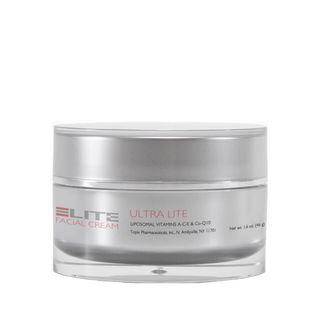
Glycolix Elite Facial Cream Ultra Lite
Works for
1 of 2 advertised claims delivered
MoisturizingUbiquinone, Beeswax + 9 moreGood evidence
“Elite Facial Cream Ultra Lite”
This product can help improve hydration of the skin with the two types of ingredients.
The first type is called “humectants”:
these ingredients help attract water.
When humectants are on the surface of the skin, they “pull in” the moisture from the outside environment, or from
within deeper layers of the skin. The following ingredients in this product do the job:
glycerin, aloe barbadensis leaf juice.
This product also contains ingredients called “occlusives”. They help reduce the speed with which our skin loses moisture to the outside environment. These ingredients also help soften the upper layer of the skin, so it feels less tight and nicer to the touch. The following ingredients in this product do the job: beeswax, dimethicone.
Anti-blemishRetinyl palmitate, Aloe barbadensis leaf juice + 1 moreLimited evidence
“Can be used for acne patients with dry skin.”
This product contains ingredients (retinyl palmitate) that could help reduce blemishes and clogged pores in theory, but there is not enough evidence that they actually work.
Anti-oxidationNot advertised by the brand · Superoxide dismutase, Ubiquinone + 3 moreStrong evidence
This product contains antioxidants (superoxide dismutase, ubiquinone) that can help neutralize free radicals in skin. By doing so, they can lessen the damage the skin gets from the UV light (sun).
Anti-agingNot advertised by the brand · Retinyl palmitate, Ubiquinone + 3 moreModerate evidence
This product contains retinyl palmitate. This ingredient might be able to help reduce and prevent fine lines and wrinkles, improve skin elasticity and firmness, but there is not enough evidence that it actually works.
Evens skin toneNot advertised by the brand · Retinyl palmitate, Camellia sinensis leaf extractModerate evidence
The following ingredient (ingredients) in this product might be helpful, but there is no evidence to confirm that it actually works: retinyl palmitate.
Can it cause trouble?
Irritancy1 strong irritant: Retinyl palmitateMedium risk
Comedogenic1 ingredient rated 2 or more on the 0–5 pore-clogging scale1 flagged
User reviews
Be the first — your take helps the next person decide.
Ingredients
Filter by role to see what each ingredient is doing.
Water~40–60%
Aloe barbadensis leaf juice~6.2–9.3%
- Irritation risk
- Medium
Traditionally used to treat sunburns, dermatitis and inflammation, but evidence for its effectiveness is lacking. The extract can contain humectants that help attract water into the skin
More about Aloe barbadensis leaf juiceGlycerin~3.7–5.6%
- Irritation risk
- Low
One of the best moisturizing ingredients. Naturally present in skin. It attracts water to the upper layer of the skin working as a humectant
More about GlycerinCetearyl alcohol~2.3–3.4%
- Irritation risk
- Low
- Comedogenicity
- 2/5
A non-drying alcohol. Works as an emollient. Helps water and oil mix together and creates a nice product texture
More about Cetearyl alcoholPropylene glycol~2.1–3.1%
- Irritation risk
- High
Helps oil and water mix together and can enhance the penetration of other ingredients into the skin. It can be irritating
More about Propylene glycolSqualane~1.8–2.7%
- Irritation risk
- Low
An oil naturally present in skin. Works as an emollient to soften the skin and form a protective layer on its surface without a greasy feeling.
More about SqualanePolysorbate 60~1.5–2.2%
Dimethicone~1.4–2%
- Irritation risk
- Low
A silicone that helps to reduce water loss from the surface of the skin. Can temporarily "fill in" lines and wrinkles, absorb oil, and create a nice product finish
More about DimethiconePhospholipids~1–1.5%
- Irritation risk
- Low
Emollients that are naturaly present in skin. In addition, they help water and oil mix together in the product
More about PhospholipidsTocopheryl acetate~0.85–1.25%
- Irritation risk
- Medium
A more stable but less bio-available form of vitamin E compared to Tocopherol. Might help moisturize and protect the skin from free radicals, but mostly used in low concentrations to stabilize other ingredients.
More about Tocopheryl acetateRetinyl palmitate~0.5–1.1%
- Irritation risk
- High
Three steps removed from the active form of vitamin A - retinoic acid. To have an effect in the skin, it first needs to be converted twice to become the retinoic acid. This means it is less potent than retinol, but could also be less irritating. Once converted to the retinoic acid in the skin, it helps against all signs of aging, improves skin cell turnover and helps fight blemishes and clogged pores. However, in many cosmetic formulations, it is used in a concentration that is too low to have the full effect
More about Retinyl palmitateAscorbyl palmitate~0.4–0.9%
- Irritation risk
- Medium
Being a lipid soluble form of vitamin C, it is more stable and can penetrate the skin better than L-Ascorbic acid. It is effective in protecting the skin from free radicals, as well as evening the skin tone, but is less effective in stimulating collagen production compared to L-Ascorbic acid.
More about Ascorbyl palmitateCamellia sinensis leaf extract~0.35–0.85%
- Irritation risk
- Low
Can contain potent anti-oxidant compounds (abbreviated ECG, GCG, EGC, and EGCG) that might help protect the skin from free radicals. Can help calm down inflammation and has some anti-bacterial properties. Unfortunately, these antioxidants are unstable and lose their effectiveness very quickly in products. The concentration of the antioxidant compounds in the extract also tends to be low to be effective in topical formulation
More about Camellia sinensis leaf extractUbiquinone~0.35–0.75%
- Irritation risk
- Low
Coenzyme Q10. It helps neutralize free radicals in skin, improves skin hydration and might be helpful agains fine lines and wrinkles. It can be an allergen
More about UbiquinoneSuperoxide dismutase~0.3–0.7%
- Irritation risk
- Low
An antioxidant enzyme that is naturally present in skin. It can help support skin barrier function and reduce inflammation in skin. It is used in topical medications for inflammatory skin conditions including atopic dermatitis (eczema) and psoriasis. There are three types of natural Superoxide Dismutase in human skin. The compound used in topical treatments and cosmetics are mimics of typically one of these natural variants
More about Superoxide dismutaseLeuconostoc/radish root ferment filtrate~0.2–0.8%
- Irritation risk
- Medium
A preservative that comes from radishes fermented by a bacteria. New research suggests that the preservation properties in the ingredient come from an ammonium salt that is not present naturally in radish root but used in its cultivation. Is problematic because the exact amount of the preservative agents is difficult to determine
More about Leuconostoc/radish root ferment filtrateMaltodextrin~0.15–0.65%
- Irritation risk
- Low
Used to stabilize the product formulation and can help absorb oil
More about MaltodextrinBeeswax~0.15–0.65%
- Irritation risk
- Low
Forms a protective barrier that holds water and keeps dry skin hydrated. Keeps an emulsion from separating into its oil and liquid components, and increases the thickness of a product. Can be an allergen
More about BeeswaxCarbomer~0.1–0.5%
- Irritation risk
- Low
Helps create a thicker or gel-like product texture. It is not a surfactant but can be used in gentle cleansing formulations
More about CarbomerPotassium hydroxide~0.1–0.5%
Sodium benzoate~0.1–0.3%
Potassium sorbate~0.05–0.3%
Phenoxyethanol~0.05–0.3%
- Irritation risk
- Low
A preservative. It helps prevent bacterial growth in cosmetic products
More about PhenoxyethanolBenzyl alcohol~0.05–0.2%
- Irritation risk
- High
A preservative. Can be used to mask unpleasant smell. Can be irritating
More about Benzyl alcoholCaprylyl glycol~0.05–0.25%
- Irritation risk
- Medium
Helps preserve products and creates a nice product texture
More about Caprylyl glycolCitric acid~0.01–0.05%
- Irritation risk
- Medium
Can work as an exfoliant but is typically used to adjust the product pH
More about Citric acidIngredient list view
Water, Aloe barbadensis leaf juice, Glycerin, Cetearyl alcohol, Propylene glycol, Unknown, Squalane, Polysorbate 60, Dimethicone, Phospholipids, Tocopheryl acetate, Retinyl palmitate, Ascorbyl palmitate, Camellia sinensis leaf extract, Ubiquinone, Superoxide dismutase, Leuconostoc/radish root ferment filtrate, Maltodextrin, Beeswax, Carbomer, Potassium hydroxide, Sodium benzoate, Potassium sorbate, Phenoxyethanol, Benzyl alcohol, Caprylyl glycol, Citric acid
Compare prices
Retailers ranked by price — lowest first.
Affiliate links · prices updated regularly · As an Amazon Associate, WIMJ earns from qualifying purchases.
Sources cited in this review
Every concentration estimate and effectiveness label is anchored to one of these 13 studies and safety reviews.
- 1
- 2Surfactants and experimental irritant contact dermatitisncbi.nlm.nih.gov
- 3Propylene Glycolpubmed.ncbi.nlm.nih.gov
- 4Skin-sensitizing and irritant properties of propylene glycolonlinelibrary.wiley.com
- 5
- 6Final Report on the Safety Assessment of Dimethicone Copolyoljournals.sagepub.com

Affiliate links · As an Amazon Associate, WIMJ earns from qualifying purchases.