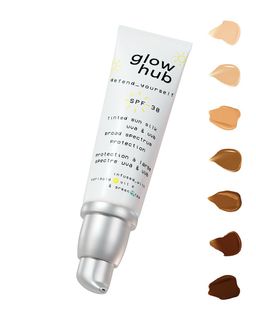
Glow Hub Beauty Defend Yourself Facial Sunscreen SPF 30 TINTED

Glow Hub Beauty Defend Yourself Facial Sunscreen SPF 30 TINTED

SPF 30Efficacy90/100IrritancyMedium·8 UV filters
Edit

Works for

2 of 2 advertised claims delivered

Sun protection
SPF 30 · 8 UV filters
Broad spectrum
SPF 30Broad spectrumChemical filtersTinted

This product offers a good level of protection against both UVB and UVA rays.

This sunscreen uses organic (so-called "chemical") sunscreen filters. Organic, or "chemical" filters usually provide reliable sun protection and rarely leave a white cast. Sunscreens with organic filters can sting eyes.

This product can be considered "reef safe" because it does not contain the UV filters (oxybenzone and octinoxate) that can be harmful to coral reefs when present in the water in high concentrations.

UV spectrum
UVB290–320 nmUVA II320–340 nmUVA I340–400 nm
Octocrylene
Octisalate
Homosalate
Butyloctyl Salicylate
Polysilicone-15
Titanium Dioxide
Tinosorb S
Avobenzone
FilterCoverageWhat it doesEst. amount
OctocryleneUVB Photo-stable A weak sunscreen that protects against the sun rays that cause sunburn (UVB) and is somewhat effective against the UVA rays. It is quite stable and can help stabilize other, more vulnerable, sunscreen ingredients like Avobenzone. It is an organic, or so called "chemical" sunscreen~6–7.3%
OctisalateEthylhexyl SalicylateUVBOctisalate. A UV filter. It offers some protection against the sun rays that cause sunburn (UVB), but does not protect against the most aging sun rays (UVA). It loses its effectiveness quickly when exposed to sunlight. It is an organic, or so called "chemical" sunscreen~3.2–4%
HomosalateUVB Photo-stable A weak sunscreen that offers some protection against the sun rays that cause sunburn (UVB), but does not offer meaningful protection against protect against the most aging sun rays (UVA). It loses its effectiveness quickly when exposed to sunlight. It is an organic, or so called "chemical" sunscreen. When used in low concentrations, helps to stabilize the product formulation~2.6–3.2%
Butyloctyl SalicylateUVBA synthetic ester of salicylic acid that is used to help disperse pigments and boost effectiveness of sunscreen ingredients. It is able to absorb UV light (working as an organic, or chemical filter), but is not approved as a sunscreen ingredient on its own~1.2–1.5%
Polysilicone-15UVB Photo-stable A UV filter. Effective against UVB rays, but does not protect against the most aging UVA light~0.95–1.15%
Titanium Dioxide Mineral UVBUVA2 Photo-stable Works as a UV filter when used in high concentrations. It is photostable and is effective mostly against the UVB light, with some protection in the UVA range. In small concentrations, used for its ability to improve the color of cosmetic products. Is usually well tolerated by the skin~0.1–0.2%
Tinosorb SBis-ethylhexyloxyphenol Methoxyphenyl TriazineUVBUVA Photo-stable Tinosorb S. One of the most effective broad spectrum sunscreen ingredients. Protects from both UVA and UVB rays. It is photostable. Unfortunately, not approved by FDA (US) yet.~2–2.5%
AvobenzoneButyl MethoxydibenzoylmethaneUVA1Avobenzone. An organic, or so-called "chemical" UV filter. Protects against both UVA and UVB rays. Needs to be combined with other filters in a formulation to be stable.~4.5–5.5%
~ marks concentrations estimated from label position and typical use levels
Reef-safe
No oxybenzone or octinoxate — the two filters banned in Hawaii, Florida Keys and Aruba.
Evens skin tone
Camellia sinensis leaf extract
Strong evidence
What the product description says
“Protect skin from burning, help prevent pigmentation & keep your moisture barrier strong + skin healthy.”
Source: Glowhubs

This product offers broad spectrum sun protection. It means that it can prevent hyperpigmentation and help keep the skin tone even (sun damage is the main factor causing age spots, darkening of post-acne marks and other discolorations).

Camellia sinensis leaf extractEffect: LowCan contain potent anti-oxidant compounds (abbreviated ECG, GCG, EGC, and EGCG) that might help protect the skin from free radicals. Can help calm down inflammation and has some anti-bacterial properties. Unfortunately, these antioxidants are unstable and lose their effectiveness very quickly in products. The concentration of the antioxidant compounds in the extract also tends to be low to be effective in topical formulation~0.3–0.6%
Anti-aging
Not advertised by the brand · Camellia sinensis leaf extract
Strong evidence

This product can help prevent early signs of skin aging because it offers a good level of broad spectrum sun protection. Sun damage is the main cause of premature skin aging, and protecting your skin from the sun is the best anti-aging strategy.

Camellia sinensis leaf extractEffect: LowCan contain potent anti-oxidant compounds (abbreviated ECG, GCG, EGC, and EGCG) that might help protect the skin from free radicals. Can help calm down inflammation and has some anti-bacterial properties. Unfortunately, these antioxidants are unstable and lose their effectiveness very quickly in products. The concentration of the antioxidant compounds in the extract also tends to be low to be effective in topical formulation~0.3–0.6%
Anti-oxidation
Not advertised by the brand · Camellia sinensis leaf extract, Calendula officinalis flower extract + 1 more
Moderate evidence

This product contains antioxidants (camellia sinensis leaf extract) that might be able to help neutralize free radicals in skin to lessen the damage it gets from the UV light (sun). There is not enough evidence to confirm their effectiveness in skin though.

Camellia sinensis leaf extractKey activeEffect: MediumCan contain potent anti-oxidant compounds (abbreviated ECG, GCG, EGC, and EGCG) that might help protect the skin from free radicals. Can help calm down inflammation and has some anti-bacterial properties. Unfortunately, these antioxidants are unstable and lose their effectiveness very quickly in products. The concentration of the antioxidant compounds in the extract also tends to be low to be effective in topical formulation~0.3–0.6%
Calendula officinalis flower extractEffect: LowA plant extract that has some anti-oxidant and anti-bacterial properties. Can be irritating~0.3–0.55%
Tocopheryl acetateEffect: Low, below effective doseA more stable but less bio-available form of vitamin E compared to Tocopherol. Might help moisturize and protect the skin from free radicals, but mostly used in low concentrations to stabilize other ingredients.~0.35–0.6%
Moisturizing
Not advertised by the brand · Glycerin, C12-15 alkyl benzoate + 3 more
Good evidence

This product contains good ingredients to attract water to the upper layer of the skin. These ingredients are called "humectants": glycerin.

When humectants are on the surface of the skin, they “pull in” the moisture from the outside environment, or from within deeper layers of the skin. If the air is dry, humectants can speed up the moisture loss from the skin. This is why it is a good idea to use another product on top of this one to help "seal in" the moisture (look for ingredients like dimethicone, squalane, oils and butters).

GlycerinKey active· HumectantEffect: HighOne of the best moisturizing ingredients. Naturally present in skin. It attracts water to the upper layer of the skin working as a humectant~1.8–2.2%
C12-15 alkyl benzoateKey active· EmollientEffect: MediumEnhances the product texture and makes it more spreadable. Helps reduce water loss from the outer layer of skin. Extands the shelf life by preventing bacteria growth~3.2–3.9%
Cetearyl alcoholKey active· EmollientEffect: MediumA non-drying alcohol. Works as an emollient. Helps water and oil mix together and creates a nice product texture~0.6–0.85%
Glyceryl stearate seKey activeEffect: MediumUsed to stabilize the product formulations and works as an emollient~0.55–0.8%
Camellia sinensis leaf extractEffect: LowCan contain potent anti-oxidant compounds (abbreviated ECG, GCG, EGC, and EGCG) that might help protect the skin from free radicals. Can help calm down inflammation and has some anti-bacterial properties. Unfortunately, these antioxidants are unstable and lose their effectiveness very quickly in products. The concentration of the antioxidant compounds in the extract also tends to be low to be effective in topical formulation~0.3–0.6%

Can it cause trouble?

Irritancy
1 strong irritant: Calendula officinalis flower extract
Medium risk
We flagged 16 ingredients with irritancy potential. Severity depends on your sensitivity threshold; the table lists the worst offenders first.
IngredientFunctionIrritationEst. amount
Calendula officinalis flower extractA plant extract that has some anti-oxidant and anti-bacterial properties. Can be irritatingHigh~0.3–0.55%est.
Sodium lauryl sulfateA cleansing agent (SLS). It can be irritatingHigh~0.55–0.85%est.
OctocryleneA weak sunscreen that protects against the sun rays that cause sunburn (UVB) and is somewhat effective against the UVA rays. It is quite stable and can help stabilize other, more vulnerable, sunscreen ingredients like Avobenzone. It is an organic, or so called "chemical" sunscreenMedium~6–7.3%est.
Butyl methoxydibenzoylmethaneAvobenzone. An organic, or so-called "chemical" UV filter. Protects against both UVA and UVB rays. Needs to be combined with other filters in a formulation to be stable.Medium~4.5–5.5%est.
HomosalateA weak sunscreen that offers some protection against the sun rays that cause sunburn (UVB), but does not offer meaningful protection against protect against the most aging sun rays (UVA). It loses its effectiveness quickly when exposed to sunlight. It is an organic, or so called "chemical" sunscreen. When used in low concentrations, helps to stabilize the product formulationMedium~2.6–3.2%est.
Bis-ethylhexyloxyphenol methoxyphenyl triazineTinosorb S. One of the most effective broad spectrum sunscreen ingredients. Protects from both UVA and UVB rays. It is photostable. Unfortunately, not approved by FDA (US) yet.Medium~2–2.5%est.
Butyloctyl salicylateA synthetic ester of salicylic acid that is used to help disperse pigments and boost effectiveness of sunscreen ingredients. It is able to absorb UV light (working as an organic, or chemical filter), but is not approved as a sunscreen ingredient on its ownMedium~1.2–1.5%est.
Aluminum starch octenylsuccinateUsed to thicken the product's consistencyMedium~1–1.2%est.
Potassium cetyl phosphateHelps oil and water mix togetherMedium~0.75–1.15%est.
Polysilicone-15A UV filter. Effective against UVB rays, but does not protect against the most aging UVA lightMedium~0.95–1.15%est.
Vp/eicosene copolymerUsed to improve the product adherence to the skin, for example, to pro-long the protective effect of sunscreens. Can be irritating to very sensitive skinMedium~0.6–0.9%est.
Potassium hydroxideUsed to adjust the pH level of productsMedium~0.45–0.65%est.
EthylhexylglycerinA preservativeMedium~0.4–0.6%est.
Tocopheryl acetateA more stable but less bio-available form of vitamin E compared to Tocopherol. Might help moisturize and protect the skin from free radicals, but mostly used in low concentrations to stabilize other ingredients.Medium~0.35–0.6%est.
Citric acidCan work as an exfoliant but is typically used to adjust the product pHMedium~0.25–0.45%est.
Potassium sorbateA preservativeMedium~0.2–0.35%est.
Comedogenic
3 ingredients rated 2 or more on the 0–5 pore-clogging scale
3 flagged
These ingredients have a comedogenic rating of 2 or more on a 0–5 scale; the table shows each one's rating. In leave-on products they can clog pores in acne-prone skin.
IngredientFunctionRatingEst. amount
Sodium lauryl sulfateA cleansing agent (SLS). It can be irritating3/5~0.55–0.85%est.
Cetearyl alcoholA non-drying alcohol. Works as an emollient. Helps water and oil mix together and creates a nice product texture2/5~0.6–0.85%est.
Glyceryl stearate seUsed to stabilize the product formulations and works as an emollient2/5~0.55–0.8%est.
Edit

User reviews

Would you recommend?
No community reviews yet.

Be the first — your take helps the next person decide.

Write a review · ~30s

Ingredients

Filter by role to see what each ingredient is doing.

Water~45–55%
Formula
Irritation risk
Low

Plain old water

More about Water
Octocrylene~6–7.3%
UV filterKey activeIrritant · medium
Irritation risk
Medium
Works for
Sun protection

A weak sunscreen that protects against the sun rays that cause sunburn (UVB) and is somewhat effective against the UVA rays. It is quite stable and can help stabilize other, more vulnerable, sunscreen ingredients like Avobenzone. It is an organic, or so called "chemical" sunscreen

More about Octocrylene
Butyl methoxydibenzoylmethane~4.5–5.5%
UV filterKey activeIrritant · medium
Irritation risk
Medium
Works for
Sun protection

Avobenzone. An organic, or so-called "chemical" UV filter. Protects against both UVA and UVB rays. Needs to be combined with other filters in a formulation to be stable.

More about Butyl methoxydibenzoylmethane
C12-15 alkyl benzoate~3.2–3.9%
Key active
Irritation risk
Low
Works for
Moisturizing

Enhances the product texture and makes it more spreadable. Helps reduce water loss from the outer layer of skin. Extands the shelf life by preventing bacteria growth

More about C12-15 alkyl benzoate
Ethylhexyl salicylate~3.2–4%
UV filter
Irritation risk
Low
Works for
Sun protection

Octisalate. A UV filter. It offers some protection against the sun rays that cause sunburn (UVB), but does not protect against the most aging sun rays (UVA). It loses its effectiveness quickly when exposed to sunlight. It is an organic, or so called "chemical" sunscreen

More about Ethylhexyl salicylate
Homosalate~2.6–3.2%
UV filterKey activeIrritant · medium
Irritation risk
Medium
Works for
Sun protection

A weak sunscreen that offers some protection against the sun rays that cause sunburn (UVB), but does not offer meaningful protection against protect against the most aging sun rays (UVA). It loses its effectiveness quickly when exposed to sunlight. It is an organic, or so called "chemical" sunscreen. When used in low concentrations, helps to stabilize the product formulation

More about Homosalate
Glycerin~1.8–2.2%
Key active
Irritation risk
Low
Works for
Moisturizing

One of the best moisturizing ingredients. Naturally present in skin. It attracts water to the upper layer of the skin working as a humectant

More about Glycerin
Bis-ethylhexyloxyphenol methoxyphenyl triazine~2–2.5%
UV filterKey activeIrritant · medium
Irritation risk
Medium
Works for
Sun protection

Tinosorb S. One of the most effective broad spectrum sunscreen ingredients. Protects from both UVA and UVB rays. It is photostable. Unfortunately, not approved by FDA (US) yet.

More about Bis-ethylhexyloxyphenol methoxyphenyl triazine
Butyloctyl salicylate~1.2–1.5%
UV filterKey activeIrritant · medium
Irritation risk
Medium
Works for
Sun protection

A synthetic ester of salicylic acid that is used to help disperse pigments and boost effectiveness of sunscreen ingredients. It is able to absorb UV light (working as an organic, or chemical filter), but is not approved as a sunscreen ingredient on its own

More about Butyloctyl salicylate
Aluminum starch octenylsuccinate~1–1.2%
Irritant · medium
Irritation risk
Medium

Used to thicken the product's consistency

More about Aluminum starch octenylsuccinate
Potassium cetyl phosphate~0.75–1.15%
Irritant · medium
Irritation risk
Medium
Works for
Cleansing

Helps oil and water mix together

More about Potassium cetyl phosphate
Polysilicone-15~0.95–1.15%
UV filterKey activeIrritant · medium
Irritation risk
Medium
Works for
Sun protection

A UV filter. Effective against UVB rays, but does not protect against the most aging UVA light

More about Polysilicone-15
Vp/eicosene copolymer~0.6–0.9%
Irritant · medium
Irritation risk
Medium
Works for
Sun protection

Used to improve the product adherence to the skin, for example, to pro-long the protective effect of sunscreens. Can be irritating to very sensitive skin

More about Vp/eicosene copolymer
Phenoxyethanol~0.55–0.85%
Formula
Irritation risk
Low

A preservative. It helps prevent bacterial growth in cosmetic products

More about Phenoxyethanol
Ammonium acryloyldimethyltaurate/vp copolymer~0.55–0.8%
Formula
Irritation risk
Low

Increases thickness of a product. Texture enhancer for oil-in-water emulsions

More about Ammonium acryloyldimethyltaurate/vp copolymer
Cetearyl alcohol~0.6–0.85%
Key activeComedogenic 2/5
Irritation risk
Low
Comedogenicity
2/5
Works for
CleansingMoisturizing

A non-drying alcohol. Works as an emollient. Helps water and oil mix together and creates a nice product texture

More about Cetearyl alcohol
Glyceryl stearate se~0.55–0.8%
Key activeComedogenic 2/5
Irritation risk
Low
Comedogenicity
2/5
Works for
CleansingMoisturizing

Used to stabilize the product formulations and works as an emollient

More about Glyceryl stearate se
Styrene/acrylates copolymer~0.45–0.7%
Formula
Irritation risk
Low

Used to create an even product consistency. Can help boost efficiency of sunscreen filters

More about Styrene/acrylates copolymer
Triethoxycaprylylsilane~0.45–0.65%
Formula
Irritation risk
Low

A type of silicone that helps oil and water mix well together. Helps to disperse other ingredients, e.g. pigments, evenly in a formulation

More about Triethoxycaprylylsilane
Potassium hydroxide~0.45–0.65%
Irritant · medium
Irritation risk
Medium

Used to adjust the pH level of products

More about Potassium hydroxide
Ethylhexylglycerin~0.4–0.6%
Irritant · medium
Irritation risk
Medium

A preservative

More about Ethylhexylglycerin
Sodium gluconate~0.35–0.6%
Formula
Irritation risk
Low

Helps stabilize product formulations

More about Sodium gluconate
Tocopheryl acetate~0.35–0.6%
Irritant · medium
Irritation risk
Medium
Works for
Anti-oxidation

A more stable but less bio-available form of vitamin E compared to Tocopherol. Might help moisturize and protect the skin from free radicals, but mostly used in low concentrations to stabilize other ingredients.

More about Tocopheryl acetate
Calendula officinalis flower extract~0.3–0.55%
Irritant · high
Irritation risk
High
Works for
Anti-oxidation

A plant extract that has some anti-oxidant and anti-bacterial properties. Can be irritating

More about Calendula officinalis flower extract
Alumina~0.5–0.75%
Formula
Irritation risk
Low

The same compound that is used safely in dental implants and bone cements. In cosmetics, it is used to improve the consistency of products

More about Alumina
Xanthan gum~0.3–0.6%
Formula
Irritation risk
Low
Works for
Cleansing

Used to create a thicker product consistency

More about Xanthan gum
Camellia sinensis leaf extract~0.3–0.6%
Key active
Irritation risk
Low
Works for
AntibacterialAnti-oxidationAnti-agingAnti-blemishEvens skin toneMoisturizing

Can contain potent anti-oxidant compounds (abbreviated ECG, GCG, EGC, and EGCG) that might help protect the skin from free radicals. Can help calm down inflammation and has some anti-bacterial properties. Unfortunately, these antioxidants are unstable and lose their effectiveness very quickly in products. The concentration of the antioxidant compounds in the extract also tends to be low to be effective in topical formulation

More about Camellia sinensis leaf extract
Silica~0.45–0.7%
Formula
Irritation risk
Low

Used to absorb oil and can temporarily mattify skin

More about Silica
Ppg-2-deceth-30~0.2–0.4%
Formula
Irritation risk
Low
Works for
Cleansing
More about Ppg-2-deceth-30
Citric acid~0.25–0.45%
Irritant · medium
Irritation risk
Medium

Can work as an exfoliant but is typically used to adjust the product pH

More about Citric acid
Sodium benzoate~0.2–0.4%
Formula
Irritation risk
Low

A preservative

More about Sodium benzoate
Potassium sorbate~0.2–0.35%
Irritant · medium
Irritation risk
Medium

A preservative

More about Potassium sorbate
Sodium lauryl sulfate~0.55–0.85%
Comedogenic 3/5Irritant · high
Irritation risk
High
Comedogenicity
3/5
Works for
Cleansing

A cleansing agent (SLS). It can be irritating

More about Sodium lauryl sulfate
Iron oxides~0.15–0.3%
Formula
Irritation risk
Low
Works for
Sun protection

An umbrella term for the following three colorants: CI 77491, CI 77492, CI 77499. They might be able to offer some protection against visible light, but the degree of the protection is not clear

More about Iron oxides
Iron oxides~0.15–0.25%
Formula
Irritation risk
Low
Works for
Sun protection

An umbrella term for the following three colorants: CI 77491, CI 77492, CI 77499. They might be able to offer some protection against visible light, but the degree of the protection is not clear

More about Iron oxides
Iron oxides~0.1–0.2%
Formula
Irritation risk
Low
Works for
Sun protection

An umbrella term for the following three colorants: CI 77491, CI 77492, CI 77499. They might be able to offer some protection against visible light, but the degree of the protection is not clear

More about Iron oxides
Titanium dioxide~0.1–0.2%
UV filterUnder-dosed
Irritation risk
Low
Works for
Sun protection

Works as a UV filter when used in high concentrations. It is photostable and is effective mostly against the UVB light, with some protection in the UVA range. In small concentrations, used for its ability to improve the color of cosmetic products. Is usually well tolerated by the skin

More about Titanium dioxide
Ingredient list view

Water, Octocrylene, Butyl methoxydibenzoylmethane, C12-15 alkyl benzoate, Ethylhexyl salicylate, Homosalate, Glycerin, Bis-ethylhexyloxyphenol methoxyphenyl triazine, Butyloctyl salicylate, Aluminum starch octenylsuccinate, Potassium cetyl phosphate, Polysilicone-15, Vp/eicosene copolymer, Phenoxyethanol, Ammonium acryloyldimethyltaurate/vp copolymer, Cetearyl alcohol, Glyceryl stearate se, Styrene/acrylates copolymer, Triethoxycaprylylsilane, Potassium hydroxide, Ethylhexylglycerin, Sodium gluconate, Tocopheryl acetate, Calendula officinalis flower extract, Alumina, Xanthan gum, Camellia sinensis leaf extract, Silica, Ppg-2-deceth-30, Citric acid, Sodium benzoate, Potassium sorbate, Sodium lauryl sulfate, Iron oxides, Iron oxides, Iron oxides, Titanium dioxide

Compare prices

Retailers ranked by price — lowest first.

Glowhubs
≈ $18.72
Buy

Affiliate links · prices updated regularly

Cheaper alternatives? See how this stacks up against similar formulas.
We compare ingredient profiles across our catalog — pick the closest match for your budget.
Open dupe finder

Sources cited in this review

Every concentration estimate and effectiveness label is anchored to one of these 10 studies and safety reviews.

  1. 1
  2. 2
  3. 3
  4. 4
  5. 5
  6. 6
Glow Hub Beauty Defend Yourself Facial Sunscreen SPF 30 TINTED
Glow Hub BeautyDefend Yourself Facial Sunscreen SPF 30 TINTED

Affiliate links · As an Amazon Associate, WIMJ earns from qualifying purchases.

As an Amazon Associate, WIMJ earns from qualifying purchases.