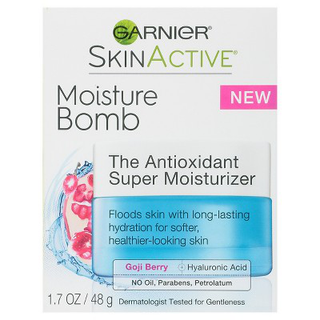
Garnier SkinActive Gel Face Moisturizer with Hyaluronic Acid
Works for
1 of 1 advertised claim delivered
Moisturizing20 ingredients credited for this claimStrong evidence
“SkinActive Gel Face Moisturizer with Hyaluronic Acid”
This product can help improve hydration of the skin with the two types of ingredients.
The first type is called “humectants”:
these ingredients help attract water.
When humectants are on the surface of the skin, they “pull in” the moisture from the outside environment, or from
within deeper layers of the skin. The following ingredients in this product do the job:
glycerin, sodium hyaluronate.
This product also contains ingredients called “occlusives”. They help reduce the speed with which our skin loses moisture to the outside environment. These ingredients also help soften the upper layer of the skin, so it feels less tight and nicer to the touch. The following ingredients in this product do the job: dimethicone, dimethiconol.
The following ingredients in this product are especially good for supporting the skin barrier and helping with the hydration level: caprooyl phytosphingosine, caprooyl sphingosine, ceramide ap, ceramide eop, ceramide eos, ceramide np, ceramide ns
Can it cause trouble?
Irritancy7 strong irritants: Alcohol denat., Parfum + 5 more — patch-test recommendedHigh risk
Comedogenic1 ingredient rated 2 or more on the 0–5 pore-clogging scale1 flagged


User reviews
Be the first — your take helps the next person decide.
Ingredients
Filter by role to see what each ingredient is doing.
Water~40–60%
Glycerin~4.1–6.1%
- Irritation risk
- Low
One of the best moisturizing ingredients. Naturally present in skin. It attracts water to the upper layer of the skin working as a humectant
More about GlycerinDimethicone~3.5–5.3%
- Irritation risk
- Low
A silicone that helps to reduce water loss from the surface of the skin. Can temporarily "fill in" lines and wrinkles, absorb oil, and create a nice product finish
More about DimethiconeCetearyl ethylhexanoate~2.6–4%
- Irritation risk
- Low
An emollient that helps soften the skin
More about Cetearyl ethylhexanoateAlcohol denat.~2–3%
- Irritation risk
- High
Produces temporary toning effect. Can help dissolve other ingredients or preserve products
More about Alcohol denat.Aloe barbadensis leaf juice~1.6–2.4%
- Irritation risk
- Medium
Traditionally used to treat sunburns, dermatitis and inflammation, but evidence for its effectiveness is lacking. The extract can contain humectants that help attract water into the skin
More about Aloe barbadensis leaf juiceHydroxyethylpiperazine ethane sulfonic acid~1.4–2.1%
- Irritation risk
- Medium
Used to regulate product's pH, but can be also used as an exfoliator when included in higher concentrations. There is a controversy about whether it can generate free radicals and induce skin cell damage when used in topical products
More about Hydroxyethylpiperazine ethane sulfonic acidAmmonium polyacryloyldimethyl taurate~1.2–1.9%
- Irritation risk
- Low
Used to create a thicker product consistency
More about Ammonium polyacryloyldimethyl tauratePhenoxyethanol~0.5–1%
- Irritation risk
- Low
A preservative. It helps prevent bacterial growth in cosmetic products
More about PhenoxyethanolCaprylyl glycol~0.6–1.35%
- Irritation risk
- Medium
Helps preserve products and creates a nice product texture
More about Caprylyl glycolIsopropyl myristate~0.45–1.05%
- Irritation risk
- Low
- Comedogenicity
- 3/5
An emollient that helps soften the skin. Could be comedogenic
More about Isopropyl myristateTocopherol~0.3–0.7%
- Irritation risk
- Low
Pure form of vitamin E. Can help moisturise and protect the skin from free radicals. Often used to help stabilise other ingredients or the formula itself
More about TocopherolAscorbyl glucoside~0.15–0.55%
- Irritation risk
- Medium
A vitamin C derivative that is more stable but less potent than pure form of vitamin C. Has a potential to boost collagen production, nutralise free radicals and reduce hyperpigmentation, but the required concentration is likely to be much higher than for the pure form of vitamin C, limiting the ingredient's effectiveness in products
More about Ascorbyl glucosideDimethiconol~0.15–0.6%
- Irritation risk
- Low
A silicone that makes products more spreadable and keeps skin smooth. Helps to add gloss to skin and may visually fill in fine lines/wrinkles for short time
More about DimethiconolBisabolol~0.1–0.4%
- Irritation risk
- Low
An active component of chamomile plant that historically has been used to calm down irritated skin. A recent study shows that bisabolol indeed can have some anti-inflammatory effect on skin, even though conclusive data is lacking. Bisabolol has a sweet floral scent and can be added to products for its aromatic properties
More about BisabololParfum~0.1–0.45%
- Irritation risk
- High
An aromatic blend of unspecified and possibly irritating ingredients
More about ParfumSodium hyaluronate~0.15–0.5%
- Irritation risk
- Low
One of the best moisturizing ingredients. Attracts water into the upper layer of the skin
More about Sodium hyaluronateXanthan gum~0.15–0.55%
- Irritation risk
- Low
Used to create a thicker product consistency
More about Xanthan gumDisodium edta~0.1–0.5%
T-butyl alcohol~0.1–0.4%
- Irritation risk
- Medium
Used to dissolve other ingredients and to improve smell of products. It could be irritating
More about T-butyl alcoholLycium barbarum fruit extract~0.1–0.35%
- Irritation risk
- Medium
A plant extract that can help neutralize free radicals in skin and attract water to its upper layer
More about Lycium barbarum fruit extractSodium hydroxide~0.1–0.35%
Limonene~0.05–0.25%
- Irritation risk
- High
A common frangrance that can easily irritate skin, especially if exposed to air, light or heat
More about LimoneneFarnesol~0.05–0.25%
Sodium benzoate~0.1–0.3%
Linalool~0.05–0.25%
Lactic acid~0.05–0.3%
- Irritation risk
- Medium
An exfoliating and moisturizing alpha-hydroxy acid (AHA). Typically causes less irritation than other AHAs, for example, glycolic acid. At high concentrations (about 15%), lactic acid can help reduce lines and wrinkles. Recent studies show that lactic acid can support the "good" bacteria living on skin's surface (healthy skin microbiome)
More about Lactic acidCeteareth-25~0.1–0.5%
Citronellol~0.05–0.25%
Potassium sorbate~0.1–0.3%
Geraniol~0.05–0.25%
Cetyl alcohol~0.1–0.4%
- Irritation risk
- Low
A non-drying alcohol that works to soften the skin and stabilize product formulations helping oil and water mix together
More about Cetyl alcoholBenzyl alcohol~0.05–0.25%
- Irritation risk
- High
A preservative. Can be used to mask unpleasant smell. Can be irritating
More about Benzyl alcoholCeramide np~0.1–0.4%
- Irritation risk
- Low
A type of lipid similar to ceramides naturally present in skin. Helps to soften the upper layer of the skin and supports the skin barrier function to keep it hydrated. Can help to prevent inflammation in skin
More about Ceramide npBehenic acid~0.1–0.5%
Punica granatum extract~0.05–0.25%
- Irritation risk
- Medium
A plant extract that can help neutralize free radicals in skin and even out the skin tone, but is typically used in products in a concentration that is too low to be effective
More about Punica granatum extractCholesterol~0.1–0.4%
- Irritation risk
- Low
An emollient that is naturally found in skin
More about CholesterolCeramide ns~0.1–0.4%
- Irritation risk
- Low
A type of lipid similar to ceramides naturally present in skin. Helps to soften the upper layer of the skin and supports the skin barrier function to keep it hydrated. Can help to prevent inflammation in skin
More about Ceramide nsEthylhexylglycerin~0.1–0.35%
Ci 42090~0.1–0.35%
Ceramide ap~0.1–0.35%
- Irritation risk
- Low
A type of lipid similar to ceramides naturally present in skin. Helps to soften the upper layer of the skin and supports the skin barrier function to keep it hydrated. Can help to prevent inflammation in skin
More about Ceramide apCeramide eop~0.1–0.45%
- Irritation risk
- Low
A type of lipid similar to ceramides naturally present in skin. Helps to soften the upper layer of the skin and supports the skin barrier function to keep it hydrated. Can help to prevent inflammation in skin
More about Ceramide eopCeramide eos~0.1–0.3%
- Irritation risk
- Low
A type of lipid similar to ceramides naturally present in skin. Helps to soften the upper layer of the skin and supports the skin barrier function to keep it hydrated. Can help to prevent inflammation in skin
More about Ceramide eosCaprooyl phytosphingosine~0.1–0.45%
- Irritation risk
- Low
A component of ceramides. Helps to soften the upper layer of the skin and supports the skin barrier function to keep it hydrated. Can help to prevent inflammation in skin
More about Caprooyl phytosphingosineCaprooyl sphingosine~0.1–0.3%
- Irritation risk
- Low
A component of ceramides. Helps to soften the upper layer of the skin and supports the skin barrier function to keep it hydrated. Can help to prevent inflammation in skin
More about Caprooyl sphingosineAscorbyl palmitate~0.05–0.15%
- Irritation risk
- Medium
Being a lipid soluble form of vitamin C, it is more stable and can penetrate the skin better than L-Ascorbic acid. It is effective in protecting the skin from free radicals, as well as evening the skin tone, but is less effective in stimulating collagen production compared to L-Ascorbic acid.
More about Ascorbyl palmitateIngredient list view
Water, Glycerin, Dimethicone, Cetearyl ethylhexanoate, Alcohol denat., Aloe barbadensis leaf juice, Hydroxyethylpiperazine ethane sulfonic acid, Ammonium polyacryloyldimethyl taurate, Phenoxyethanol, Caprylyl glycol, Isopropyl myristate, Tocopherol, Ascorbyl glucoside, Dimethiconol, Bisabolol, Parfum, Sodium hyaluronate, Xanthan gum, Disodium edta, T-butyl alcohol, Lycium barbarum fruit extract, Sodium hydroxide, Limonene, Farnesol, Sodium benzoate, Linalool, Lactic acid, Ceteareth-25, Citronellol, Potassium sorbate, Geraniol, Cetyl alcohol, Benzyl alcohol, Ceramide np, Behenic acid, Punica granatum extract, Cholesterol, Ceramide ns, Ethylhexylglycerin, Ci 42090, Ceramide ap, Ceramide eop, Ceramide eos, Caprooyl phytosphingosine, Caprooyl sphingosine, Ascorbyl palmitate, Unknown
Compare prices
Retailers ranked by price — lowest first.
Affiliate links · prices updated regularly · As an Amazon Associate, WIMJ earns from qualifying purchases.
Worth comparing, line by line.
Match % combines shared ingredients, the first five ingredients, shared actives and hero ingredients, irritancy (lower counts in the alternative's favour), texture and body area. Only products in the same routine step are compared.
| GarnierSkinActive Gel Face Moisturizer with Hyaluronic AcidYOUR PRODUCT | It CosmeticsConfidence in a Gel Lotion Moisturizer | Peter Thomas RothWater Drench Hyaluronic Acid Moisturizer | REVOLUTION SKINCARECeramides Moisture Lotion | |
|---|---|---|---|---|
| Match | — | 61% | 60% | 58% |
| Price | $12.79 | $49.00+$36.21 | $23.00+$10.21 | $6.01−$6.78 |
| Shared key ingredients | — | 12 of 18 | 12 of 18 | 11 of 18 |
| Key difference | — | Adenosine | Saccharide Isomerate | Caprylic/Capric Triglyceride |
| Irritancy | High | Medium | Medium | Low |
| Drying alcohol | Contains drying alcohol | — | — | — |
| View product | Shop | Shop | Shop |


Product summary
Based on the ingredients included, "Garnier - SkinActive Gel Face Moisturizer with Hyaluronic Acid" works well for moisturizing the skin. This moisturizer uses a good combo of humectants and emollients. These both types of ingredients are essentials for improving the skin hydration and keeping the skin barrier healthy. Glycerin, sodium hyaluronate and caprylyl glycol in this product (humectants) attract water molecules to the upper layer of the skin (the water comes from the outside air or from the deeper layers of the skin if the air is dry). Emollients in this formulation (caprooyl phytosphingosine, ceramide eop, ceramide np, ceramide ns and cholesterol) help to reduce the moisture loss from the skin. They also soften the skin surface and relieve the feeling of dryness and tightness.
Ingredient callouts
- As a plus, this moisturizer also contains ceramides (ceramide ns 0.10% - 0.40%, ceramide np 0.10% - 0.40%, ceramide eos 0.10% - 0.30%, ceramide eop 0.10% - 0.45%, ceramide ap 0.10% - 0.35%, caprooyl sphingosine 0.10% - 0.30% and caprooyl phytosphingosine 0.10% - 0.45%). Ceramides are a type of lipids that our skin produces itself. They are a building block of the skin's barrier. Ceramides used in skincare are synthetic or extracted from plants. They work well for softening the skin surface and "patch holes" in the skin's barrier.
Irritation risk
There are quite a few common irritants in this product, including ingredients without particular skin benefits. We would not recommend it for sensitive skin. We assess the overall irritancy of this moisturizer to be high. For a detailed overview of all potential irritants: click here
You can see the detailed formula review with the breakdown of all actives in the product and the full ingredient list with estimated concentrations in the tables below.
Price
The product retails for 24.28$ in the United States.
For a detailed price comparison: click here.
Sources cited in this review
Every concentration estimate and effectiveness label is anchored to one of these 27 studies and safety reviews.
- 1
- 2
- 3Final Report on the Safety Assessment of Dimethicone Copolyoljournals.sagepub.com
- 4
- 5
- 6Vitamin E in dermatologyncbi.nlm.nih.gov

Affiliate links · As an Amazon Associate, WIMJ earns from qualifying purchases.