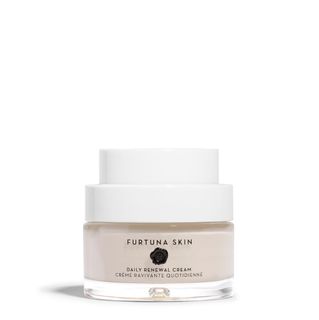
Furtuna Skin Perla Brillante Daily Renewal Cream
Works for
1 of 1 advertised claim delivered
Moisturizing16 ingredients credited for this claimGood support
“Recalibrate skin’s circadian rhythm during the day with this indulgent moisturizing cream that protects against daily stressors, renews radiance, visibly minimizes puffiness, and balances skin tone”
This product can help improve hydration of the skin with the two types of ingredients.
The first type is called “humectants”:
these ingredients help attract water.
When humectants are on the surface of the skin, they “pull in” the moisture from the outside environment, or from
within deeper layers of the skin. The following ingredients in this product do the job:
erythritol, glycerin.
This product also contains ingredients called “occlusives”. They help reduce the speed with which our skin loses moisture to the outside environment. These ingredients also help soften the upper layer of the skin, so it feels less tight and nicer to the touch. The following ingredients in this product do the job: helianthus annuus seed oil, helianthus annuus seed wax.
Can it cause trouble?
Irritancy2 strong irritants: Rosa damascena flower extract, Rosa damascena extract — patch-test recommendedHigh risk
Comedogenic3 ingredients rated 2 or more on the 0–5 pore-clogging scale3 flagged
User reviews
Be the first — your take helps the next person decide.
Ingredients
Filter by role to see what each ingredient is doing.
Olea europaea leaf water~23–34%
- Irritation risk
- Low
Undecane~7.2–10.8%
- Irritation risk
- Medium
Helps create a non-greasy finish on the skin
More about UndecaneGlycerin~4.9–7.4%
- Irritation risk
- Low
One of the best moisturizing ingredients. Naturally present in skin. It attracts water to the upper layer of the skin working as a humectant
More about GlycerinIsoamyl laurate~4.1–6.2%
- Irritation risk
- Medium
Helps stabilize emulsions and create a nice product texture
More about Isoamyl laurateWater~2.8–4.2%
Tridecane~1.9–2.8%
Polyglyceryl-6 distearate~1.7–2.6%
- Irritation risk
- Medium
Helps oil and water mix together while softening the upper layer of the skin
More about Polyglyceryl-6 distearateOlea europaea fruit oil~1.5–2.2%
- Irritation risk
- Medium
An emollient that helps soften the skin but is not effective for restoring its barrier function. Might be helpful to calm down inflammation
More about Olea europaea fruit oilCetearyl alcohol~1.4–2.1%
- Irritation risk
- Low
- Comedogenicity
- 2/5
A non-drying alcohol. Works as an emollient. Helps water and oil mix together and creates a nice product texture
More about Cetearyl alcoholJojoba esters~1.1–1.7%
- Irritation risk
- Medium
An emollient made of jojoba oil. Helps soften the skin and support its barrier function
More about Jojoba estersErythritol~0.85–1.3%
- Irritation risk
- Low
Helps to attract water to the upper layer of the skin
More about ErythritolFoeniculum vulgare seed extract~0.55–1.3%
- Irritation risk
- Low
Rosa damascena flower extract~0.5–1.15%
Arbutus unedo fruit extract~0.5–1.1%
- Irritation risk
- Low
Chenopodium album flower extract~0.45–1.05%
- Irritation risk
- Low
Rosa damascena flower extract~0.45–1.05%
Rosa damascena extract~0.45–1.05%
- Irritation risk
- High
Oil of a very fragrant pink rose used as fragrance in cosmetics. Extensive research has shown it has mixed benefits. In the pro column, inhaling this flower’s scent seems to have relaxing properties and the plant’s petals contain skin-soothing and antioxidant compounds that can benefit skin. On the flipside, the numerous chemicals that create this rose’s distinctive fragrance pose a risk of causing skin aggravation.
More about Rosa damascena extractLac~0.4–0.95%
- Irritation risk
- Low
Helps form a film on the surface of the skin and disperse other ingredients (like colorants) in cosmetics. Lac is a resinous substance secreted by parasite insects living on trees
More about LacUrtica dioica leaf extract~0.4–0.9%
- Irritation risk
- Low
Butyrospermum parkii butter~0.45–1%
- Irritation risk
- Low
- Comedogenicity
- 3/5
A great moisturising ingredient that softens the skin and reduces water loss from its upper layer. It also can be helpful in protecting skin from free radicals
More about Butyrospermum parkii butterBeta vulgaris root extract~0.35–0.85%
- Irritation risk
- Medium
A plant extract that might have some antioxidant properties, but mostly used in cosmetics for its color
More about Beta vulgaris root extractCichorium intybus root extract~0.35–0.85%
- Irritation risk
- Low
Malva sylvestris flower/leaf extract~0.35–0.8%
- Irritation risk
- Low
Papaver rhoeas flower extract~0.35–0.8%
- Irritation risk
- Low
Lamium album leaf extract~0.35–0.8%
- Irritation risk
- Low
Spirulina maxima extract~0.35–0.8%
- Irritation risk
- Low
- Comedogenicity
- 3/5
Lactobacillus ferment~0.35–0.8%
- Irritation risk
- Low
A fermentation product created by bacteria Lactobacillus. The fermented product has anti-bacterial properties and might be helpful in calming down inflammation, but studies are lacking. Helps attract water to the upper layer of the skin. Can be used as a preservative
More about Lactobacillus fermentBacillus ferment filtrate extract~0.35–0.8%
- Irritation risk
- Low
Acacia decurrens flower wax~0.35–0.8%
Helianthus annuus seed oil~0.35–0.85%
- Irritation risk
- Low
A great emollient due to its high linoleic acid content. One of the most effective plant oils in helping skin hydration and repairing skin barrier function
More about Helianthus annuus seed oilHelianthus annuus seed wax~0.35–0.85%
- Irritation risk
- Low
Helps soften the upper layer of the skin and support skin's barrier function while creating a thicker product consistency
More about Helianthus annuus seed waxCetyl alcohol~0.4–0.9%
- Irritation risk
- Low
A non-drying alcohol that works to soften the skin and stabilize product formulations helping oil and water mix together
More about Cetyl alcoholIsoamyl cocoate~0.35–0.8%
- Irritation risk
- Medium
Helps oil and water mix together and works as a cleansing agent
More about Isoamyl cocoatePolyglycerin-3~0.35–0.75%
- Irritation risk
- Low
Helps to attract water to the upper layer of the skin
More about Polyglycerin-3Polyglyceryl-3 beeswax~0.35–0.8%
- Irritation risk
- Medium
Helps water and oil mix together. Could be an allergen (beeswax)
More about Polyglyceryl-3 beeswaxSodium stearoyl glutamate~0.4–0.9%
- Irritation risk
- Medium
Helps oil and water mix together
More about Sodium stearoyl glutamateSucrose~0.2–0.75%
- Irritation risk
- Low
Can help attract water to the upper layer of the skin. In crystal form, it can work as a gentle exfoliant, gentler than the salt scrub. Helps stabilize the emulsion
More about SucroseLecithin~0.35–0.85%
- Irritation risk
- Low
Used mostly for creating emulsions - helping oil and water mix together. Helps soften the upper layer of the skin
More about LecithinXanthan gum~0.2–0.75%
- Irritation risk
- Low
Used to create a thicker product consistency
More about Xanthan gumTocopherol~0.1–0.5%
- Irritation risk
- Low
Pure form of vitamin E. Can help moisturise and protect the skin from free radicals. Often used to help stabilise other ingredients or the formula itself
More about TocopherolP-anisic acid~0.1–0.4%
- Irritation risk
- High
Helps preserve products. Can mask unpleasant smell. Could be irritating
More about P-anisic acidSodium dehydroacetate~0.1–0.4%
Citric acid~0.1–0.35%
- Irritation risk
- Medium
Can work as an exfoliant but is typically used to adjust the product pH
More about Citric acidSodium benzoate~0.1–0.3%
Potassium sorbate~0.1–0.35%
Ingredient list view
Olea europaea leaf water, Undecane, Glycerin, Isoamyl laurate, Water, Tridecane, Polyglyceryl-6 distearate, Olea europaea fruit oil, Cetearyl alcohol, Jojoba esters, Erythritol, Foeniculum vulgare seed extract, Rosa damascena flower extract, Arbutus unedo fruit extract, Chenopodium album flower extract, Rosa damascena flower extract, Rosa damascena extract, Lac, Urtica dioica leaf extract, Butyrospermum parkii butter, Beta vulgaris root extract, Cichorium intybus root extract, Malva sylvestris flower/leaf extract, Papaver rhoeas flower extract, Lamium album leaf extract, Spirulina maxima extract, Lactobacillus ferment, Bacillus ferment filtrate extract, Acacia decurrens flower wax, Helianthus annuus seed oil, Helianthus annuus seed wax, Cetyl alcohol, Isoamyl cocoate, Polyglycerin-3, Polyglyceryl-3 beeswax, Sodium stearoyl glutamate, Sucrose, Lecithin, Xanthan gum, Tocopherol, P-anisic acid, Sodium dehydroacetate, Citric acid, Sodium benzoate, Potassium sorbate
Compare prices
Retailers ranked by price — lowest first.

Sources cited in this review
Every concentration estimate and effectiveness label is anchored to one of these 15 studies and safety reviews.
- 1
- 2Use of “natural” oils for moisturization: Review of olive, coconut, and sunflower seed oilonlinelibrary.wiley.com
- 3
- 4
- 5Use of Probiotics for Dermal Applicationsresearchgate.net
- 6

Affiliate links · As an Amazon Associate, WIMJ earns from qualifying purchases.