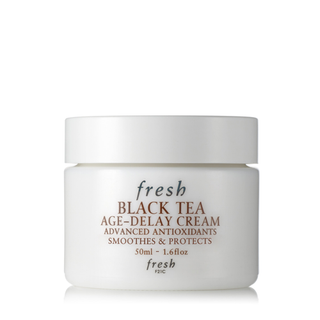
Works for
2 of 2 advertised claims delivered
Anti-agingAdenosine, Retinyl palmitate + 4 moreStrong evidence
“A face cream with advanced antioxidants that is designed to visibly reduce the appearance of fine lines and firm, smooth, and retexturize the skin.”
This product can help reduce and prevent fine lines and wrinkles, improve skin elasticity and firmness because it contains adenosine.
These ingredients in the product can also be helpful, even though there is less evidence for their effectiveness: retinyl palmitate.
Keep in mind that it typically takes at least 6 weeks to notice any results because the changes that are needed to improve fine lines and elasticity happen in the deeper layers of the skin. No topical anti-aging product can “erase” wrinkles or fully reverse signs of aging.
MoisturizingHippophae rhamnoides oil, Saccharomyces ferment filtrate + 26 moreGood evidence
“Black Tea Age Delay Moisturizer”
This product can help improve hydration of the skin with the two types of ingredients.
The first type is called “humectants”:
these ingredients help attract water.
When humectants are on the surface of the skin, they “pull in” the moisture from the outside environment, or from
within deeper layers of the skin. The following ingredients in this product do the job:
glycerin, saccharomyces ferment filtrate.
This product also contains ingredients called “occlusives”. They help reduce the speed with which our skin loses moisture to the outside environment. These ingredients also help soften the upper layer of the skin, so it feels less tight and nicer to the touch. The following ingredients in this product do the job: dimethicone, helianthus annuus seed oil.
Evens skin toneNot advertised by the brand · Retinyl palmitate, Camellia sinensis leaf extract + 1 moreModerate evidence
The following ingredient (ingredients) in this product might be helpful, but there is no evidence to confirm that it actually works: retinyl palmitate.
Anti-oxidationNot advertised by the brand · Camellia sinensis leaf extract, Adenosine + 10 moreModerate evidence
This product contains antioxidants (camellia sinensis leaf extract) that might be able to help neutralize free radicals in skin to lessen the damage it gets from the UV light (sun). There is not enough evidence to confirm their effectiveness in skin though.
Can it cause trouble?
Irritancy9 strong irritants: Citrus aurantium dulcis fruit extract, Citrus limon fruit extract + 7 more — patch-test recommendedHigh risk
Comedogenic1 ingredient rated 2 or more on the 0–5 pore-clogging scale1 flagged


User reviews
Be the first — your take helps the next person decide.
Ingredients
Filter by role to see what each ingredient is doing.
Water~45–55%
Propylene glycol dicaprylate/dicaprate~4.4–5.3%
- Irritation risk
- Low
Hydrogenated polyisobutene~4.1–5%
- Irritation risk
- Low
Used to improve the product consistency and soften the upper layer of the skin
More about Hydrogenated polyisobuteneCaprylic/capric/succinic triglyceride~2.7–3.3%
Glycerin~2.4–2.9%
- Irritation risk
- Low
One of the best moisturizing ingredients. Naturally present in skin. It attracts water to the upper layer of the skin working as a humectant
More about GlycerinCetearyl isononanoate~2–2.4%
- Irritation risk
- Low
An emollient that softens the skin and helps prevent moisture loss.
More about Cetearyl isononanoatePentylene glycol~1.7–2%
- Irritation risk
- Medium
Used to preserve products, dissolve other ingredients and create a nice product texture
More about Pentylene glycolEthylhexyl palmitate~1.5–1.8%
- Irritation risk
- Low
- Comedogenicity
- 3/5
An emollient that helps soften the skin and create a nice product texture
More about Ethylhexyl palmitateSteareth-21~1.2–1.5%
Cetyl palmitate~1–1.2%
- Irritation risk
- Low
An emollient that helps soften the skin and is used to improve product texture and stability
More about Cetyl palmitateHydrogenated coco-glycerides~0.7–1.1%
- Irritation risk
- Medium
Helps oil and water mix together while creating a nice finish on the skin
More about Hydrogenated coco-glyceridesC10-30 cholesterol/lanosterol esters~0.6–0.85%
Cetyl alcohol~0.65–0.95%
- Irritation risk
- Low
A non-drying alcohol that works to soften the skin and stabilize product formulations helping oil and water mix together
More about Cetyl alcoholEthylhexyl stearate~0.55–0.8%
- Irritation risk
- Low
Helps soften the upper layer of the skin
More about Ethylhexyl stearateStearyl alcohol~0.5–0.8%
- Irritation risk
- Low
An emollient that helps soften the skin
More about Stearyl alcoholGlyceryl stearate~0.5–0.75%
- Irritation risk
- Low
An emollient that softens the skin and forms a protective layer on its surface. Helps water and oil mix together
More about Glyceryl stearateVitis vinifera seed oil~0.5–0.7%
- Irritation risk
- Medium
A great emollient that can also have anti-oxidant properties
More about Vitis vinifera seed oilSaccharomyces ferment filtrate~0.4–0.6%
- Irritation risk
- Low
A product of yeast fermentation. Helps attract water to the upper layer of the skin
More about Saccharomyces ferment filtrateAvena sativa kernel extract~0.4–0.6%
- Irritation risk
- Low
An effective moisturizing and skin barrier repair ingredient. Helps calm down inflammation and has some anti-oxidant properties
More about Avena sativa kernel extractCamellia sinensis leaf extract~0.35–0.6%
- Irritation risk
- Low
Can contain potent anti-oxidant compounds (abbreviated ECG, GCG, EGC, and EGCG) that might help protect the skin from free radicals. Can help calm down inflammation and has some anti-bacterial properties. Unfortunately, these antioxidants are unstable and lose their effectiveness very quickly in products. The concentration of the antioxidant compounds in the extract also tends to be low to be effective in topical formulation
More about Camellia sinensis leaf extractRibes nigrum seed oil~0.35–0.6%
- Irritation risk
- Medium
An emollient. Can be helpful for restoring skin barrier function.
More about Ribes nigrum seed oilHydrolyzed soy flour~0.3–0.6%
- Irritation risk
- Low
Vaccinium myrtillus fruit extract~0.3–0.55%
- Irritation risk
- Medium
A plant extract that might help neutralize free radicals in skin, but research on its efficacy in skin is lacking
More about Vaccinium myrtillus fruit extractMoringa pterygosperma seed extract~0.3–0.55%
- Irritation risk
- Low
Might help attract water to the upper layer of the skin
More about Moringa pterygosperma seed extractSaccharum officinarum extract~0.3–0.55%
- Irritation risk
- Low
Sugar extract that helps attract water to the upper layer of the skin
More about Saccharum officinarum extractLitchi chinensis seed extract~0.3–0.55%
- Irritation risk
- Low
Hippophae rhamnoides oil~0.35–0.65%
- Irritation risk
- High
A good emollient. Contains various ingredients including vitamins and fatty acids that could work in the skin to neutralize free radicals and minimize moisture loss - if enough of these compounds is able to penetrate the skin in an active form.
More about Hippophae rhamnoides oilRubus fruticosus leaf extract~0.3–0.55%
- Irritation risk
- Low
Citrus aurantium dulcis fruit extract~0.3–0.55%
- Irritation risk
- High
A plant extract that is used as a fragrance. Can be irritating and lead to photosensitivity
More about Citrus aurantium dulcis fruit extractCitrus limon fruit extract~0.3–0.55%
- Irritation risk
- High
Used as a fragrance. Can be irritating and cause photosensitivity
More about Citrus limon fruit extractAcer saccharum extract~0.3–0.55%
- Irritation risk
- Medium
A plant extract that contains small percentage of AHAs. Is unlikely to have any skin benefit due the small concentration of the active compounds
More about Acer saccharum extractRosa damascena flower oil~0.3–0.55%
- Irritation risk
- High
Used as a fragrance. Can be irritating
More about Rosa damascena flower oilHelianthus annuus seed oil~0.35–0.6%
- Irritation risk
- Low
A great emollient due to its high linoleic acid content. One of the most effective plant oils in helping skin hydration and repairing skin barrier function
More about Helianthus annuus seed oilRosmarinus officinalis leaf extract~0.3–0.55%
- Irritation risk
- High
Can be helpful in reducing inflammation in skin, including inflamed acne. It can be irritating
More about Rosmarinus officinalis leaf extractTocopheryl acetate~0.3–0.6%
- Irritation risk
- Medium
A more stable but less bio-available form of vitamin E compared to Tocopherol. Might help moisturize and protect the skin from free radicals, but mostly used in low concentrations to stabilize other ingredients.
More about Tocopheryl acetateAscorbyl tetraisopalmitate~0.35–0.6%
- Irritation risk
- Medium
A vitamin C derivative. Studies show that is might be effective in reducing hyperpigmentation, but there are no studies confirming that it is effectively converted into the bioavailable form of Vitamin C in skin. It is not clear how this derivative compares in effectiveness to the topical application of bioavailable form of vitamin C (L-ascorbic acid)
More about Ascorbyl tetraisopalmitateRetinyl palmitate~0.3–0.55%
- Irritation risk
- High
Three steps removed from the active form of vitamin A - retinoic acid. To have an effect in the skin, it first needs to be converted twice to become the retinoic acid. This means it is less potent than retinol, but could also be less irritating. Once converted to the retinoic acid in the skin, it helps against all signs of aging, improves skin cell turnover and helps fight blemishes and clogged pores. However, in many cosmetic formulations, it is used in a concentration that is too low to have the full effect
More about Retinyl palmitateTocopherol~0.3–0.6%
- Irritation risk
- Low
Pure form of vitamin E. Can help moisturise and protect the skin from free radicals. Often used to help stabilise other ingredients or the formula itself
More about TocopherolAscorbyl palmitate~0.3–0.55%
- Irritation risk
- Medium
Being a lipid soluble form of vitamin C, it is more stable and can penetrate the skin better than L-Ascorbic acid. It is effective in protecting the skin from free radicals, as well as evening the skin tone, but is less effective in stimulating collagen production compared to L-Ascorbic acid.
More about Ascorbyl palmitateButylene glycol~0.3–0.55%
- Irritation risk
- Low
Used to create a nice product texture and help delivery of other ingredients. Might be somewhat helpful in attracting water to the upper layer of the skin
More about Butylene glycolAcrylates/c10-30 alkyl acrylate crosspolymer~0.35–0.6%
- Irritation risk
- Medium
Maintains the texture of skincare products. Allows the product to spread evenly. Helps oil and water mix together
More about Acrylates/c10-30 alkyl acrylate crosspolymerParfum~0.3–0.55%
- Irritation risk
- High
An aromatic blend of unspecified and possibly irritating ingredients
More about ParfumDimethicone~0.4–0.6%
- Irritation risk
- Low
A silicone that helps to reduce water loss from the surface of the skin. Can temporarily "fill in" lines and wrinkles, absorb oil, and create a nice product finish
More about DimethiconeTetrasodium edta~0.3–0.55%
Polyacrylamide~0.35–0.65%
- Irritation risk
- Medium
Used to improve product texture and help oil and water mix together
More about PolyacrylamideSodium hyaluronate~0.3–0.55%
- Irritation risk
- Low
One of the best moisturizing ingredients. Attracts water into the upper layer of the skin
More about Sodium hyaluronateC13-14 isoparaffin~0.35–0.65%
- Irritation risk
- Low
Helps soften the upper layer of the skin, dissolve other ingredients and create a thicker product consistency
More about C13-14 isoparaffinMaltodextrin~0.3–0.6%
- Irritation risk
- Low
Used to stabilize the product formulation and can help absorb oil
More about MaltodextrinSodium hydroxide~0.3–0.55%
Silica~0.5–0.7%
Trihydroxystearin~0.3–0.55%
- Irritation risk
- Low
Helps soften the upper layer of the skin and improve the product texture
More about TrihydroxystearinAdenosine~0.3–0.55%
- Irritation risk
- Low
Might help improve cell turnover and reduce inflammation in skin. One study shows that the ingredients might be able to help reduce dynamic wrinkles (for example, in the corners of the eyes or on the forehead)
More about AdenosineCi 77891~0.3–0.55%
- Irritation risk
- Low
Bht~0.3–0.55%
Laureth-7~0.3–0.6%
Caprylyl glycol~0.35–0.6%
- Irritation risk
- Medium
Helps preserve products and creates a nice product texture
More about Caprylyl glycolHydroxyethylcellulose~0.3–0.6%
- Irritation risk
- Low
Used to thicken product formulations and create gel-like textures
More about HydroxyethylcelluloseDisodium phosphate~0.3–0.55%
- Irritation risk
- Low
Helps adjust the product pH and stabilize the formulation
More about Disodium phosphateCitric acid~0.3–0.55%
- Irritation risk
- Medium
Can work as an exfoliant but is typically used to adjust the product pH
More about Citric acidSodium citrate~0.3–0.5%
- Irritation risk
- Medium
Helps to control the skin's pH level. Maintains the skin's natural film of amino-lactic acids and oils. Helps to preserve products
More about Sodium citrateCaramel~0.3–0.5%
- Irritation risk
- Low
Hexylene glycol~0.25–0.5%
- Irritation risk
- Medium
Helps create a more spreadable product texture
More about Hexylene glycolCi 14700~0.25–0.45%
Biotin~0.25–0.45%
- Irritation risk
- Low
Might have some moisturising properties. Is not effective when applied topically beyond some moisturizing effect
More about BiotinPotassium sorbate~0.2–0.4%
Phenoxyethanol~0.2–0.35%
- Irritation risk
- Low
A preservative. It helps prevent bacterial growth in cosmetic products
More about PhenoxyethanolLinalool~0.15–0.25%
Citronellol~0.15–0.25%
Geraniol~0.15–0.25%
Ingredient list view
Water, Propylene glycol dicaprylate/dicaprate, Hydrogenated polyisobutene, Caprylic/capric/succinic triglyceride, Glycerin, Cetearyl isononanoate, Pentylene glycol, Ethylhexyl palmitate, Steareth-21, Cetyl palmitate, Hydrogenated coco-glycerides, C10-30 cholesterol/lanosterol esters, Cetyl alcohol, Ethylhexyl stearate, Stearyl alcohol, Glyceryl stearate, Vitis vinifera seed oil, Saccharomyces ferment filtrate, Avena sativa kernel extract, Camellia sinensis leaf extract, Ribes nigrum seed oil, Hydrolyzed soy flour, Vaccinium myrtillus fruit extract, Moringa pterygosperma seed extract, Saccharum officinarum extract, Litchi chinensis seed extract, Hippophae rhamnoides oil, Rubus fruticosus leaf extract, Citrus aurantium dulcis fruit extract, Citrus limon fruit extract, Acer saccharum extract, Rosa damascena flower oil, Helianthus annuus seed oil, Rosmarinus officinalis leaf extract, Tocopheryl acetate, Ascorbyl tetraisopalmitate, Retinyl palmitate, Tocopherol, Ascorbyl palmitate, Butylene glycol, Acrylates/c10-30 alkyl acrylate crosspolymer, Parfum, Dimethicone, Tetrasodium edta, Polyacrylamide, Sodium hyaluronate, C13-14 isoparaffin, Maltodextrin, Sodium hydroxide, Silica, Trihydroxystearin, Adenosine, Ci 77891, Bht, Laureth-7, Caprylyl glycol, Hydroxyethylcellulose, Disodium phosphate, Citric acid, Sodium citrate, Caramel, Hexylene glycol, Ci 14700, Biotin, Potassium sorbate, Phenoxyethanol, Linalool, Citronellol, Geraniol
Compare prices
Retailers ranked by price — lowest first.

Worth comparing, line by line.
Match % combines shared ingredients, the first five ingredients, shared actives and hero ingredients, irritancy (lower counts in the alternative's favour), texture and body area. Only products in the same routine step are compared.
| FreshBlack Tea Age Delay MoisturizerYOUR PRODUCT | P.CALMCato Cream | Beauty of JoseonDynasty Cream | Secret KeyHyaluron Aqua Soft Cream | |
|---|---|---|---|---|
| Match | — | 58% | 57% | 57% |
| Price | $90.00 | $17.99−$72.01 | $20.50−$69.50 | $11.40−$78.60 |
| Shared key ingredients | — | 7 of 14 | 6 of 14 | 5 of 14 |
| Key difference | — | Niacinamide | Niacinamide | Niacinamide |
| Irritancy | High | Medium | Medium | Medium |
| Drying alcohol | — | — | — | — |
| View product | Shop | Shop | Shop |


Sources cited in this review
Every concentration estimate and effectiveness label is anchored to one of these 27 studies and safety reviews.
- 1
- 2
- 3
- 4Herbal Medicine: Biomolecular and Clinical Aspects. 2nd edition.ncbi.nlm.nih.gov
- 5
- 6

Affiliate links · As an Amazon Associate, WIMJ earns from qualifying purchases.