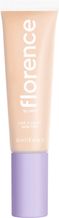
florence by mills Like a Light Skin Tint
Works for
1 of 2 advertised claims delivered
Moisturizing15 ingredients credited for this claimGood support
“A natural form of Squalene plumps the skin with hydration, deeply nourishing the complexion while smoothing the surface.”
This product can help improve hydration of the skin with the two types of ingredients.
The first type is called “humectants”:
these ingredients help attract water.
When humectants are on the surface of the skin, they “pull in” the moisture from the outside environment, or from
within deeper layers of the skin. The following ingredients in this product do the job:
biosaccharide gum-1, glycerin.
This product also contains ingredients called “occlusives”. They help reduce the speed with which our skin loses moisture to the outside environment. These ingredients also help soften the upper layer of the skin, so it feels less tight and nicer to the touch. The following ingredients in this product do the job: helianthus annuus seed oil, squalane.
Evens skin toneNo ingredient credited for this claimNo support
“Enriched with Jojoba, the formula has anti-inflammatory power, reducing any redness and cooling any irritation to leave a more even tone and texture.”
Effective ingredients missing or their concentration is too low
Can it cause trouble?
Irritancy10 flagged ingredientsLow risk
Comedogenic3 ingredients rated 2 or more on the 0–5 pore-clogging scale3 flagged
User reviews
Be the first — your take helps the next person decide.
Ingredients
Filter by role to see what each ingredient is doing.
Water~40–60%
Glycerin~4.1–6.2%
- Irritation risk
- Low
One of the best moisturizing ingredients. Naturally present in skin. It attracts water to the upper layer of the skin working as a humectant
More about GlycerinGlyceryl stearate se~3.3–5%
- Irritation risk
- Low
- Comedogenicity
- 2/5
Used to stabilize the product formulations and works as an emollient
More about Glyceryl stearate seOctyldodecanol~2.7–4%
- Irritation risk
- Low
An emollient that helps to soften the skin and create a pleasant product texture and stabilize the formulation
More about OctyldodecanolHelianthus annuus seed oil~2.1–3.2%
- Irritation risk
- Low
A great emollient due to its high linoleic acid content. One of the most effective plant oils in helping skin hydration and repairing skin barrier function
More about Helianthus annuus seed oilCoco-caprylate~1.7–2.6%
- Irritation risk
- Medium
An emollient that softens skin and creates a nice product texture
More about Coco-caprylateAvena sativa bran extract~1.6–2.3%
- Irritation risk
- Medium
Sodium hyaluronate~1.2–1.9%
- Irritation risk
- Low
One of the best moisturizing ingredients. Attracts water into the upper layer of the skin
More about Sodium hyaluronateTocopherol~1–1.5%
- Irritation risk
- Low
Pure form of vitamin E. Can help moisturise and protect the skin from free radicals. Often used to help stabilise other ingredients or the formula itself
More about TocopherolMeadowfoam delta-lactone~0.8–1.2%
- Irritation risk
- Low
Limnanthes alba seed oil~0.55–1.25%
- Irritation risk
- Low
This oil's cmposition is closest to rapeseed oil. It is a very stable oil and serves as an emoillient
More about Limnanthes alba seed oilPersea gratissima oil~0.45–1.05%
- Irritation risk
- Medium
An emollient that helps soften the skin and could be helpful in repairing its barrier function
More about Persea gratissima oilButyrospermum parkii butter~0.4–0.95%
- Irritation risk
- Low
- Comedogenicity
- 3/5
A great moisturising ingredient that softens the skin and reduces water loss from its upper layer. It also can be helpful in protecting skin from free radicals
More about Butyrospermum parkii butterJojoba esters~0.35–0.85%
- Irritation risk
- Medium
An emollient made of jojoba oil. Helps soften the skin and support its barrier function
More about Jojoba estersMagnesium aluminum silicate~0.35–0.8%
- Irritation risk
- Low
Might be helpful in restoring skin barrier function and, when combined with zinc carbonate and malonic acid, reducing fine lines and wrinkles by stimulating elastin production. Also helps stabilize the product formulation
More about Magnesium aluminum silicateTocopheryl acetate~0.3–0.75%
- Irritation risk
- Medium
A more stable but less bio-available form of vitamin E compared to Tocopherol. Might help moisturize and protect the skin from free radicals, but mostly used in low concentrations to stabilize other ingredients.
More about Tocopheryl acetateEthylhexylglycerin~0.3–0.7%
Lecithin~0.3–0.7%
- Irritation risk
- Low
Used mostly for creating emulsions - helping oil and water mix together. Helps soften the upper layer of the skin
More about LecithinSqualane~0.2–0.8%
- Irritation risk
- Low
An oil naturally present in skin. Works as an emollient to soften the skin and form a protective layer on its surface without a greasy feeling.
More about SqualaneMaltodextrin~0.15–0.65%
- Irritation risk
- Low
Used to stabilize the product formulation and can help absorb oil
More about MaltodextrinCetearyl alcohol~0.15–0.7%
- Irritation risk
- Low
- Comedogenicity
- 2/5
A non-drying alcohol. Works as an emollient. Helps water and oil mix together and creates a nice product texture
More about Cetearyl alcoholSodium stearoyl glutamate~0.15–0.7%
- Irritation risk
- Medium
Helps oil and water mix together
More about Sodium stearoyl glutamatePolyglyceryl-4 caprate~0.15–0.55%
Xanthan gum~0.15–0.5%
- Irritation risk
- Low
Used to create a thicker product consistency
More about Xanthan gumIsoamyl laurate~0.15–0.55%
- Irritation risk
- Medium
Helps stabilize emulsions and create a nice product texture
More about Isoamyl laurateSilica~0.2–0.75%
Biosaccharide gum-1~0.1–0.4%
- Irritation risk
- Low
Helps attract water to the upper layer of the skin and is claimed to provide a longer-lasting hydration because of its ability to create a water-binding film on the surface of the skin
More about Biosaccharide gum-1Phenoxyethanol~0.1–0.35%
- Irritation risk
- Low
A preservative. It helps prevent bacterial growth in cosmetic products
More about PhenoxyethanolDisodium edta~0.1–0.3%
Citric acid~0.05–0.25%
- Irritation risk
- Medium
Can work as an exfoliant but is typically used to adjust the product pH
More about Citric acidIron oxides~0.05–0.2%
- Irritation risk
- Low
An umbrella term for the following three colorants: CI 77491, CI 77492, CI 77499. They might be able to offer some protection against visible light, but the degree of the protection is not clear
More about Iron oxidesCi 77891~0.05–0.15%
- Irritation risk
- Low
Titanium dioxide~0.05–0.15%
- Irritation risk
- Low
Works as a UV filter when used in high concentrations. It is photostable and is effective mostly against the UVB light, with some protection in the UVA range. In small concentrations, used for its ability to improve the color of cosmetic products. Is usually well tolerated by the skin
More about Titanium dioxideIngredient list view
Water, Glycerin, Glyceryl stearate se, Octyldodecanol, Helianthus annuus seed oil, Coco-caprylate, Avena sativa bran extract, Sodium hyaluronate, Tocopherol, Meadowfoam delta-lactone, Limnanthes alba seed oil, Persea gratissima oil, Butyrospermum parkii butter, Jojoba esters, Magnesium aluminum silicate, Tocopheryl acetate, Ethylhexylglycerin, Lecithin, Squalane, Maltodextrin, Cetearyl alcohol, Sodium stearoyl glutamate, Polyglyceryl-4 caprate, Xanthan gum, Isoamyl laurate, Silica, Biosaccharide gum-1, Phenoxyethanol, Disodium edta, Citric acid, Iron oxides, Ci 77891, Titanium dioxide
Compare prices
Retailers ranked by price — lowest first.

Sources cited in this review
Every concentration estimate and effectiveness label is anchored to one of these 11 studies and safety reviews.
- 1
- 2
- 3
- 4Effect of topically applied lipids on surfactant-irritated skinonlinelibrary.wiley.com
- 5
- 6Hyaluronic acid: A key molecule in skin agingncbi.nlm.nih.gov

Affiliate links · As an Amazon Associate, WIMJ earns from qualifying purchases.