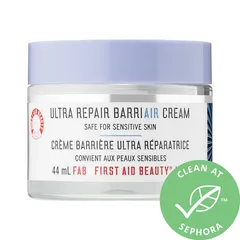
Works for:
based on ingredients and %- Moisturizing
- Anti-oxidation
Can it cause trouble?
- Irritation risk: medium
- Comedogenic risk ingredients: 0
Key actives

Product Summary
Based on the ingredients included, "First Aid Beauty - Ultra Repair BarriAIR Cream" works well for moisturizing the skin. To work well, any moisturizer needs to include a combination of water-binding and emollient ingredients. First Aid Beauty - Ultra Repair BarriAIR Cream ticks this box. Humectants in this product (glycerin, hydrolyzed yeast extract, sodium hyaluronate and caprylyl glycol) help to increase the water content in the upper layer of the skin. (These ingredients do so by "capturing" water molecules from the outside air or from within the deeper layers of the skin). Emollients in this formulation (ceramide ng, colloidal oatmeal, linoleic acid, cholesterol and linolenic acid) help to reduce the moisture loss from the skin. They also soften the skin surface and relieve the feeling of dryness and tightness.
Ingredient callouts
- Another benefit is that this moisturizer contain ceramides (ceramide ng 0.60% - 0.95%). Ceramides are an important part of our natural skin barrier. The ceramides used in skincare are synthetic or come from plants. They help soften the skin and can help "fill the gaps" in the skin barrier, keeping the skin hydrated and resilient for longer.
- Another helpful ingredient in this moisturizer is Linoleic Acid. It is one of the fatty acids naturally present in skin. It is part of the skin barrier. Preliminary research shows that it might be able to reduce clogged pores.
Irritation risk
There are some common irritants in this product, including ingredients that do not have benefits for the skin. We assess the overall irritancy of this moisturizer to be medium. For a detailed overview of all potential irritants: click here
You can see the detailed formula review with the breakdown of all actives in the product and the full ingredient list with estimated concentrations in the tables below.
Price
The product retails for 20.70$ in the United States, from 15.00£ up to 50.00£ in the United Kingdom and for 26.30CA$ in Canada.
For a detailed price comparison: click here.
Works for
Moisturizing
What does the product description say?
Ultra Repair BarriAIR Cream
Source: From product name
This product can help improve hydration of the skin with the two types of ingredients.
The first type is called “humectants”:
these ingredients help attract water.
When humectants are on the surface of the skin, they “pull in” the moisture from the outside environment, or from
within deeper layers of the skin. The following ingredients in this product do the job:
glycerin, hydrolyzed yeast extract.
This product also contains ingredients called “occlusives”. They help reduce the speed with which our skin loses moisture to the outside environment. These ingredients also help soften the upper layer of the skin, so it feels less tight and nicer to the touch. The following ingredients in this product do the job: caprylic/capric triglyceride, cholesterol.
The following ingredients in this product are especially good for supporting the skin barrier and helping with the hydration level: ceramide ng, colloidal oatmeal, linoleic acid
One of the best moisturizing ingredients. Attracts water into the upper layer of the skin
An emollient that is naturally found in skin
Helps to restore skin barrier function, soften the upper layer of the skin and calm down inflammation
One of the best moisturizing ingredients. Naturally present in skin. It attracts water to the upper layer of the skin working as a humectant
A type of lipid similar to ceramides naturally present in skin. Helps to soften the upper layer of the skin and supports the skin barrier function to keep it hydrated. Can help to prevent inflammation in skin
Helps attract water to the upper layer of the skin and might have some anti-oxidant and skin lightening properties
A good mix of fatty acids that forms a protective layer on the skin. Improves the shelf life of products. Derived from coconut and glycerin
An excellent emollient. Helps soften the skin, restore its barrier function, and can help to calm down inflammation. It can be helpful to prevent blemishes and clogged pores
An emollient that helps soften the skin and calm down inflammation
A non-drying alcohol that works to soften the skin and stabilize product formulations helping oil and water mix together
Helps preserve products and creates a nice product texture
An emollient that helps soften the skin and creates a thicker product texture
An emollient that softens the skin and forms a protective layer on its surface. Helps water and oil mix together
Can contain potent anti-oxidant compounds (abbreviated ECG, GCG, EGC, and EGCG) that might help protect the skin from free radicals. Can help calm down inflammation and has some anti-bacterial properties. Unfortunately, these antioxidants are unstable and lose their effectiveness very quickly in products. The concentration of the antioxidant compounds in the extract also tends to be low to be effective in topical formulation
Helps oil and water mix together and works as an emollient
Used mostly for creating emulsions - helping oil and water mix together. Helps soften the upper layer of the skin
Pure form of vitamin E. Can help moisturise and protect the skin from free radicals. Often used to help stabilise other ingredients or the formula itself
Anti-oxidation
This product contains antioxidants (camellia sinensis leaf extract) that might be able to help neutralize free radicals in skin to lessen the damage it gets from the UV light (sun). There is not enough evidence to confirm their effectiveness in skin though.
Can contain potent anti-oxidant compounds (abbreviated ECG, GCG, EGC, and EGCG) that might help protect the skin from free radicals. Can help calm down inflammation and has some anti-bacterial properties. Unfortunately, these antioxidants are unstable and lose their effectiveness very quickly in products. The concentration of the antioxidant compounds in the extract also tends to be low to be effective in topical formulation
Helps to restore skin barrier function, soften the upper layer of the skin and calm down inflammation
A plant extract that can help lighten the skin and calm down inflammation. Might be helpful in neutralizing free radicals
Helps attract water to the upper layer of the skin and might have some anti-oxidant and skin lightening properties
Pure form of vitamin E. Can help moisturise and protect the skin from free radicals. Often used to help stabilise other ingredients or the formula itself
How honest is this product?
| Promise | Can it deliver? |
|---|---|
| Moisturizing |
Total Promises Fulfilled score: 100/100.
We receive a small commission for purchases made through these links at no cost for you. Thank you for your support! Learn more
Potential irritants
Comedogenic ingredients
No comedogenic ingredients detected
User reviews (0)
Averages from community submissions.
No reviews yet for this product.
Be the first to share your experience!
Tried this product?
Help capture what the ingredient list can't—texture, finish, pilling, scent, and more. Answer what you can, skip the rest.
Takes ~30 seconds.
Reviews are shown in aggregate. No personal details.
Key Actives
Can contain potent anti-oxidant compounds (abbreviated ECG, GCG, EGC, and EGCG) that might help protect the skin from free radicals. Can help calm down inflammation and has some anti-bacterial properties. Unfortunately, these antioxidants are unstable and lose their effectiveness very quickly in products. The concentration of the antioxidant compounds in the extract also tends to be low to be effective in topical formulation
Helps to restore skin barrier function, soften the upper layer of the skin and calm down inflammation
An emollient that helps soften the skin and calm down inflammation
Pure form of vitamin E. Can help moisturise and protect the skin from free radicals. Often used to help stabilise other ingredients or the formula itself
Helps attract water to the upper layer of the skin and might have some anti-oxidant and skin lightening properties
An excellent emollient. Helps soften the skin, restore its barrier function, and can help to calm down inflammation. It can be helpful to prevent blemishes and clogged pores
A type of lipid similar to ceramides naturally present in skin. Helps to soften the upper layer of the skin and supports the skin barrier function to keep it hydrated. Can help to prevent inflammation in skin
An emollient that is naturally found in skin
One of the best moisturizing ingredients. Naturally present in skin. It attracts water to the upper layer of the skin working as a humectant
A good mix of fatty acids that forms a protective layer on the skin. Improves the shelf life of products. Derived from coconut and glycerin
One of the best moisturizing ingredients. Attracts water into the upper layer of the skin
Used to create a gel-like product texture, as well as to stabilize emulsions
Potential irritants
Could have anti-inflammatory effect on skin, but can be irritating as well. Can be added to products for its smell
An emollient that helps soften the skin and creates a thicker product texture
Used in products to help dissolve oxygen and enhance oxygen molecule penetration into the skin. There is no evidence for benefits of the oxygen emulsion in topical creams, lotions or serums. There is a study available confirming a positive impact of oxygen therapy for skin wound healing, but it used an oxygen emulsion stored under high pressure using special equipment
A good mix of fatty acids that forms a protective layer on the skin. Improves the shelf life of products. Derived from coconut and glycerin
A plant extract that can help lighten the skin and calm down inflammation. Might be helpful in neutralizing free radicals
An emollient that helps soften the skin and calm down inflammation
Helps water and oil mix together and create a gel-like product consistency
A preservative that comes from radishes fermented by a bacteria. New research suggests that the preservation properties in the ingredient come from an ammonium salt that is not present naturally in radish root but used in its cultivation. Is problematic because the exact amount of the preservative agents is difficult to determine
Comedogenic ingredients
We couldn't find any comedogenic ingredients in this product
All ingredients
Acts as a solvent for other ingredients. Speeds up the absorption of other ingredients into the skin
One of the best moisturizing ingredients. Naturally present in skin. It attracts water to the upper layer of the skin working as a humectant
An emollient that helps soften the skin and creates a thicker product texture
Used in products to help dissolve oxygen and enhance oxygen molecule penetration into the skin. There is no evidence for benefits of the oxygen emulsion in topical creams, lotions or serums. There is a study available confirming a positive impact of oxygen therapy for skin wound healing, but it used an oxygen emulsion stored under high pressure using special equipment
A good mix of fatty acids that forms a protective layer on the skin. Improves the shelf life of products. Derived from coconut and glycerin
Is used to enhance product texture and can help to optically mask skin imperfections
Oxygen molecules that are abundant in normal air. In cosmetic formulas typically comes as a perfluorohexane oxygen emulsion. There is no evidence for benefits of the oxygen emulsion in topical creams, lotions or serums. There is a study available confirming a positive impact of oxygen therapy for skin wound healing, but it used an emulsion stored under high pressure using special equipment
Helps to restore skin barrier function, soften the upper layer of the skin and calm down inflammation
Helps attract water to the upper layer of the skin and might have some anti-oxidant and skin lightening properties
A type of lipid similar to ceramides naturally present in skin. Helps to soften the upper layer of the skin and supports the skin barrier function to keep it hydrated. Can help to prevent inflammation in skin
One of the best moisturizing ingredients. Attracts water into the upper layer of the skin
A plant extract that can help lighten the skin and calm down inflammation. Might be helpful in neutralizing free radicals
Could have anti-inflammatory effect on skin, but can be irritating as well. Can be added to products for its smell
Can contain potent anti-oxidant compounds (abbreviated ECG, GCG, EGC, and EGCG) that might help protect the skin from free radicals. Can help calm down inflammation and has some anti-bacterial properties. Unfortunately, these antioxidants are unstable and lose their effectiveness very quickly in products. The concentration of the antioxidant compounds in the extract also tends to be low to be effective in topical formulation
An excellent emollient. Helps soften the skin, restore its barrier function, and can help to calm down inflammation. It can be helpful to prevent blemishes and clogged pores
An emollient that helps soften the skin and calm down inflammation
Used to create a thicker product consistency and stabilize formulations
Pure form of vitamin E. Can help moisturise and protect the skin from free radicals. Often used to help stabilise other ingredients or the formula itself
Often used to support the moisturization effect of polysaccharides (contained, for example, in yeast extract)
Helps to dissolve other ingredients in a formulation. Slows down the rate of product drying
Used to create a thicker product consistency
An emollient that softens the skin and forms a protective layer on its surface. Helps water and oil mix together
Used to create a gel-like product texture, as well as to stabilize emulsions
Used mostly for creating emulsions - helping oil and water mix together. Helps soften the upper layer of the skin
Helps water and oil mix together and create a gel-like product consistency
A non-drying alcohol that works to soften the skin and stabilize product formulations helping oil and water mix together
A preservative. It helps prevent bacterial growth in cosmetic products
Used in products to create an oxygen emulsion
A preservative that comes from radishes fermented by a bacteria. New research suggests that the preservation properties in the ingredient come from an ammonium salt that is not present naturally in radish root but used in its cultivation. Is problematic because the exact amount of the preservative agents is difficult to determine
Ingredient list view
Water, Propanediol, Glycerin, Cetyl ethylhexanoate, Perfluorohexane, Caprylic/capric triglyceride, Polymethyl methacrylate, Oxygen, Colloidal oatmeal, Caprylyl glycol, Hydrolyzed yeast extract, Ceramide ng, Sodium hyaluronate, Glycyrrhiza glabra root extract, Chrysanthemum parthenium extract, Camellia sinensis leaf extract, Linoleic acid, Linolenic acid, Sodium polyacrylate starch, Stearic acid, Cetyl hydroxyethylcellulose, Cholesterol, Tocopherol, Polyglucuronic acid, Dipropylene glycol, Sodium acrylate/sodium acryloyldimethyl taurate copolymer, Glyceryl stearate, Sodium polyacrylate, Polypropylene, Polysorbate 80, Lecithin, Ethylhexylglycerin, Steareth-30, Cetyl alcohol, Phenoxyethanol, Chlorphenesin, Perfluoromethylcyclopentane, Leuconostoc/radish root ferment filtrate, Sodium benzoate, Potassium sorbate
- Glycerol and the skin: holistic approach to its origin and functions
- Topical Oxygen Emulsion A Novel Wound Therapy
- Mechanism of action and clinical benefits of colloidal oatmeal for dermatologic practice
- The natural yeast extract isolated by ethanol precipitation inhibits melanin synthesis by modulating tyrosinase activity and downregulating melanosome transfer
- Evaluation of dermatological effects of cosmetic formulations containing Saccharomyces cerevisiae extract and vitamins
- Topical emulsions containing ceramides: Effects on the skin barrier function and anti‐inflammatory properties
- Topically Applied Ceramides Interact with the Stratum Corneum Lipid Matrix in Compromised Ex Vivo Skin
- Hyaluronic acid: A key molecule in skin aging
- Hyaluronan (Hyaluronic Acid): a natural moisturizer for skin care
- The Permeability Barrier in Essential Fatty Acid Deficiency: Evidence for a Direct Role for Linoleic Acid in Barrier Function
- Digital image analysis of the effect of topically applied linoleic acid on acne microcomedones.
- Vitamin E in dermatology
- Vitamin E and Skin Health
- Polyglucuronic acids: Structures, functions and degrading enzymes