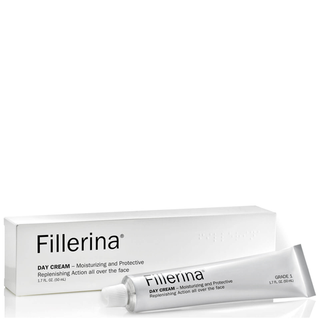
Fillerina Day Cream - Grade 1
Works for
2 of 3 advertised claims delivered
Sun protectionSPF 15 · 3 UV filters · Broad spectrumWeak protectionSPF under 30
This product offers broad spectrum sun protection, but it is weak. We recommend to use a broad spectrum sunscreen with at least SPF 30.
Moisturizing21 ingredients credited for this claimStrong support
“Day Cream .”
This product can help improve hydration of the skin with the two types of ingredients.
The first type is called “humectants”:
these ingredients help attract water.
When humectants are on the surface of the skin, they “pull in” the moisture from the outside environment, or from
within deeper layers of the skin. The following ingredients in this product do the job:
arginine, glycerin.
This product also contains ingredients called “occlusives”. They help reduce the speed with which our skin loses moisture to the outside environment. These ingredients also help soften the upper layer of the skin, so it feels less tight and nicer to the touch. The following ingredients in this product do the job: arginine, cocos nucifera oil.
The following ingredients in this product are especially good for supporting the skin barrier and helping with the hydration level: acetyl hexapeptide-30, acetyl hexapeptide-37, palmitoyl tripeptide-38
Anti-aging6 ingredients credited for this claimModerate support
“Formulated with six types of Hyaluronic Acid, antioxidant Vitamin E and exfoliating Salicylic Acid, the gentle yet effective cream delivers all-day hydration while performing a plumping and 'filling' effect on early onset wrinkles and expression lines.”
This product contains acetyl hexapeptide-30, acetyl hexapeptide-37, palmitoyl tripeptide-38. These ingredients might be able to help reduce and prevent fine lines and wrinkles, improve skin elasticity and firmness, but there is not enough evidence that it actually works. The biggest anti-aging effect in this product comes from sun protection. Sun damage is the main factor causing early signs of skin aging. We, however, do not recommend using this product as a sunscreen because the protection it offers is not strong enough).
Can it cause trouble?
Irritancy10 strong irritants: Imidazolidinyl urea, Parfum + 8 more — patch-test recommendedHigh risk
Comedogenic5 ingredients rated 2 or more on the 0–5 pore-clogging scale5 flagged

User reviews
Be the first — your take helps the next person decide.
Ingredients
Filter by role to see what each ingredient is doing.
Water~45–55%
Cetearyl isononanoate~4.1–5%
- Irritation risk
- Low
An emollient that softens the skin and helps prevent moisture loss.
More about Cetearyl isononanoatePropylene glycol~4.1–5%
- Irritation risk
- High
Helps oil and water mix together and can enhance the penetration of other ingredients into the skin. It can be irritating
More about Propylene glycolEthylhexyl methoxycinnamate~3.5–4.3%
- Irritation risk
- High
Octinoxate. When used in higher concentrations, works as a sunscreen protecting the skin from UVB rays. When used in lower concentration, helps to preserve the product formulation. Is shown to be harmful to coral reefs - consider avoiding bathing in coral reef areas when wearing a product with this ingredient. It can be irritating
More about Ethylhexyl methoxycinnamateEthylhexyl salicylate~3.1–3.8%
- Irritation risk
- Low
Octisalate. A UV filter. It offers some protection against the sun rays that cause sunburn (UVB), but does not protect against the most aging sun rays (UVA). It loses its effectiveness quickly when exposed to sunlight. It is an organic, or so called "chemical" sunscreen
More about Ethylhexyl salicylateGlyceryl stearate se~1.9–2.3%
- Irritation risk
- Low
- Comedogenicity
- 2/5
Used to stabilize the product formulations and works as an emollient
More about Glyceryl stearate seGlyceryl stearate~1.6–2%
- Irritation risk
- Low
An emollient that softens the skin and forms a protective layer on its surface. Helps water and oil mix together
More about Glyceryl stearateEthylhexyl cocoate~1.4–1.7%
- Irritation risk
- Low
Helps soften the upper layer of the skin
More about Ethylhexyl cocoateCeteareth-20~1.2–1.5%
- Irritation risk
- Medium
- Comedogenicity
- 2/5
Helps oil and water mix together. Has some emollient properties
More about Ceteareth-20Isodecyl oleate~0.95–1.15%
- Irritation risk
- Low
- Comedogenicity
- 2/5
Hdi/trimethylol hexyllactone crosspolymer~0.65–0.95%
- Irritation risk
- Low
Used to create a silky product texture and add volume to products
More about Hdi/trimethylol hexyllactone crosspolymerMethylene bis-benzotriazolyl tetramethylbutylphenol~0.7–1.05%
- Irritation risk
- Medium
Tinosorb M. A UV filter. Is effective against both UVA and UVB rays. It also provides some protection against visible light. It is photostable and can also be used to improve photostability of other sunscreen ingredients. Its physical properties help to create lightweight sunscreen formulations. It can leave a slight white cast. Unfortunately, it is not approved by the FDA (US) yet
More about Methylene bis-benzotriazolyl tetramethylbutylphenolCetyl alcohol~0.55–0.85%
- Irritation risk
- Low
A non-drying alcohol that works to soften the skin and stabilize product formulations helping oil and water mix together
More about Cetyl alcoholAluminum starch octenylsuccinate~0.45–0.65%
- Irritation risk
- Medium
Used to thicken the product's consistency
More about Aluminum starch octenylsuccinateImidazolidinyl urea~0.35–0.6%
- Irritation risk
- High
A preservative. Is more irritating than many other preservatives available
More about Imidazolidinyl ureaXylitol~0.35–0.6%
- Irritation risk
- Low
Helps attract water to the upper layer of the skin and repair the skin barrier function
More about XylitolCocos nucifera oil~0.3–0.6%
- Irritation risk
- Low
- Comedogenicity
- 3/5
An emollient. Found to be as effective as a moisturizer for dry skin as mineral oil. Could be comedogenic
More about Cocos nucifera oilEthylhexylglycerin~0.35–0.65%
Phenoxyethanol~0.3–0.6%
- Irritation risk
- Low
A preservative. It helps prevent bacterial growth in cosmetic products
More about PhenoxyethanolParfum~0.25–0.5%
- Irritation risk
- High
An aromatic blend of unspecified and possibly irritating ingredients
More about ParfumGlycerin~0.3–0.55%
- Irritation risk
- Low
One of the best moisturizing ingredients. Naturally present in skin. It attracts water to the upper layer of the skin working as a humectant
More about GlycerinSodium hyaluronate~0.25–0.5%
- Irritation risk
- Low
One of the best moisturizing ingredients. Attracts water into the upper layer of the skin
More about Sodium hyaluronateCarbomer~0.25–0.45%
- Irritation risk
- Low
Helps create a thicker or gel-like product texture. It is not a surfactant but can be used in gentle cleansing formulations
More about CarbomerTocopheryl acetate~0.25–0.5%
- Irritation risk
- Medium
A more stable but less bio-available form of vitamin E compared to Tocopherol. Might help moisturize and protect the skin from free radicals, but mostly used in low concentrations to stabilize other ingredients.
More about Tocopheryl acetateHydrolyzed glycosaminoglycans~0.25–0.45%
- Irritation risk
- Low
Long sugars that help attract water to the upper layer of the skin
More about Hydrolyzed glycosaminoglycansMethylparaben~0.15–0.3%
Ethylparaben~0.2–0.4%
Glyceryl oleate~0.3–0.55%
- Irritation risk
- High
Helps oil and water mix together. Can be irritating
More about Glyceryl oleateLimonene~0.25–0.45%
- Irritation risk
- High
A common frangrance that can easily irritate skin, especially if exposed to air, light or heat
More about LimoneneSilica~0.4–0.65%
Butylparaben~0.2–0.4%
Propylparaben~0.2–0.4%
Cyathea cumingii leaf extract~0.3–0.5%
- Irritation risk
- Low
Linalool~0.25–0.45%
Butylene glycol~0.25–0.5%
- Irritation risk
- Low
Used to create a nice product texture and help delivery of other ingredients. Might be somewhat helpful in attracting water to the upper layer of the skin
More about Butylene glycolPseudoalteromonas ferment extract~0.25–0.5%
- Irritation risk
- Low
Sodium hyaluronate crosspolymer~0.25–0.5%
- Irritation risk
- Medium
Attracts water into the upper layer of the skin
More about Sodium hyaluronate crosspolymerBht~0.25–0.5%
Hexylene glycol~0.25–0.45%
- Irritation risk
- Medium
Helps create a more spreadable product texture
More about Hexylene glycolHexyl cinnamal~0.25–0.45%
Bha~0.25–0.5%
Hydrolyzed hyaluronic acid~0.25–0.45%
- Irritation risk
- Low
One of the best moisturizing ingredients. Attracts water into the upper layer of the skin. A version of it is naturally present in skin
More about Hydrolyzed hyaluronic acidButylphenyl methylpropional~0.25–0.45%
- Irritation risk
- High
A fragrance. Can trigger allergic reactions and be irritating
More about Butylphenyl methylpropionalGeraniol~0.25–0.45%
Citronellol~0.25–0.45%
Hyaluronic acid~0.25–0.5%
- Irritation risk
- Low
One of the best moisturizing ingredients. Attracts water into the upper layer of the skin. Naturally present in skin. Typically has large molecule size unless advertised otherwise on the product label. Helps support skin's barrier function and may help to reduce inflammation
More about Hyaluronic acidCoumarin~0.25–0.45%
Hydroxypropyl cyclodextrin~0.3–0.55%
- Irritation risk
- Medium
Used to stabilize product formulations and help soften the upper layer of the skin
More about Hydroxypropyl cyclodextrinHydrolyzed sodium hyaluronate~0.25–0.45%
- Irritation risk
- Low
Attracts water into the upper layer of the skin
More about Hydrolyzed sodium hyaluronateCitral~0.25–0.45%
Pentylene glycol~0.3–0.55%
- Irritation risk
- Medium
Used to preserve products, dissolve other ingredients and create a nice product texture
More about Pentylene glycolCaprylyl glycol~0.3–0.55%
- Irritation risk
- Medium
Helps preserve products and creates a nice product texture
More about Caprylyl glycolArginine~0.25–0.45%
- Irritation risk
- Low
An amino acid that is naturally present in skin and helps keep it hydrated. When used together with AHAs, it can reduce their irritating effect on the skin
More about ArginineSalicylic acid~0.25–0.5%
- Irritation risk
- High
Used for skin exfoliation. It has an anti-inflammatory and anti-bacterial effect, helps to unclog pores, prevent blemishes and speed up healing of the existing ones. Sometimes referred to as a BHA (beta-hydroxy acid)
More about Salicylic acidSodium hydroxide~0.25–0.5%
Citric acid~0.25–0.45%
- Irritation risk
- Medium
Can work as an exfoliant but is typically used to adjust the product pH
More about Citric acidAscorbyl palmitate~0.25–0.45%
- Irritation risk
- Medium
Being a lipid soluble form of vitamin C, it is more stable and can penetrate the skin better than L-Ascorbic acid. It is effective in protecting the skin from free radicals, as well as evening the skin tone, but is less effective in stimulating collagen production compared to L-Ascorbic acid.
More about Ascorbyl palmitateAcetyl hexapeptide-30~0.25–0.45%
- Irritation risk
- Low
A type of peptide. Peptides are excellent moisturizers and might be able support collagen production reducing fine lines and wrinkles
More about Acetyl hexapeptide-30Palmitoyl tripeptide-38~0.25–0.45%
- Irritation risk
- Low
A type of peptide. Peptides are excellent moisturizers and might be able support collagen production reducing fine lines and wrinkles
More about Palmitoyl tripeptide-38Acetyl hexapeptide-37~0.25–0.4%
- Irritation risk
- Low
A type of peptide. Peptides are excellent moisturizers and might be able support collagen production reducing fine lines and wrinkles
More about Acetyl hexapeptide-37Xylitol~0.2–0.4%
- Irritation risk
- Low
Helps attract water to the upper layer of the skin and repair the skin barrier function
More about XylitolTocopherol~0.15–0.3%
- Irritation risk
- Low
Pure form of vitamin E. Can help moisturise and protect the skin from free radicals. Often used to help stabilise other ingredients or the formula itself
More about TocopherolHexapeptide-84~0.15–0.3%
- Irritation risk
- Low
Salicylic acid~0.15–0.3%
- Irritation risk
- High
Used for skin exfoliation. It has an anti-inflammatory and anti-bacterial effect, helps to unclog pores, prevent blemishes and speed up healing of the existing ones. Sometimes referred to as a BHA (beta-hydroxy acid)
More about Salicylic acidCocos nucifera oil~0.1–0.25%
- Irritation risk
- Low
- Comedogenicity
- 3/5
An emollient. Found to be as effective as a moisturizer for dry skin as mineral oil. Could be comedogenic
More about Cocos nucifera oilIngredient list view
Water, Cetearyl isononanoate, Propylene glycol, Ethylhexyl methoxycinnamate, Ethylhexyl salicylate, Glyceryl stearate se, Glyceryl stearate, Ethylhexyl cocoate, Ceteareth-20, Isodecyl oleate, Hdi/trimethylol hexyllactone crosspolymer, Methylene bis-benzotriazolyl tetramethylbutylphenol, Cetyl alcohol, Aluminum starch octenylsuccinate, Imidazolidinyl urea, Xylitol, Cocos nucifera oil, Ethylhexylglycerin, Phenoxyethanol, Parfum, Glycerin, Sodium hyaluronate, Carbomer, Tocopheryl acetate, Hydrolyzed glycosaminoglycans, Methylparaben, Ethylparaben, Glyceryl oleate, Limonene, Silica, Butylparaben, Propylparaben, Cyathea cumingii leaf extract, Linalool, Butylene glycol, Pseudoalteromonas ferment extract, Sodium hyaluronate crosspolymer, Bht, Hexylene glycol, Hexyl cinnamal, Bha, Hydrolyzed hyaluronic acid, Butylphenyl methylpropional, Geraniol, Citronellol, Hyaluronic acid, Coumarin, Hydroxypropyl cyclodextrin, Hydrolyzed sodium hyaluronate, Citral, Pentylene glycol, Caprylyl glycol, Arginine, Salicylic acid, Sodium hydroxide, Citric acid, Ascorbyl palmitate, Acetyl hexapeptide-30, Palmitoyl tripeptide-38, Acetyl hexapeptide-37, Unknown, Xylitol, Tocopherol, Hexapeptide-84, Salicylic acid, Cocos nucifera oil, Unknown
Compare prices
Retailers ranked by price — lowest first.
Affiliate links · prices updated regularly · As an Amazon Associate, WIMJ earns from qualifying purchases.
Worth comparing, line by line.
Match % combines shared ingredients, the first five ingredients, shared actives and hero ingredients, irritancy (lower counts in the alternative's favour), texture and body area. Only products in the same routine step are compared.
| FillerinaDay Cream - Grade 1YOUR PRODUCT | Paula's choiceSkin Restoring Moisturizer with SPF 15 | SVRSEBIACLEAR Crème SPF50 | NurrWrinkle Defense Cream with SPF 15 | |
|---|---|---|---|---|
| Match | — | 69% | 69% | 66% |
| Price | $48.00 | $64.78+$16.78 | — | $36.58−$11.42 |
| Shared key ingredients | — | 3 of 15 | 3 of 15 | 3 of 15 |
| Key difference | — | Niacinamide | Niacinamide | Acetyl Dipeptide-1 Cetyl Ester |
| Irritancy | High | Medium | Medium | Medium |
| SPF | SPF 15 | SPF 15 | SPF 50 | SPF 15 |
| Drying alcohol | — | — | — | — |
| View product | Shop | Shop | Shop |


Product summary
"Fillerina - Day Cream - Grade 1" "is a broad spectrum sunscreen meaning that it protects both from UVB rays (" burning "- they cause sunburn) and UVA rays (" aging "- they don't cause sunburn but lead to premature aging and pigmentation issues). However, this moisturizer does not offer enough sun protection. We recommend to use a sunscreen with at least SPF 30 daily.
As a plus, this sunscreen uses some of the new generation UV filters (Tinosorb M). These filters are more stable and more gentle on the skin.
Its formula is also hydrating, so you might not need an additional moistruizer during the day.
Sunscreen filters
This sunscreen uses so-called" chemical ", or organic UV filters (organic simply means that their molecules contain atoms of carbon). These filters typically give good sun protection and rarely leave a white cast, but they can be irritating for sensitive skin. These are the sun protection ingredients in this sunscreen: octinoxate 3.50% - 4.30%, octisalate 3.10% - 3.80% and tinosorb m 0.70% - 1.05%.
Irritation risk
This moisturizer contains a bunch of common irritants, including ingredients that do not provide any known benefit for the skin. It might not be the best choice if your skin is sensitive. We assess the overall irritancy of this moisturizer to be high. For a detailed overview of all potential irritants: click here
You can see the detailed formula review with the breakdown of all actives in the product and the full ingredient list with estimated concentrations in the tables below.
Price
The product retails for 229.00A$ in Australia, for 48.00$ in the United States, for 78.00CA$ in Canada and for 48.00£ in the United Kingdom.
For a detailed price comparison: click here.
Sources cited in this review
Every concentration estimate and effectiveness label is anchored to one of these 18 studies and safety reviews.
- 1Surfactants and experimental irritant contact dermatitisncbi.nlm.nih.gov
- 2Propylene Glycolpubmed.ncbi.nlm.nih.gov
- 3Skin-sensitizing and irritant properties of propylene glycolonlinelibrary.wiley.com
- 4
- 5
- 6

Affiliate links · As an Amazon Associate, WIMJ earns from qualifying purchases.