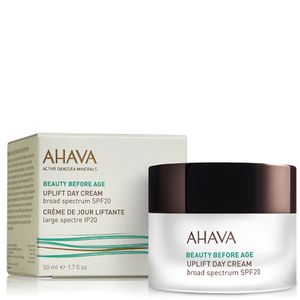
Ahava Uplift Day Cream SPF20
Works for
2 of 4 advertised claims delivered
Sun protectionSPF 20 · 3 UV filters · Partial spectrumWeak protectionSPF under 30
This product does not offer good protection against UVA rays.
This product can be considered "reef safe" because it does not contain the UV filters (oxybenzone and octinoxate) that can be harmful to coral reefs when present in the water in high concentrations.
Moisturizing17 ingredients credited for this claimStrong support
“Uplift Day Cream SPF20”
This product can help improve hydration of the skin with the two types of ingredients.
The first type is called “humectants”:
these ingredients help attract water.
When humectants are on the surface of the skin, they “pull in” the moisture from the outside environment, or from
within deeper layers of the skin. The following ingredients in this product do the job:
cyclomethicone, glycerin.
This product also contains ingredients called “occlusives”. They help reduce the speed with which our skin loses moisture to the outside environment. These ingredients also help soften the upper layer of the skin, so it feels less tight and nicer to the touch. The following ingredients in this product do the job: dimethicone, dimethiconol.
The following ingredients in this product are especially good for supporting the skin barrier and helping with the hydration level: acetyl dipeptide-1 cetyl ester, palmitoyl tripeptide-38
Anti-aging4 ingredients credited for this claimModerate support
“UVA and UVB protection helps to prevent visible signs of aging while botanical extracts, 21 Dead Sea minerals and other skin-enhancing ingredients revitalize, refresh and tone.”
This product contains acetyl dipeptide-1 cetyl ester, palmitoyl tripeptide-38. These ingredients might be able to help reduce and prevent fine lines and wrinkles, improve skin elasticity and firmness, but there is not enough evidence that it actually works. The biggest anti-aging effect in this product comes from sun protection. Sun damage is the main factor causing early signs of skin aging. We, however, do not recommend using this product as a sunscreen because the protection it offers is not strong enough).
Evens skin tone1 ingredient credited for this claimLimited support
“Fortified with innovative Positive Stress Dead Sea Metabiotics TM Technology, the fast-absorbing formula works to maintain the skin's youthful structure, whilst combating uneven skin tone and minimising the appearance of wrinkles to leave your complexion smooth, radiant and refined.”
This product might help improve the skin tone through exfoliation. In other words, it helps to speed up the shedding of cells from the upper layer of the skin, and this might help reduce hyperpigmentation.
The biggest effect for evening out skin tone in this product comes from sun protection. Sun damage is the main factor causing age spots, darkening of post-acne marks and other discolorations. This is why sun protection is the best strategy for maintaining an even skin tone. We, however, do not recommend using this product as a sunscreen because the protection it offers is not strong enough).
Anti-blemishNot advertised by the brand · 4 ingredients credited for this claimStrong support
This product can help reduce breakouts and clogged pores because it contains the following ingredient: salicylic acid. This ingredient is used for treating acne and can have a noticeable effect.
ExfoliationNot advertised by the brand · 2 ingredients credited for this claimStrong support
This product can help exfoliate the skin. In other words, it helps break down the bonds between dead cells on the surface of the skin and speed up the skin turnover. Skin often appears softer and brighter after exfoliation, but overdoing it can result in disrupted skin barrier. The following ingredient is doing the exfoliating job in this product: salicylic acid.
Can it cause trouble?
Irritancy8 strong irritants: Mentha piperita leaf juice, Parfum + 6 more — patch-test recommendedHigh risk
Comedogenic2 ingredients rated 2 or more on the 0–5 pore-clogging scale2 flagged

User reviews
Be the first — your take helps the next person decide.
Ingredients
Filter by role to see what each ingredient is doing.
Salicylic acid~1.25–2.5%
- Irritation risk
- High
Used for skin exfoliation. It has an anti-inflammatory and anti-bacterial effect, helps to unclog pores, prevent blemishes and speed up healing of the existing ones. Sometimes referred to as a BHA (beta-hydroxy acid)
More about Salicylic acidHomosalate7%
- Irritation risk
- Medium
A weak sunscreen that offers some protection against the sun rays that cause sunburn (UVB), but does not offer meaningful protection against protect against the most aging sun rays (UVA). It loses its effectiveness quickly when exposed to sunlight. It is an organic, or so called "chemical" sunscreen. When used in low concentrations, helps to stabilize the product formulation
More about HomosalateEthylhexyl salicylate5%
- Irritation risk
- Low
Octisalate. A UV filter. It offers some protection against the sun rays that cause sunburn (UVB), but does not protect against the most aging sun rays (UVA). It loses its effectiveness quickly when exposed to sunlight. It is an organic, or so called "chemical" sunscreen
More about Ethylhexyl salicylateWater~8.2–12.4%
Butyloctyl salicylate~4.2–6.3%
- Irritation risk
- Medium
A synthetic ester of salicylic acid that is used to help disperse pigments and boost effectiveness of sunscreen ingredients. It is able to absorb UV light (working as an organic, or chemical filter), but is not approved as a sunscreen ingredient on its own
More about Butyloctyl salicylatePolyester-8~3.2–4.9%
- Irritation risk
- Medium
Used to stabilize product formulations and individual ingredients (for example, sunscreens). Can be an allergen
More about Polyester-8Butylene glycol~2–2.9%
- Irritation risk
- Low
Used to create a nice product texture and help delivery of other ingredients. Might be somewhat helpful in attracting water to the upper layer of the skin
More about Butylene glycolAcetyl dipeptide-1 cetyl ester~1.6–2.4%
- Irritation risk
- Low
A type of peptide. Peptides are excellent moisturizers and might be able support collagen production reducing fine lines and wrinkles
More about Acetyl dipeptide-1 cetyl esterHydroxyethylcellulose~1.3–1.9%
- Irritation risk
- Low
Used to thicken product formulations and create gel-like textures
More about HydroxyethylcelluloseSorbitan laurate~1–1.5%
Cyclomethicone~0.85–1.25%
- Irritation risk
- Low
A type of silicone that leaves a nice silky finish on the skin and can help soften its upper layer
More about CyclomethiconePropanediol~0.45–1%
- Irritation risk
- Low
Acts as a solvent for other ingredients. Speeds up the absorption of other ingredients into the skin
More about PropanediolZea mays starch~0.4–0.9%
- Irritation risk
- Medium
- Comedogenicity
- 3/5
Used to thicken the product's consistency
More about Zea mays starchGlycol~0.3–0.7%
- Irritation risk
- Low
Octyldodecyl neopentanoate~0.3–0.7%
- Irritation risk
- Low
An emollient that helps soften the skin. Often used to stabilize other ingredients, for example, sunscreen
More about Octyldodecyl neopentanoateGlyceryl stearate~0.2–0.75%
- Irritation risk
- Low
An emollient that softens the skin and forms a protective layer on its surface. Helps water and oil mix together
More about Glyceryl stearatePeg-100 stearate~0.15–0.7%
- Irritation risk
- Low
Helps oil and water mix togehter and creates a nice product texture
More about Peg-100 stearateTrehalose~0.1–0.5%
- Irritation risk
- Low
A sugar that attracts water to the upper layer of the skin
More about TrehaloseMyristyl myristate~0.15–0.65%
- Irritation risk
- Medium
- Comedogenicity
- 3/5
An emollient. Is not recommended for acne-prone skin as it can be comedogenic
More about Myristyl myristatePeg-4 olivate~0.1–0.5%
Glycerin~0.1–0.45%
- Irritation risk
- Low
One of the best moisturizing ingredients. Naturally present in skin. It attracts water to the upper layer of the skin working as a humectant
More about GlycerinHydroxypropyl cyclodextrin~0.1–0.45%
- Irritation risk
- Medium
Used to stabilize product formulations and help soften the upper layer of the skin
More about Hydroxypropyl cyclodextrinPalmitoyl tripeptide-38~0.05–0.3%
- Irritation risk
- Low
A type of peptide. Peptides are excellent moisturizers and might be able support collagen production reducing fine lines and wrinkles
More about Palmitoyl tripeptide-38Styrene/acrylates copolymer~0.15–0.6%
- Irritation risk
- Low
Used to create an even product consistency. Can help boost efficiency of sunscreen filters
More about Styrene/acrylates copolymerPichia/sea silt ferment lysate extract~0.05–0.25%
- Irritation risk
- Low
Linum usitatissimum seed extract~0.05–0.2%
- Irritation risk
- Low
Ethylhexylglycerin~0.05–0.25%
Phenoxyethanol~0.05–0.3%
- Irritation risk
- Low
A preservative. It helps prevent bacterial growth in cosmetic products
More about PhenoxyethanolAloe barbadensis leaf juice~0.05–0.25%
- Irritation risk
- Medium
Traditionally used to treat sunburns, dermatitis and inflammation, but evidence for its effectiveness is lacking. The extract can contain humectants that help attract water into the skin
More about Aloe barbadensis leaf juiceHydrolyzed corn protein~0.05–0.25%
- Irritation risk
- Low
Mentha piperita leaf juice~0.05–0.25%
Dimethicone~0.1–0.45%
- Irritation risk
- Low
A silicone that helps to reduce water loss from the surface of the skin. Can temporarily "fill in" lines and wrinkles, absorb oil, and create a nice product finish
More about DimethiconeDimethiconol~0.1–0.4%
- Irritation risk
- Low
A silicone that makes products more spreadable and keeps skin smooth. Helps to add gloss to skin and may visually fill in fine lines/wrinkles for short time
More about DimethiconolAcrylates/c10-30 alkyl acrylate crosspolymer~0.15–0.55%
- Irritation risk
- Medium
Maintains the texture of skincare products. Allows the product to spread evenly. Helps oil and water mix together
More about Acrylates/c10-30 alkyl acrylate crosspolymerCarbomer~0.1–0.3%
- Irritation risk
- Low
Helps create a thicker or gel-like product texture. It is not a surfactant but can be used in gentle cleansing formulations
More about CarbomerSilica~0.15–0.55%
Aminomethyl propanediol~0.05–0.25%
- Irritation risk
- Medium
Helps adjust the product pH and can be used to mask the odor of other ingredients
More about Aminomethyl propanediolAllantoin~0.05–0.2%
- Irritation risk
- Low
Helps calm down inflammation in skin and can help reduce itching. Helps to repair the skin barrier and keep skin hydrated
More about AllantoinAloe barbadensis leaf extract~0.1–0.45%
- Irritation risk
- Medium
Traditionally used to treat sunburns, dermatitis and inflammation, but evidence for its effectiveness is lacking. The extract can contain humectants that help attract water into the skin
More about Aloe barbadensis leaf extractPropylene glycol~0.05–0.25%
- Irritation risk
- High
Helps oil and water mix together and can enhance the penetration of other ingredients into the skin. It can be irritating
More about Propylene glycolChamomilla recutita flower extract~0.05–0.25%
- Irritation risk
- High
Plant extract that can have healing and anti-inflammatory properties. It is a potential allergen and can be irritating
More about Chamomilla recutita flower extractParfum~0.05–0.2%
- Irritation risk
- High
An aromatic blend of unspecified and possibly irritating ingredients
More about ParfumXanthan gum~0.1–0.3%
- Irritation risk
- Low
Used to create a thicker product consistency
More about Xanthan gumTocopheryl acetate~0.05–0.3%
- Irritation risk
- Medium
A more stable but less bio-available form of vitamin E compared to Tocopherol. Might help moisturize and protect the skin from free radicals, but mostly used in low concentrations to stabilize other ingredients.
More about Tocopheryl acetateBenzotriazolyl dodecyl p-cresol~0.05–0.25%
- Irritation risk
- Medium
Used to stabilize the product formulation protecting it from sun light
More about Benzotriazolyl dodecyl p-cresolMethyl methacrylate crosspolymer~0.15–0.5%
- Irritation risk
- Low
Helps thicken the product consistency
More about Methyl methacrylate crosspolymerTocopherol~0.1–0.35%
- Irritation risk
- Low
Pure form of vitamin E. Can help moisturise and protect the skin from free radicals. Often used to help stabilise other ingredients or the formula itself
More about TocopherolKaolin~0.15–0.65%
- Irritation risk
- Low
A type of clay that consists mainly of aluminum silicate. Helps absorb oil and creates a thicker product consistency. Can be used to add a white color
More about KaolinMaris aqua~0.05–0.3%
Sea water~0.05–0.3%
- Irritation risk
- Low
Dissolves other ingredients. It does not have additional skin benefits compared to plain water
More about Sea waterBenzyl salicylate~0.05–0.2%
Limonene~0.05–0.2%
- Irritation risk
- High
A common frangrance that can easily irritate skin, especially if exposed to air, light or heat
More about LimoneneHexyl cinnamal~0.05–0.25%
Linalool~0.05–0.2%
Citronellol~0.01–0.1%
Hydroxycitronellal~0.01–0.1%
- Irritation risk
- High
A fragrance. A likely allergen and can be irritating
More about HydroxycitronellalIngredient list view
Salicylic acid, Homosalate, Ethylhexyl salicylate, Water, Butyloctyl salicylate, Polyester-8, Butylene glycol, Acetyl dipeptide-1 cetyl ester, Hydroxyethylcellulose, Sorbitan laurate, Cyclomethicone, Propanediol, Zea mays starch, Unknown, Glycol, Octyldodecyl neopentanoate, Glyceryl stearate, Peg-100 stearate, Trehalose, Myristyl myristate, Peg-4 olivate, Glycerin, Hydroxypropyl cyclodextrin, Palmitoyl tripeptide-38, Styrene/acrylates copolymer, Pichia/sea silt ferment lysate extract, Linum usitatissimum seed extract, Ethylhexylglycerin, Phenoxyethanol, Aloe barbadensis leaf juice, Hydrolyzed corn protein, Mentha piperita leaf juice, Dimethicone, Dimethiconol, Acrylates/c10-30 alkyl acrylate crosspolymer, Carbomer, Silica, Aminomethyl propanediol, Allantoin, Aloe barbadensis leaf extract, Propylene glycol, Chamomilla recutita flower extract, Parfum, Xanthan gum, Tocopheryl acetate, Benzotriazolyl dodecyl p-cresol, Methyl methacrylate crosspolymer, Tocopherol, Kaolin, Maris aqua, Unknown, Sea water, Benzyl salicylate, Limonene, Hexyl cinnamal, Linalool, Citronellol, Hydroxycitronellal
Compare prices
Retailers ranked by price — lowest first.
Affiliate links · prices updated regularly · As an Amazon Associate, WIMJ earns from qualifying purchases.
Worth comparing, line by line.
Match % combines shared ingredients, the first five ingredients, shared actives and hero ingredients, irritancy (lower counts in the alternative's favour), texture and body area. Only products in the same routine step are compared.
| AhavaUplift Day Cream SPF20YOUR PRODUCT | MartidermPigment Zero DSP-Cream SPF 50+ | SVRSEBIACLEAR Crème SPF50 | L'Oréal ParisBright Reveal SPF 30 Moisturizer | |
|---|---|---|---|---|
| Match | — | 73% | 72% | 71% |
| Price | $70.99 | $63.03−$7.96 | — | $22.22−$48.77 |
| Shared key ingredients | — | 4 of 14 | 3 of 14 | 3 of 14 |
| Key difference | — | Niacinamide | Niacinamide | Glycolic Acid |
| Irritancy | High | Medium | Medium | High |
| SPF | SPF 20 | SPF 50 | SPF 50 | SPF 30 |
| Drying alcohol | — | — | — | — |
| View product | Shop | Shop | Shop |


Product summary
"Ahava - Uplift Day Cream SPF20" does not provide enough UVA protection. UVA rays do not cause sunburn, but still damage the skin, leading to early signs of aging and pigmentation issues.
Its formula is also hydrating, so you might not need an additional moistruizer during the day.
Sunscreen filters
This is a so-called "chemical" sunscreen. It means that it uses organic UV filters. They typically offer good sun protection and rarely leave a white cast, but they can be irritating for some people with sensitive skin. Here are the exact UV filters in this sunscreen: butyloctyl salicylate 4.20% - 6.30%, octisalate 5.00% (declared) and homosalate 7.00% (declared).
Irritation risk
This moisturizer contains a bunch of common irritants, including ingredients that do not provide any known benefit for the skin. It might not be the best choice if your skin is sensitive. We assess the overall irritancy of this moisturizer to be high. For a detailed overview of all potential irritants: click here
You can see the detailed formula review with the breakdown of all actives in the product and the full ingredient list with estimated concentrations in the tables below.
Price
The product retails for 70.88A$ in Australia, for 70.99$ in the United States and for 82.00£ in the United Kingdom.
For a detailed price comparison: click here.
Sources cited in this review
Every concentration estimate and effectiveness label is anchored to one of these 19 studies and safety reviews.
- 1Salicylic acid as a peeling agent: a comprehensive reviewncbi.nlm.nih.gov
- 2Beta Hydroxy Acidsfda.gov
- 3A review of toxicity from topical salicylic acid preparationssciencedirect.com
- 4
- 5
- 6

Affiliate links · As an Amazon Associate, WIMJ earns from qualifying purchases.