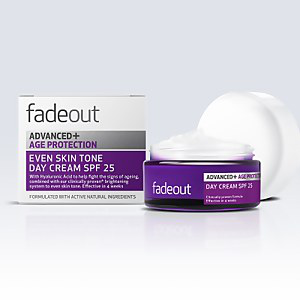
Fade Out ADVANCED + Age Protection Even Skin Tone Day Cream SPF 25
Works for
4 of 5 advertised claims delivered
Sun protectionSPF 25 · 3 UV filters · Partial spectrumWeak protectionSPF under 30
This product does not offer good protection against UVA rays.
Exfoliation1 ingredient credited for this claimStrong support
“Niacinamide (Vitamin B3) and naturally-sourced Lactic Acid deliver gentle exfoliation to alleviate the appearance of pre-existing discolouration and promote a more even, unified tone.”
This product can help exfoliate the skin. In other words, it helps break down the bonds between dead cells on the surface of the skin and speed up the skin turnover. Skin often appears softer and brighter after exfoliation, but overdoing it can result in disrupted skin barrier. The following ingredient is doing the exfoliating job in this product: lactic acid.
Evens skin tone3 ingredients credited for this claimStrong support
“ADVANCED + Age Protection Even Skin Tone Day Cream SPF 25”
This product can help reduce hypepigmentation and even out the skin tone because it contains the following effective ingredients: lactic acid
The following ingredient (ingredients) in this product might be helpful, but there is no evidence to confirm that it actually can help even out the skin tone: glycyrrhiza glabra root extract.
Keep in mind that you would need to apply any topical skincare targetted at hypigmentation consistently for a couple of months to get a result. No topical skincare product can help get rid of hyperpigmentation (including post-acne marks and age spots) instantly.
This product can also help with skin tone because it offers sun protection. Sun damage is the main factor causing age spots, darkening of post-acne marks and other discolorations. This is why sun protection is the best strategy for maintaining an even skin tone. We, however, do not recommend using this product as a sunscreen because the protection it offers is not strong enough).
Moisturizing10 ingredients credited for this claimStrong support
“ADVANCED + Age Protection Even Skin Tone Day Cream SPF 25”
This product can help improve hydration of the skin with the two types of ingredients.
The first type is called “humectants”:
these ingredients help attract water.
When humectants are on the surface of the skin, they “pull in” the moisture from the outside environment, or from
within deeper layers of the skin. The following ingredients in this product do the job:
glycerin, lactic acid.
This product also contains ingredients called “occlusives”. They help reduce the speed with which our skin loses moisture to the outside environment. These ingredients also help soften the upper layer of the skin, so it feels less tight and nicer to the touch. The following ingredients in this product do the job: dimethicone, cetearyl alcohol.
The following ingredients in this product are especially good for supporting the skin barrier and helping with the hydration level: panthenol
Anti-aging4 ingredients credited for this claimModerate support
“A high concentration of Hyaluronic Acid delivers a visible plumping effect, working to optimise moisture levels and smooth the look of fine lines, while extracts of Mulberry and Liquorice join forces to reduce the natural production of melanin – the brown pigment that causes dark patches at the surface.”
This product contains lactic acid. This ingredient might be able to help reduce and prevent fine lines and wrinkles, improve skin elasticity and firmness, but there is not enough evidence that it actually works. The biggest anti-aging effect in this product comes from sun protection. Sun damage is the main factor causing early signs of skin aging. We, however, do not recommend using this product as a sunscreen because the protection it offers is not strong enough).
Can it cause trouble?
Irritancy4 strong irritants: Parfum, Citronellol + 2 more — patch-test recommendedHigh risk
Comedogenic2 ingredients rated 2 or more on the 0–5 pore-clogging scale2 flagged


User reviews
Be the first — your take helps the next person decide.
Ingredients
Filter by role to see what each ingredient is doing.
Water~45–55%
Ethylhexyl methoxycinnamate~5.6–6.9%
- Irritation risk
- High
Octinoxate. When used in higher concentrations, works as a sunscreen protecting the skin from UVB rays. When used in lower concentration, helps to preserve the product formulation. Is shown to be harmful to coral reefs - consider avoiding bathing in coral reef areas when wearing a product with this ingredient. It can be irritating
More about Ethylhexyl methoxycinnamateSodium lactate~4.2–5.1%
- Irritation risk
- Medium
Helps attract water to the upper layer of the skin. Is often used to adjust the pH level of the product
More about Sodium lactateHomosalate~3.7–4.5%
- Irritation risk
- Medium
A weak sunscreen that offers some protection against the sun rays that cause sunburn (UVB), but does not offer meaningful protection against protect against the most aging sun rays (UVA). It loses its effectiveness quickly when exposed to sunlight. It is an organic, or so called "chemical" sunscreen. When used in low concentrations, helps to stabilize the product formulation
More about HomosalateLactic acid~2.3–2.9%
- Irritation risk
- Medium
An exfoliating and moisturizing alpha-hydroxy acid (AHA). Typically causes less irritation than other AHAs, for example, glycolic acid. At high concentrations (about 15%), lactic acid can help reduce lines and wrinkles. Recent studies show that lactic acid can support the "good" bacteria living on skin's surface (healthy skin microbiome)
More about Lactic acidCetearyl alcohol~2–2.4%
- Irritation risk
- Low
- Comedogenicity
- 2/5
A non-drying alcohol. Works as an emollient. Helps water and oil mix together and creates a nice product texture
More about Cetearyl alcoholGlyceryl stearate~1.7–2.1%
- Irritation risk
- Low
An emollient that softens the skin and forms a protective layer on its surface. Helps water and oil mix together
More about Glyceryl stearatePeg-100 stearate~1.5–1.9%
- Irritation risk
- Low
Helps oil and water mix togehter and creates a nice product texture
More about Peg-100 stearateDimethicone~1.3–1.6%
- Irritation risk
- Low
A silicone that helps to reduce water loss from the surface of the skin. Can temporarily "fill in" lines and wrinkles, absorb oil, and create a nice product finish
More about DimethiconeGlycerin~1.1–1.3%
- Irritation risk
- Low
One of the best moisturizing ingredients. Naturally present in skin. It attracts water to the upper layer of the skin working as a humectant
More about GlycerinStearyl alcohol~0.8–1.2%
- Irritation risk
- Low
An emollient that helps soften the skin
More about Stearyl alcoholHexylene glycol~0.6–0.85%
- Irritation risk
- Medium
Helps create a more spreadable product texture
More about Hexylene glycolNiacinamide~0.55–0.8%
- Irritation risk
- Low
Is proven to be effective in reducing blemishes, evening out skin tone and helping to improve lines and wrinkles. It helps the skin to repair sun damage, calm down inflammation and keep maintain good levels of moisture. The concentration of about 2% is effective for supporting the skin barrier and evening out the skin tone. Concentration of 4-6% is better for helping with acne and balancing the sebum production
More about NiacinamideTitanium dioxide~0.7–1.05%
- Irritation risk
- Low
Works as a UV filter when used in high concentrations. It is photostable and is effective mostly against the UVB light, with some protection in the UVA range. In small concentrations, used for its ability to improve the color of cosmetic products. Is usually well tolerated by the skin
More about Titanium dioxideCeteareth-20~0.55–0.85%
- Irritation risk
- Medium
- Comedogenicity
- 2/5
Helps oil and water mix together. Has some emollient properties
More about Ceteareth-20Phenoxyethanol~0.45–0.7%
- Irritation risk
- Low
A preservative. It helps prevent bacterial growth in cosmetic products
More about PhenoxyethanolSucrose palmitate~0.5–0.75%
Tocopheryl acetate~0.4–0.65%
- Irritation risk
- Medium
A more stable but less bio-available form of vitamin E compared to Tocopherol. Might help moisturize and protect the skin from free radicals, but mostly used in low concentrations to stabilize other ingredients.
More about Tocopheryl acetateParfum~0.3–0.6%
- Irritation risk
- High
An aromatic blend of unspecified and possibly irritating ingredients
More about ParfumSodium saccharin~0.35–0.6%
- Irritation risk
- Low
Panthenol~0.3–0.55%
- Irritation risk
- Low
Helps attract water to the upper layer of the skin and can help improve skin barrier function
More about PanthenolGlyceryl linoleate~0.35–0.65%
- Irritation risk
- Medium
Helps oil and water mix together
More about Glyceryl linoleateAlumina~0.4–0.6%
- Irritation risk
- Low
The same compound that is used safely in dental implants and bone cements. In cosmetics, it is used to improve the consistency of products
More about AluminaEthylhexylglycerin~0.3–0.5%
Glycyrrhiza glabra root extract~0.25–0.45%
- Irritation risk
- Medium
A plant extract that can help lighten the skin and calm down inflammation. Might be helpful in neutralizing free radicals
More about Glycyrrhiza glabra root extractMorus nigra leaf extract~0.25–0.5%
- Irritation risk
- Low
Disodium edta~0.25–0.45%
Simethicone~0.3–0.5%
- Irritation risk
- Low
A type of silicone that helps to create nice product texture and is used as an anti-foaming agent
More about SimethiconeGlyceryl oleate~0.25–0.5%
- Irritation risk
- High
Helps oil and water mix together. Can be irritating
More about Glyceryl oleateSodium hyaluronate~0.2–0.4%
- Irritation risk
- Low
One of the best moisturizing ingredients. Attracts water into the upper layer of the skin
More about Sodium hyaluronatePotassium sorbate~0.2–0.35%
Ascorbyl palmitate~0.15–0.3%
- Irritation risk
- Medium
Being a lipid soluble form of vitamin C, it is more stable and can penetrate the skin better than L-Ascorbic acid. It is effective in protecting the skin from free radicals, as well as evening the skin tone, but is less effective in stimulating collagen production compared to L-Ascorbic acid.
More about Ascorbyl palmitateTocopherol~0.15–0.3%
- Irritation risk
- Low
Pure form of vitamin E. Can help moisturise and protect the skin from free radicals. Often used to help stabilise other ingredients or the formula itself
More about TocopherolCitric acid~0.15–0.25%
- Irritation risk
- Medium
Can work as an exfoliant but is typically used to adjust the product pH
More about Citric acidCitronellol~0.1–0.2%
Linalool~0.1–0.15%
Hydroxyisohexyl 3-cyclohexene carboxaldehyde~0.05–0.1%
- Irritation risk
- High
A fragrance. Can be irritating
More about Hydroxyisohexyl 3-cyclohexene carboxaldehydeIngredient list view
Water, Ethylhexyl methoxycinnamate, Sodium lactate, Homosalate, Lactic acid, Cetearyl alcohol, Glyceryl stearate, Peg-100 stearate, Dimethicone, Glycerin, Stearyl alcohol, Hexylene glycol, Niacinamide, Titanium dioxide, Ceteareth-20, Phenoxyethanol, Sucrose palmitate, Tocopheryl acetate, Parfum, Sodium saccharin, Panthenol, Glyceryl linoleate, Alumina, Ethylhexylglycerin, Glycyrrhiza glabra root extract, Morus nigra leaf extract, Disodium edta, Simethicone, Glyceryl oleate, Sodium hyaluronate, Potassium sorbate, Ascorbyl palmitate, Tocopherol, Citric acid, Citronellol, Linalool, Hydroxyisohexyl 3-cyclohexene carboxaldehyde
Compare prices
Retailers ranked by price — lowest first.

.png)
Worth comparing, line by line.
Match % combines shared ingredients, the first five ingredients, shared actives and hero ingredients, irritancy (lower counts in the alternative's favour), texture and body area. Only products in the same routine step are compared.
| Fade OutADVANCED + Age Protection Even Skin Tone Day Cream SPF 25YOUR PRODUCT | OlayTotal Effects Whip Face Moisturizer with Sunscreen SPF 40 | SkinMedicaTotal Defense and Repair SPF 50 | NellaHoney 1 Snail White Moist Sun Cream | |
|---|---|---|---|---|
| Match | — | 84% | 83% | 83% |
| Price | $18.00 | $16.99−$1.01 | $61.20+$43.20 | $14.40−$3.60 |
| Shared key ingredients | — | 5 of 10 | 6 of 10 | 6 of 10 |
| Key difference | — | Sodium Ascorbyl Phosphate | Knotgrass Extract | Adenosine |
| Irritancy | High | Medium | Low | Medium |
| SPF | SPF 25 | SPF 40 | SPF 50 | SPF 50 |
| Drying alcohol | — | — | — | — |
| View product | Shop | Shop | Shop |


Product summary
We do not recommend "Fade Out - ADVANCED + Age Protection Even Skin Tone Day Cream SPF 25" because it does not provide good UVA protection. UVA sun rays don't burn the skin, but they still lead to photoaging and hyperpigmentation.
Its formula is also hydrating, so you might not need an additional moistruizer during the day.
Sunscreen filters
This is a so-called "chemical" sunscreen. It means that it uses organic UV filters. They typically offer good sun protection and rarely leave a white cast, but they can be irritating for some people with sensitive skin. Here are the exact UV filters in this sunscreen: octinoxate 5.60% - 6.90% and homosalate 3.70% - 4.50%.
Irritation risk
We assess the overall irritancy of this moisturizer to be high. For a detailed overview of all potential irritants: click here
You can see the detailed formula review with the breakdown of all actives in the product and the full ingredient list with estimated concentrations in the tables below.
Price
The product retails for 18.00$ in the United States and for 16.99£ in the United Kingdom.
For a detailed price comparison: click here.
Sources cited in this review
Every concentration estimate and effectiveness label is anchored to one of these 16 studies and safety reviews.
- 1
- 2Epidermal and dermal effects of topical lactic acidncbi.nlm.nih.gov
- 3Dual Effects of Alpha-Hydroxy Acids on the Skinpdfs.semanticscholar.org
- 4
- 5Final Report on the Safety Assessment of Dimethicone Copolyoljournals.sagepub.com
- 6

Affiliate links · As an Amazon Associate, WIMJ earns from qualifying purchases.