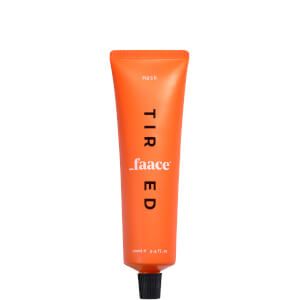
Works for
1 of 2 advertised claims delivered
MoisturizingBiosaccharide gum-1, Glycerin + 5 moreGood evidence
“The cream is infused with aloe vera to moisturise the skin’s natural barrier while glycerin helps to promote long-lasting hydration.”
This product contains good ingredients to attract water to the upper layer of the skin. These ingredients are called "humectants": biosaccharide gum-1, glycerin.
When humectants are on the surface of the skin, they “pull in” the moisture from the outside environment, or from within deeper layers of the skin. If the air is dry, humectants can speed up the moisture loss from the skin. This is why it is a good idea to use another product on top of this one to help "seal in" the moisture (look for ingredients like dimethicone, squalane, oils and butters).
Evens skin toneLactic acidWeak evidence
“Vitamin C features for its brightening properties while helping to defend skin against the effects of environmental aggressors.”
Effective ingredients missing or their concentration is too low
Can it cause trouble?
Irritancy11 strong irritants: Citrus aurantium dulcis peel oil, Melaleuca alternifolia leaf oil + 9 more — patch-test recommendedHigh risk
ComedogenicClean of flagged comedogenic ingredientsNone flagged
User reviews
Be the first — your take helps the next person decide.
Ingredients
Filter by role to see what each ingredient is doing.
Water~40–60%
Aloe barbadensis extract~5.8–8.7%
- Irritation risk
- Medium
Traditionally used to treat sunburns, dermatitis and inflammation, but evidence for its effectiveness is lacking. The extract can contain humectants that help attract water into the skin
More about Aloe barbadensis extractGlycerin~3.4–5.1%
- Irritation risk
- Low
One of the best moisturizing ingredients. Naturally present in skin. It attracts water to the upper layer of the skin working as a humectant
More about GlycerinSclerotium gum~2.6–3.9%
- Irritation risk
- Low
Used to create gel-like formulas and stabilize emulsions
More about Sclerotium gumBiosaccharide gum-1~1.9–2.8%
- Irritation risk
- Low
Helps attract water to the upper layer of the skin and is claimed to provide a longer-lasting hydration because of its ability to create a water-binding film on the surface of the skin
More about Biosaccharide gum-1Xanthan gum~1.4–2.1%
- Irritation risk
- Low
Used to create a thicker product consistency
More about Xanthan gumCoco-caprylate~1.2–1.8%
- Irritation risk
- Medium
An emollient that softens skin and creates a nice product texture
More about Coco-caprylatePropanediol~1–1.5%
- Irritation risk
- Low
Acts as a solvent for other ingredients. Speeds up the absorption of other ingredients into the skin
More about PropanediolSalix alba extract~0.55–1.3%
- Irritation risk
- Low
Sodium ascorbyl phosphate~0.5–1.2%
- Irritation risk
- Medium
A stable derivative of vitamin C. It is oil-soluble which means it is more likely to penetrate the skin compared to the pure form of vitamin C (which is water-soluble), but it is less bio-available and is way less effective in stimulating collagen and reducing wrinkles compared to the pure form of vitamin C (L-ascorbic acid) and its other derivatives (for example, magnesium ascorbyl phosphate). At the same time, this vitamin C derivative has been shown in studies to be effective in reducing acne, blemishes and clogged pores. It is less irritating then the pure form of vitamin C
More about Sodium ascorbyl phosphateCitrus aurantium dulcis peel oil~0.35–0.85%
- Irritation risk
- High
An essentil oil from orange peel. Potential allergen and can be irritating
More about Citrus aurantium dulcis peel oilCaffeine~0.3–0.75%
- Irritation risk
- Medium
Might be helpful in neutralizing free radicals. Can have a dehydration effect that might somewhat decrease the look of puffy eyes
More about CaffeineMelaleuca alternifolia leaf oil~0.15–0.7%
- Irritation risk
- High
An essential oil that can be irritating. Has some anti-bacterial properties
More about Melaleuca alternifolia leaf oilRosa canina fruit oil~0.15–0.7%
- Irritation risk
- Medium
A great emollient. Contains vitamin E (tocopherol) which may give it some anti-oxidant properties. Can contain volatile compounds and can be irritating
More about Rosa canina fruit oilPunica granatum seed oil~0.15–0.6%
- Irritation risk
- Low
Helps soften the upper layer of the skin
More about Punica granatum seed oilSodium bicarbonate~0.35–0.75%
Pelargonium graveolens leaf oil~0.15–0.5%
- Irritation risk
- High
An essential oil used as a fragrance. Can be irritating
More about Pelargonium graveolens leaf oilLactic acid~0.1–0.45%
- Irritation risk
- Medium
An exfoliating and moisturizing alpha-hydroxy acid (AHA). Typically causes less irritation than other AHAs, for example, glycolic acid. At high concentrations (about 15%), lactic acid can help reduce lines and wrinkles. Recent studies show that lactic acid can support the "good" bacteria living on skin's surface (healthy skin microbiome)
More about Lactic acidMentha piperita oil~0.1–0.35%
Citric acid~0.05–0.3%
- Irritation risk
- Medium
Can work as an exfoliant but is typically used to adjust the product pH
More about Citric acidLimonene~0.05–0.25%
- Irritation risk
- High
A common frangrance that can easily irritate skin, especially if exposed to air, light or heat
More about LimoneneLinalool~0.05–0.25%
Citral~0.05–0.2%
Geraniol~0.05–0.15%
Citronellol~0.05–0.1%
Eugenol~0.01–0.05%
Isoeugenol~0.01–0.05%
- Irritation risk
- High
Ingredient list view
Water, Aloe barbadensis extract, Glycerin, Sclerotium gum, Biosaccharide gum-1, Xanthan gum, Coco-caprylate, Propanediol, Salix alba extract, Sodium ascorbyl phosphate, Citrus aurantium dulcis peel oil, Caffeine, Unknown, Melaleuca alternifolia leaf oil, Rosa canina fruit oil, Punica granatum seed oil, Sodium bicarbonate, Pelargonium graveolens leaf oil, Lactic acid, Mentha piperita oil, Citric acid, Limonene, Linalool, Citral, Geraniol, Citronellol, Eugenol, Isoeugenol
Compare prices
Retailers ranked by price — lowest first.

Sources cited in this review
Every concentration estimate and effectiveness label is anchored to one of these 11 studies and safety reviews.
- 1
- 2
- 3Sodium ascorbyl phosphate in topical microemulsionssciencedirect.com
- 4
- 5
- 6

Affiliate links · As an Amazon Associate, WIMJ earns from qualifying purchases.