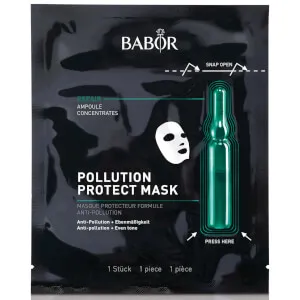
BABOR Pollution Protect Ampoule Mask

BABOR Pollution Protect Ampoule Mask

Efficacy50/100IrritancyHigh

Works for

Anti-aging
Aloe barbadensis leaf juice, Sodium ascorbyl phosphate + 1 more
Not delivered
What the product description says
“comprehensively protects the skin against changes caused by air-pollution, UV/R rays and blue light Pure encapsulated vitamin E. protects against free radicals and oxidative stress "”
Source: Lookfantastic US

This product does not contain ingredients that are able to reduce fine lines and wrinkles or help with skin elasticity, but it can improve the look of the skin temporarily through moisturization. Well-moisturized skin might also be able to repair the sun damage better.

This ingredient bifida ferment lysate might be able to help neutralize free radicals in skin and help it fight off some of the sun damage.

Aloe barbadensis leaf juiceEffect: Low, below effective doseTraditionally used to treat sunburns, dermatitis and inflammation, but evidence for its effectiveness is lacking. The extract can contain humectants that help attract water into the skin~1.2–1.8%
Sodium ascorbyl phosphateEffect: Low, below effective doseA stable derivative of vitamin C. It is oil-soluble which means it is more likely to penetrate the skin compared to the pure form of vitamin C (which is water-soluble), but it is less bio-available and is way less effective in stimulating collagen and reducing wrinkles compared to the pure form of vitamin C (L-ascorbic acid) and its other derivatives (for example, magnesium ascorbyl phosphate). At the same time, this vitamin C derivative has been shown in studies to be effective in reducing acne, blemishes and clogged pores. It is less irritating then the pure form of vitamin C~0.1–0.3%
Lactic acidEffect: Medium, below effective doseAn exfoliating and moisturizing alpha-hydroxy acid (AHA). Typically causes less irritation than other AHAs, for example, glycolic acid. At high concentrations (about 15%), lactic acid can help reduce lines and wrinkles. Recent studies show that lactic acid can support the "good" bacteria living on skin's surface (healthy skin microbiome)~0.05–0.1%
Anti-oxidation
Not advertised by the brand · Bifida ferment lysate, Tocopheryl acetate + 3 more
May help

This product contains antioxidants (bifida ferment lysate) that might be able to help neutralize free radicals in skin to lessen the damage it gets from the UV light (sun). There is not enough evidence to confirm their effectiveness in skin though.

Bifida ferment lysateEffect: MediumConsists of remains of dead yeast bacteria cells. Helps to hydrate the skin and reduce irritation. Might has some anti-oxidant effect~2–3%
Tocopheryl acetateEffect: LowA more stable but less bio-available form of vitamin E compared to Tocopherol. Might help moisturize and protect the skin from free radicals, but mostly used in low concentrations to stabilize other ingredients.~1.6–2.3%
Scutellaria baicalensis root extractEffect: LowA plant extract that might contain a compound baicalin that could be helpful in neutralizing free radicals and reducing inflammation in skin. The baicalin concentration in skincare products is often too low for an effective action. Can be used for its fragrant properties~0.05–0.25%
Sodium ascorbyl phosphateEffect: Medium, below effective doseA stable derivative of vitamin C. It is oil-soluble which means it is more likely to penetrate the skin compared to the pure form of vitamin C (which is water-soluble), but it is less bio-available and is way less effective in stimulating collagen and reducing wrinkles compared to the pure form of vitamin C (L-ascorbic acid) and its other derivatives (for example, magnesium ascorbyl phosphate). At the same time, this vitamin C derivative has been shown in studies to be effective in reducing acne, blemishes and clogged pores. It is less irritating then the pure form of vitamin C~0.1–0.3%
Rosmarinus officinalis leaf extractEffect: Low, below effective doseCan be helpful in reducing inflammation in skin, including inflamed acne. It can be irritating~0.05–0.2%
Moisturizing
Not advertised by the brand · Glycerin, Butylene glycol + 11 more
Works

This product can help improve hydration of the skin with the two types of ingredients.

The first type is called “humectants”:
these ingredients help attract water. When humectants are on the surface of the skin, they “pull in” the moisture from the outside environment, or from within deeper layers of the skin. The following ingredients in this product do the job: betaine, glycerin.

This product also contains ingredients called “occlusives”. They help reduce the speed with which our skin loses moisture to the outside environment. These ingredients also help soften the upper layer of the skin, so it feels less tight and nicer to the touch. The following ingredients in this product do the job: helianthus annuus seed oil, persea gratissima oil.

GlycerinEffect: HighOne of the best moisturizing ingredients. Naturally present in skin. It attracts water to the upper layer of the skin working as a humectant~4.1–6.1%
Butylene glycolEffect: LowUsed to create a nice product texture and help delivery of other ingredients. Might be somewhat helpful in attracting water to the upper layer of the skin~3.4–5.1%
Bifida ferment lysateEffect: HighConsists of remains of dead yeast bacteria cells. Helps to hydrate the skin and reduce irritation. Might has some anti-oxidant effect~2–3%
Theobroma grandiflorum seed butterEffect: HighHelps soften the upper layer of the skin and might as well help to attract moisture to its upper layer~1.3–2%
Helianthus annuus seed oilEffect: HighA great emollient due to its high linoleic acid content. One of the most effective plant oils in helping skin hydration and repairing skin barrier function~1–1.6%
Persea gratissima oilEffect: HighAn emollient that helps soften the skin and could be helpful in repairing its barrier function~0.8–1.2%
BetaineEffect: HighHelps attract water to the upper layer of the skin and improves the product texture~0.45–1%
Vegetable oilEffect: MediumAn oil from a mixture of different vegetables. Helps soften the upper layer of the skin~0.15–0.6%
Sodium hyaluronateEffect: HighOne of the best moisturizing ingredients. Attracts water into the upper layer of the skin~0.1–0.35%
Scutellaria baicalensis root extractEffect: LowA plant extract that might contain a compound baicalin that could be helpful in neutralizing free radicals and reducing inflammation in skin. The baicalin concentration in skincare products is often too low for an effective action. Can be used for its fragrant properties~0.05–0.25%
Aloe barbadensis leaf juiceEffect: Low, below effective doseTraditionally used to treat sunburns, dermatitis and inflammation, but evidence for its effectiveness is lacking. The extract can contain humectants that help attract water into the skin~1.2–1.8%
Dipotassium glycyrrhizateEffect: High, below effective doseA salt derived from licorice. Works as an emollient to soften the upper layer of the skin and can help calm down inflammation. Might be helpful for skin lightening~0.15–0.6%
Lactic acidEffect: High, below effective doseAn exfoliating and moisturizing alpha-hydroxy acid (AHA). Typically causes less irritation than other AHAs, for example, glycolic acid. At high concentrations (about 15%), lactic acid can help reduce lines and wrinkles. Recent studies show that lactic acid can support the "good" bacteria living on skin's surface (healthy skin microbiome)~0.05–0.1%

Can it cause trouble?

Irritancy
14 flagged ingredients — patch-test recommended
High risk
We flagged 14 ingredients with irritancy potential. Severity depends on your sensitivity threshold; the table lists the worst offenders first.
IngredientFunctionIrritationEst. amount
ParfumAn aromatic blend of unspecified and possibly irritating ingredientsHigh~0.15–0.6%est.
Illicium verum fruit extractAnise fruit extract. Used as a fragrance. Can be irritatingHigh~0.1–0.35%est.
Scutellaria baicalensis root extractA plant extract that might contain a compound baicalin that could be helpful in neutralizing free radicals and reducing inflammation in skin. The baicalin concentration in skincare products is often too low for an effective action. Can be used for its fragrant propertiesHigh~0.05–0.25%est.
Rosmarinus officinalis leaf extractCan be helpful in reducing inflammation in skin, including inflamed acne. It can be irritatingHigh~0.05–0.2%est.
Polyglyceryl-3 methylglucose distearateHelps water and oil mix togetherMedium~2.4–3.6%est.
Tocopheryl acetateA more stable but less bio-available form of vitamin E compared to Tocopherol. Might help moisturize and protect the skin from free radicals, but mostly used in low concentrations to stabilize other ingredients.Medium~1.6–2.3%est.
Theobroma grandiflorum seed butterHelps soften the upper layer of the skin and might as well help to attract moisture to its upper layerMedium~1.3–2%est.
Aloe barbadensis leaf juiceTraditionally used to treat sunburns, dermatitis and inflammation, but evidence for its effectiveness is lacking. The extract can contain humectants that help attract water into the skinMedium~1.2–1.8%est.
Persea gratissima oilAn emollient that helps soften the skin and could be helpful in repairing its barrier functionMedium~0.8–1.2%est.
Disodium edtaStabilizes the product formulationMedium~0.15–0.55%est.
Sodium ascorbyl phosphateA stable derivative of vitamin C. It is oil-soluble which means it is more likely to penetrate the skin compared to the pure form of vitamin C (which is water-soluble), but it is less bio-available and is way less effective in stimulating collagen and reducing wrinkles compared to the pure form of vitamin C (L-ascorbic acid) and its other derivatives (for example, magnesium ascorbyl phosphate). At the same time, this vitamin C derivative has been shown in studies to be effective in reducing acne, blemishes and clogged pores. It is less irritating then the pure form of vitamin CMedium~0.1–0.3%est.
Lactic acidAn exfoliating and moisturizing alpha-hydroxy acid (AHA). Typically causes less irritation than other AHAs, for example, glycolic acid. At high concentrations (about 15%), lactic acid can help reduce lines and wrinkles. Recent studies show that lactic acid can support the "good" bacteria living on skin's surface (healthy skin microbiome)Medium~0.05–0.1%est.
Citric acidCan work as an exfoliant but is typically used to adjust the product pHMedium~0.01–0.05%est.
Potassium sorbateA preservativeMedium~0.05–0.1%est.
Comedogenic
Clean of flagged comedogenic ingredients
None flagged

User reviews

Would you recommend?
No community reviews yet.

Be the first — your take helps the next person decide.

Ingredients

Filter by role to see what each ingredient is doing.

Water~40–60%
Irritation risk
Low

Plain old water

More about Water
Glycerin~4.1–6.1%
Irritation risk
Low
Works for
Moisturizing

One of the best moisturizing ingredients. Naturally present in skin. It attracts water to the upper layer of the skin working as a humectant

More about Glycerin
Butylene glycol~3.4–5.1%
Irritation risk
Low
Works for
Moisturizing

Used to create a nice product texture and help delivery of other ingredients. Might be somewhat helpful in attracting water to the upper layer of the skin

More about Butylene glycol
Polyglyceryl-3 methylglucose distearate~2.4–3.6%
Irritant · medium
Irritation risk
Medium
Works for
Cleansing

Helps water and oil mix together

More about Polyglyceryl-3 methylglucose distearate
Bifida ferment lysate~2–3%
Irritation risk
Low
Works for
MoisturizingAnti-oxidationEvens skin tone

Consists of remains of dead yeast bacteria cells. Helps to hydrate the skin and reduce irritation. Might has some anti-oxidant effect

More about Bifida ferment lysate
Tocopheryl acetate~1.6–2.3%
Irritant · medium
Irritation risk
Medium
Works for
Anti-oxidation

A more stable but less bio-available form of vitamin E compared to Tocopherol. Might help moisturize and protect the skin from free radicals, but mostly used in low concentrations to stabilize other ingredients.

More about Tocopheryl acetate
Theobroma grandiflorum seed butter~1.3–2%
Irritant · medium
Irritation risk
Medium
Works for
Moisturizing

Helps soften the upper layer of the skin and might as well help to attract moisture to its upper layer

More about Theobroma grandiflorum seed butter
Aloe barbadensis leaf juice~1.2–1.8%
Irritant · medium
Irritation risk
Medium
Works for
MoisturizingReduces irritationReduces rednessAntibacterialAnti-inflammatoryAnti-blemishAnti-aging

Traditionally used to treat sunburns, dermatitis and inflammation, but evidence for its effectiveness is lacking. The extract can contain humectants that help attract water into the skin

More about Aloe barbadensis leaf juice
Helianthus annuus seed oil~1–1.6%
Irritation risk
Low
Works for
Moisturizing

A great emollient due to its high linoleic acid content. One of the most effective plant oils in helping skin hydration and repairing skin barrier function

More about Helianthus annuus seed oil
Persea gratissima oil~0.8–1.2%
Irritant · medium
Irritation risk
Medium
Works for
Moisturizing

An emollient that helps soften the skin and could be helpful in repairing its barrier function

More about Persea gratissima oil
Betaine~0.45–1%
Irritation risk
Low
Works for
Moisturizing

Helps attract water to the upper layer of the skin and improves the product texture

More about Betaine
Marrubium vulgare extract~0.15–0.65%
Xanthan gum~0.3–0.7%
Irritation risk
Low
Works for
Cleansing

Used to create a thicker product consistency

More about Xanthan gum
Phenoxyethanol~0.2–0.7%
Irritation risk
Low

A preservative. It helps prevent bacterial growth in cosmetic products

More about Phenoxyethanol
2-hexanol~0.15–0.6%
Irritation risk
Low
More about 2-hexanol
Parfum~0.15–0.6%
Irritant · high
Irritation risk
High

An aromatic blend of unspecified and possibly irritating ingredients

More about Parfum
Dipotassium glycyrrhizate~0.15–0.6%
Irritation risk
Low
Works for
MoisturizingAnti-inflammatoryEvens skin tone

A salt derived from licorice. Works as an emollient to soften the upper layer of the skin and can help calm down inflammation. Might be helpful for skin lightening

More about Dipotassium glycyrrhizate
Disodium edta~0.15–0.55%
Irritant · medium
Irritation risk
Medium

Stabilizes the product formulation

More about Disodium edta
Vegetable oil~0.15–0.6%
Irritation risk
Low
Works for
Moisturizing

An oil from a mixture of different vegetables. Helps soften the upper layer of the skin

More about Vegetable oil
Illicium verum fruit extract~0.1–0.35%
Irritant · high
Irritation risk
High

Anise fruit extract. Used as a fragrance. Can be irritating

More about Illicium verum fruit extract
Sodium hyaluronate~0.1–0.35%
Irritation risk
Low
Works for
Moisturizing

One of the best moisturizing ingredients. Attracts water into the upper layer of the skin

More about Sodium hyaluronate
Ethyl ferulate~0.1–0.3%
Irritation risk
Low
More about Ethyl ferulate
Polyglyceryl-5 trioleate~0.1–0.4%
Irritation risk
Low
Works for
Cleansing
More about Polyglyceryl-5 trioleate
Scutellaria baicalensis root extract~0.05–0.25%
Irritant · high
Irritation risk
High
Works for
Anti-inflammatoryMoisturizingAntibacterialReduces irritationAnti-oxidation

A plant extract that might contain a compound baicalin that could be helpful in neutralizing free radicals and reducing inflammation in skin. The baicalin concentration in skincare products is often too low for an effective action. Can be used for its fragrant properties

More about Scutellaria baicalensis root extract
Sodium ascorbyl phosphate~0.1–0.3%
Irritant · medium
Irritation risk
Medium
Works for
Anti-blemishAnti-oxidationAnti-aging

A stable derivative of vitamin C. It is oil-soluble which means it is more likely to penetrate the skin compared to the pure form of vitamin C (which is water-soluble), but it is less bio-available and is way less effective in stimulating collagen and reducing wrinkles compared to the pure form of vitamin C (L-ascorbic acid) and its other derivatives (for example, magnesium ascorbyl phosphate). At the same time, this vitamin C derivative has been shown in studies to be effective in reducing acne, blemishes and clogged pores. It is less irritating then the pure form of vitamin C

More about Sodium ascorbyl phosphate
Sodium benzoate~0.05–0.2%
Irritation risk
Low

A preservative

More about Sodium benzoate
Rosmarinus officinalis leaf extract~0.05–0.2%
Irritant · high
Irritation risk
High
Works for
Anti-blemishAnti-oxidationAntibacterial

Can be helpful in reducing inflammation in skin, including inflamed acne. It can be irritating

More about Rosmarinus officinalis leaf extract
Sodium hydroxide~0.05–0.25%
Irritation risk
Low

Used to adjust the product's pH

More about Sodium hydroxide
Acetic acid~0.05–0.15%
Irritation risk
Low
More about Acetic acid
Lactic acid~0.05–0.1%
Irritant · medium
Irritation risk
Medium
Works for
ExfoliationMoisturizingEvens skin toneAnti-aging

An exfoliating and moisturizing alpha-hydroxy acid (AHA). Typically causes less irritation than other AHAs, for example, glycolic acid. At high concentrations (about 15%), lactic acid can help reduce lines and wrinkles. Recent studies show that lactic acid can support the "good" bacteria living on skin's surface (healthy skin microbiome)

More about Lactic acid
Citric acid~0.01–0.05%
Irritant · medium
Irritation risk
Medium

Can work as an exfoliant but is typically used to adjust the product pH

More about Citric acid
Potassium sorbate~0.05–0.1%
Irritant · medium
Irritation risk
Medium

A preservative

More about Potassium sorbate
Ingredient list view

Water, Glycerin, Butylene glycol, Polyglyceryl-3 methylglucose distearate, Bifida ferment lysate, Tocopheryl acetate, Theobroma grandiflorum seed butter, Aloe barbadensis leaf juice, Helianthus annuus seed oil, Persea gratissima oil, Betaine, Marrubium vulgare extract, Xanthan gum, Phenoxyethanol, 2-hexanol, Parfum, Dipotassium glycyrrhizate, Disodium edta, Vegetable oil, Illicium verum fruit extract, Sodium hyaluronate, Ethyl ferulate, Polyglyceryl-5 trioleate, Scutellaria baicalensis root extract, Sodium ascorbyl phosphate, Sodium benzoate, Rosmarinus officinalis leaf extract, Sodium hydroxide, Acetic acid, Lactic acid, Citric acid, Potassium sorbate

Compare prices

Retailers ranked by price — lowest first.

No pricing data available yet for this product.

Worth comparing, line by line.

Match % combines shared ingredients, the first five ingredients, shared actives and hero ingredients, irritancy (lower counts in the alternative's favour), texture and body area. Only products in the same routine step are compared.

Side-by-side comparison of this product against its closest alternatives
BABORPollution Protect Ampoule MaskYOUR PRODUCTBaleaAqua Sheet Mask, 1pcISANACollagen Booster Sheet Mask, 1pcKlairsMoist Soothing Tencel Sheet Mask
Match—42%40%40%
Price————
Shared key ingredients—5 of 86 of 84 of 8
Key difference—Caprylic/Capric TriglyceridePanthenolCeramide Ap
Irritancy High Medium High Low
Drying alcohol—— Contains drying alcohol —
View product Shop Shop Shop

More alternatives: innisfree Jeju Root Energy maskPatchology moodmask ''Get Dewy With It'' Mega Moisture Sheet Mask

Cheaper alternatives? See how this stacks up against similar formulas.
We compare ingredient profiles across our catalog — pick the closest match for your budget.
Open dupe finder

Sources cited in this review

Every concentration estimate and effectiveness label is anchored to one of these 28 studies and safety reviews.

  1. 1
  2. 2
  3. 3
  4. 4
  5. 5
  6. 6
BABOR Pollution Protect Ampoule Mask
BABORPollution Protect Ampoule Mask

Affiliate links · As an Amazon Associate, WIMJ earns from qualifying purchases.

As an Amazon Associate, WIMJ earns from qualifying purchases.