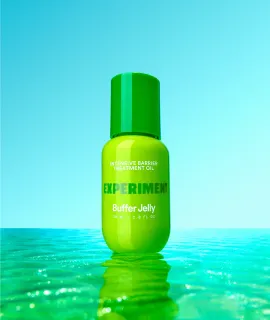
Works for
1 of 1 advertised claim delivered
Moisturizing14 ingredients credited for this claimStrong support
“This oil-meets-gel is clinically proven to help strengthen your skin barrier, calm irritation, and smooth rough, dry skin.”
This product can help soften the skin and reduce its moisture loss with emollients and occlusives: simmondsia chinensis seed oil, squalane.
Keep in mind that this product does not contain effective ingredients to attract water to the upper layer of the skin. This is why an additional product with humectants like glycerin or hyaluronic acid can be helpful (apply it before this product for the best results).
The following ingredients in this product are especially good for supporting the skin barrier and helping with the hydration level: ceramide np, linoleic acid, petrolatum
Anti-blemishNot advertised by the brand · 2 ingredients credited for this claimGood support
This product might be able to help reduce blemishes and clogged pores because it contains ethyl linoleate.
The following ingredient (ingredients) in this product might be helpful, but there is no evidence to confirm that it actually works: linoleic acid
Anti-oxidationNot advertised by the brand · 3 ingredients credited for this claimModerate support
This product contains antioxidants (naringenin) that might be able to help neutralize free radicals in skin to lessen the damage it gets from the UV light (sun). There is not enough evidence to confirm their effectiveness in skin though.
Can it cause trouble?
Irritancy6 flagged ingredientsLow risk
ComedogenicClean of flagged comedogenic ingredientsNone flagged
User reviews
Be the first — your take helps the next person decide.
Ingredients
Filter by role to see what each ingredient is doing.
Carthamus tinctorius seed oil~23–34%
- Irritation risk
- Low
An emollient that helps soften the skin and might help calm down inflammation
More about Carthamus tinctorius seed oilSimmondsia chinensis seed oil~5.9–8.8%
- Irritation risk
- Medium
Softens the upper layer of skin and helps restore the healthy skin barrier. Has shown to help calm down inflammation in skin. It is a stable oil, meaning that it retains its properties even when exposed to air.
More about Simmondsia chinensis seed oilSqualane~4.6–6.8%
- Irritation risk
- Low
An oil naturally present in skin. Works as an emollient to soften the skin and form a protective layer on its surface without a greasy feeling.
More about SqualaneC13-15 alkane~3.6–5.4%
Dextrin palmitate/ethylhexanoate~2.5–3.8%
Petrolatum~2.2–3.4%
- Irritation risk
- Low
One of the most effective and the most studied occlusive ingredients that creates a protective layer on top of the skin preventing moisture loss
More about PetrolatumJojoba esters~1.6–2.5%
- Irritation risk
- Medium
An emollient made of jojoba oil. Helps soften the skin and support its barrier function
More about Jojoba estersAvena sativa kernel oil~1.2–1.8%
- Irritation risk
- Low
An effective moisturizing and skin barrier repair ingredient. Helps calm down inflammation and has some anti-oxidant properties
More about Avena sativa kernel oilEuphorbia cerifera wax~1.3–2%
- Irritation risk
- Low
Tocopherol~0.85–1.25%
- Irritation risk
- Low
Pure form of vitamin E. Can help moisturise and protect the skin from free radicals. Often used to help stabilise other ingredients or the formula itself
More about TocopherolPanthenyl triacetate~0.5–1.15%
- Irritation risk
- Low
A stable oil-soluble derivative of vitamin B5. It can help support skin barrier and reduce inflammation in skin
More about Panthenyl triacetateCeramide np~0.5–1.2%
- Irritation risk
- Low
A type of lipid similar to ceramides naturally present in skin. Helps to soften the upper layer of the skin and supports the skin barrier function to keep it hydrated. Can help to prevent inflammation in skin
More about Ceramide npEuterpe oleracea sterols~0.35–0.85%
- Irritation risk
- Low
Ethyl linoleate~0.35–0.85%
- Irritation risk
- Medium
Helps reduce acne and blemishes. Helps to soften the upper layer of the skin and reduce inflammation. Might be helpful in reducing hyperpigmentation and evening out the skin tone, but evidence of effectiveness in skin are lacking
More about Ethyl linoleateCamellia sinensis leaf wax~0.15–0.7%
- Irritation risk
- Low
Naringenin~0.15–0.5%
- Irritation risk
- Medium
A flavanoid that can be found in high concentrations in grapefruits, oranges, other citrus fruits, and tomato skin. Early studies suggest that it might be able to help reduce inflammation in skin and neutralize free radicals
More about NaringeninLinoleic acid~0.2–0.75%
- Irritation risk
- Low
An excellent emollient. Helps soften the skin, restore its barrier function, and can help to calm down inflammation. It can be helpful to prevent blemishes and clogged pores
More about Linoleic acidOleic acid~0.15–0.55%
- Irritation risk
- Medium
Helps soften the upper layer of the skin. At the same time, it can weaken the skin's barrier enhancing penetration of other ingredients and increasing the risk of skin dryness
More about Oleic acidLinolenic acid~0.15–0.7%
- Irritation risk
- Medium
An emollient that helps soften the skin and calm down inflammation
More about Linolenic acidIngredient list view
Carthamus tinctorius seed oil, Simmondsia chinensis seed oil, Squalane, C13-15 alkane, Dextrin palmitate/ethylhexanoate, Petrolatum, Jojoba esters, Avena sativa kernel oil, Euphorbia cerifera wax, Tocopherol, Panthenyl triacetate, Ceramide np, Euterpe oleracea sterols, Ethyl linoleate, Camellia sinensis leaf wax, Naringenin, Linoleic acid, Oleic acid, Linolenic acid
Compare prices
Retailers ranked by price — lowest first.
Affiliate links · prices updated regularly · As an Amazon Associate, WIMJ earns from qualifying purchases.
Product summary
"Experiment - Buffer Jelly" is effective for: Moisturizing
This product could be helpful for: Anti-blemish, but its actives are not the most effective or are not well-studied.
Ingredient callouts
- Ceramides (ceramide np 0.50% - 1.20%). Ceramides are a type of lipids that our skin produces itself. They are a building block of the skin's barrier. Ceramides used in skincare are synthetic or extracted from plants. They work well for softening the skin surface and "patch holes" in the skin's barrier.
Sources cited in this review
Every concentration estimate and effectiveness label is anchored to one of these 13 studies and safety reviews.
- 1Vitamin E in dermatologyncbi.nlm.nih.gov
- 2Vitamin E and Skin Healthlpi.oregonstate.edu
- 3
- 4
- 5
- 6

Affiliate links · As an Amazon Associate, WIMJ earns from qualifying purchases.