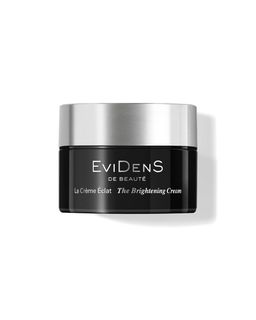
EviDenS de Beauté The Brightening Cream
Works for
3 of 3 advertised claims delivered
Evens skin toneAlpha-arbutin, Glycyrrhiza glabra root extract + 3 moreStrong evidence
“minimize the appearance of pigmentation spots, leaving the complexion looking bright, clear and beautifully even-toned”
This product can help reduce hypepigmentation and even out the skin tone because it contains the following effective ingredients: alpha-arbutin
The following ingredient (ingredients) in this product might be helpful, but there is no evidence to confirm that it actually can help even out the skin tone: alanine, glycyrrhiza glabra root extract.
Keep in mind that you would need to apply any topical skincare targetted at hypigmentation consistently for a couple of months to get a result. No topical skincare product can help get rid of hyperpigmentation (including post-acne marks and age spots) instantly.
Anti-agingSerine, Aspartic acid + 5 moreModerate evidence
“Triple Collagen, the brand’s exclusive anti-aging ingredient”
This product contains aspartic acid, serine, threonine. These ingredients might be able to help reduce and prevent fine lines and wrinkles, improve skin elasticity and firmness, but there is not enough evidence that it actually works.
MoisturizingSodium pca, Soluble collagen + 33 moreGood evidence
“nourishing and highly soothing active ingredients, The Brightening Cream protectively envelops the skin in moisture”
This product can help improve hydration of the skin with the two types of ingredients.
The first type is called “humectants”:
these ingredients help attract water.
When humectants are on the surface of the skin, they “pull in” the moisture from the outside environment, or from
within deeper layers of the skin. The following ingredients in this product do the job:
alanine, arginine.
This product also contains ingredients called “occlusives”. They help reduce the speed with which our skin loses moisture to the outside environment. These ingredients also help soften the upper layer of the skin, so it feels less tight and nicer to the touch. The following ingredients in this product do the job: arginine, dimethicone.
Anti-oxidationNot advertised by the brand · Ubiquinone, Camellia sinensis leaf extract + 3 moreStrong evidence
This product contains antioxidants (ubiquinone) that can help neutralize free radicals in skin. By doing so, they can lessen the damage the skin gets from the UV light (sun).
The following ingredients - camellia sinensis leaf extract also can have an antioxidant effect, but there is less evidence to confirm their effectiveness in skin.
Can it cause trouble?
Irritancy6 strong irritants: Alcohol, Benzyl benzoate + 4 more — patch-test recommendedHigh risk
Comedogenic2 ingredients rated 2 or more on the 0–5 pore-clogging scale2 flagged
User reviews
Be the first — your take helps the next person decide.
Ingredients
Filter by role to see what each ingredient is doing.
Water~45–55%
Squalane~4.8–5.9%
- Irritation risk
- Low
An oil naturally present in skin. Works as an emollient to soften the skin and form a protective layer on its surface without a greasy feeling.
More about SqualaneTriethylhexanoin~4.5–5.6%
- Irritation risk
- Medium
Helps soften the upper layer of the skin
More about TriethylhexanoinButylene glycol~3.5–4.2%
- Irritation risk
- Low
Used to create a nice product texture and help delivery of other ingredients. Might be somewhat helpful in attracting water to the upper layer of the skin
More about Butylene glycolGlycerin~2.9–3.5%
- Irritation risk
- Low
One of the best moisturizing ingredients. Naturally present in skin. It attracts water to the upper layer of the skin working as a humectant
More about Glycerin1,2-hexanediol~1.2–1.4%
Ascorbyl tetraisopalmitate~1.9–2.4%
- Irritation risk
- Medium
A vitamin C derivative. Studies show that is might be effective in reducing hyperpigmentation, but there are no studies confirming that it is effectively converted into the bioavailable form of Vitamin C in skin. It is not clear how this derivative compares in effectiveness to the topical application of bioavailable form of vitamin C (L-ascorbic acid)
More about Ascorbyl tetraisopalmitateMethyl gluceth-10~1.7–2.1%
Macadamia ternifolia seed oil~1.5–1.9%
- Irritation risk
- Medium
Plant oil from nuts that helps soften the upper layer of the skin. Contains a high concentration of oleic acid that can weaken skin's barrier function and increase water-loss while enhancing penetration of other ingredients
More about Macadamia ternifolia seed oilDimethicone~1.4–1.7%
- Irritation risk
- Low
A silicone that helps to reduce water loss from the surface of the skin. Can temporarily "fill in" lines and wrinkles, absorb oil, and create a nice product finish
More about DimethiconeHydroxyethyl acrylate/sodium acryloyldimethyl taurate copolymer~1.1–1.3%
- Irritation risk
- Medium
A gelling agent that thickens the product consistency and leaves the skin with a velvety finish
More about Hydroxyethyl acrylate/sodium acryloyldimethyl taurate copolymerHydrogenated rapeseed alcohol~1–1.3%
Simmondsia chinensis seed oil~1–1.3%
- Irritation risk
- Medium
Softens the upper layer of skin and helps restore the healthy skin barrier. Has shown to help calm down inflammation in skin. It is a stable oil, meaning that it retains its properties even when exposed to air.
More about Simmondsia chinensis seed oilBehenyl alcohol~1–1.2%
- Irritation risk
- Low
Non-drying alcohol that helps water and oil mix together. Also serves as an emollient
More about Behenyl alcoholPolysorbate 60~0.9–1.1%
Polyglyceryl-10 laurate~0.8–1.2%
- Irritation risk
- Medium
Helps water and oil mix together
More about Polyglyceryl-10 laurateCyclohexasiloxane~0.8–1.15%
- Irritation risk
- Low
A silicone that serves as an emollient. Helps create a nice non-greasy feels
More about CyclohexasiloxaneDextrin palmitate~0.75–1.15%
- Irritation risk
- Medium
Helps water and oil mix together
More about Dextrin palmitatePeg-45 stearate~0.75–1.1%
Ppg-4-ceteth-20~0.7–1.1%
Alcohol~0.65–1%
- Irritation risk
- High
Can be drying and contribute to skin irritation. Used in formulars to dissolve other ingredients, create a thinner product consistency or for its antibacterial properties
More about AlcoholCetyl-pg hydroxyethyl palmitamide~0.65–0.95%
- Irritation risk
- Low
Cholesteryl/octyldodecyl lauroyl glutamate~0.6–0.95%
- Irritation risk
- Low
Caprylic/capric triglyceride~0.7–1.05%
- Irritation risk
- Medium
A good mix of fatty acids that forms a protective layer on the skin. Improves the shelf life of products. Derived from coconut and glycerin
More about Caprylic/capric triglycerideGlycosyl trehalose~0.65–0.95%
Pvp~0.65–0.95%
- Irritation risk
- Medium
Helps evenly disperse other ingredients in a formulation and create an even layer on the surface of the skin
More about PvpTetrasodium edta~0.6–0.95%
Alpha-arbutin~0.6–0.9%
- Irritation risk
- Medium
Might help reduce hyperpigmentation when used regularly over a long period of time. Is more effective than beta-arbutin
More about Alpha-arbutinMoringa oleifera seed oil~0.65–1%
- Irritation risk
- Medium
A plant oil that helps soften the upper layer of the skin. Is unlikely to be helpful in restoring skin barrier function due to the low content of linoleic acid
More about Moringa oleifera seed oilSorbitan isostearate~0.65–0.95%
- Irritation risk
- Low
Helps oil and water mix together
More about Sorbitan isostearateHydrogenated starch hydrolysate~0.65–0.95%
- Irritation risk
- Low
Helps to attract water to the upper layer of the skin. Can add sweet taste to lip products
More about Hydrogenated starch hydrolysateTocopherol~0.65–0.95%
- Irritation risk
- Low
Pure form of vitamin E. Can help moisturise and protect the skin from free radicals. Often used to help stabilise other ingredients or the formula itself
More about TocopherolCyclopentasiloxane~0.65–1%
- Irritation risk
- Low
A silicone that helps improve the product texture and spreadability. Can absorb oil creating a short-term mattifying effect on the skin
More about CyclopentasiloxaneUbiquinone~0.65–0.95%
- Irritation risk
- Low
Coenzyme Q10. It helps neutralize free radicals in skin, improves skin hydration and might be helpful agains fine lines and wrinkles. It can be an allergen
More about UbiquinoneHydrogenated lecithin~0.65–0.95%
- Irritation risk
- Low
Helps to retain moisture by creating a protective barrier on the skin. Rich in fatty acids. Improves product texture and helps with the penetration of other ingredients.
More about Hydrogenated lecithinCamellia sinensis leaf extract~0.65–0.95%
- Irritation risk
- Low
Can contain potent anti-oxidant compounds (abbreviated ECG, GCG, EGC, and EGCG) that might help protect the skin from free radicals. Can help calm down inflammation and has some anti-bacterial properties. Unfortunately, these antioxidants are unstable and lose their effectiveness very quickly in products. The concentration of the antioxidant compounds in the extract also tends to be low to be effective in topical formulation
More about Camellia sinensis leaf extractLaminaria ochroleuca extract~0.6–0.95%
- Irritation risk
- Low
- Comedogenicity
- 3/5
Helps attract water to the upper layer of the skin
More about Laminaria ochroleuca extractHydrolyzed collagen~0.65–1%
- Irritation risk
- Low
A typically plant-derived compound that is supposed mimic human collagen. Cannot penetrate the skin barrier so is not particularly useful in skincare products beyond attracting water to the upper layer of the skin
More about Hydrolyzed collagenChamomilla recutita flower extract~0.6–0.95%
- Irritation risk
- High
Plant extract that can have healing and anti-inflammatory properties. It is a potential allergen and can be irritating
More about Chamomilla recutita flower extractGlycyrrhiza glabra root extract~0.6–0.9%
- Irritation risk
- Medium
A plant extract that can help lighten the skin and calm down inflammation. Might be helpful in neutralizing free radicals
More about Glycyrrhiza glabra root extractPhenoxyethanol~0.65–0.95%
- Irritation risk
- Low
A preservative. It helps prevent bacterial growth in cosmetic products
More about PhenoxyethanolMorus alba root extract~0.6–0.95%
- Irritation risk
- Low
Algin~0.65–0.95%
- Irritation risk
- Low
- Comedogenicity
- 3/5
Used to thicken product formulation. Can help attract water to the upper layer of the skin
More about AlginFullerenes~0.6–0.95%
- Irritation risk
- Low
Hydrolyzed elastin~0.65–1%
- Irritation risk
- Low
Vitis vinifera leaf extract~0.6–0.9%
- Irritation risk
- Medium
Sodium pca~0.6–0.95%
- Irritation risk
- Low
Naturally present in skin and helps to attract water to its upper layer
More about Sodium pcaSodium lactate~0.6–0.95%
- Irritation risk
- Medium
Helps attract water to the upper layer of the skin. Is often used to adjust the pH level of the product
More about Sodium lactateSodium hyaluronate~0.6–0.95%
- Irritation risk
- Low
One of the best moisturizing ingredients. Attracts water into the upper layer of the skin
More about Sodium hyaluronateArginine~0.6–0.9%
- Irritation risk
- Low
An amino acid that is naturally present in skin and helps keep it hydrated. When used together with AHAs, it can reduce their irritating effect on the skin
More about ArginineAspartic acid~0.6–0.9%
- Irritation risk
- Low
An amino-acid that helps increase skin hydration and might help to slightly improve skin firmness, potentially reducing lines and wrinkles
More about Aspartic acidPca~0.6–0.9%
- Irritation risk
- Low
Naturally present in skin and helps to attract water to its upper layer
More about PcaSoluble collagen~0.5–0.75%
- Irritation risk
- Low
A typically plant-derived compound that is supposed mimic human collagen. Cannot penetrate the skin barrier so is not particularly useful in skincare products beyond attracting water to the upper layer of the skin
More about Soluble collagenCitric acid~0.5–0.75%
- Irritation risk
- Medium
Can work as an exfoliant but is typically used to adjust the product pH
More about Citric acidGlycine~0.5–0.75%
- Irritation risk
- Low
Helps to attract water to the upper layer of the skin and can help restore the skin barrier function
More about GlycineAlanine~0.5–0.75%
- Irritation risk
- Low
An amino-acid that helps to attract water to the upper layer of the skin and might help to lighten the skin, but solid evidence is lacking
More about AlanineSerine~0.45–0.7%
- Irritation risk
- Low
An amino-acid that helps to attract water to the upper layer of the skin. In combination with other amino-acids, might help to reduce fine lines and wrinkles
More about SerineValine~0.45–0.65%
- Irritation risk
- Low
Threonine~0.4–0.6%
- Irritation risk
- Low
An amino-acid that helps to attract water to the upper layer of the skin. In combination with other amino-acids, might help to reduce fine lines and wrinkles
More about ThreonineProline~0.4–0.6%
Isoleucine~0.3–0.6%
- Irritation risk
- Low
An amino acid that can help attract water to the upper layer of the skin and support skin's barrier function
More about IsoleucinePhenylalanine~0.3–0.55%
- Irritation risk
- Low
Histidine~0.25–0.4%
Benzyl benzoate~0.2–0.35%
- Irritation risk
- High
Fragrance with sweet balsamic smell. Help to preserve products and dissolve other ingredients. Could trigger allergic reactions and be irritating
More about Benzyl benzoateLinalool~0.2–0.35%
Hexyl cinnamal~0.15–0.3%
Alpha-isomethyl ionone~0.1–0.2%
- Irritation risk
- High
A fragrance. Potential allergen and can be irritating
More about Alpha-isomethyl iononeCitronellol~0.1–0.2%
Ingredient list view
Water, Squalane, Triethylhexanoin, Butylene glycol, Glycerin, 1,2-hexanediol, Ascorbyl tetraisopalmitate, Methyl gluceth-10, Macadamia ternifolia seed oil, Dimethicone, Hydroxyethyl acrylate/sodium acryloyldimethyl taurate copolymer, Hydrogenated rapeseed alcohol, Simmondsia chinensis seed oil, Behenyl alcohol, Polysorbate 60, Unknown, Polyglyceryl-10 laurate, Cyclohexasiloxane, Dextrin palmitate, Peg-45 stearate, Ppg-4-ceteth-20, Alcohol, Cetyl-pg hydroxyethyl palmitamide, Cholesteryl/octyldodecyl lauroyl glutamate, Caprylic/capric triglyceride, Glycosyl trehalose, Pvp, Tetrasodium edta, Alpha-arbutin, Moringa oleifera seed oil, Sorbitan isostearate, Hydrogenated starch hydrolysate, Tocopherol, Cyclopentasiloxane, Ubiquinone, Hydrogenated lecithin, Camellia sinensis leaf extract, Laminaria ochroleuca extract, Hydrolyzed collagen, Chamomilla recutita flower extract, Glycyrrhiza glabra root extract, Phenoxyethanol, Morus alba root extract, Algin, Fullerenes, Hydrolyzed elastin, Vitis vinifera leaf extract, Sodium pca, Sodium lactate, Sodium hyaluronate, Arginine, Aspartic acid, Pca, Soluble collagen, Citric acid, Glycine, Alanine, Serine, Valine, Threonine, Proline, Isoleucine, Phenylalanine, Histidine, Benzyl benzoate, Linalool, Hexyl cinnamal, Alpha-isomethyl ionone, Citronellol
Compare prices
Retailers ranked by price — lowest first.

Affiliate links · prices updated regularly
Sources cited in this review
Every concentration estimate and effectiveness label is anchored to one of these 28 studies and safety reviews.
- 1
- 2
- 3
- 4
- 5
- 6

Affiliate links · As an Amazon Associate, WIMJ earns from qualifying purchases.