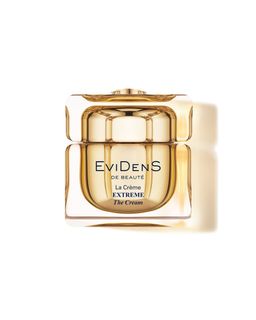
EviDenS de Beauté The Extreme Cream
Works for
2 of 2 advertised claims delivered
MoisturizingArginine/lysine polypeptide, Hexapeptide-3 + 32 moreStrong evidence
“Clinically proven to help maintain the skin’s youthful appearance, it minimizes wrinkles and fine lines, leaving skin soft, moisturized and nourished for enhanced firmness and increased density.”
This product can help improve hydration of the skin with the two types of ingredients.
The first type is called “humectants”:
these ingredients help attract water.
When humectants are on the surface of the skin, they “pull in” the moisture from the outside environment, or from
within deeper layers of the skin. The following ingredients in this product do the job:
carnosine, diglycerin.
This product also contains ingredients called “occlusives”. They help reduce the speed with which our skin loses moisture to the outside environment. These ingredients also help soften the upper layer of the skin, so it feels less tight and nicer to the touch. The following ingredients in this product do the job: dimethicone, helianthus annuus seed oil.
The following ingredients in this product are especially good for supporting the skin barrier and helping with the hydration level: acetyl dipeptide-1 cetyl ester, arginine/lysine polypeptide, hexapeptide-3
Anti-agingAcetyl dipeptide-1 cetyl ester, Arginine/lysine polypeptide + 7 moreModerate evidence
“A high concentration of vital energy with anti-aging benefits, this cream combats and corrects all visible signs of aging, bringing a youthful glow to mature skin types.”
This product contains acetyl dipeptide-1 cetyl ester, arginine/lysine polypeptide, carnosine, hexapeptide-3. These ingredients might be able to help reduce and prevent fine lines and wrinkles, improve skin elasticity and firmness, but there is not enough evidence that it actually works.
Anti-oxidationNot advertised by the brand · Carnosine, Glucosyl hesperidin + 11 moreStrong evidence
This product contains antioxidants (carnosine) that can help neutralize free radicals in skin. By doing so, they can lessen the damage the skin gets from the UV light (sun).
Can it cause trouble?
Irritancy5 strong irritants: Alcohol, Citrus junos fruit extract + 3 more — patch-test recommendedHigh risk
Comedogenic1 ingredient rated 2 or more on the 0–5 pore-clogging scale1 flagged
User reviews
Be the first — your take helps the next person decide.
Ingredients
Filter by role to see what each ingredient is doing.
Water~45–55%
Diglycerin~5.4–6.6%
- Irritation risk
- Low
Helps attract water to the upper layer of the skin
More about DiglycerinSqualane~4.3–5.3%
- Irritation risk
- Low
An oil naturally present in skin. Works as an emollient to soften the skin and form a protective layer on its surface without a greasy feeling.
More about SqualaneIsononyl isononanoate~3.2–4%
- Irritation risk
- Low
Forms a protective film on the surface of the skin to prevent moisture loss. Gives a velvety feel to products while reducing tackiness
More about Isononyl isononanoateButylene glycol~2.3–2.8%
- Irritation risk
- Low
Used to create a nice product texture and help delivery of other ingredients. Might be somewhat helpful in attracting water to the upper layer of the skin
More about Butylene glycolDipentaerythrityl hexahydroxystearate~1.9–2.3%
Cetyl palmitate~1.6–2%
- Irritation risk
- Low
An emollient that helps soften the skin and is used to improve product texture and stability
More about Cetyl palmitateDiisostearyl malate~1.4–1.7%
- Irritation risk
- Medium
Helps to soften the upper layer of the skin
More about Diisostearyl malate1,2-hexanediol~0.65–0.95%
Behenyl alcohol~0.95–1.15%
- Irritation risk
- Low
Non-drying alcohol that helps water and oil mix together. Also serves as an emollient
More about Behenyl alcoholDiphenylsiloxy phenyl trimethicone~0.6–0.9%
- Irritation risk
- Low
Help improve the product's texture
More about Diphenylsiloxy phenyl trimethiconeGlycerin~0.55–0.8%
- Irritation risk
- Low
One of the best moisturizing ingredients. Naturally present in skin. It attracts water to the upper layer of the skin working as a humectant
More about GlycerinAscorbyl tetraisopalmitate~0.45–0.65%
- Irritation risk
- Medium
A vitamin C derivative. Studies show that is might be effective in reducing hyperpigmentation, but there are no studies confirming that it is effectively converted into the bioavailable form of Vitamin C in skin. It is not clear how this derivative compares in effectiveness to the topical application of bioavailable form of vitamin C (L-ascorbic acid)
More about Ascorbyl tetraisopalmitateGlyceryl stearate~0.45–0.65%
- Irritation risk
- Low
An emollient that softens the skin and forms a protective layer on its surface. Helps water and oil mix together
More about Glyceryl stearateHydroxyethyl acrylate/sodium acryloyldimethyl taurate copolymer~0.3–0.55%
- Irritation risk
- Medium
A gelling agent that thickens the product consistency and leaves the skin with a velvety finish
More about Hydroxyethyl acrylate/sodium acryloyldimethyl taurate copolymerPeg-100 stearate~0.45–0.65%
- Irritation risk
- Low
Helps oil and water mix togehter and creates a nice product texture
More about Peg-100 stearateGlycosyl trehalose~0.3–0.6%
Dimethicone~0.3–0.6%
- Irritation risk
- Low
A silicone that helps to reduce water loss from the surface of the skin. Can temporarily "fill in" lines and wrinkles, absorb oil, and create a nice product finish
More about DimethiconeStearic acid~0.35–0.65%
- Irritation risk
- Low
Helps oil and water mix together and works as an emollient
More about Stearic acidHydrogenated starch hydrolysate~0.2–0.4%
- Irritation risk
- Low
Helps to attract water to the upper layer of the skin. Can add sweet taste to lip products
More about Hydrogenated starch hydrolysateTocopheryl acetate~0.2–0.35%
- Irritation risk
- Medium
A more stable but less bio-available form of vitamin E compared to Tocopherol. Might help moisturize and protect the skin from free radicals, but mostly used in low concentrations to stabilize other ingredients.
More about Tocopheryl acetateRosa canina fruit oil~0.2–0.4%
- Irritation risk
- Medium
A great emollient. Contains vitamin E (tocopherol) which may give it some anti-oxidant properties. Can contain volatile compounds and can be irritating
More about Rosa canina fruit oilPrunus armeniaca kernel oil~0.2–0.35%
- Irritation risk
- Medium
An emollient that helps soften the skin
More about Prunus armeniaca kernel oilPersea gratissima oil~0.2–0.35%
- Irritation risk
- Medium
An emollient that helps soften the skin and could be helpful in repairing its barrier function
More about Persea gratissima oilPpg-4-ceteth-20~0.2–0.35%
Alcohol~0.15–0.3%
- Irritation risk
- High
Can be drying and contribute to skin irritation. Used in formulars to dissolve other ingredients, create a thinner product consistency or for its antibacterial properties
More about AlcoholCarnosine~0.15–0.3%
- Irritation risk
- Low
A type of peptide. It attracts water to the upper layer of the skin. It can help neutralize free radicals in skin combatting the sun damage
More about CarnosinePolysorbate 60~0.2–0.35%
Triethylhexanoin~0.15–0.25%
- Irritation risk
- Medium
Helps soften the upper layer of the skin
More about TriethylhexanoinCarbomer~0.15–0.3%
- Irritation risk
- Low
Helps create a thicker or gel-like product texture. It is not a surfactant but can be used in gentle cleansing formulations
More about CarbomerGlucosyl hesperidin~0.15–0.3%
- Irritation risk
- Low
Might be able to neutralize free radicals in skin. Also works as a humectant
More about Glucosyl hesperidinArginine/lysine polypeptide~0.15–0.3%
- Irritation risk
- Low
A type of peptide. Peptides are excellent moisturizers and might be able support collagen production reducing fine lines and wrinkles
More about Arginine/lysine polypeptidePunica granatum fruit extract~0.15–0.3%
- Irritation risk
- High
A fruit extract that is used to add a fragrance to the product. It might have some antioxidant properties
More about Punica granatum fruit extractPotassium hydroxide~0.2–0.35%
Mica~0.2–0.35%
- Irritation risk
- Low
Creates an illusion of smoother and more radiant skin tone. Adds shimmer to the skin by reflecting light
More about MicaSorbitan isostearate~0.2–0.35%
- Irritation risk
- Low
Helps oil and water mix together
More about Sorbitan isostearateDisodium edta~0.15–0.3%
Oryza sativa lees extract~0.2–0.35%
- Irritation risk
- Low
Oryzanol~0.2–0.35%
- Irritation risk
- Low
An anti-oxidant that helps stabilize product formulations. Might help neutralise free radicals in skin
More about OryzanolSodium hyaluronate~0.2–0.35%
- Irritation risk
- Low
One of the best moisturizing ingredients. Attracts water into the upper layer of the skin
More about Sodium hyaluronateTocopherol~0.2–0.35%
- Irritation risk
- Low
Pure form of vitamin E. Can help moisturise and protect the skin from free radicals. Often used to help stabilise other ingredients or the formula itself
More about TocopherolSorbitan laurate~0.2–0.35%
Camellia sinensis leaf extract~0.2–0.35%
- Irritation risk
- Low
Can contain potent anti-oxidant compounds (abbreviated ECG, GCG, EGC, and EGCG) that might help protect the skin from free radicals. Can help calm down inflammation and has some anti-bacterial properties. Unfortunately, these antioxidants are unstable and lose their effectiveness very quickly in products. The concentration of the antioxidant compounds in the extract also tends to be low to be effective in topical formulation
More about Camellia sinensis leaf extractCitric acid~0.2–0.35%
- Irritation risk
- Medium
Can work as an exfoliant but is typically used to adjust the product pH
More about Citric acidPaeonia albiflora root extract~0.2–0.35%
- Irritation risk
- Low
Hydrolyzed collagen~0.2–0.4%
- Irritation risk
- Low
A typically plant-derived compound that is supposed mimic human collagen. Cannot penetrate the skin barrier so is not particularly useful in skincare products beyond attracting water to the upper layer of the skin
More about Hydrolyzed collagenSodium citrate~0.2–0.35%
- Irritation risk
- Medium
Helps to control the skin's pH level. Maintains the skin's natural film of amino-lactic acids and oils. Helps to preserve products
More about Sodium citratePhenoxyethanol~0.2–0.35%
- Irritation risk
- Low
A preservative. It helps prevent bacterial growth in cosmetic products
More about PhenoxyethanolLilium candidum bulb extract~0.2–0.35%
- Irritation risk
- Low
Hydroxyethylcellulose~0.2–0.4%
- Irritation risk
- Low
Used to thicken product formulations and create gel-like textures
More about HydroxyethylcellulosePaeonia suffruticosa root extract~0.2–0.35%
Acetyl dipeptide-1 cetyl ester~0.2–0.35%
- Irritation risk
- Low
A type of peptide. Peptides are excellent moisturizers and might be able support collagen production reducing fine lines and wrinkles
More about Acetyl dipeptide-1 cetyl esterAlgin~0.2–0.35%
- Irritation risk
- Low
- Comedogenicity
- 3/5
Used to thicken product formulation. Can help attract water to the upper layer of the skin
More about AlginHelianthus annuus seed oil~0.2–0.4%
- Irritation risk
- Low
A great emollient due to its high linoleic acid content. One of the most effective plant oils in helping skin hydration and repairing skin barrier function
More about Helianthus annuus seed oilZinc gluconate~0.2–0.35%
- Irritation risk
- Medium
Typically used to stabilize the product formulations. It is a salt of a polyhydroxy acid (PHA) and in larger concentrations, can help shed the dead cells from the skin surface revealing smoother skin. It can help attract water to the upper layer of the skin. Might to be helpful against acne and clogged pores. Could be helpful in neutralizing free radicals, but solid research is missing. Due to the zinc content, might help calm down inflammation in skin
More about Zinc gluconateMagnesium aspartate~0.2–0.35%
- Irritation risk
- Low
Might be helpful in restoring skin barrier function and calm down inflammation in skin
More about Magnesium aspartateSoluble collagen~0.2–0.35%
- Irritation risk
- Low
A typically plant-derived compound that is supposed mimic human collagen. Cannot penetrate the skin barrier so is not particularly useful in skincare products beyond attracting water to the upper layer of the skin
More about Soluble collagenSorbic acid~0.15–0.3%
Citrus junos fruit extract~0.2–0.35%
- Irritation risk
- High
Contains essential oil. Can be irritating and lead to photosensitivity
More about Citrus junos fruit extractCopper gluconate~0.15–0.3%
- Irritation risk
- Medium
Typically used to stabilize the product formulations. It is a salt of polyhydroxy acid (PHA) and in larger concentrations, can help shed the dead cells from the skin surface revealing smoother skin. It can help attract water to the upper layer of the skin. Might to be helpful against acne and clogged pores. Could be helpful in neutralizing free radicals, but solid research is missing
More about Copper gluconateOligopeptide-6~0.15–0.3%
- Irritation risk
- Low
Hexapeptide-3~0.15–0.3%
- Irritation risk
- Low
A type of peptide. Peptides are excellent moisturizers and might be able support collagen production reducing fine lines and wrinkles
More about Hexapeptide-3Natto gum~0.15–0.3%
- Irritation risk
- Low
Linalool~0.15–0.25%
Citronellol~0.1–0.15%
Limonene~0.1–0.15%
- Irritation risk
- High
A common frangrance that can easily irritate skin, especially if exposed to air, light or heat
More about LimoneneIngredient list view
Water, Diglycerin, Squalane, Isononyl isononanoate, Butylene glycol, Dipentaerythrityl hexahydroxystearate, Cetyl palmitate, Diisostearyl malate, 1,2-hexanediol, Behenyl alcohol, Diphenylsiloxy phenyl trimethicone, Glycerin, Ascorbyl tetraisopalmitate, Glyceryl stearate, Hydroxyethyl acrylate/sodium acryloyldimethyl taurate copolymer, Peg-100 stearate, Glycosyl trehalose, Dimethicone, Stearic acid, Unknown, Hydrogenated starch hydrolysate, Tocopheryl acetate, Rosa canina fruit oil, Prunus armeniaca kernel oil, Persea gratissima oil, Ppg-4-ceteth-20, Alcohol, Carnosine, Polysorbate 60, Triethylhexanoin, Carbomer, Glucosyl hesperidin, Arginine/lysine polypeptide, Punica granatum fruit extract, Potassium hydroxide, Mica, Sorbitan isostearate, Disodium edta, Oryza sativa lees extract, Unknown, Oryzanol, Sodium hyaluronate, Tocopherol, Sorbitan laurate, Camellia sinensis leaf extract, Citric acid, Paeonia albiflora root extract, Unknown, Hydrolyzed collagen, Sodium citrate, Phenoxyethanol, Lilium candidum bulb extract, Hydroxyethylcellulose, Paeonia suffruticosa root extract, Acetyl dipeptide-1 cetyl ester, Algin, Helianthus annuus seed oil, Zinc gluconate, Magnesium aspartate, Soluble collagen, Unknown, Sorbic acid, Citrus junos fruit extract, Copper gluconate, Oligopeptide-6, Hexapeptide-3, Natto gum, Linalool, Citronellol, Limonene
Compare prices
Retailers ranked by price — lowest first.

Sources cited in this review
Every concentration estimate and effectiveness label is anchored to one of these 29 studies and safety reviews.
- 1
- 2
- 3
- 4
- 5
- 6

Affiliate links · As an Amazon Associate, WIMJ earns from qualifying purchases.