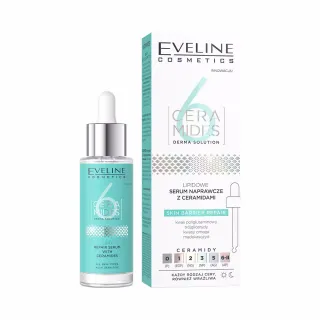
Eveline Cosmetics Lipid repair serum + cermides
Works for
MoisturizingCeramide ap, Ceramide ng + 24 moreWorks well
“The serum strengthens the skin barrier, immediately moisturizes, deeply nourishes, and promotes regeneration.”
This product can help improve hydration of the skin with the two types of ingredients.
The first type is called “humectants”:
these ingredients help attract water.
When humectants are on the surface of the skin, they “pull in” the moisture from the outside environment, or from
within deeper layers of the skin. The following ingredients in this product do the job:
glycerin, polyglutamic acid.
This product also contains ingredients called “occlusives”. They help reduce the speed with which our skin loses moisture to the outside environment. These ingredients also help soften the upper layer of the skin, so it feels less tight and nicer to the touch. The following ingredients in this product do the job: caprylic/capric triglyceride, squalane.
The following ingredients in this product are especially good for supporting the skin barrier and helping with the hydration level: ceramide ag, ceramide ap, ceramide eop, ceramide ng, ceramide np, madecassoside, palmitoyl hexapeptide-12, phytosphingosine
Anti-agingCentella asiatica leaf extract, Madecassoside + 3 moreWorks well
“Thanks to this serum, the skin regains deep hydration, youthful elasticity, and a healthy appearance.”
This product can help reduce and prevent fine lines and wrinkles, improve skin elasticity and firmness because it contains palmitoyl hexapeptide-12.
These ingredients in the product can also be helpful, even though there is less evidence for their effectiveness: centella asiatica leaf extract, madecassoside.
Keep in mind that it typically takes at least 6 weeks to notice any results because the changes that are needed to improve fine lines and elasticity happen in the deeper layers of the skin. No topical anti-aging product can “erase” wrinkles or fully reverse signs of aging.
Anti-oxidationSide benefit · Madecassoside, Tocopheryl acetateWorks well
This product contains antioxidants (madecassoside) that can help neutralize free radicals in skin. By doing so, they can lessen the damage the skin gets from the UV light (sun).
Can it cause trouble?
Irritancy2 strong irritants: Salvia officinalis leaf extract, ParfumMedium risk
Comedogenic1 ingredient rated 2 or more on the 0–5 pore-clogging scale1 flagged

User reviews
Be the first — your take helps the next person decide.
Ingredients
Filter by role to see what each ingredient is doing.
Water~45–55%
Aloe barbadensis leaf juice~6.4–7.8%
- Irritation risk
- Medium
Traditionally used to treat sunburns, dermatitis and inflammation, but evidence for its effectiveness is lacking. The extract can contain humectants that help attract water into the skin
More about Aloe barbadensis leaf juicePropanediol~4.5–5.5%
- Irritation risk
- Low
Acts as a solvent for other ingredients. Speeds up the absorption of other ingredients into the skin
More about PropanediolGlycerin~3.2–3.9%
- Irritation risk
- Low
One of the best moisturizing ingredients. Naturally present in skin. It attracts water to the upper layer of the skin working as a humectant
More about GlycerinTripelargonin~2.4–3%
- Irritation risk
- Low
Helps soften the upper layer of the skin
More about TripelargoninCaprylic/capric triglyceride~2–2.5%
- Irritation risk
- Medium
A good mix of fatty acids that forms a protective layer on the skin. Improves the shelf life of products. Derived from coconut and glycerin
More about Caprylic/capric triglycerideSqualane~1.7–2.1%
- Irritation risk
- Low
An oil naturally present in skin. Works as an emollient to soften the skin and form a protective layer on its surface without a greasy feeling.
More about SqualaneLauryl glucoside~1.5–1.8%
Pentaerythrityl distearate~1.1–1.4%
Polyglyceryl-2 dipolyhydroxystearate~0.75–1.15%
- Irritation risk
- Low
Helps to soften the upper layer of the skin
More about Polyglyceryl-2 dipolyhydroxystearateGlycine soja oil~0.6–0.9%
- Irritation risk
- Medium
- Comedogenicity
- 2/5
A good emollient that helps soften the skin and helps repair its barrier function. It can clog pores if used in high concentrations.
More about Glycine soja oilOlea europaea fruit oil~0.5–0.8%
- Irritation risk
- Medium
An emollient that helps soften the skin but is not effective for restoring its barrier function. Might be helpful to calm down inflammation
More about Olea europaea fruit oilCannabis sativa seed oil~0.45–0.7%
- Irritation risk
- Medium
A plant oil that due to its high linoleic acid content can help strengthen skin's barrier function and soften its upper layer
More about Cannabis sativa seed oilShea butter ethyl esters~0.45–0.65%
- Irritation risk
- Low
Helps soften the upper layer of the skin
More about Shea butter ethyl estersTocopheryl acetate~0.4–0.6%
- Irritation risk
- Medium
A more stable but less bio-available form of vitamin E compared to Tocopherol. Might help moisturize and protect the skin from free radicals, but mostly used in low concentrations to stabilize other ingredients.
More about Tocopheryl acetateCentella asiatica leaf extract~0.35–0.6%
- Irritation risk
- Medium
A plant extract that has been shown to be able to reduce inflammation in skin, support restoration of skin barrier function, as well as support collagen production. It can be irritating to sensitive skin. Might be helpful in preventing stretch marks. It could, however, itself be irritating.
More about Centella asiatica leaf extractSalvia officinalis leaf extract~0.45–0.65%
- Irritation risk
- High
Sage leaf extract. It can be irritating
More about Salvia officinalis leaf extractMadecassoside~0.3–0.55%
- Irritation risk
- Medium
An antioxidant that is typically derived from plant Centella Asiatica. It can help neutralize free radicals in skin and support skin barrier function. It could, however, itself be irritating. It is often unstable in formulations
More about MadecassosidePolyglutamic acid~0.3–0.55%
- Irritation risk
- Low
Helps attract water to the upper layer of the skin.
More about Polyglutamic acidCeramide ng~0.3–0.55%
- Irritation risk
- Low
A type of lipid similar to ceramides naturally present in skin. Helps to soften the upper layer of the skin and supports the skin barrier function to keep it hydrated. Can help to prevent inflammation in skin
More about Ceramide ngCeramide np~0.3–0.55%
- Irritation risk
- Low
A type of lipid similar to ceramides naturally present in skin. Helps to soften the upper layer of the skin and supports the skin barrier function to keep it hydrated. Can help to prevent inflammation in skin
More about Ceramide npCeramide ap~0.3–0.55%
- Irritation risk
- Low
A type of lipid similar to ceramides naturally present in skin. Helps to soften the upper layer of the skin and supports the skin barrier function to keep it hydrated. Can help to prevent inflammation in skin
More about Ceramide apPhytosphingosine~0.3–0.55%
- Irritation risk
- Low
A type of lipid that is naturally present in skin. It might help in repairing skin barrier function and has anti-bacterial effect
More about PhytosphingosineCeramide ag~0.25–0.45%
Ceramide eop~0.25–0.5%
- Irritation risk
- Low
A type of lipid similar to ceramides naturally present in skin. Helps to soften the upper layer of the skin and supports the skin barrier function to keep it hydrated. Can help to prevent inflammation in skin
More about Ceramide eopAllantoin~0.25–0.4%
- Irritation risk
- Low
Helps calm down inflammation in skin and can help reduce itching. Helps to repair the skin barrier and keep skin hydrated
More about AllantoinPalmitoyl hexapeptide-12~0.25–0.45%
- Irritation risk
- Low
A type of peptide. Peptides are excellent moisturizers and might be able support collagen production reducing fine lines and wrinkles
More about Palmitoyl hexapeptide-12Phenoxyethanol~0.25–0.5%
- Irritation risk
- Low
A preservative. It helps prevent bacterial growth in cosmetic products
More about PhenoxyethanolHydroxyacetophenone~0.25–0.45%
Ethylhexylglycerin~0.25–0.45%
Parfum~0.2–0.4%
- Irritation risk
- High
An aromatic blend of unspecified and possibly irritating ingredients
More about ParfumPotassium cetyl phosphate~0.25–0.5%
- Irritation risk
- Medium
Helps oil and water mix together
More about Potassium cetyl phosphateSodium carbomer~0.25–0.45%
Xanthan gum~0.25–0.5%
- Irritation risk
- Low
Used to create a thicker product consistency
More about Xanthan gumButylene glycol~0.25–0.45%
- Irritation risk
- Low
Used to create a nice product texture and help delivery of other ingredients. Might be somewhat helpful in attracting water to the upper layer of the skin
More about Butylene glycolHydrogenated lecithin~0.25–0.5%
- Irritation risk
- Low
Helps to retain moisture by creating a protective barrier on the skin. Rich in fatty acids. Improves product texture and helps with the penetration of other ingredients.
More about Hydrogenated lecithinPhytosterols~0.3–0.55%
- Irritation risk
- Medium
Lipids that work as an emollient and can be helpful in repairing skin barrier function
More about PhytosterolsTribehenin~0.3–0.55%
- Irritation risk
- Low
Used to create a thicker product consistency and soften the upper layer of the skin
More about TribeheninCholesterol~0.3–0.55%
- Irritation risk
- Low
An emollient that is naturally found in skin
More about CholesterolLactic acid~0.25–0.45%
- Irritation risk
- Medium
An exfoliating and moisturizing alpha-hydroxy acid (AHA). Typically causes less irritation than other AHAs, for example, glycolic acid. At high concentrations (about 15%), lactic acid can help reduce lines and wrinkles. Recent studies show that lactic acid can support the "good" bacteria living on skin's surface (healthy skin microbiome)
More about Lactic acidCarbomer~0.2–0.4%
- Irritation risk
- Low
Helps create a thicker or gel-like product texture. It is not a surfactant but can be used in gentle cleansing formulations
More about CarbomerC12-15 alkyl benzoate~0.25–0.45%
- Irritation risk
- Low
Enhances the product texture and makes it more spreadable. Helps reduce water loss from the outer layer of skin. Extands the shelf life by preventing bacteria growth
More about C12-15 alkyl benzoateSodium lauroyl lactylate~0.2–0.35%
- Irritation risk
- Medium
Helps water and oil mix together
More about Sodium lauroyl lactylateDisodium edta~0.15–0.3%
Citric acid~0.15–0.3%
- Irritation risk
- Medium
Can work as an exfoliant but is typically used to adjust the product pH
More about Citric acidSodium benzoate~0.15–0.25%
Potassium sorbate~0.15–0.3%
Ingredient list view
Water, Aloe barbadensis leaf juice, Propanediol, Glycerin, Tripelargonin, Caprylic/capric triglyceride, Squalane, Lauryl glucoside, Pentaerythrityl distearate, Polyglyceryl-2 dipolyhydroxystearate, Glycine soja oil, Olea europaea fruit oil, Cannabis sativa seed oil, Shea butter ethyl esters, Tocopheryl acetate, Centella asiatica leaf extract, Salvia officinalis leaf extract, Madecassoside, Polyglutamic acid, Ceramide ng, Ceramide np, Ceramide ap, Phytosphingosine, Ceramide ag, Ceramide eop, Allantoin, Palmitoyl hexapeptide-12, Phenoxyethanol, Hydroxyacetophenone, Ethylhexylglycerin, Parfum, Potassium cetyl phosphate, Sodium carbomer, Xanthan gum, Butylene glycol, Hydrogenated lecithin, Phytosterols, Tribehenin, Cholesterol, Lactic acid, Carbomer, C12-15 alkyl benzoate, Sodium lauroyl lactylate, Disodium edta, Citric acid, Sodium benzoate, Potassium sorbate
Compare prices
Retailers ranked by price — lowest first.

Worth comparing, line by line.
Match % combines shared ingredients, the first five ingredients, shared actives and hero ingredients, irritancy (lower counts in the alternative's favour), texture and body area. Only products in the same routine step are compared.
| Eveline CosmeticsLipid repair serum + cermidesYOUR PRODUCT | Nacomi Next LevelMultifunctional Face Serum, Trehalose 10% | Dr. Emi ArpaAbsolut A Retinal Serum | Priceline5 Ceramide Complex Intense Hydration Serum | |
|---|---|---|---|---|
| Match | — | 50% | 49% | 49% |
| Price | — | — | — | $10.18 |
| Shared key ingredients | — | 9 of 20 | 8 of 20 | 8 of 20 |
| Key difference | — | Niacinamide | Palmitoyl Pentapeptide-4 | Ceramide As |
| Irritancy | Medium | Medium | Low | Low |
| Drying alcohol | — | — | — | — |
| View product | Shop | Shop | Shop |
More alternatives: Transparent Lab Ceramide Repair Serum - Transparent LabIrritated. FACE + BODY SERUM
Product summary
"Eveline Cosmetics - Lipid repair serum + cermides" could be helpful for: Moisturizing, but its actives are not the most effective or are not well-studied.
Ingredient callouts
- Humectants (glycerin 2.80% - 4.20%). These ingredients help attract water to the upper layer of the skin and improve the skin hydration.
Sources cited in this review
Every concentration estimate and effectiveness label is anchored to one of these 21 studies and safety reviews.
- 1
- 2Use of “natural” oils for moisturization: Review of olive, coconut, and sunflower seed oilonlinelibrary.wiley.com
- 3
- 4Hemp (Cannabis sativa L.) as a Resource for Green Cosmeticstandfonline.com
- 5Centella asiatica in Dermatology: An Overviewonlinelibrary.wiley.com
- 6Contact dermatitis due to Madecassolonlinelibrary.wiley.com

Affiliate links · As an Amazon Associate, WIMJ earns from qualifying purchases.