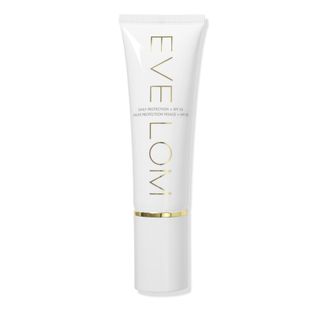
Eve Lom Daily Protection SPF50
Works for
5 of 6 advertised claims delivered
Sun protectionSPF 50 · 7 UV filtersBroad spectrum
This product offers a good level of protection against both UVB and UVA rays.
This sunscreen uses organic (so-called "chemical") sunscreen filters. Organic, or "chemical" filters usually provide reliable sun protection and rarely leave a white cast. Sunscreens with organic filters can sting eyes.
Anti-aging3 ingredients credited for this claimStrong support
“The oil-free formula reduces wrinkles, increases firmness, brightens, nourishes and firms skin.”
This product can help reduce and prevent fine lines and wrinkles, improve skin elasticity and firmness because it contains niacinamide.
Keep in mind that it typically takes at least 6 weeks to notice any results because the changes that are needed to improve fine lines and elasticity happen in the deeper layers of the skin. No topical anti-aging product can “erase” wrinkles or fully reverse signs of aging.
This product can also help prevent early signs of skin aging because it offers a good level of broad spectrum sun protection. Sun damage is the main cause of premature skin aging, and protecting your skin from the sun is the best anti-aging strategy.
Evens skin tone3 ingredients credited for this claimStrong support
“Working to leave you with an even-toned complexion that is protected from external aggressors, the product includes Vitamin C that diminishes the appearance of age spots and pigmentation that can appear on the skin.”
This product offers broad spectrum sun protection. It means that it can prevent hyperpigmentation and help keep the skin tone even (sun damage is the main factor causing age spots, darkening of post-acne marks and other discolorations).
Moisturizing6 ingredients credited for this claimStrong support
“Add moisture and shine with a slick of Kiss Mix.”
This product can help soften the skin and reduce its moisture loss with emollients and occlusives: phenyl trimethicone, cetearyl alcohol.
Keep in mind that this product does not contain effective ingredients to attract water to the upper layer of the skin. This is why an additional product with humectants like glycerin or hyaluronic acid can be helpful (apply it before this product for the best results).
The following ingredients in this product are especially good for supporting the skin barrier and helping with the hydration level: niacinamide
Anti-blemish1 ingredient credited for this claimGood support
“Lactic acid also works to gently exfoliate and eliminate impurities and breakouts, helping you to achieve beautifully radiant skin.”
This product might be able to help reduce blemishes and clogged pores because it contains niacinamide.
Exfoliation1 ingredient credited for this claimWeak support
“Lactic acid also works to gently exfoliate and eliminate impurities and breakouts, helping you to achieve beautifully radiant skin.”
This product does not contain effective exfoliating ingredients. It might be able to deliver physical exfoliation, that is scrub off some of the dead cells on the surface of the skin. We do not recommend physical exfoliation, because it is not uniform (some bits of skin can get exfoliated too much while others not at all). It can also traumatize the skin and aggrevate acne and other skin conditions.
Can it cause trouble?
Irritancy1 strong irritant: Benzophenone-3Medium risk
Comedogenic1 ingredient rated 2 or more on the 0–5 pore-clogging scale1 flagged


User reviews
Be the first — your take helps the next person decide.
Ingredients
Filter by role to see what each ingredient is doing.
Water~45–55%
Homosalate~5.9–7.3%
- Irritation risk
- Medium
A weak sunscreen that offers some protection against the sun rays that cause sunburn (UVB), but does not offer meaningful protection against protect against the most aging sun rays (UVA). It loses its effectiveness quickly when exposed to sunlight. It is an organic, or so called "chemical" sunscreen. When used in low concentrations, helps to stabilize the product formulation
More about HomosalateBenzophenone-3~4.5–5.5%
- Irritation risk
- High
Same as oxybenzone. Protects in the UVB and short UVA range. In small concentrations, used to stabilize product formulation. Can be irritating. Is shown to be harmful to coral reefs - consider avoiding bathing in coral reef areas when wearing a product with this ingredient. It can penetrate the skin and get absorbed into bloodstream faster than other popular filters available in the US. The study that produced this finding did not address any potential health effects of the absorption
More about Benzophenone-3Niacinamide~3.1–3.8%
- Irritation risk
- Low
Is proven to be effective in reducing blemishes, evening out skin tone and helping to improve lines and wrinkles. It helps the skin to repair sun damage, calm down inflammation and keep maintain good levels of moisture. The concentration of about 2% is effective for supporting the skin barrier and evening out the skin tone. Concentration of 4-6% is better for helping with acne and balancing the sebum production
More about NiacinamideEthylhexyl salicylate~3.2–3.9%
- Irritation risk
- Low
Octisalate. A UV filter. It offers some protection against the sun rays that cause sunburn (UVB), but does not protect against the most aging sun rays (UVA). It loses its effectiveness quickly when exposed to sunlight. It is an organic, or so called "chemical" sunscreen
More about Ethylhexyl salicylatePhenyl trimethicone~2–2.4%
- Irritation risk
- Low
A type of silicone that can decrease loss of moisture from the skin surface. It helps create a nice product texture
More about Phenyl trimethiconeCetearyl alcohol~1.7–2%
- Irritation risk
- Low
- Comedogenicity
- 2/5
A non-drying alcohol. Works as an emollient. Helps water and oil mix together and creates a nice product texture
More about Cetearyl alcoholButyl methoxydibenzoylmethane~2–2.4%
- Irritation risk
- Medium
Avobenzone. An organic, or so-called "chemical" UV filter. Protects against both UVA and UVB rays. Needs to be combined with other filters in a formulation to be stable.
More about Butyl methoxydibenzoylmethaneEthylhexyl methoxycinnamate~1.7–2.1%
- Irritation risk
- High
Octinoxate. When used in higher concentrations, works as a sunscreen protecting the skin from UVB rays. When used in lower concentration, helps to preserve the product formulation. Is shown to be harmful to coral reefs - consider avoiding bathing in coral reef areas when wearing a product with this ingredient. It can be irritating
More about Ethylhexyl methoxycinnamateOctocrylene~1.4–1.8%
- Irritation risk
- Medium
A weak sunscreen that protects against the sun rays that cause sunburn (UVB) and is somewhat effective against the UVA rays. It is quite stable and can help stabilize other, more vulnerable, sunscreen ingredients like Avobenzone. It is an organic, or so called "chemical" sunscreen
More about OctocryleneCaprylic/capric triglyceride~0.75–1.1%
- Irritation risk
- Medium
A good mix of fatty acids that forms a protective layer on the skin. Improves the shelf life of products. Derived from coconut and glycerin
More about Caprylic/capric triglycerideBehentrimonium methosulfate~0.55–0.85%
- Irritation risk
- Medium
Helps oil and water mix together
More about Behentrimonium methosulfateDivinyldimethicone/dimethicone copolymer~0.5–0.8%
- Irritation risk
- Low
Polysilicone-15~0.65–0.95%
- Irritation risk
- Medium
A UV filter. Effective against UVB rays, but does not protect against the most aging UVA light
More about Polysilicone-15Phenoxyethanol~0.45–0.65%
- Irritation risk
- Low
A preservative. It helps prevent bacterial growth in cosmetic products
More about PhenoxyethanolCetearyl olivate~0.45–0.65%
Sorbitan olivate~0.4–0.65%
Polyquaternium-37~0.35–0.65%
- Irritation risk
- Low
Helps soften the upper layer of the skin and create a nice product finish
More about Polyquaternium-37Propylene glycol dicaprylate/dicaprate~0.35–0.6%
- Irritation risk
- Low
Spilanthes acmella flower extract~0.25–0.5%
- Irritation risk
- High
Plant extract that might hep calm down inflammation in skin
More about Spilanthes acmella flower extractTocopheryl acetate~0.25–0.45%
- Irritation risk
- Medium
A more stable but less bio-available form of vitamin E compared to Tocopherol. Might help moisturize and protect the skin from free radicals, but mostly used in low concentrations to stabilize other ingredients.
More about Tocopheryl acetateAscorbyl tetraisopalmitate~0.25–0.45%
- Irritation risk
- Medium
A vitamin C derivative. Studies show that is might be effective in reducing hyperpigmentation, but there are no studies confirming that it is effectively converted into the bioavailable form of Vitamin C in skin. It is not clear how this derivative compares in effectiveness to the topical application of bioavailable form of vitamin C (L-ascorbic acid)
More about Ascorbyl tetraisopalmitateEthylhexylglycerin~0.2–0.35%
Lactic acid~0.2–0.35%
- Irritation risk
- Medium
An exfoliating and moisturizing alpha-hydroxy acid (AHA). Typically causes less irritation than other AHAs, for example, glycolic acid. At high concentrations (about 15%), lactic acid can help reduce lines and wrinkles. Recent studies show that lactic acid can support the "good" bacteria living on skin's surface (healthy skin microbiome)
More about Lactic acidPpg-1 trideceth-6~0.2–0.35%
C12-13 pareth-3~0.15–0.3%
C12-13 pareth-23~0.25–0.45%
Sodium citrate~0.1–0.2%
- Irritation risk
- Medium
Helps to control the skin's pH level. Maintains the skin's natural film of amino-lactic acids and oils. Helps to preserve products
More about Sodium citrateCitric acid~0.05–0.1%
- Irritation risk
- Medium
Can work as an exfoliant but is typically used to adjust the product pH
More about Citric acidBht~0.05–0.1%
Ingredient list view
Water, Homosalate, Benzophenone-3, Niacinamide, Ethylhexyl salicylate, Phenyl trimethicone, Cetearyl alcohol, Butyl methoxydibenzoylmethane, Ethylhexyl methoxycinnamate, Octocrylene, Caprylic/capric triglyceride, Behentrimonium methosulfate, Divinyldimethicone/dimethicone copolymer, Polysilicone-15, Phenoxyethanol, Cetearyl olivate, Sorbitan olivate, Polyquaternium-37, Propylene glycol dicaprylate/dicaprate, Spilanthes acmella flower extract, Tocopheryl acetate, Ascorbyl tetraisopalmitate, Ethylhexylglycerin, Lactic acid, Ppg-1 trideceth-6, C12-13 pareth-3, C12-13 pareth-23, Sodium citrate, Citric acid, Bht
Compare prices
Retailers ranked by price — lowest first.
Affiliate links · prices updated regularly · As an Amazon Associate, WIMJ earns from qualifying purchases.
Worth comparing, line by line.
Match % combines shared ingredients, the first five ingredients, shared actives and hero ingredients, irritancy (lower counts in the alternative's favour), texture and body area. Only products in the same routine step are compared.
| Eve LomDaily Protection SPF50YOUR PRODUCT | SkinMedicaTotal Defense and Repair SPF 50 | GlytoneTriple Defense Brightening Complex with Sunscreen Broad Spectrum SPF 30 | La Roche-PosayAnthelios Anti-Imperfection SPF50+ Salicylic Acid Sun Cream | |
|---|---|---|---|---|
| Match | — | 86% | 86% | 85% |
| Price | $75.00 | $61.20−$13.80 | $68.00−$7.00 | $16.00−$59.00 |
| Shared key ingredients | — | 4 of 10 | 4 of 10 | 4 of 10 |
| Key difference | — | Knotgrass Extract | Anhydroxylitol | Salicylic Acid |
| Irritancy | Medium | Low | Low | Low |
| SPF | SPF 50 | SPF 50 | SPF 30 | SPF 50 |
| Drying alcohol | — | — | — | — |
| View product | Shop | Shop | Shop |


Product summary
Based on the ingredient list, we assess that this product can provide reliable sun protection. It can protect from both UVA and UVB rays. This is great news because not all sunscreens with SPF ratings give UVA protection. (UVA rays do not cause sunburn, but still damage our skin and lead to early aging).
Its formula is also hydrating, so you might find that you do not need an additional moisturizer during the day. This product prevents early signs of aging by protecting against sun damage (all broad spectrum sunscreens do that).
Sunscreen filters
This is a so-called "chemical" sunscreen. It means that it uses organic UV filters. They typically offer good sun protection and rarely leave a white cast, but they can be irritating for some people with sensitive skin. These are the sun protection ingredients in this sunscreen: oxybenzone 4.50% - 5.50%, avobenzone 2.00% - 2.40%, octinoxate 1.70% - 2.10%, octisalate 3.20% - 3.90%, homosalate 5.90% - 7.30%, octocrylene 1.40% - 1.80% and polysilicone-15 0.65% - 0.95%.
Irritation risk
This product contains actives that can be irritating. We assess the overall irritancy of this sunscreen to be medium. For a detailed overview of all potential irritants: click here
You can see the detailed formula review with the breakdown of all actives in the product and the full ingredient list with estimated concentrations in the tables below.
Price
The product retails from 75.00$ up to 95.00$ in the United States and from 70.00£ up to 112.00£ in the United Kingdom.
For a detailed price comparison: click here.
Sources cited in this review
Every concentration estimate and effectiveness label is anchored to one of these 13 studies and safety reviews.
- 1
- 2
- 3
- 4On Photostability of Oxybenzonecore.ac.uk
- 5
- 6

Affiliate links · As an Amazon Associate, WIMJ earns from qualifying purchases.