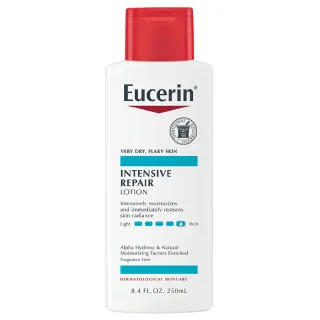
Eucerin Intensive Repair Lotion
Works for
1 of 2 advertised claims delivered
MoisturizingUrea, Caprylic/capric triglyceride + 8 moreStrong evidence
“3-dimensional system moisturizes, exfoliates and conditions very dry, flaky skin Enriched with Alpha Hydroxy (AHA) and Natural Moisturizing Factors Immediately restores skins radiance and delivers 24 hour hydration Fragrance, dye, and paraben free; Safe for sensitive skin Frequent washing and external factors like the environment can strip hands of vital elements needed to keep hands soft, smooth and hydrated.”
This product can help improve hydration of the skin with the two types of ingredients.
The first type is called “humectants”:
these ingredients help attract water.
When humectants are on the surface of the skin, they “pull in” the moisture from the outside environment, or from
within deeper layers of the skin. The following ingredients in this product do the job:
glycerin, sodium lactate.
This product also contains ingredients called “occlusives”. They help reduce the speed with which our skin loses moisture to the outside environment. These ingredients also help soften the upper layer of the skin, so it feels less tight and nicer to the touch. The following ingredients in this product do the job: caprylic/capric triglyceride, dimethicone.
The following ingredients in this product are especially good for supporting the skin barrier and helping with the hydration level: urea
ExfoliationUrea, Lactic acidLimited evidence
“Eucerin Intensive Repair is a clinically proven 3-Dimensional formula that moisturizes, exfoliates & conditions to repair very dry, flaky and ashy skin.”
This product might help exfoliate the skin with urea, but This ingredient is not the most effective.
Can it cause trouble?
Irritancy6 flagged ingredientsMedium risk
Comedogenic2 ingredients rated 2 or more on the 0–5 pore-clogging scale2 flagged
User reviews
Ingredients
Filter by role to see what each ingredient is doing.
Hydrogenated castor oil~23–34%
- Irritation risk
- Medium
A plant oil that can help soften the skin. It might be helpful in calming down inflammation, but solid research is lacking. Is often used in lip products to create the needed product consistency
More about Hydrogenated castor oilPeg-2 hydrogenated castor oil~4.4–6.6%
Magnesium sulfate~4.6–6.9%
Sodium lactate~3.3–5%
- Irritation risk
- Medium
Helps attract water to the upper layer of the skin. Is often used to adjust the pH level of the product
More about Sodium lactateCaprylic/capric triglyceride~3–4.5%
- Irritation risk
- Medium
A good mix of fatty acids that forms a protective layer on the skin. Improves the shelf life of products. Derived from coconut and glycerin
More about Caprylic/capric triglyceridePeg-7 hydrogenated castor oil~2–3%
Sorbitan isostearate~1.6–2.3%
- Irritation risk
- Low
Helps oil and water mix together
More about Sorbitan isostearateOzokerite~1.4–2%
Isopropyl palmitate~1.1–1.7%
- Irritation risk
- Medium
- Comedogenicity
- 3/5
Helps soften the upper layer of the skin and create a thicker product consistency
More about Isopropyl palmitateOctyldodecanol~0.95–1.4%
- Irritation risk
- Low
An emollient that helps to soften the skin and create a pleasant product texture and stabilize the formulation
More about OctyldodecanolBenzyl alcohol~0.5–1%
- Irritation risk
- High
A preservative. Can be used to mask unpleasant smell. Can be irritating
More about Benzyl alcoholPeg-45/dodecyl glycol copolymer~0.5–1.1%
- Irritation risk
- Low
Water~0.45–1%
Glycerin~0.45–1%
- Irritation risk
- Low
One of the best moisturizing ingredients. Naturally present in skin. It attracts water to the upper layer of the skin working as a humectant
More about GlycerinUrea~0.35–0.85%
- Irritation risk
- Low
Naturally present in skin (urea makes up about 7% of natural moisturizing factors in skin). Attracts water to the upper layer of the skin. Also has a positive effect on the skin barrier beyond the humectant action. Can enhance penetration of other ingredients. Is an exfoliating ingredient when used in high concentrations
More about UreaLactic acid~0.35–0.85%
- Irritation risk
- Medium
An exfoliating and moisturizing alpha-hydroxy acid (AHA). Typically causes less irritation than other AHAs, for example, glycolic acid. At high concentrations (about 15%), lactic acid can help reduce lines and wrinkles. Recent studies show that lactic acid can support the "good" bacteria living on skin's surface (healthy skin microbiome)
More about Lactic acidDimethicone~0.45–1.05%
- Irritation risk
- Low
A silicone that helps to reduce water loss from the surface of the skin. Can temporarily "fill in" lines and wrinkles, absorb oil, and create a nice product finish
More about DimethiconeParaffinum liquidum~0.4–0.9%
- Irritation risk
- Low
Mineral oil. One of the most effective and well studied occlusive and emollient moisturizing ingredients. Helps reduce moisture loss in skin and repair skin barrier function
More about Paraffinum liquidumMethoxy peg-22/dodecyl glycol copolymer~0.3–0.75%
- Irritation risk
- Low
Water~0.2–0.8%
Paraffinum liquidum~0.35–0.8%
- Irritation risk
- Low
Mineral oil. One of the most effective and well studied occlusive and emollient moisturizing ingredients. Helps reduce moisture loss in skin and repair skin barrier function
More about Paraffinum liquidumOctyldodecanol~0.3–0.75%
- Irritation risk
- Low
An emollient that helps to soften the skin and create a pleasant product texture and stabilize the formulation
More about OctyldodecanolCaprylic/capric triglyceride~0.35–0.8%
- Irritation risk
- Medium
A good mix of fatty acids that forms a protective layer on the skin. Improves the shelf life of products. Derived from coconut and glycerin
More about Caprylic/capric triglycerideIsopropyl palmitate~0.3–0.7%
- Irritation risk
- Medium
- Comedogenicity
- 3/5
Helps soften the upper layer of the skin and create a thicker product consistency
More about Isopropyl palmitateSodium lactate~0.15–0.7%
- Irritation risk
- Medium
Helps attract water to the upper layer of the skin. Is often used to adjust the pH level of the product
More about Sodium lactateUrea~0.15–0.65%
- Irritation risk
- Low
Naturally present in skin (urea makes up about 7% of natural moisturizing factors in skin). Attracts water to the upper layer of the skin. Also has a positive effect on the skin barrier beyond the humectant action. Can enhance penetration of other ingredients. Is an exfoliating ingredient when used in high concentrations
More about UreaGlycerin~0.2–0.75%
- Irritation risk
- Low
One of the best moisturizing ingredients. Naturally present in skin. It attracts water to the upper layer of the skin working as a humectant
More about GlycerinPeg-7 hydrogenated castor oil~0.2–0.7%
Benzyl alcohol~0.15–0.55%
- Irritation risk
- High
A preservative. Can be used to mask unpleasant smell. Can be irritating
More about Benzyl alcoholDimethicone~0.3–0.7%
- Irritation risk
- Low
A silicone that helps to reduce water loss from the surface of the skin. Can temporarily "fill in" lines and wrinkles, absorb oil, and create a nice product finish
More about DimethiconeMethoxy peg-22/dodecyl glycol copolymer~0.15–0.55%
- Irritation risk
- Low
Peg-45/dodecyl glycol copolymer~0.15–0.55%
- Irritation risk
- Low
Magnesium sulfate~0.15–0.55%
Lactic acid~0.1–0.45%
- Irritation risk
- Medium
An exfoliating and moisturizing alpha-hydroxy acid (AHA). Typically causes less irritation than other AHAs, for example, glycolic acid. At high concentrations (about 15%), lactic acid can help reduce lines and wrinkles. Recent studies show that lactic acid can support the "good" bacteria living on skin's surface (healthy skin microbiome)
More about Lactic acidOzokerite~0.1–0.45%
Hydrogenated castor oil isostearate~0.1–0.35%
- Irritation risk
- Low
Hydrogenated castor oil~0.15–0.55%
- Irritation risk
- Medium
A plant oil that can help soften the skin. It might be helpful in calming down inflammation, but solid research is lacking. Is often used in lip products to create the needed product consistency
More about Hydrogenated castor oilIngredient list view
Hydrogenated castor oil, Peg-2 hydrogenated castor oil, Magnesium sulfate, Sodium lactate, Caprylic/capric triglyceride, Peg-7 hydrogenated castor oil, Sorbitan isostearate, Ozokerite, Isopropyl palmitate, Octyldodecanol, Benzyl alcohol, Peg-45/dodecyl glycol copolymer, Water, Glycerin, Urea, Lactic acid, Dimethicone, Paraffinum liquidum, Methoxy peg-22/dodecyl glycol copolymer, Water, Paraffinum liquidum, Octyldodecanol, Caprylic/capric triglyceride, Isopropyl palmitate, Sodium lactate, Urea, Glycerin, Peg-7 hydrogenated castor oil, Benzyl alcohol, Dimethicone, Methoxy peg-22/dodecyl glycol copolymer, Peg-45/dodecyl glycol copolymer, Magnesium sulfate, Lactic acid, Ozokerite, Unknown, Hydrogenated castor oil isostearate, Hydrogenated castor oil
Compare prices
Retailers ranked by price — lowest first.


Worth comparing, line by line.
Match % combines shared ingredients, the first five ingredients, shared actives and hero ingredients, irritancy (lower counts in the alternative's favour), texture and body area. Only products in the same routine step are compared.
| EucerinIntensive Repair LotionYOUR PRODUCT | CetaphilCracked Skin Repair Lotion | |
|---|---|---|
| Match | — | 58% |
| Price | $8.09 | $14.27+$6.18 |
| Shared key ingredients | — | 6 of 7 |
| Key difference | — | — |
| Irritancy | Medium | Low |
| Drying alcohol | — | — |
| View product | Shop |

Product summary
"Eucerin - Intensive Repair Lotion" is effective for: Moisturizing
Ingredient callouts
- This product contains acids (lactic acid 0.10% - 0.45% and lactic acid 0.35% - 0.85%). Their concentration is low, and they will not have a strong exfoliating effect. Instead, they work to support the skin natural acid mantle and to attract water (as humectants). Lactic acid is particularly good in attracting water to the upper layer of the skin and improving the skin barrier.
Price
The product retails from 38.00A$ up to 41.00A$ in Australia, from 8.09$ up to 12.49$ in the United States and for 11.62£ in the United Kingdom.
For a detailed price comparison: click here.
Sources cited in this review
Every concentration estimate and effectiveness label is anchored to one of these 12 studies and safety reviews.
- 1
- 2
- 3
- 4Safety Assessment of Magnesium Sulfate as Used in Cosmeticsncbi.nlm.nih.gov
- 5Final Report on the Safety Assessment of Isopropyl Isostearatejournals.sagepub.com
- 6

Affiliate links · As an Amazon Associate, WIMJ earns from qualifying purchases.