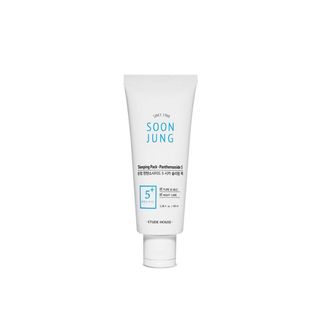
Etude House Soon Jung 5-Panthensoside Cica Sleeping Pack
Works for
1 of 1 advertised claim delivered
MoisturizingPanthenol, Madecassoside + 20 moreStrong evidence
“Keep your skin soothed and hydrated, even when you're asleep, with ETUDE HOUSE Soon Jung 5-Panthensoside Cica Sleeping Pack.”
This product can help improve hydration of the skin with the two types of ingredients.
The first type is called “humectants”:
these ingredients help attract water.
When humectants are on the surface of the skin, they “pull in” the moisture from the outside environment, or from
within deeper layers of the skin. The following ingredients in this product do the job:
glycerin, trehalose.
This product also contains ingredients called “occlusives”. They help reduce the speed with which our skin loses moisture to the outside environment. These ingredients also help soften the upper layer of the skin, so it feels less tight and nicer to the touch. The following ingredients in this product do the job: copernicia cerifera wax, squalane.
The following ingredients in this product are especially good for supporting the skin barrier and helping with the hydration level: madecassoside, panthenol
Anti-oxidationNot advertised by the brand · Asiaticoside, Madecassoside + 3 moreStrong evidence
This product contains antioxidants (asiaticoside, madecassoside) that can help neutralize free radicals in skin. By doing so, they can lessen the damage the skin gets from the UV light (sun).
Anti-agingNot advertised by the brand · Asiaticoside, Madecassoside + 2 moreModerate evidence
This product contains asiaticoside, madecassoside. These ingredients might be able to help reduce and prevent fine lines and wrinkles, improve skin elasticity and firmness, but there is not enough evidence that it actually works.
Can it cause trouble?
Irritancy11 flagged ingredientsLow risk
Comedogenic2 ingredients rated 2 or more on the 0–5 pore-clogging scale2 flagged

User reviews
Be the first — your take helps the next person decide.
Ingredients
Filter by role to see what each ingredient is doing.
Water~40–60%
Glycerin~3.9–5.9%
- Irritation risk
- Low
One of the best moisturizing ingredients. Naturally present in skin. It attracts water to the upper layer of the skin working as a humectant
More about GlycerinPropanediol~3.5–5.2%
- Irritation risk
- Low
Acts as a solvent for other ingredients. Speeds up the absorption of other ingredients into the skin
More about PropanediolPanthenol~2.7–4%
- Irritation risk
- Low
Helps attract water to the upper layer of the skin and can help improve skin barrier function
More about PanthenolCetearyl alcohol~2–3%
- Irritation risk
- Low
- Comedogenicity
- 2/5
A non-drying alcohol. Works as an emollient. Helps water and oil mix together and creates a nice product texture
More about Cetearyl alcoholDicaprylyl ether~1.7–2.5%
- Irritation risk
- Low
Helps soften the upper layer of the skin while creating a non-greasy feel on the skin. Helps to dissolve other ingredients
More about Dicaprylyl etherDicaprylyl carbonate~1.4–2.1%
- Irritation risk
- Low
Helps products spread more easily and works as an emollient to soften skin
More about Dicaprylyl carbonateSqualane~1.3–2%
- Irritation risk
- Low
An oil naturally present in skin. Works as an emollient to soften the skin and form a protective layer on its surface without a greasy feeling.
More about SqualaneGlyceryl stearate~1.1–1.6%
- Irritation risk
- Low
An emollient that softens the skin and forms a protective layer on its surface. Helps water and oil mix together
More about Glyceryl stearateCopernicia cerifera wax~0.95–1.45%
- Irritation risk
- Low
Helps to soften the upper layer of the skin and create a nice product consistency
More about Copernicia cerifera waxCopernicia cerifera cera~0.55–1.3%
- Irritation risk
- Low
Brazilian palm wax. Helps soften the upper layer of the skin
More about Copernicia cerifera ceraCopernicia cerifera wax~0.55–1.25%
- Irritation risk
- Low
Helps to soften the upper layer of the skin and create a nice product consistency
More about Copernicia cerifera waxHydroxyethyl acrylate/sodium acryloyldimethyl taurate copolymer~0.4–0.9%
- Irritation risk
- Medium
A gelling agent that thickens the product consistency and leaves the skin with a velvety finish
More about Hydroxyethyl acrylate/sodium acryloyldimethyl taurate copolymerAcrylates/c10-30 alkyl acrylate crosspolymer~0.35–0.85%
- Irritation risk
- Medium
Maintains the texture of skincare products. Allows the product to spread evenly. Helps oil and water mix together
More about Acrylates/c10-30 alkyl acrylate crosspolymerStearic acid~0.4–0.95%
- Irritation risk
- Low
Helps oil and water mix together and works as an emollient
More about Stearic acidHydrogenated lecithin~0.35–0.75%
- Irritation risk
- Low
Helps to retain moisture by creating a protective barrier on the skin. Rich in fatty acids. Improves product texture and helps with the penetration of other ingredients.
More about Hydrogenated lecithinLauroyl lysine~0.2–0.8%
- Irritation risk
- Low
Helps soften the upper layer of the skin and creates a nice product texture
More about Lauroyl lysineGlyceryl caprylate~0.3–0.75%
- Irritation risk
- Low
An emollient that can also help water and oil mix together, as well as prevent bacteria growth in products
More about Glyceryl caprylateButylene glycol~0.15–0.7%
- Irritation risk
- Low
Used to create a nice product texture and help delivery of other ingredients. Might be somewhat helpful in attracting water to the upper layer of the skin
More about Butylene glycolPolyglyceryl-3 methylglucose distearate~0.2–0.7%
- Irritation risk
- Medium
Helps water and oil mix together
More about Polyglyceryl-3 methylglucose distearateXanthan gum~0.15–0.65%
- Irritation risk
- Low
Used to create a thicker product consistency
More about Xanthan gumEthylhexylglycerin~0.15–0.55%
Trehalose~0.1–0.5%
- Irritation risk
- Low
A sugar that attracts water to the upper layer of the skin
More about TrehaloseAsiaticoside~0.1–0.4%
- Irritation risk
- Medium
An active compound of Centella Asiatica plant extract. In combination with other active compounds of Centella Asiatica extract (madecasosside, asiatic acid and madecassic acid), asiaticoside has been shown to be helpful in wound-healing, restoring skin barrier function and supporting collagen production in skin. It can, however, itself be irritating
More about AsiaticosideNarcissus tazetta bulb extract~0.1–0.45%
- Irritation risk
- Medium
Might contain compounds called dormins that in theory could help lighten skin and reduce hyperpigmentation, but solid research is lacking
More about Narcissus tazetta bulb extractMadecassic acid~0.1–0.45%
- Irritation risk
- Medium
An active compound of Centella Asiatica plant extract. In combination with other active compounds of Centella Asiatica extract (asiaticoside, madecasosside and asiatic acid), madecassic acid has been shown to be helpful in wound-healing, restoring skin barrier function and supporting collagen production in skin. It can, however, itself be irritating
More about Madecassic acidSorbitan isostearate~0.1–0.45%
- Irritation risk
- Low
Helps oil and water mix together
More about Sorbitan isostearateDisodium edta~0.1–0.4%
Asiatic acid~0.1–0.35%
- Irritation risk
- Medium
An active compound of Centella Asiatica plant extract. In combination with other active compounds of Centella Asiatica extract (asiaticoside, madecasosside and madecassic acid) asiatic acid has been shown to be helpful in wound-healing, restoring skin barrier function and supporting collagen production in skin. It can, however, itself be irritating
More about Asiatic acidLactobacillus ferment lysate~0.1–0.3%
- Irritation risk
- Low
A "broth" with parts of dead cells of lactobacteria. Might be helpful supporting diverse microbiome in skin, but evidence is lacking
More about Lactobacillus ferment lysateMadecassoside~0.05–0.3%
- Irritation risk
- Medium
An antioxidant that is typically derived from plant Centella Asiatica. It can help neutralize free radicals in skin and support skin barrier function. It could, however, itself be irritating. It is often unstable in formulations
More about MadecassosideTocopherol~0.05–0.25%
- Irritation risk
- Low
Pure form of vitamin E. Can help moisturise and protect the skin from free radicals. Often used to help stabilise other ingredients or the formula itself
More about TocopherolGlycine soja oil~0.05–0.25%
- Irritation risk
- Medium
- Comedogenicity
- 2/5
A good emollient that helps soften the skin and helps repair its barrier function. It can clog pores if used in high concentrations.
More about Glycine soja oilCamellia sinensis leaf extract~0.05–0.15%
- Irritation risk
- Low
Can contain potent anti-oxidant compounds (abbreviated ECG, GCG, EGC, and EGCG) that might help protect the skin from free radicals. Can help calm down inflammation and has some anti-bacterial properties. Unfortunately, these antioxidants are unstable and lose their effectiveness very quickly in products. The concentration of the antioxidant compounds in the extract also tends to be low to be effective in topical formulation
More about Camellia sinensis leaf extractIngredient list view
Water, Glycerin, Propanediol, Panthenol, Cetearyl alcohol, Dicaprylyl ether, Dicaprylyl carbonate, Squalane, Glyceryl stearate, Copernicia cerifera wax, Copernicia cerifera cera, Copernicia cerifera wax, Hydroxyethyl acrylate/sodium acryloyldimethyl taurate copolymer, Acrylates/c10-30 alkyl acrylate crosspolymer, Stearic acid, Hydrogenated lecithin, Lauroyl lysine, Glyceryl caprylate, Butylene glycol, Polyglyceryl-3 methylglucose distearate, Xanthan gum, Ethylhexylglycerin, Trehalose, Asiaticoside, Narcissus tazetta bulb extract, Madecassic acid, Sorbitan isostearate, Disodium edta, Asiatic acid, Lactobacillus ferment lysate, Madecassoside, Tocopherol, Glycine soja oil, Camellia sinensis leaf extract
Compare prices
Retailers ranked by price — lowest first.
Worth comparing, line by line.
Match % combines shared ingredients, the first five ingredients, shared actives and hero ingredients, irritancy (lower counts in the alternative's favour), texture and body area. Only products in the same routine step are compared.
| Etude HouseSoon Jung 5-Panthensoside Cica Sleeping PackYOUR PRODUCT | AESTURAA-Cica Stress Relief Cream Essence | innisfreeBija Cica Balm EX | BeplainCicaterol Moisturizer | |
|---|---|---|---|---|
| Match | — | 57% | 56% | 54% |
| Price | — | $18.80 | — | $25.60 |
| Shared key ingredients | — | 6 of 10 | 7 of 10 | 6 of 10 |
| Key difference | — | Beta-Glucan | Cyclopentasiloxane | Niacinamide |
| Irritancy | Low | Low | Low | Low |
| Drying alcohol | — | — | — | — |
| View product | Shop | Shop | Shop |


Product summary
Based on the ingredient list, "Etude House - Soon Jung 5-Panthensoside Cica Sleeping Pack" can work well for skin moisturization. The formulation is based on a combination of good humectants and emollients. Both are needed to increase the skin hydration level. Humectants in this product (panthenol, glycerin, trehalose and butylene glycol) help to increase the water content in the upper layer of the skin. (These ingredients do so by "capturing" water molecules from the outside air or from within the deeper layers of the skin). Copernicia cerifera wax, squalane, cetearyl alcohol, copernicia cerifera cera and dicaprylyl carbonate in this product help decrease the water evoporation from the skin, so that it stays hydrated for longer. These ingredients also soften the skin and take away the feeling of tightness and dryness.
Ingredient callouts
- this moisturizer contains actives derived from an extract of the Centella Asiatica plant (also known as Gotu Kola) - madecassoside 0.05% - 0.30%, asiatic acid 0.10% - 0.35%, madecassic acid 0.10% - 0.45% and asiaticoside 0.10% - 0.40% The Centella Asiatica actives, even in low concentration, can help reduce inflammation in skin, strengthen the skin barrier and reduce photodamage. They can also help to decrease scarring.
- This formulation also includes panthenol (pro-vitamin B5) at about 2.70% - 4.00% concentration. In this concentration, panthenol works effectively to improve the skin barrier and reduce inflammation.
Irritation risk
This product does not contain known common irritants and is suitable for sensitive skin. We assess the overall irritancy of this moisturizer to be low. For a detailed overview of all potential irritants: click here
You can see the detailed formula review with the breakdown of all actives in the product and the full ingredient list with estimated concentrations in the tables below.
Sources cited in this review
Every concentration estimate and effectiveness label is anchored to one of these 16 studies and safety reviews.
- 1
- 2Skin moisturizing effects of panthenol-based formulationspdfs.semanticscholar.org
- 3
- 4Centella asiatica in cosmetologyncbi.nlm.nih.gov
- 5Contact dermatitis due to Madecassolonlinelibrary.wiley.com
- 6Centella asiatica in Dermatology: An Overviewonlinelibrary.wiley.com

Affiliate links · As an Amazon Associate, WIMJ earns from qualifying purchases.