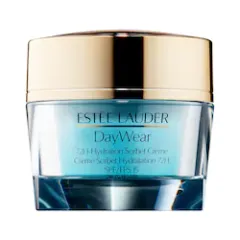
Works for:
based on ingredients and %- Moisturizing
- Anti-oxidation
- Evens skin tone
Doesn't work for:
based on ingredients and %- Sun protection
Can it cause trouble?
- Irritation risk: high
- Comedogenic risk ingredients: 2
Key actives

Product Summary
Judging from the ingredient list, "Estée Lauder - Daywear Anti-Oxidant 72H-Hydration Sorbet Creme" works well for improving skin hydration As we expect from a proper moisturizer, the formula includes a combo of effective humectants and emollients. These are the two different types of ingredients that are essential for improving the skin hydration and supporting a healthy skin barrier. Humectants in this product (algae extract, artemia extract, glycerin, saccharomyces lysate extract and sodium hyaluronate) help to increase the water content in the upper layer of the skin. (These ingredients do so by "capturing" water molecules from the outside air or from within the deeper layers of the skin). Emollients in this formulation (linoleic acid, algae extract, cholesterol, squalane and pentylene glycol) help to reduce the moisture loss from the skin. They also soften the skin surface and relieve the feeling of dryness and tightness.
Irritation risk
We assess the overall irritancy of this moisturizer to be high. For a detailed overview of all potential irritants: click here
You can see the detailed formula review with the breakdown of all actives in the product and the full ingredient list with estimated concentrations in the tables below.
Price
The product retails for 59.00$ in the United States, for 45.00£ in the United Kingdom and for 72.00CA$ in Canada.
For a detailed price comparison: click here.
Anti-oxidation
This product contains antioxidants (glycyrrhetinic acid, vitis vinifera seed extract) that can help neutralize free radicals in skin. By doing so, they can lessen the damage the skin gets from the UV light (sun).
A plant extract that contains resveratrol and other anti-oxidant compounds that can help neutralize free radicals, reduce inflammation in skin and even out its tone. Can be also used to stabilize the product formulation
Active compound of licorice root. Works to calm down inflammation, as an anti-oxidant, and might be helpful in lightening the skin and reducing hyperpigmentation
Zooplankton extract that can attract water to the upper level of the skin and might have some anti-oxidant effect
Might be helpful in neutralising free radicals in skin and have some hydration properties
Might be helpful in neutralizing free radicals. Can have a dehydration effect that might somewhat decrease the look of puffy eyes
A fruit extract that might have some anti-oxidant effect
Being a lipid soluble form of vitamin C, it is more stable than ascorbic acid, but still degrades quickly and needs to be stabilized in a formulation with another ingredient. It is claimed to penetrate skin better than pure vitamin C and have the the similar benefits, but solid studies of its effectiveness are lacking. Is likely to require a higher concentration in a product than pure vitamin C to be effective. It might be able to help reduce pore clogging.
Can help neutralize free radicals in skin. Preliminary studies show that it can be more effective than coenzyme Q10 but studies on effective concentration for topical applications are lacking
Might contain compounds called dormins that in theory could help lighten skin and reduce hyperpigmentation, but solid research is lacking
A more stable but less bio-available form of vitamin E compared to Tocopherol. Might help moisturize and protect the skin from free radicals, but mostly used in low concentrations to stabilize other ingredients.
Might be somewhat helpful in reducing hyperpigmentation and neutralizing free radicals but its typical concentration in a product is too low for having an effect
A plant extract that can contain resveratrol, an antioxidant that can help neutralize free radicals in skin. The effectiveness depends on the extract quality and concentration in the product
A plant extract that might have some anti-oxidant properties. Avoid if you are sensitive to gluten
Plant extract that might have moisturizing properties. Avoid if you suffer from wheat or gluten intolerance
Moisturizing
What does the product description say?
Daywear Anti-Oxidant 72H-Hydration Sorbet Creme
Source: From product name
This product can help improve hydration of the skin with the two types of ingredients.
The first type is called “humectants”:
these ingredients help attract water.
When humectants are on the surface of the skin, they “pull in” the moisture from the outside environment, or from
within deeper layers of the skin. The following ingredients in this product do the job:
algae extract, artemia extract.
This product also contains ingredients called “occlusives”. They help reduce the speed with which our skin loses moisture to the outside environment. These ingredients also help soften the upper layer of the skin, so it feels less tight and nicer to the touch. The following ingredients in this product do the job: squalane, algae extract.
The following ingredients in this product are especially good for supporting the skin barrier and helping with the hydration level: linoleic acid
One of the best moisturizing ingredients. Naturally present in skin. It attracts water to the upper layer of the skin working as a humectant
An excellent emollient. Helps soften the skin, restore its barrier function, and can help to calm down inflammation. It can be helpful to prevent blemishes and clogged pores
Helps attract water to the upper layer of the skin. Can have some anti-inflammatory effect
One of the best moisturizing ingredients. Attracts water into the upper layer of the skin
An oil naturally present in skin. Works as an emollient to soften the skin and form a protective layer on its surface without a greasy feeling.
Might be helpful in neutralising free radicals in skin and have some hydration properties
Plant extract that helps the skin to attract water and make it more smooth for touch. Also shows promise of anti-aging properties, but research is not extensive yet
Zooplankton extract that can attract water to the upper level of the skin and might have some anti-oxidant effect
An emollient that is naturally found in skin
Used to create a nice product texture and help delivery of other ingredients. Might be somewhat helpful in attracting water to the upper layer of the skin
An emollient that helps soften the upper layer of the skin
Used to preserve products, dissolve other ingredients and create a nice product texture
A type of silicone that helps to soften the upper layer of the skin and create a nice product finish on the skin
Plant extract that might have moisturizing properties. Avoid if you suffer from wheat or gluten intolerance
Might be somewhat helpful in reducing hyperpigmentation and neutralizing free radicals but its typical concentration in a product is too low for having an effect
A plant extract that can help strengthen the skin barrier function and improve skin moisture levels
Evens skin tone
What does the product description say?
Dryness, Dullness, and Uneven Texture Formulation.
Source: Sephora CA
The following ingredient (ingredients) in this product might be helpful, but there is no evidence to confirm that it actually works: glycyrrhetinic acid.
Active compound of licorice root. Works to calm down inflammation, as an anti-oxidant, and might be helpful in lightening the skin and reducing hyperpigmentation
Being a lipid soluble form of vitamin C, it is more stable than ascorbic acid, but still degrades quickly and needs to be stabilized in a formulation with another ingredient. It is claimed to penetrate skin better than pure vitamin C and have the the similar benefits, but solid studies of its effectiveness are lacking. Is likely to require a higher concentration in a product than pure vitamin C to be effective. It might be able to help reduce pore clogging.
Might contain compounds called dormins that in theory could help lighten skin and reduce hyperpigmentation, but solid research is lacking
Sun protection
This product does not offer sun protection, or it is very low.
This product can be considered "reef safe" because it does not contain the UV filters (oxybenzone and octinoxate) that can be harmful to coral reefs when present in the water in high concentrations.
A weak sunscreen that protects against the sun rays that cause sunburn (UVB) and is somewhat effective against the UVA rays. It is quite stable and can help stabilize other, more vulnerable, sunscreen ingredients like Avobenzone. It is an organic, or so called "chemical" sunscreen
Avobenzone. An organic, or so-called "chemical" UV filter. Protects against both UVA and UVB rays. Needs to be combined with other filters in a formulation to be stable.
A weak sunscreen that offers some protection against the sun rays that cause sunburn (UVB), but does not offer meaningful protection against protect against the most aging sun rays (UVA). It loses its effectiveness quickly when exposed to sunlight. It is an organic, or so called "chemical" sunscreen. When used in low concentrations, helps to stabilize the product formulation
Octisalate. A UV filter. It offers some protection against the sun rays that cause sunburn (UVB), but does not protect against the most aging sun rays (UVA). It loses its effectiveness quickly when exposed to sunlight. It is an organic, or so called "chemical" sunscreen
How honest is this product?
| Promise | Can it deliver? |
|---|---|
| Sun protection | |
| Moisturizing |
Total Promises Fulfilled score: 50/100.
We receive a small commission for purchases made through these links at no cost for you. Thank you for your support! Learn more
Potential irritants
Comedogenic ingredients
User reviews (0)
Averages from community submissions.
No reviews yet for this product.
Be the first to share your experience!
Tried this product?
Help capture what the ingredient list can't—texture, finish, pilling, scent, and more. Answer what you can, skip the rest.
Takes ~30 seconds.
Reviews are shown in aggregate. No personal details.
Key Actives
A plant extract that contains resveratrol and other anti-oxidant compounds that can help neutralize free radicals, reduce inflammation in skin and even out its tone. Can be also used to stabilize the product formulation
Might be helpful in neutralising free radicals in skin and have some hydration properties
Being a lipid soluble form of vitamin C, it is more stable than ascorbic acid, but still degrades quickly and needs to be stabilized in a formulation with another ingredient. It is claimed to penetrate skin better than pure vitamin C and have the the similar benefits, but solid studies of its effectiveness are lacking. Is likely to require a higher concentration in a product than pure vitamin C to be effective. It might be able to help reduce pore clogging.
An excellent emollient. Helps soften the skin, restore its barrier function, and can help to calm down inflammation. It can be helpful to prevent blemishes and clogged pores
Active compound of licorice root. Works to calm down inflammation, as an anti-oxidant, and might be helpful in lightening the skin and reducing hyperpigmentation
Might be helpful in neutralizing free radicals. Can have a dehydration effect that might somewhat decrease the look of puffy eyes
Plant extract that helps the skin to attract water and make it more smooth for touch. Also shows promise of anti-aging properties, but research is not extensive yet
An emollient that is naturally found in skin
Zooplankton extract that can attract water to the upper level of the skin and might have some anti-oxidant effect
Avobenzone. An organic, or so-called "chemical" UV filter. Protects against both UVA and UVB rays. Needs to be combined with other filters in a formulation to be stable.
A weak sunscreen that offers some protection against the sun rays that cause sunburn (UVB), but does not offer meaningful protection against protect against the most aging sun rays (UVA). It loses its effectiveness quickly when exposed to sunlight. It is an organic, or so called "chemical" sunscreen. When used in low concentrations, helps to stabilize the product formulation
A weak sunscreen that protects against the sun rays that cause sunburn (UVB) and is somewhat effective against the UVA rays. It is quite stable and can help stabilize other, more vulnerable, sunscreen ingredients like Avobenzone. It is an organic, or so called "chemical" sunscreen
One of the best moisturizing ingredients. Naturally present in skin. It attracts water to the upper layer of the skin working as a humectant
One of the best moisturizing ingredients. Attracts water into the upper layer of the skin
Can help neutralize free radicals in skin. Preliminary studies show that it can be more effective than coenzyme Q10 but studies on effective concentration for topical applications are lacking
Helps attract water to the upper layer of the skin. Can have some anti-inflammatory effect
An oil naturally present in skin. Works as an emollient to soften the skin and form a protective layer on its surface without a greasy feeling.
Potential irritants
Produces temporary toning effect. Can help dissolve other ingredients or preserve products
A fruit extract that might have some anti-oxidant effect
Used as a fragrance. Can be irritating and cause photosensitivity
An aromatic blend of unspecified and possibly irritating ingredients
Avobenzone. An organic, or so-called "chemical" UV filter. Protects against both UVA and UVB rays. Needs to be combined with other filters in a formulation to be stable.
A weak sunscreen that offers some protection against the sun rays that cause sunburn (UVB), but does not offer meaningful protection against protect against the most aging sun rays (UVA). It loses its effectiveness quickly when exposed to sunlight. It is an organic, or so called "chemical" sunscreen. When used in low concentrations, helps to stabilize the product formulation
A weak sunscreen that protects against the sun rays that cause sunburn (UVB) and is somewhat effective against the UVA rays. It is quite stable and can help stabilize other, more vulnerable, sunscreen ingredients like Avobenzone. It is an organic, or so called "chemical" sunscreen
Used to preserve products, dissolve other ingredients and create a nice product texture
Might be somewhat helpful in reducing hyperpigmentation and neutralizing free radicals but its typical concentration in a product is too low for having an effect
Might be helpful in neutralising free radicals in skin and have some hydration properties
A more stable but less bio-available form of vitamin E compared to Tocopherol. Might help moisturize and protect the skin from free radicals, but mostly used in low concentrations to stabilize other ingredients.
Being a lipid soluble form of vitamin C, it is more stable than ascorbic acid, but still degrades quickly and needs to be stabilized in a formulation with another ingredient. It is claimed to penetrate skin better than pure vitamin C and have the the similar benefits, but solid studies of its effectiveness are lacking. Is likely to require a higher concentration in a product than pure vitamin C to be effective. It might be able to help reduce pore clogging.
Might be helpful in neutralizing free radicals. Can have a dehydration effect that might somewhat decrease the look of puffy eyes
Might contain compounds called dormins that in theory could help lighten skin and reduce hyperpigmentation, but solid research is lacking
A plant extract that can contain resveratrol, an antioxidant that can help neutralize free radicals in skin. The effectiveness depends on the extract quality and concentration in the product
Plant extract that might have moisturizing properties. Avoid if you suffer from wheat or gluten intolerance
A plant extract that might have some anti-oxidant properties. Avoid if you are sensitive to gluten
A plant extract that can help strengthen the skin barrier function and improve skin moisture levels
Active compound of licorice root. Works to calm down inflammation, as an anti-oxidant, and might be helpful in lightening the skin and reducing hyperpigmentation
Maintains the texture of skincare products. Allows the product to spread evenly. Helps oil and water mix together
Can work as an exfoliant but is typically used to adjust the product pH
Comedogenic ingredients
Plant extract that helps the skin to attract water and make it more smooth for touch. Also shows promise of anti-aging properties, but research is not extensive yet
Plant extract that might have moisturizing properties. Avoid if you suffer from wheat or gluten intolerance
All ingredients
Avobenzone. An organic, or so-called "chemical" UV filter. Protects against both UVA and UVB rays. Needs to be combined with other filters in a formulation to be stable.
A weak sunscreen that offers some protection against the sun rays that cause sunburn (UVB), but does not offer meaningful protection against protect against the most aging sun rays (UVA). It loses its effectiveness quickly when exposed to sunlight. It is an organic, or so called "chemical" sunscreen. When used in low concentrations, helps to stabilize the product formulation
Octisalate. A UV filter. It offers some protection against the sun rays that cause sunburn (UVB), but does not protect against the most aging sun rays (UVA). It loses its effectiveness quickly when exposed to sunlight. It is an organic, or so called "chemical" sunscreen
A weak sunscreen that protects against the sun rays that cause sunburn (UVB) and is somewhat effective against the UVA rays. It is quite stable and can help stabilize other, more vulnerable, sunscreen ingredients like Avobenzone. It is an organic, or so called "chemical" sunscreen
One of the best moisturizing ingredients. Naturally present in skin. It attracts water to the upper layer of the skin working as a humectant
Produces temporary toning effect. Can help dissolve other ingredients or preserve products
Used to preserve products, dissolve other ingredients and create a nice product texture
A type of silicone that helps to soften the upper layer of the skin and create a nice product finish on the skin
Increases thickness of a product. Texture enhancer for oil-in-water emulsions
Might be somewhat helpful in reducing hyperpigmentation and neutralizing free radicals but its typical concentration in a product is too low for having an effect
One of the best moisturizing ingredients. Attracts water into the upper layer of the skin
Might be helpful in neutralising free radicals in skin and have some hydration properties
Can help neutralize free radicals in skin. Preliminary studies show that it can be more effective than coenzyme Q10 but studies on effective concentration for topical applications are lacking
A more stable but less bio-available form of vitamin E compared to Tocopherol. Might help moisturize and protect the skin from free radicals, but mostly used in low concentrations to stabilize other ingredients.
Being a lipid soluble form of vitamin C, it is more stable than ascorbic acid, but still degrades quickly and needs to be stabilized in a formulation with another ingredient. It is claimed to penetrate skin better than pure vitamin C and have the the similar benefits, but solid studies of its effectiveness are lacking. Is likely to require a higher concentration in a product than pure vitamin C to be effective. It might be able to help reduce pore clogging.
A type of sugar that is used to support delivery of active ingredients and can enhance their penetration into the skin without disrupting the skin's barrier
A fruit extract that might have some anti-oxidant effect
Might be helpful in neutralizing free radicals. Can have a dehydration effect that might somewhat decrease the look of puffy eyes
Might contain compounds called dormins that in theory could help lighten skin and reduce hyperpigmentation, but solid research is lacking
A plant extract that can contain resveratrol, an antioxidant that can help neutralize free radicals in skin. The effectiveness depends on the extract quality and concentration in the product
Plant extract that helps the skin to attract water and make it more smooth for touch. Also shows promise of anti-aging properties, but research is not extensive yet
Used as a fragrance. Can be irritating and cause photosensitivity
A plant extract that contains resveratrol and other anti-oxidant compounds that can help neutralize free radicals, reduce inflammation in skin and even out its tone. Can be also used to stabilize the product formulation
Plant extract that might have moisturizing properties. Avoid if you suffer from wheat or gluten intolerance
A plant extract that might have some anti-oxidant properties. Avoid if you are sensitive to gluten
A plant extract that can help strengthen the skin barrier function and improve skin moisture levels
An excellent emollient. Helps soften the skin, restore its barrier function, and can help to calm down inflammation. It can be helpful to prevent blemishes and clogged pores
Active compound of licorice root. Works to calm down inflammation, as an anti-oxidant, and might be helpful in lightening the skin and reducing hyperpigmentation
Helps attract water to the upper layer of the skin. Can have some anti-inflammatory effect
Zooplankton extract that can attract water to the upper level of the skin and might have some anti-oxidant effect
An emollient that helps soften the upper layer of the skin
Acts as a solvent for other ingredients. Speeds up the absorption of other ingredients into the skin
An oil naturally present in skin. Works as an emollient to soften the skin and form a protective layer on its surface without a greasy feeling.
Maintains the texture of skincare products. Allows the product to spread evenly. Helps oil and water mix together
Used to create a nice product texture and help delivery of other ingredients. Might be somewhat helpful in attracting water to the upper layer of the skin
Can work as an exfoliant but is typically used to adjust the product pH
An aromatic blend of unspecified and possibly irritating ingredients
A preservative. It helps prevent bacterial growth in cosmetic products
Ingredient list view
Butyl methoxydibenzoylmethane, Homosalate, Ethylhexyl salicylate, Octocrylene, Water, Glycerin, Alcohol denat., Pentylene glycol, Caprylyl methicone, Unknown, Ammonium acryloyldimethyltaurate/vp copolymer, Cucumis sativus fruit extract, Sodium hyaluronate, Thermus thermophillus ferment, Guaiacol, Manganese chloride, Ergothioneine, Tocopheryl acetate, Tetrahexyldecyl ascorbate, Cyclodextrin, Psidium guajava fruit extract, Fumaria officinalis flower/leaf/stem extract, Caffeine, Narcissus tazetta bulb extract, Polygonum cuspidatum root extract, Algae extract, Citrus limon fruit extract, Helianthus annuus seedcake, Vitis vinifera seed extract, Triticum vulgare germ extract, Hordeum vulgare extract, Gentiana lutea root extract, Linoleic acid, Cholesterol, Glycyrrhetinic acid, Saccharomyces lysate extract, Palmitoyl hydroxypropyltrimonium amylopectin/glycerin crosspolymer, Artemia extract, Propylene glycol dicaprate, Fumaric acid, Ethylhexylglycerin, Propanediol, Squalane, Acrylates/c10-30 alkyl acrylate crosspolymer, Butylene glycol, Citric acid, Sodium hydroxide, Parfum, Disodium edta, Bht, Phenoxyethanol, Ci 42090
- Opinion on Homosalate - Scientific Committee on Consumer Products
- Glycerol and the skin: holistic approach to its origin and functions
- Hyaluronic acid: A key molecule in skin aging
- Hyaluronan (Hyaluronic Acid): a natural moisturizer for skin care
- A comparison of the relative antioxidant potency of L‐ergothioneine and idebenone
- l-Ergothioneine Protects Skin Cells against UV-Induced Damage—A Preliminary Study
- Double-blind, half-face study comparing topical vitamin C and vehicle for rejuvenation of photodamage
- Application of tetra-isopalmitoyl ascorbic acid in cosmetic formulations: Stability studies and in vivo efficacy
- Cyclodextrins: new drug delivery systems in dermatology
- Guava: phytochemical composition of a potential source of antioxidants for cosmetic and/or dermatological applications
- Nuclear Factor Kappa B Inhibition as a Therapeutic Target of Nutraceuticals in Arthritis, Osteoarthritis, and Related Inflammation
- Resveratrol as an active ingredient for cosmetic and dermatological applications: a review
- Safety Assessment of Citrus-Derived Peel Oils as Used in Cosmetics
- Safety Assessment of Helianthus annuus (Sunflower)-Derived Ingredients as Used in Cosmetics
- Safety Assessment of Vitis Vinifera (Grape)-Derived Ingredients as Used in Cosmetics
- The Topical Effect of Grape Seed Extract 2% Cream on Surgery Wound Healing
- Review of the Pharmacological Effects of Vitis vinifera (Grape) and its Bioactive Constituents: An Update
- Wheat in skin care
- Celiac Disease & Skin Care Products
- Preventive and Therapeutic Role of Functional Ingredients of Barley Grass for Chronic Diseases in Human Beings
- The Herbal Bitter Drug Gentiana lutea Modulates Lipid Synthesis in Human Keratinocytes In Vitro and In Vivo
- The Permeability Barrier in Essential Fatty Acid Deficiency: Evidence for a Direct Role for Linoleic Acid in Barrier Function
- Digital image analysis of the effect of topically applied linoleic acid on acne microcomedones.
- Glycyrrhetinic acid, the active principle of licorice, can reduce the thickness of subcutaneous thigh fat through topical application
- Effects of topical application of B‐Resorcinol and Glycyrrhetinic acid monotherapy and in combination with fractional CO2 laser treatment for benign hand hyperpigmentation treatment
- 18β-Glycyrrhetinic Acid and Glabridin Prevent Oxidative DNA Fragmentation in UVB-irradiated Human Keratinocyte Cultures
- Use of Probiotics for Dermal Applications
- The Effects of Purified Artemia Extract Proteins on Proliferation, Differentiation and Apoptosis of Human Leukemic HL-60 Cells