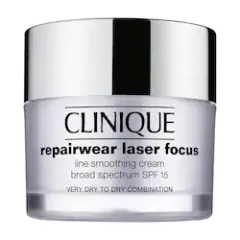
Clinique Repairwear Laser Focus Line Smoothing Cream Broad Spectrum SPF 15 for Very Dry to Dry Combination Skin
Works for:
based on ingredients and %- Moisturizing
- Anti-aging
- Anti-oxidation
Doesn't work for:
based on ingredients and %- Sun protection
Can it cause trouble?
- Irritation risk: medium
- Comedogenic risk ingredients: 4
Key actives
Product Summary
We do not recommend "Clinique - Repairwear Laser Focus Line Smoothing Cream Broad Spectrum SPF 15 for Very Dry to Dry Combination Skin" because it does not provide good UVA protection. UVA sun rays don't burn the skin, but they still lead to photoaging and hyperpigmentation.
It also works as a moisturizer, so you do not have to use an additional hydrating product.
Sunscreen filters
This sunscreen uses a mixture of both mineral and organic (so-called "chemical") UV filters. The organic filters in the product are: octinoxate and octisalate. As for the mineral filters, this sunscreen uses titanium dioxide.
Irritation risk
This formulation includes some common irritants, including ingredients that do not provide a benefit for the skin. We assess the overall irritancy of this moisturizer to be medium. For a detailed overview of all potential irritants: click here
You can see the detailed formula review with the breakdown of all actives in the product and the full ingredient list with estimated concentrations in the tables below.
Price
The product retails for 60.00$ in the United States.
For a detailed price comparison: click here.
Moisturizing
What does the product description say?
A daily moisturizer that reduces the appearance of lines and wrinkles while offering sun protection.
Source: Sephora
This product can help improve hydration of the skin with the two types of ingredients.
The first type is called “humectants”:
these ingredients help attract water.
When humectants are on the surface of the skin, they “pull in” the moisture from the outside environment, or from
within deeper layers of the skin. The following ingredients in this product do the job:
algae extract, glycerin.
This product also contains ingredients called “occlusives”. They help reduce the speed with which our skin loses moisture to the outside environment. These ingredients also help soften the upper layer of the skin, so it feels less tight and nicer to the touch. The following ingredients in this product do the job: dimethicone, methicone.
The following ingredients in this product are especially good for supporting the skin barrier and helping with the hydration level: acetyl hexapeptide-8, linoleic acid, petrolatum, phytosphingosine
A type of peptide. Peptides are excellent moisturizers and might be able support collagen production reducing fine lines and wrinkles
Plant extract that helps the skin to attract water and make it more smooth for touch. Also shows promise of anti-aging properties, but research is not extensive yet
Helps soften the upper layer of the skin. Could be comedogenic due to the myrisic acid content
An emollient that helps soften the skin. Often used to stabilize other ingredients, for example, sunscreen
One of the best moisturizing ingredients. Naturally present in skin. It attracts water to the upper layer of the skin working as a humectant
An oil naturally present in skin. Works as an emollient to soften the skin and form a protective layer on its surface without a greasy feeling.
A sugar that attracts water to the upper layer of the skin
Helps to attract water to the upper layer of the skin and can help restore the skin barrier function
One of the most effective and the most studied occlusive ingredients that creates a protective layer on top of the skin preventing moisture loss
A type of lipid that is naturally present in skin. It might help in repairing skin barrier function and has anti-bacterial effect
An emollient that is naturally found in skin
Is helpful in restoring skin barrier function supporting its moisture levels. Is claimed to stimulte collagen production in skin but evidence is lacking
A silicone that helps to reduce water loss from the surface of the skin. Can temporarily "fill in" lines and wrinkles, absorb oil, and create a nice product finish
A type of silicone that helps soften the upper layer of the skin and reduces the water loss from the skin surface
Helps attract water to the upper layer of the skin. Can have some anti-inflammatory effect
Helps soften the upper layer of the skin
One of the best moisturizing ingredients. Attracts water into the upper layer of the skin
An excellent emollient. Helps soften the skin, restore its barrier function, and can help to calm down inflammation. It can be helpful to prevent blemishes and clogged pores
An emollient that helps soften the skin and create a nice product texture
Is claimed to stimulate collagen and elastin production, as well as work as an anti-oxidant. There is however not enough evidence for its effectiveness
Used to create a nice product texture and help delivery of other ingredients. Might be somewhat helpful in attracting water to the upper layer of the skin
Helps soften the upper layer of the skin and create a nice product consistency
An emollient that is naturally present in skin and helps soften it
Used to create a nice product consistency while softening the upper layer of the skin
Used to preserve products, dissolve other ingredients and create a nice product texture
A silicone that forms a light film on the skin surface helping to bind water and temporarily absorb oils creating a matt and powdery feel
An emollient that helps soften the upper layer of the skin
Helps attract water to the upper layer of the skin and improves the product texture
Non-drying alcohol that helps water and oil mix together. Also serves as an emollient
Helps soften the upper layer of the skin and improve the product's texture
Helps preserve products and creates a nice product texture
Used to soften the upper layer of the skin and create a nice product texture
Helps soften the upper layer of the skin
An emollient that softens the skin and forms a protective layer on its surface. Helps water and oil mix together
Used to improve the product consistency and soften the upper layer of the skin
Helps create a nice product feeling on the skin and help soften its upper layer
A plant extract that is claimed to be helpful in moisturizing and lightening the skin, but evidence is missing
Plant extract that might have moisturizing properties. Avoid if you suffer from wheat or gluten intolerance
Used mostly for creating emulsions - helping oil and water mix together. Helps soften the upper layer of the skin
Might help to soften the upper layer of the skin. Is claimed to have anti-oxidant properties, but evidence in missing
Has astringent properties. Creates a tightening and drying effect on the skin. Can be irritating
Anti-aging
What does the product description say?
Repairwear Laser Focus Line Smoothing Cream Broad Spectrum SPF 15 for Very Dry to Dry Combination Skin
Source: Ulta
This product contains acetyl hexapeptide-8, adenosine phosphate, creatine. These ingredients might be able to help reduce and prevent fine lines and wrinkles, improve skin elasticity and firmness, but there is not enough evidence that it actually works. The biggest anti-aging effect in this product comes from sun protection. Sun damage is the main factor causing early signs of skin aging. We, however, do not recommend using this product as a sunscreen because the protection it offers is not strong enough).
A type of peptide. Peptides are excellent moisturizers and might be able support collagen production reducing fine lines and wrinkles
Might help improve cell turnover and reduce inflammation in skin. One study shows that the ingredients might be able to stimulate collagen production in skin
Can support skin's ability to neutralize free radicals and produce collagen, though further research is needed to confirm effectiveness
Might be able to protect the skin from free radicals, but further evidence of effectiveness is needed
Is claimed to stimulate collagen and elastin production, as well as work as an anti-oxidant. There is however not enough evidence for its effectiveness
Is helpful in restoring skin barrier function supporting its moisture levels. Is claimed to stimulte collagen production in skin but evidence is lacking
Plant extract that helps the skin to attract water and make it more smooth for touch. Also shows promise of anti-aging properties, but research is not extensive yet
A more stable but less potent derivative of vitamin C. It can help neautralize free radicals and even out the skin tone if used in high enough concentration (required levels are likely to be much higher than for pure vitamin C, and solid studies are lacking at the moment)
Is claimed to have anti-aging properties, but research about its effect in topical application is missing
Anti-oxidation
This product contains antioxidants (creatine, decarboxy carnosine hcl) that might be able to help neutralize free radicals in skin to lessen the damage it gets from the UV light (sun). There is not enough evidence to confirm their effectiveness in skin though.
Can support skin's ability to neutralize free radicals and produce collagen, though further research is needed to confirm effectiveness
Might be able to protect the skin from free radicals, but further evidence of effectiveness is needed
Is claimed to stimulate collagen and elastin production, as well as work as an anti-oxidant. There is however not enough evidence for its effectiveness
Might be helpful in neutralizing free radicals. Can have a dehydration effect that might somewhat decrease the look of puffy eyes
A likely irritant. Might have some anti-oxidant activity, but is mostly used as a fragrance in cosmetic products
A more stable but less potent derivative of vitamin C. It can help neautralize free radicals and even out the skin tone if used in high enough concentration (required levels are likely to be much higher than for pure vitamin C, and solid studies are lacking at the moment)
Has astringent properties. Creates a tightening and drying effect on the skin. Can be irritating
A plant extract that might have some anti-oxidant properties. Avoid if you are sensitive to gluten
A plant extract that can contain resveratrol, an antioxidant that can help neutralize free radicals in skin. The effectiveness depends on the extract quality and concentration in the product
A more stable but less bio-available form of vitamin E compared to Tocopherol. Might help moisturize and protect the skin from free radicals, but mostly used in low concentrations to stabilize other ingredients.
Plant extract that might have moisturizing properties. Avoid if you suffer from wheat or gluten intolerance
Might help to soften the upper layer of the skin. Is claimed to have anti-oxidant properties, but evidence in missing
Sun protection
What does the product description say?
Repairwear Laser Focus Line Smoothing Cream Broad Spectrum SPF 15 for Very Dry to Dry Combination Skin
Source: Ulta
This product does not offer good protection against UVA rays.
Works as a UV filter when used in high concentrations. It is photostable and is effective mostly against the UVB light, with some protection in the UVA range. In small concentrations, used for its ability to improve the color of cosmetic products. Is usually well tolerated by the skin
Octinoxate. When used in higher concentrations, works as a sunscreen protecting the skin from UVB rays. When used in lower concentration, helps to preserve the product formulation. Is shown to be harmful to coral reefs - consider avoiding bathing in coral reef areas when wearing a product with this ingredient. It can be irritating
Octisalate. A UV filter. It offers some protection against the sun rays that cause sunburn (UVB), but does not protect against the most aging sun rays (UVA). It loses its effectiveness quickly when exposed to sunlight. It is an organic, or so called "chemical" sunscreen
How honest is this product?
| Promise | Can it deliver? |
|---|---|
| Sun protection | |
| Moisturizing | |
| Anti-aging |
Total Promises Fulfilled score: 75/100.
Potential irritants
Comedogenic ingredients
User reviews (0)
Averages from community submissions.
No reviews yet for this product.
Be the first to share your experience!
Tried this product?
Help capture what the ingredient list can't—texture, finish, pilling, scent, and more. Answer what you can, skip the rest.
Takes ~30 seconds.
Reviews are shown in aggregate. No personal details.
Key Actives
An excellent emollient. Helps soften the skin, restore its barrier function, and can help to calm down inflammation. It can be helpful to prevent blemishes and clogged pores
Is helpful in restoring skin barrier function supporting its moisture levels. Is claimed to stimulte collagen production in skin but evidence is lacking
A type of lipid that is naturally present in skin. It might help in repairing skin barrier function and has anti-bacterial effect
A more stable but less potent derivative of vitamin C. It can help neautralize free radicals and even out the skin tone if used in high enough concentration (required levels are likely to be much higher than for pure vitamin C, and solid studies are lacking at the moment)
A silicone that helps to reduce water loss from the surface of the skin. Can temporarily "fill in" lines and wrinkles, absorb oil, and create a nice product finish
Plant extract that helps the skin to attract water and make it more smooth for touch. Also shows promise of anti-aging properties, but research is not extensive yet
Can support skin's ability to neutralize free radicals and produce collagen, though further research is needed to confirm effectiveness
Might help improve cell turnover and reduce inflammation in skin. One study shows that the ingredients might be able to stimulate collagen production in skin
A type of peptide. Peptides are excellent moisturizers and might be able support collagen production reducing fine lines and wrinkles
Might be helpful in neutralizing free radicals. Can have a dehydration effect that might somewhat decrease the look of puffy eyes
An emollient that is naturally found in skin
Might be able to protect the skin from free radicals, but further evidence of effectiveness is needed
A silicone that forms a light film on the skin surface helping to bind water and temporarily absorb oils creating a matt and powdery feel
Octinoxate. When used in higher concentrations, works as a sunscreen protecting the skin from UVB rays. When used in lower concentration, helps to preserve the product formulation. Is shown to be harmful to coral reefs - consider avoiding bathing in coral reef areas when wearing a product with this ingredient. It can be irritating
Works as a UV filter when used in high concentrations. It is photostable and is effective mostly against the UVB light, with some protection in the UVA range. In small concentrations, used for its ability to improve the color of cosmetic products. Is usually well tolerated by the skin
Helps soften the upper layer of the skin
One of the best moisturizing ingredients. Naturally present in skin. It attracts water to the upper layer of the skin working as a humectant
One of the most effective and the most studied occlusive ingredients that creates a protective layer on top of the skin preventing moisture loss
An emollient that helps soften the skin. Often used to stabilize other ingredients, for example, sunscreen
Helps attract water to the upper layer of the skin. Can have some anti-inflammatory effect
Helps soften the upper layer of the skin. Could be comedogenic due to the myrisic acid content
A plant extract that can contain an anti-inflammatory compound
An oil naturally present in skin. Works as an emollient to soften the skin and form a protective layer on its surface without a greasy feeling.
A sugar that attracts water to the upper layer of the skin
A type of silicone that helps soften the upper layer of the skin and reduces the water loss from the skin surface
One of the best moisturizing ingredients. Attracts water into the upper layer of the skin
Helps to attract water to the upper layer of the skin and can help restore the skin barrier function
Potential irritants
Octinoxate. When used in higher concentrations, works as a sunscreen protecting the skin from UVB rays. When used in lower concentration, helps to preserve the product formulation. Is shown to be harmful to coral reefs - consider avoiding bathing in coral reef areas when wearing a product with this ingredient. It can be irritating
A likely irritant. Might have some anti-oxidant activity, but is mostly used as a fragrance in cosmetic products
Has astringent properties. Creates a tightening and drying effect on the skin. Can be irritating
Used to soften the upper layer of the skin and create a nice product texture
Helps create a nice product feeling on the skin and help soften its upper layer
Used to preserve products, dissolve other ingredients and create a nice product texture
A plant extract that can contain resveratrol, an antioxidant that can help neutralize free radicals in skin. The effectiveness depends on the extract quality and concentration in the product
Helps soften the upper layer of the skin. Could be comedogenic due to the myrisic acid content
Plant extract that might have moisturizing properties. Avoid if you suffer from wheat or gluten intolerance
A plant extract that might have some anti-oxidant properties. Avoid if you are sensitive to gluten
A plant extract that can contain an anti-inflammatory compound
Might be helpful in neutralizing free radicals. Can have a dehydration effect that might somewhat decrease the look of puffy eyes
A more stable but less bio-available form of vitamin E compared to Tocopherol. Might help moisturize and protect the skin from free radicals, but mostly used in low concentrations to stabilize other ingredients.
Helps preserve products and creates a nice product texture
Used to stabilize product formulation, help create an even product layer over skin (for example, in sunscreen) and create a thicker product consistency
Helps soften the upper layer of the skin and improve the product's texture
Can work as an exfoliant but is typically used to adjust the product pH
A more stable but less potent derivative of vitamin C. It can help neautralize free radicals and even out the skin tone if used in high enough concentration (required levels are likely to be much higher than for pure vitamin C, and solid studies are lacking at the moment)
Comedogenic ingredients
Plant extract that helps the skin to attract water and make it more smooth for touch. Also shows promise of anti-aging properties, but research is not extensive yet
Might help to soften the upper layer of the skin. Is claimed to have anti-oxidant properties, but evidence in missing
Plant extract that might have moisturizing properties. Avoid if you suffer from wheat or gluten intolerance
An emollient that helps soften the skin and create a nice product texture
All ingredients
Octinoxate. When used in higher concentrations, works as a sunscreen protecting the skin from UVB rays. When used in lower concentration, helps to preserve the product formulation. Is shown to be harmful to coral reefs - consider avoiding bathing in coral reef areas when wearing a product with this ingredient. It can be irritating
Octisalate. A UV filter. It offers some protection against the sun rays that cause sunburn (UVB), but does not protect against the most aging sun rays (UVA). It loses its effectiveness quickly when exposed to sunlight. It is an organic, or so called "chemical" sunscreen
Works as a UV filter when used in high concentrations. It is photostable and is effective mostly against the UVB light, with some protection in the UVA range. In small concentrations, used for its ability to improve the color of cosmetic products. Is usually well tolerated by the skin
Helps soften the upper layer of the skin and create a nice product consistency
One of the best moisturizing ingredients. Naturally present in skin. It attracts water to the upper layer of the skin working as a humectant
One of the most effective and the most studied occlusive ingredients that creates a protective layer on top of the skin preventing moisture loss
An emollient that helps soften the skin. Often used to stabilize other ingredients, for example, sunscreen
Used to soften the upper layer of the skin and create a nice product texture
A silicone that helps to reduce water loss from the surface of the skin. Can temporarily "fill in" lines and wrinkles, absorb oil, and create a nice product finish
Helps to retain moisture by creating a protective barrier on the skin. Rich in fatty acids. Improves product texture and helps with the penetration of other ingredients.
Used to create a nice product texture and help delivery of other ingredients. Might be somewhat helpful in attracting water to the upper layer of the skin
Used to improve the product consistency and soften the upper layer of the skin
Used to create a nice product consistency while softening the upper layer of the skin
Helps create a nice product feeling on the skin and help soften its upper layer
Used to preserve products, dissolve other ingredients and create a nice product texture
A likely irritant. Might have some anti-oxidant activity, but is mostly used as a fragrance in cosmetic products
Helps attract water to the upper layer of the skin. Can have some anti-inflammatory effect
A plant extract that can contain resveratrol, an antioxidant that can help neutralize free radicals in skin. The effectiveness depends on the extract quality and concentration in the product
Plant extract that helps the skin to attract water and make it more smooth for touch. Also shows promise of anti-aging properties, but research is not extensive yet
Helps soften the upper layer of the skin. Could be comedogenic due to the myrisic acid content
Might help to soften the upper layer of the skin. Is claimed to have anti-oxidant properties, but evidence in missing
Has astringent properties. Creates a tightening and drying effect on the skin. Can be irritating
Can support skin's ability to neutralize free radicals and produce collagen, though further research is needed to confirm effectiveness
Might help improve cell turnover and reduce inflammation in skin. One study shows that the ingredients might be able to stimulate collagen production in skin
An excellent emollient. Helps soften the skin, restore its barrier function, and can help to calm down inflammation. It can be helpful to prevent blemishes and clogged pores
A plant extract that is claimed to be helpful in moisturizing and lightening the skin, but evidence is missing
Is helpful in restoring skin barrier function supporting its moisture levels. Is claimed to stimulte collagen production in skin but evidence is lacking
Plant extract that might have moisturizing properties. Avoid if you suffer from wheat or gluten intolerance
A plant extract that might have some anti-oxidant properties. Avoid if you are sensitive to gluten
A plant extract that can contain an anti-inflammatory compound
A type of peptide. Peptides are excellent moisturizers and might be able support collagen production reducing fine lines and wrinkles
Might be helpful in neutralizing free radicals. Can have a dehydration effect that might somewhat decrease the look of puffy eyes
Helps attract water to the upper layer of the skin and improves the product texture
An emollient that helps soften the skin and create a nice product texture
Might be able to protect the skin from free radicals, but further evidence of effectiveness is needed
A type of lipid that is naturally present in skin. It might help in repairing skin barrier function and has anti-bacterial effect
An emollient that helps soften the upper layer of the skin
A more stable but less bio-available form of vitamin E compared to Tocopherol. Might help moisturize and protect the skin from free radicals, but mostly used in low concentrations to stabilize other ingredients.
Helps oil and water mix togehter and creates a nice product texture
Helps preserve products and creates a nice product texture
Used to stabilize product formulation, help create an even product layer over skin (for example, in sunscreen) and create a thicker product consistency
Helps soften the upper layer of the skin and improve the product's texture
A silicone that forms a light film on the skin surface helping to bind water and temporarily absorb oils creating a matt and powdery feel
An oil naturally present in skin. Works as an emollient to soften the skin and form a protective layer on its surface without a greasy feeling.
An emollient that is naturally present in skin and helps soften it
An emollient that softens the skin and forms a protective layer on its surface. Helps water and oil mix together
Is claimed to have anti-aging properties, but research about its effect in topical application is missing
Is claimed to stimulate collagen and elastin production, as well as work as an anti-oxidant. There is however not enough evidence for its effectiveness
Can work as an exfoliant but is typically used to adjust the product pH
A more stable but less potent derivative of vitamin C. It can help neautralize free radicals and even out the skin tone if used in high enough concentration (required levels are likely to be much higher than for pure vitamin C, and solid studies are lacking at the moment)
Non-drying alcohol that helps water and oil mix together. Also serves as an emollient
A type of silicone that helps soften the upper layer of the skin and reduces the water loss from the skin surface
Increases thickness of a product. Texture enhancer for oil-in-water emulsions
One of the best moisturizing ingredients. Attracts water into the upper layer of the skin
Is used to add opaque (non-transparent) appearance to formulations. Can be used to coat other ingredients for even dispersion. This is a different ingredient compared to the ones used in antipersperants (aluminium chloride and aluminium chlorohydrate)
Helps to attract water to the upper layer of the skin and can help restore the skin barrier function
Used mostly for creating emulsions - helping oil and water mix together. Helps soften the upper layer of the skin
Helps create a thicker or gel-like product texture. It is not a surfactant but can be used in gentle cleansing formulations
A preservative. It helps prevent bacterial growth in cosmetic products
Ingredient list view
Ethylhexyl methoxycinnamate, Ethylhexyl salicylate, Titanium dioxide, Water, Neopentyl glycol diheptanoate, Simmondsia chinensis butter, Glycerin, Petrolatum, Octyldodecyl neopentanoate, Di-c12-15 alkyl fumarate, Dimethicone, Hydrogenated lecithin, Butylene glycol, Hydrogenated polyisobutene, Pentaerythrityl tetraethylhexanoate, Hexyldecyl stearate, Polyethylene, Pentylene glycol, Potato starch modified, Citrus reticulata peel extract, Saccharomyces lysate extract, Polygonum cuspidatum root extract, Algae extract, Coffea robusta seed extract, Astrocaryum murumuru seed butter, Padina pavonica thallus extract, Betula alba bark extract, Creatine, Adenosine phosphate, Laurdimonium hydroxypropyl hydrolyzed soy protein, Linoleic acid, Hydrolyzed rice extract, Hydroxyproline, Triticum vulgare germ extract, Hordeum vulgare extract, Sigesbeckia orientalis extract, Coleus barbatus root extract, Acetyl hexapeptide-8, Sodium dna, Caffeine, Cholesterol, Ethylhexyl stearate, Sorbitol, Ethylhexyl palmitate, Decarboxy carnosine hcl, Phytosphingosine, Propylene glycol dicaprate, Tocopheryl acetate, Peg-100 stearate, Disodium nadh, Caprylyl glycol, Acrylates copolymer, C12-16 alcohols, Polysilicone-11, Squalane, Palmitic acid, Trehalose, Glyceryl stearate, Sodium rna, Dipalmitoyl hydroxyproline, Proline, Citric acid, Potassium sorbate, Aminopropyl ascorbyl phosphate, Behenyl alcohol, Methicone, Ammonium acryloyldimethyltaurate/vp copolymer, Hexylene glycol, Xanthan gum, Sodium hydroxide, Sodium hyaluronate, Aluminum hydroxide, Potassium sulfate, Glycine, Lecithin, Carbomer, Disodium edta, Phenoxyethanol
- Glycerol and the skin: holistic approach to its origin and functions
- Amended Safety Assessment of Alkyl Esters as Used in Cosmetics
- Dimethicone as a protective ingredient in topical medications
- Final Report on the Safety Assessment of Dimethicone Copolyol
- Final report of the cosmetic ingredient review expert panel on the safety assessment of Polyisobutene and Hydrogenated Polyisobutene as used in cosmetics
- Safety Assessment of Pentaerythrityl Tetraesters as Used in Cosmetics
- Safety Assessment of Alkyl Esters as Used in Cosmetics
- Use of Probiotics for Dermal Applications
- Nuclear Factor Kappa B Inhibition as a Therapeutic Target of Nutraceuticals in Arthritis, Osteoarthritis, and Related Inflammation
- Resveratrol as an active ingredient for cosmetic and dermatological applications: a review
- AMAZON RAINFOREST COSMETICS: CHEMICAL APPROACH FOR QUALITY CONTROL
- Dermal penetration of creatine from a face-care formulation containing creatine, guarana and glycerol is linked to effective antiwrinkle and antisagging efficacy in male subjects
- Folic acid and creatine improve the firmness of human skin in vivo
- The Creatine Kinase System in Human Skin: Protective Effects of Creatine Against Oxidative and UV Damage In Vitro and In Vivo
- Effects of adenosine 5'-monophosphate on epidermal turnover
- Targeting adenosine receptors to prevent inflammatory skin diseases
- The Permeability Barrier in Essential Fatty Acid Deficiency: Evidence for a Direct Role for Linoleic Acid in Barrier Function
- Digital image analysis of the effect of topically applied linoleic acid on acne microcomedones.
- Topical effects of N-acetyl-L-hydroxyproline on ceramide synthesis and alleviation of pruritus
- Wheat in skin care
- Celiac Disease & Skin Care Products
- Preventive and Therapeutic Role of Functional Ingredients of Barley Grass for Chronic Diseases in Human Beings
- Purified Pland Extracts
- Dynamic monitoring of glutathione redox status in UV-B irradiated reconstituted epidermis: effect of antioxidant activity on skin homeostasis
- Final Report on the Safety Assessment of Acrylates Copolymer and 33 Related Cosmetic Ingredients
- Amended Safety Assessment of Acrylates Copolymers as Used in Cosmetics
- An exemplary claim substantiation for the firming / filling activity of a synthetic tripeptide
- Hyaluronic acid: A key molecule in skin aging
- Hyaluronan (Hyaluronic Acid): a natural moisturizer for skin care
- Safety Assessment of Alumina and Aluminum Hydroxide as Used in Cosmetics
- Effect of Topical Application of Glycine and Proline on Recalcitrant Leg Ulcers of Prolidase Deficiency
- Functional glycine receptor in cultured human keratinocytes