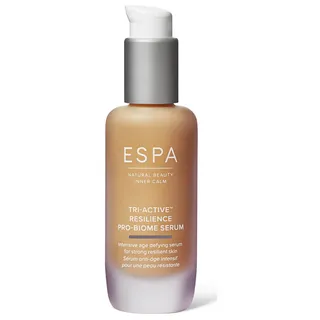
ESPA Tri-Active Resilience Pro Biome Serum

ESPA Tri-Active Resilience Pro Biome Serum

Efficacy50/100IrritancyHigh

Works for

Anti-aging
Sodium ascorbyl phosphate, Tocopherol + 4 more
Not delivered
What the product description says
“ESPA Tri-Active Resilience Pro Biome Serum is a clinically proven intensive age-defying serum that utilises pre and probiotic technology, for strong, resilient skin.”
Source: Face the future

This product does not contain ingredients that are able to reduce fine lines and wrinkles or help with skin elasticity, but it can improve the look of the skin temporarily through moisturization. Well-moisturized skin might also be able to repair the sun damage better.

This ingredient bifida ferment lysate might be able to help neutralize free radicals in skin and help it fight off some of the sun damage.

Sodium ascorbyl phosphateEffect: Low, below effective doseA stable derivative of vitamin C. It is oil-soluble which means it is more likely to penetrate the skin compared to the pure form of vitamin C (which is water-soluble), but it is less bio-available and is way less effective in stimulating collagen and reducing wrinkles compared to the pure form of vitamin C (L-ascorbic acid) and its other derivatives (for example, magnesium ascorbyl phosphate). At the same time, this vitamin C derivative has been shown in studies to be effective in reducing acne, blemishes and clogged pores. It is less irritating then the pure form of vitamin C~0.15–0.3%
TocopherolEffect: Low, below effective dosePure form of vitamin E. Can help moisturise and protect the skin from free radicals. Often used to help stabilise other ingredients or the formula itself~0.15–0.25%
Laminaria digitata extractEffect: Low, below effective doseSeaweed extract that helps the skin to attract water and make it more smooth for touch. Also shows promise of anti-aging properties, but good research is lacking at the moment~0.15–0.25%
Alaria esculenta extractEffect: Low, below effective doseWorks as a humectant helping to attract water to the upper layer of the skin and might be effective as an anti-oxidant.~0.1–0.2%
Retinyl palmitateUnder-dosedThree steps removed from the active form of vitamin A - retinoic acid. To have an effect in the skin, it first needs to be converted twice to become the retinoic acid. This means it is less potent than retinol, but could also be less irritating. Once converted to the retinoic acid in the skin, it helps against all signs of aging, improves skin cell turnover and helps fight blemishes and clogged pores. However, in many cosmetic formulations, it is used in a concentration that is too low to have the full effect~0.15–0.25%
Lactic acidUnder-dosedAn exfoliating and moisturizing alpha-hydroxy acid (AHA). Typically causes less irritation than other AHAs, for example, glycolic acid. At high concentrations (about 15%), lactic acid can help reduce lines and wrinkles. Recent studies show that lactic acid can support the "good" bacteria living on skin's surface (healthy skin microbiome)~0.1–0.15%
Evens skin tone
Bifida ferment lysate, Paeonia lactiflora root extract + 2 more
Not delivered
What the product description says
“Formulated with peony and microalgae to help defend against skin stressors, Irish moss seaweed to de-congest the skin, and neroli to replenish, ESPA Tri-Active Resilience Pro Biome Serum evens skin tone, improves elasticity and firmness, enhances radiance, and leaves skin feeling soft and supple.”
Source: Face the future

This product contains ingredients (bifida ferment lysate, paeonia lactiflora root extract) that could help reduce hyperpigmentation (for example, post-acne marks or age spots) in theory, but there is not enough evidence that they actually work.

Bifida ferment lysateEffect: LowConsists of remains of dead yeast bacteria cells. Helps to hydrate the skin and reduce irritation. Might has some anti-oxidant effect~2.9–3.5%
Paeonia lactiflora root extractEffect: LowA plant extract that might help neutralize free radicals and reduce hyperpigmentation, but the research on its effectiveness in skin is lacking~0.15–0.25%
Retinyl palmitateUnder-dosedThree steps removed from the active form of vitamin A - retinoic acid. To have an effect in the skin, it first needs to be converted twice to become the retinoic acid. This means it is less potent than retinol, but could also be less irritating. Once converted to the retinoic acid in the skin, it helps against all signs of aging, improves skin cell turnover and helps fight blemishes and clogged pores. However, in many cosmetic formulations, it is used in a concentration that is too low to have the full effect~0.15–0.25%
Lactic acidUnder-dosedAn exfoliating and moisturizing alpha-hydroxy acid (AHA). Typically causes less irritation than other AHAs, for example, glycolic acid. At high concentrations (about 15%), lactic acid can help reduce lines and wrinkles. Recent studies show that lactic acid can support the "good" bacteria living on skin's surface (healthy skin microbiome)~0.1–0.15%
Anti-oxidation
Side benefit · Bifida ferment lysate, Buddleja officinalis flower extract + 8 more
May help

This product contains antioxidants (bifida ferment lysate) that can help neutralize free radicals in skin to lessen the damage it gets from the UV light (sun). There is some human evidence for this effect in skin, though it is smaller or less consistent than the evidence for the best antioxidants.

Bifida ferment lysateKey activeEffect: MediumConsists of remains of dead yeast bacteria cells. Helps to hydrate the skin and reduce irritation. Might has some anti-oxidant effect~2.9–3.5%
Buddleja officinalis flower extractEffect: LowA plant flower extract that might help calm down inflammation in skin and neutralize free radicals, but evidence of effectiveness in skin is lacking~0.25–0.5%
Chlorella vulgaris extractEffect: LowA plant extract that can help to attract water to the upper layer of the skin and might have some anti-oxidant and anti-inflammatory properties~0.15–0.25%
Paeonia lactiflora root extractEffect: LowA plant extract that might help neutralize free radicals and reduce hyperpigmentation, but the research on its effectiveness in skin is lacking~0.15–0.25%
Laminaria digitata extractEffect: Low, below effective doseSeaweed extract that helps the skin to attract water and make it more smooth for touch. Also shows promise of anti-aging properties, but good research is lacking at the moment~0.15–0.25%
Tocopheryl acetateEffect: Low, below effective doseA more stable but less bio-available form of vitamin E compared to Tocopherol. Might help moisturize and protect the skin from free radicals, but mostly used in low concentrations to stabilize other ingredients.~0.15–0.25%
Alaria esculenta extractEffect: Low, below effective doseWorks as a humectant helping to attract water to the upper layer of the skin and might be effective as an anti-oxidant.~0.1–0.2%
Rosmarinus officinalis leaf extractEffect: Low, below effective doseCan be helpful in reducing inflammation in skin, including inflamed acne. It can be irritating~0.1–0.2%
TocopherolUnder-dosedPure form of vitamin E. Can help moisturise and protect the skin from free radicals. Often used to help stabilise other ingredients or the formula itself~0.15–0.25%
Sodium ascorbyl phosphateUnder-dosedA stable derivative of vitamin C. It is oil-soluble which means it is more likely to penetrate the skin compared to the pure form of vitamin C (which is water-soluble), but it is less bio-available and is way less effective in stimulating collagen and reducing wrinkles compared to the pure form of vitamin C (L-ascorbic acid) and its other derivatives (for example, magnesium ascorbyl phosphate). At the same time, this vitamin C derivative has been shown in studies to be effective in reducing acne, blemishes and clogged pores. It is less irritating then the pure form of vitamin C~0.15–0.3%
Moisturizing
Side benefit · Glycerin, Bifida ferment lysate + 24 more
Works

This product can help improve hydration of the skin with the two types of ingredients.

The first type is called “humectants”:
these ingredients help attract water. When humectants are on the surface of the skin, they “pull in” the moisture from the outside environment, or from within deeper layers of the skin. The following ingredients in this product do the job: calcium pca, glycerin.

This product also contains ingredients called “occlusives”. They help reduce the speed with which our skin loses moisture to the outside environment. These ingredients also help soften the upper layer of the skin, so it feels less tight and nicer to the touch. The following ingredients in this product do the job: caprylic/capric triglyceride, chondrus crispus extract.

GlycerinKey active· HumectantEffect: HighOne of the best moisturizing ingredients. Naturally present in skin. It attracts water to the upper layer of the skin working as a humectant~3.7–4.5%
Bifida ferment lysateKey activeEffect: HighConsists of remains of dead yeast bacteria cells. Helps to hydrate the skin and reduce irritation. Might has some anti-oxidant effect~2.9–3.5%
Helianthus annuus seed oilKey active· Emollient, OcclusiveEffect: HighA great emollient due to its high linoleic acid content. One of the most effective plant oils in helping skin hydration and repairing skin barrier function~1.9–2.3%
Caprylic/capric triglycerideKey active· Emollient, OcclusiveEffect: HighA good mix of fatty acids that forms a protective layer on the skin. Improves the shelf life of products. Derived from coconut and glycerin~1.4–1.8%
Sodium hyaluronateKey active· HumectantEffect: HighOne of the best moisturizing ingredients. Attracts water into the upper layer of the skin~0.3–0.6%
Sodium pcaKey active· HumectantEffect: HighNaturally present in skin and helps to attract water to its upper layer~0.2–0.35%
Glyceryl linolenateKey active· EmollientEffect: MediumHelps soften the upper layer of the skin~0.2–0.35%
Chondrus crispus extractKey active· OcclusiveEffect: HighRed algae extract that helps attract water to the upper layer of the skin and create a nicer product consistency~0.15–0.3%
Saccharide isomerateKey active· HumectantEffect: HighHelps attract water to the upper layer of the skin~0.15–0.25%
TrehaloseKey active· HumectantEffect: HighA sugar that attracts water to the upper layer of the skin~0.15–0.25%
GlucoseKey active· HumectantEffect: MediumHelps attract water to the upper layer of the skin. Could be helpful in restoring the skin barrier function~0.15–0.25%
Chlorella vulgaris extractKey activeEffect: MediumA plant extract that can help to attract water to the upper layer of the skin and might have some anti-oxidant and anti-inflammatory properties~0.15–0.25%
Sodium lactateKey active· HumectantEffect: HighHelps attract water to the upper layer of the skin. Is often used to adjust the pH level of the product~0.1–0.2%
Calcium pcaKey active· HumectantEffect: HighHelps attract water to the upper layer of the skin~0.1–0.2%
Plankton extractKey activeEffect: MediumCan help attract water to the upper layer of the skin~0.1–0.2%
Sorbitol· HumectantEffect: LowHelps attract water to the upper layer of the skin and improves the product texture~0.7–1.05%
Caprylyl glycol· Humectant, EmollientEffect: LowHelps preserve products and creates a nice product texture~0.2–0.35%
Glyceryl caprylate· EmollientEffect: LowAn emollient that can also help water and oil mix together, as well as prevent bacteria growth in products~0.2–0.35%
Propylene glycol· HumectantEffect: LowHelps oil and water mix together and can enhance the penetration of other ingredients into the skin. It can be irritating~0.15–0.3%
Rosa damascena flower oilEffect: LowUsed as a fragrance. Can be irritating~0.15–0.3%
Lithothamnion calcareum extractEffect: LowA mineral-rich extract from red algae. Might be able to help attract water to the upper layer of the skin~0.1–0.2%
LecithinEffect: Low, below effective doseUsed mostly for creating emulsions - helping oil and water mix together. Helps soften the upper layer of the skin~0.15–0.3%
TocopherolEffect: Low, below effective dosePure form of vitamin E. Can help moisturise and protect the skin from free radicals. Often used to help stabilise other ingredients or the formula itself~0.15–0.25%
Laminaria digitata extractUnder-dosedSeaweed extract that helps the skin to attract water and make it more smooth for touch. Also shows promise of anti-aging properties, but good research is lacking at the moment~0.15–0.25%
Lactic acidUnder-dosedAn exfoliating and moisturizing alpha-hydroxy acid (AHA). Typically causes less irritation than other AHAs, for example, glycolic acid. At high concentrations (about 15%), lactic acid can help reduce lines and wrinkles. Recent studies show that lactic acid can support the "good" bacteria living on skin's surface (healthy skin microbiome)~0.1–0.15%
Alaria esculenta extractUnder-dosedWorks as a humectant helping to attract water to the upper layer of the skin and might be effective as an anti-oxidant.~0.1–0.2%

Can it cause trouble?

Irritancy
23 strong irritants: Hamamelis virginiana water, Alcohol + 21 more — patch-test recommended
High risk
We flagged 42 ingredients with irritancy potential. Severity depends on your sensitivity threshold; the table lists the worst offenders first.
IngredientFunctionIrritationEst. amount
Hamamelis virginiana waterA plant extract that can help calm down inflammation in skin. Can, however, itself be irritatingHigh~4.5–5.5%est.
AlcoholCan be drying and contribute to skin irritation. Used in formulars to dissolve other ingredients, create a thinner product consistency or for its antibacterial propertiesHigh~2.2–2.7%est.
LimoneneA common frangrance that can easily irritate skin, especially if exposed to air, light or heatHigh~0.2–0.4%est.
Citrus aurantium dulcis peel oilAn essentil oil from orange peel. Potential allergen and can be irritatingHigh~0.15–0.3%est.
Propylene glycolHelps oil and water mix together and can enhance the penetration of other ingredients into the skin. It can be irritatingHigh~0.15–0.3%est.
Citrus aurantium bergamia fruit oilA plant oil with a high content of volatile compounds that can irritate the skin and lead to allergic reactions. Can lead to photosensitivityHigh~0.15–0.25%est.
Citrus nobilis peel oilA plant oil with high content of volatile compounds that, especially when exposed to air, can cause allergic reactions and irritate the skinHigh~0.15–0.25%est.
ParfumAn aromatic blend of unspecified and possibly irritating ingredientsHigh~0.1–0.2%est.
Pelargonium graveolens oilUsed as a fragrance. Can be irritatingHigh~0.1–0.2%est.
Rosmarinus officinalis leaf extractCan be helpful in reducing inflammation in skin, including inflamed acne. It can be irritatingHigh~0.1–0.2%est.
LinaloolA fragrance. Can be irritatingHigh~0.1–0.2%est.
Buddleja officinalis flower extractA plant flower extract that might help calm down inflammation in skin and neutralize free radicals, but evidence of effectiveness in skin is lackingHigh~0.25–0.5%est.
Cananga odorata flower oilAn essential oil. Can be irritatingHigh~0.1–0.2%est.
Citrus aurantium amara leaf/twig oil—High~0.15–0.25%est.
Citrus aurantium amara flower extractUsed as a fragrance for its citrus smell. Can be irritatingHigh~0.15–0.25%est.
GeraniolA fragrance. Can be irritatingHigh~0.1–0.2%est.
Cymbopogon nardus oil—High~0.15–0.25%est.
Jasminum officinale flower extractFragrance. Can be irritatingHigh~0.1–0.2%est.
Litsea cubeba fruit oilAn essential oil with a lemon-like smell that is extracted from a fruit grown in Asia. Used as a fragranceHigh~0.1–0.2%est.
CitralA fragrance with a lemon scent. A likely irritantHigh~0.1–0.2%est.
Benzyl benzoateFragrance with sweet balsamic smell. Help to preserve products and dissolve other ingredients. Could trigger allergic reactions and be irritatingHigh~0.1–0.2%est.
Benzyl salicylateA fragrance. Is a likely irritantHigh~0.1–0.2%est.
Citrus aurantium amara flower oilUsed as a fragrance. Can be irritatingHigh~0.15–0.3%est.
Rosa damascena flower oilUsed as a fragrance. Can be irritatingHigh~0.15–0.3%est.
Retinyl palmitateThree steps removed from the active form of vitamin A - retinoic acid. To have an effect in the skin, it first needs to be converted twice to become the retinoic acid. This means it is less potent than retinol, but could also be less irritating. Once converted to the retinoic acid in the skin, it helps against all signs of aging, improves skin cell turnover and helps fight blemishes and clogged pores. However, in many cosmetic formulations, it is used in a concentration that is too low to have the full effectHigh~0.15–0.25%est.
Caprylic/capric triglycerideA good mix of fatty acids that forms a protective layer on the skin. Improves the shelf life of products. Derived from coconut and glycerinMedium~1.4–1.8%est.
Caprylyl glycolHelps preserve products and creates a nice product textureMedium~0.2–0.35%est.
EthylhexylglycerinA preservativeMedium~0.2–0.35%est.
Benzoic acidA preservativeMedium~0.15–0.25%est.
Sodium lactateHelps attract water to the upper layer of the skin. Is often used to adjust the pH level of the productMedium~0.1–0.2%est.
Dehydroacetic acidA preservativeMedium~0.1–0.2%est.
Plankton extractCan help attract water to the upper layer of the skinMedium~0.1–0.2%est.
Phytic acidAn alpha-hydroxy acid (AHA), but is mostly used to stabilize product formulations in cosmeticsMedium~0.15–0.25%est.
Paeonia lactiflora root extractA plant extract that might help neutralize free radicals and reduce hyperpigmentation, but the research on its effectiveness in skin is lackingMedium~0.15–0.25%est.
Potassium sorbateA preservativeMedium~0.15–0.3%est.
Chlorella vulgaris extractA plant extract that can help to attract water to the upper layer of the skin and might have some anti-oxidant and anti-inflammatory propertiesMedium~0.15–0.25%est.
Citric acidCan work as an exfoliant but is typically used to adjust the product pHMedium~0.15–0.25%est.
Tocopheryl acetateA more stable but less bio-available form of vitamin E compared to Tocopherol. Might help moisturize and protect the skin from free radicals, but mostly used in low concentrations to stabilize other ingredients.Medium~0.15–0.25%est.
Glyceryl linoleateHelps oil and water mix togetherMedium~0.2–0.35%est.
Sodium ascorbyl phosphateA stable derivative of vitamin C. It is oil-soluble which means it is more likely to penetrate the skin compared to the pure form of vitamin C (which is water-soluble), but it is less bio-available and is way less effective in stimulating collagen and reducing wrinkles compared to the pure form of vitamin C (L-ascorbic acid) and its other derivatives (for example, magnesium ascorbyl phosphate). At the same time, this vitamin C derivative has been shown in studies to be effective in reducing acne, blemishes and clogged pores. It is less irritating then the pure form of vitamin CMedium~0.15–0.3%est.
Disodium edtaStabilizes the product formulationMedium~0.15–0.25%est.
Lactic acidAn exfoliating and moisturizing alpha-hydroxy acid (AHA). Typically causes less irritation than other AHAs, for example, glycolic acid. At high concentrations (about 15%), lactic acid can help reduce lines and wrinkles. Recent studies show that lactic acid can support the "good" bacteria living on skin's surface (healthy skin microbiome)Medium~0.1–0.15%est.
Comedogenic
5 ingredients rated 2 or more on the 0–5 pore-clogging scale
5 flagged
These ingredients have a comedogenic rating of 2 or more on a 0–5 scale; the table shows each one's rating. In leave-on products they can clog pores in acne-prone skin.
IngredientFunctionRatingEst. amount
Chondrus crispus extractRed algae extract that helps attract water to the upper layer of the skin and create a nicer product consistency3/5~0.15–0.3%est.
Lithothamnion calcareum extractA mineral-rich extract from red algae. Might be able to help attract water to the upper layer of the skin3/5~0.1–0.2%est.
Plankton extractCan help attract water to the upper layer of the skin3/5~0.1–0.2%est.
Laminaria digitata extractSeaweed extract that helps the skin to attract water and make it more smooth for touch. Also shows promise of anti-aging properties, but good research is lacking at the moment3/5~0.15–0.25%est.
Chlorella vulgaris extractA plant extract that can help to attract water to the upper layer of the skin and might have some anti-oxidant and anti-inflammatory properties3/5~0.15–0.25%est.
Did this help you decide?

User reviews

Would you recommend?
No community reviews yet.

Be the first — your take helps the next person decide.

Ingredients

Filter by role to see what each ingredient is doing.

Water~45–55%
Formula
Irritation risk
Low

Plain old water

More about Water
Hamamelis virginiana water~4.5–5.5%
Irritant · high
Irritation risk
High
Works for
Anti-inflammatory

A plant extract that can help calm down inflammation in skin. Can, however, itself be irritating

More about Hamamelis virginiana water
Glycerin~3.7–4.5%
Key active
Irritation risk
Low
Works for
Moisturizing

One of the best moisturizing ingredients. Naturally present in skin. It attracts water to the upper layer of the skin working as a humectant

More about Glycerin
Bifida ferment lysate~2.9–3.5%
Key active
Irritation risk
Low
Works for
MoisturizingAnti-oxidationEvens skin tone

Consists of remains of dead yeast bacteria cells. Helps to hydrate the skin and reduce irritation. Might has some anti-oxidant effect

More about Bifida ferment lysate
Alcohol~2.2–2.7%
Irritant · high
Irritation risk
High
Works for
Antibacterial

Can be drying and contribute to skin irritation. Used in formulars to dissolve other ingredients, create a thinner product consistency or for its antibacterial properties

More about Alcohol
Helianthus annuus seed oil~1.9–2.3%
Key active
Irritation risk
Low
Works for
Moisturizing

A great emollient due to its high linoleic acid content. One of the most effective plant oils in helping skin hydration and repairing skin barrier function

More about Helianthus annuus seed oil
Pectin~1.5–1.9%
Formula
Irritation risk
Low
More about Pectin
Caprylic/capric triglyceride~1.4–1.8%
Key activeIrritant · medium
Irritation risk
Medium
Works for
Moisturizing

A good mix of fatty acids that forms a protective layer on the skin. Improves the shelf life of products. Derived from coconut and glycerin

More about Caprylic/capric triglyceride
Phenoxyethanol~0.5–1%
Formula
Irritation risk
Low

A preservative. It helps prevent bacterial growth in cosmetic products

More about Phenoxyethanol
Sorbitol~0.7–1.05%
Formula
Irritation risk
Low
Works for
Moisturizing

Helps attract water to the upper layer of the skin and improves the product texture

More about Sorbitol
Xanthan gum~0.5–0.8%
Formula
Irritation risk
Low
Works for
Cleansing

Used to create a thicker product consistency

More about Xanthan gum
Sodium hyaluronate~0.3–0.6%
Key active
Irritation risk
Low
Works for
Moisturizing

One of the best moisturizing ingredients. Attracts water into the upper layer of the skin

More about Sodium hyaluronate
Limonene~0.2–0.4%
Irritant · high
Irritation risk
High

A common frangrance that can easily irritate skin, especially if exposed to air, light or heat

More about Limonene
Sodium pca~0.2–0.35%
Key active
Irritation risk
Low
Works for
Moisturizing

Naturally present in skin and helps to attract water to its upper layer

More about Sodium pca
Citrus aurantium dulcis peel oil~0.15–0.3%
Irritant · high
Irritation risk
High

An essentil oil from orange peel. Potential allergen and can be irritating

More about Citrus aurantium dulcis peel oil
Caprylyl glycol~0.2–0.35%
Irritant · medium
Irritation risk
Medium
Works for
Moisturizing

Helps preserve products and creates a nice product texture

More about Caprylyl glycol
Propylene glycol~0.15–0.3%
Irritant · high
Irritation risk
High
Works for
Moisturizing

Helps oil and water mix together and can enhance the penetration of other ingredients into the skin. It can be irritating

More about Propylene glycol
Maris aqua~0.2–0.35%
Formula
Irritation risk
Low

Sea water. Helps dissolve other ingredients in a product

More about Maris aqua
Ethylhexylglycerin~0.2–0.35%
Irritant · medium
Irritation risk
Medium

A preservative

More about Ethylhexylglycerin
Chondrus crispus extract~0.15–0.3%
Key activeComedogenic 3/5
Irritation risk
Low
Comedogenicity
3/5
Works for
Moisturizing

Red algae extract that helps attract water to the upper layer of the skin and create a nicer product consistency

More about Chondrus crispus extract
Citrus aurantium bergamia fruit oil~0.15–0.25%
Irritant · high
Irritation risk
High

A plant oil with a high content of volatile compounds that can irritate the skin and lead to allergic reactions. Can lead to photosensitivity

More about Citrus aurantium bergamia fruit oil
Citrus nobilis peel oil~0.15–0.25%
Irritant · high
Irritation risk
High

A plant oil with high content of volatile compounds that, especially when exposed to air, can cause allergic reactions and irritate the skin

More about Citrus nobilis peel oil
Benzoic acid~0.15–0.25%
Irritant · medium
Irritation risk
Medium

A preservative

More about Benzoic acid
Lecithin~0.15–0.3%
Formula
Irritation risk
Low
Works for
CleansingMoisturizing

Used mostly for creating emulsions - helping oil and water mix together. Helps soften the upper layer of the skin

More about Lecithin
Avena strigosa seed extract~0.1–0.2%
Formula
Sodium lactate~0.1–0.2%
Key activeIrritant · medium
Irritation risk
Medium
Works for
Moisturizing

Helps attract water to the upper layer of the skin. Is often used to adjust the pH level of the product

More about Sodium lactate
Inulin lauryl carbamate~0.1–0.25%
Formula
Irritation risk
Low
Works for
Cleansing
More about Inulin lauryl carbamate
Parfum~0.1–0.2%
Irritant · high
Irritation risk
High

An aromatic blend of unspecified and possibly irritating ingredients

More about Parfum
Pelargonium graveolens oil~0.1–0.2%
Irritant · high
Irritation risk
High

Used as a fragrance. Can be irritating

More about Pelargonium graveolens oil
Dehydroacetic acid~0.1–0.2%
Irritant · medium
Irritation risk
Medium

A preservative

More about Dehydroacetic acid
Alaria esculenta extract~0.1–0.2%
Under-dosed
Irritation risk
Low
Works for
MoisturizingAnti-oxidationAnti-aging

Works as a humectant helping to attract water to the upper layer of the skin and might be effective as an anti-oxidant.

More about Alaria esculenta extract
Calcium pca~0.1–0.2%
Key active
Irritation risk
Low
Works for
Moisturizing

Helps attract water to the upper layer of the skin

More about Calcium pca
Rosmarinus officinalis leaf extract~0.1–0.2%
Irritant · high
Irritation risk
High
Works for
Anti-blemishAntibacterialAnti-oxidation

Can be helpful in reducing inflammation in skin, including inflamed acne. It can be irritating

More about Rosmarinus officinalis leaf extract
Linalool~0.1–0.2%
Irritant · high
Irritation risk
High

A fragrance. Can be irritating

More about Linalool
Buddleja officinalis flower extract~0.25–0.5%
Irritant · high
Irritation risk
High
Works for
Anti-inflammatoryAntibacterialAnti-oxidation

A plant flower extract that might help calm down inflammation in skin and neutralize free radicals, but evidence of effectiveness in skin is lacking

More about Buddleja officinalis flower extract
Lithothamnion calcareum extract~0.1–0.2%
Comedogenic 3/5
Irritation risk
Low
Comedogenicity
3/5
Works for
Moisturizing

A mineral-rich extract from red algae. Might be able to help attract water to the upper layer of the skin

More about Lithothamnion calcareum extract
Plankton extract~0.1–0.2%
Key activeComedogenic 3/5Irritant · medium
Irritation risk
Medium
Comedogenicity
3/5
Works for
Moisturizing

Can help attract water to the upper layer of the skin

More about Plankton extract
Phytic acid~0.15–0.25%
Irritant · medium
Irritation risk
Medium

An alpha-hydroxy acid (AHA), but is mostly used to stabilize product formulations in cosmetics

More about Phytic acid
Cananga odorata flower oil~0.1–0.2%
Irritant · high
Irritation risk
High

An essential oil. Can be irritating

More about Cananga odorata flower oil
Citrus aurantium amara leaf/twig oil~0.15–0.25%
Irritant · high
Paeonia lactiflora root extract~0.15–0.25%
Irritant · medium
Irritation risk
Medium
Works for
Evens skin toneAnti-oxidation

A plant extract that might help neutralize free radicals and reduce hyperpigmentation, but the research on its effectiveness in skin is lacking

More about Paeonia lactiflora root extract
Citrus aurantium amara flower extract~0.15–0.25%
Irritant · high
Irritation risk
High

Used as a fragrance for its citrus smell. Can be irritating

More about Citrus aurantium amara flower extract
Trehalose~0.15–0.25%
Key active
Irritation risk
Low
Works for
Moisturizing

A sugar that attracts water to the upper layer of the skin

More about Trehalose
Glucose~0.15–0.25%
Key active
Irritation risk
Low
Works for
Moisturizing

Helps attract water to the upper layer of the skin. Could be helpful in restoring the skin barrier function

More about Glucose
Geraniol~0.1–0.2%
Irritant · high
Irritation risk
High

A fragrance. Can be irritating

More about Geraniol
Laminaria digitata extract~0.15–0.25%
Under-dosedComedogenic 3/5
Irritation risk
Low
Comedogenicity
3/5
Works for
MoisturizingAnti-oxidationAnti-aging

Seaweed extract that helps the skin to attract water and make it more smooth for touch. Also shows promise of anti-aging properties, but good research is lacking at the moment

More about Laminaria digitata extract
Potassium sorbate~0.15–0.3%
Irritant · medium
Irritation risk
Medium

A preservative

More about Potassium sorbate
Tocopherol~0.15–0.25%
Under-dosed
Irritation risk
Low
Works for
Anti-oxidationAnti-agingAnti-inflammatoryMoisturizing

Pure form of vitamin E. Can help moisturise and protect the skin from free radicals. Often used to help stabilise other ingredients or the formula itself

More about Tocopherol
Cymbopogon nardus oil~0.15–0.25%
Irritant · high
Jasminum officinale flower extract~0.1–0.2%
Irritant · high
Irritation risk
High

Fragrance. Can be irritating

More about Jasminum officinale flower extract
Litsea cubeba fruit oil~0.1–0.2%
Irritant · high
Irritation risk
High
Works for
Antibacterial

An essential oil with a lemon-like smell that is extracted from a fruit grown in Asia. Used as a fragrance

More about Litsea cubeba fruit oil
Myrocarpus fastigiatus oil~0.15–0.25%
Formula
Chlorella vulgaris extract~0.15–0.25%
Key activeComedogenic 3/5Irritant · medium
Irritation risk
Medium
Comedogenicity
3/5
Works for
MoisturizingAnti-oxidationAnti-inflammatory

A plant extract that can help to attract water to the upper layer of the skin and might have some anti-oxidant and anti-inflammatory properties

More about Chlorella vulgaris extract
Sodium benzoate~0.15–0.25%
Formula
Irritation risk
Low

A preservative

More about Sodium benzoate
Citric acid~0.15–0.25%
Irritant · medium
Irritation risk
Medium

Can work as an exfoliant but is typically used to adjust the product pH

More about Citric acid
Citral~0.1–0.2%
Irritant · high
Irritation risk
High

A fragrance with a lemon scent. A likely irritant

More about Citral
Saccharide isomerate~0.15–0.25%
Key active
Irritation risk
Low
Works for
Moisturizing

Helps attract water to the upper layer of the skin

More about Saccharide isomerate
Benzyl benzoate~0.1–0.2%
Irritant · high
Irritation risk
High

Fragrance with sweet balsamic smell. Help to preserve products and dissolve other ingredients. Could trigger allergic reactions and be irritating

More about Benzyl benzoate
Tocopheryl acetate~0.15–0.25%
Irritant · medium
Irritation risk
Medium
Works for
Anti-oxidation

A more stable but less bio-available form of vitamin E compared to Tocopherol. Might help moisturize and protect the skin from free radicals, but mostly used in low concentrations to stabilize other ingredients.

More about Tocopheryl acetate
Benzyl salicylate~0.1–0.2%
Irritant · high
Irritation risk
High

A fragrance. Is a likely irritant

More about Benzyl salicylate
Glyceryl linoleate~0.2–0.35%
Irritant · medium
Irritation risk
Medium
Works for
Cleansing

Helps oil and water mix together

More about Glyceryl linoleate
Glyceryl linolenate~0.2–0.35%
Key active
Irritation risk
Low
Works for
Moisturizing

Helps soften the upper layer of the skin

More about Glyceryl linolenate
Sodium ascorbyl phosphate~0.15–0.3%
Under-dosedIrritant · medium
Irritation risk
Medium
Works for
Anti-blemishAnti-oxidationAnti-aging

A stable derivative of vitamin C. It is oil-soluble which means it is more likely to penetrate the skin compared to the pure form of vitamin C (which is water-soluble), but it is less bio-available and is way less effective in stimulating collagen and reducing wrinkles compared to the pure form of vitamin C (L-ascorbic acid) and its other derivatives (for example, magnesium ascorbyl phosphate). At the same time, this vitamin C derivative has been shown in studies to be effective in reducing acne, blemishes and clogged pores. It is less irritating then the pure form of vitamin C

More about Sodium ascorbyl phosphate
Citrus aurantium amara flower oil~0.15–0.3%
Irritant · high
Irritation risk
High

Used as a fragrance. Can be irritating

More about Citrus aurantium amara flower oil
Jasminum sambac flower extract~0.15–0.25%
Formula
Rosa damascena flower oil~0.15–0.3%
Irritant · high
Irritation risk
High
Works for
Moisturizing

Used as a fragrance. Can be irritating

More about Rosa damascena flower oil
Retinyl palmitate~0.15–0.25%
Under-dosedIrritant · high
Irritation risk
High
Works for
Evens skin toneAnti-blemishAnti-agingExfoliation

Three steps removed from the active form of vitamin A - retinoic acid. To have an effect in the skin, it first needs to be converted twice to become the retinoic acid. This means it is less potent than retinol, but could also be less irritating. Once converted to the retinoic acid in the skin, it helps against all signs of aging, improves skin cell turnover and helps fight blemishes and clogged pores. However, in many cosmetic formulations, it is used in a concentration that is too low to have the full effect

More about Retinyl palmitate
Disodium edta~0.15–0.25%
Irritant · medium
Irritation risk
Medium

Stabilizes the product formulation

More about Disodium edta
Glyceryl caprylate~0.2–0.35%
Formula
Irritation risk
Low
Works for
CleansingMoisturizing

An emollient that can also help water and oil mix together, as well as prevent bacteria growth in products

More about Glyceryl caprylate
Lactic acid~0.1–0.15%
Under-dosedIrritant · medium
Irritation risk
Medium
Works for
Evens skin toneMoisturizingExfoliationAnti-aging

An exfoliating and moisturizing alpha-hydroxy acid (AHA). Typically causes less irritation than other AHAs, for example, glycolic acid. At high concentrations (about 15%), lactic acid can help reduce lines and wrinkles. Recent studies show that lactic acid can support the "good" bacteria living on skin's surface (healthy skin microbiome)

More about Lactic acid
Sodium hydroxide~0.1–0.15%
Formula
Irritation risk
Low

Used to adjust the product's pH

More about Sodium hydroxide
Ingredient list view

Water, Hamamelis virginiana water, Glycerin, Bifida ferment lysate, Alcohol, Helianthus annuus seed oil, Pectin, Caprylic/capric triglyceride, Phenoxyethanol, Sorbitol, Xanthan gum, Sodium hyaluronate, Limonene, Sodium pca, Citrus aurantium dulcis peel oil, Caprylyl glycol, Propylene glycol, Maris aqua, Ethylhexylglycerin, Chondrus crispus extract, Citrus aurantium bergamia fruit oil, Citrus nobilis peel oil, Benzoic acid, Lecithin, Avena strigosa seed extract, Sodium lactate, Inulin lauryl carbamate, Parfum, Pelargonium graveolens oil, Dehydroacetic acid, Alaria esculenta extract, Calcium pca, Rosmarinus officinalis leaf extract, Linalool, Buddleja officinalis flower extract, Lithothamnion calcareum extract, Plankton extract, Phytic acid, Cananga odorata flower oil, Citrus aurantium amara leaf/twig oil, Paeonia lactiflora root extract, Citrus aurantium amara flower extract, Trehalose, Glucose, Geraniol, Laminaria digitata extract, Potassium sorbate, Tocopherol, Cymbopogon nardus oil, Jasminum officinale flower extract, Litsea cubeba fruit oil, Myrocarpus fastigiatus oil, Chlorella vulgaris extract, Sodium benzoate, Citric acid, Citral, Saccharide isomerate, Benzyl benzoate, Tocopheryl acetate, Benzyl salicylate, Glyceryl linoleate, Glyceryl linolenate, Sodium ascorbyl phosphate, Citrus aurantium amara flower oil, Jasminum sambac flower extract, Rosa damascena flower oil, Retinyl palmitate, Disodium edta, Glyceryl caprylate, Lactic acid, Sodium hydroxide

Compare prices

Retailers ranked by price — lowest first.

🇬🇧 Face the future (UK)
≈ $84.96
Buy
🇬🇧 Amazon UK (UK)Price as of 11/22 12:06 GMT
≈ $87.07
Buy

Affiliate links · As an Amazon Associate, WIMJ earns from qualifying purchases.

Worth comparing, line by line.

Match % combines shared ingredients, the first five ingredients, shared actives and hero ingredients, irritancy (lower counts in the alternative's favour), texture and body area. Only products in the same routine step are compared.

Side-by-side comparison of this product against its closest alternatives
ESPATri-Active Resilience Pro Biome SerumYOUR PRODUCTOSKIASuper 16 Collagen SerumElla BachéRetinol Night Treatment SerumEstée LauderPerfectionist Pro Rapid Brightening Treatment With Ferment3 + Vitamin C
Match—40%38%37%
Price—$35.44$105.85$66.92
Shared key ingredients—7 of 126 of 125 of 12
Key difference—BakuchiolNiacinamideSalicylic Acid
Irritancy High Medium Medium Medium
Drying alcohol Contains drying alcohol ———
View product Shop Shop Shop

More alternatives: KORRES Mini Greek Yoghurt Probiotic Super SerumBarefaced Overachiever

Cheaper alternatives? See how this stacks up against similar formulas.
We compare ingredient profiles across our catalog — pick the closest match for your budget.
Open dupe finder

Product summary

"ESPA - Tri-Active Resilience Pro Biome Serum" could be helpful for: Moisturizing, but its actives are not the most effective or are not well-studied.

Ingredient callouts

  • this product includes a form of Retinoids (vitamin A) - retinyl palmitate 0.15% - 0.25%, but this type of vitamin A is not very effective. It could in theory help with fine lines and wrinkles, but the effect is most likely minimal.
  • Humectants (saccharide isomerate 0.15% - 0.25%, trehalose 0.15% - 0.25%, calcium pca 0.10% - 0.20%, sodium lactate 0.10% - 0.20%, sodium pca 0.20% - 0.35%, sodium hyaluronate 0.30% - 0.60% and glycerin 3.70% - 4.50%). These ingredients help attract water to the upper layer of the skin and improve the skin hydration.

Price

The product retails for 75.00£ in the United Kingdom.

For a detailed price comparison: click here.

Sources cited in this review

Every concentration estimate and effectiveness label is anchored to one of these 40 studies and safety reviews.

  1. 1
  2. 2
  3. 3
  4. 4
  5. 5
  6. 6
ESPA Tri-Active Resilience Pro Biome Serum
ESPATri-Active Resilience Pro Biome Serum

Affiliate links · As an Amazon Associate, WIMJ earns from qualifying purchases.

As an Amazon Associate, WIMJ earns from qualifying purchases.