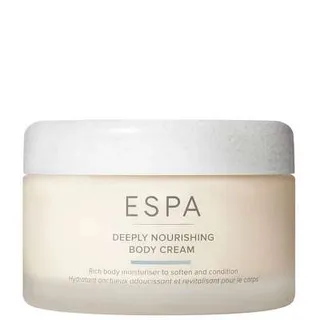
ESPA Body Moisturisers Deeply Nourishing Body Cream

ESPA Body Moisturisers Deeply Nourishing Body Cream

Efficacy75/100IrritancyHigh

Works for

Moisturizing
Olea europaea fruit oil, Glycerin + 23 more
Works
What the product description says
“Body Moisturisers Deeply Nourishing Body Cream”
Source: Allbeauty

This product can help improve hydration of the skin with the two types of ingredients.

The first type is called “humectants”:
these ingredients help attract water. When humectants are on the surface of the skin, they “pull in” the moisture from the outside environment, or from within deeper layers of the skin. The following ingredients in this product do the job: glycerin, sodium hyaluronate.

This product also contains ingredients called “occlusives”. They help reduce the speed with which our skin loses moisture to the outside environment. These ingredients also help soften the upper layer of the skin, so it feels less tight and nicer to the touch. The following ingredients in this product do the job: helianthus annuus seed oil, glycine soja oil.

Olea europaea fruit oilKey active· EmollientEffect: MediumAn emollient that helps soften the skin but is not effective for restoring its barrier function. Might be helpful to calm down inflammation~4.9–6%
GlycerinKey active· HumectantEffect: HighOne of the best moisturizing ingredients. Naturally present in skin. It attracts water to the upper layer of the skin working as a humectant~3.9–4.8%
Cetyl alcoholKey active· EmollientEffect: MediumA non-drying alcohol that works to soften the skin and stabilize product formulations helping oil and water mix together~2.3–2.9%
Oenothera biennis oilKey active· EmollientEffect: HighHelps soften the upper layer of the skin and can support skin barrier function~1.2–1.5%
Hydrogenated vegetable oilKey active· EmollientEffect: MediumAn oil from a mixture of different vegetables. Helps soften the upper layer of the skin~0.75–1.1%
Centella asiatica extractKey activeEffect: HighA plant extract that has been shown to be able to reduce inflammation in skin, support restoration of skin barrier function, as well as support collagen production. Contains active compounds called centelloids: asiaticoside, madecasosside, asiatic acid and madecassic acid. Might be helpful in preventing stretch marks. It can be itself be irritating though.~0.55–0.8%
Glycine soja sterolsKey active· EmollientEffect: HighAn emollient that helps soften the skin~0.5–0.75%
Glycine soja oilKey active· EmollientEffect: HighA good emollient that helps soften the skin and helps repair its barrier function. It can clog pores if used in high concentrations.~0.45–0.65%
Sodium pcaKey active· HumectantEffect: HighNaturally present in skin and helps to attract water to its upper layer~0.4–0.6%
Persea gratissima oilKey active· EmollientEffect: HighAn emollient that helps soften the skin and could be helpful in repairing its barrier function~0.35–0.65%
Helianthus annuus seed oilKey active· Emollient, OcclusiveEffect: HighA great emollient due to its high linoleic acid content. One of the most effective plant oils in helping skin hydration and repairing skin barrier function~0.35–0.6%
Cetearyl alcoholKey active· EmollientEffect: MediumA non-drying alcohol. Works as an emollient. Helps water and oil mix together and creates a nice product texture~0.35–0.65%
HexyldecanolKey active· EmollientEffect: MediumHelps soften the upper layer of the skin~0.35–0.6%
Sodium hyaluronateKey active· HumectantEffect: HighOne of the best moisturizing ingredients. Attracts water into the upper layer of the skin~0.3–0.55%
Sodium lactateKey active· HumectantEffect: HighHelps attract water to the upper layer of the skin. Is often used to adjust the pH level of the product~0.3–0.55%
C12-16 alcohols· EmollientEffect: LowHelps soften the upper layer of the skin and improve the product's texture~3.1–3.8%
Palmitic acid· EmollientEffect: LowAn emollient that is naturally present in skin and helps soften it~1.7–2%
Sorbitol· HumectantEffect: LowHelps attract water to the upper layer of the skin and improves the product texture~0.55–0.8%
Glyceryl stearate· EmollientEffect: LowAn emollient that softens the skin and forms a protective layer on its surface. Helps water and oil mix together~0.4–0.6%
Hexyl laurate· EmollientEffect: LowHelps soften the upper layer of the skin and create a nice product consistency~0.35–0.6%
Scutellaria baicalensis root extract· HumectantEffect: LowA plant extract that might contain a compound baicalin that could be helpful in neutralizing free radicals and reducing inflammation in skin. The baicalin concentration in skincare products is often too low for an effective action. Can be used for its fragrant properties~0.3–0.5%
Butylene glycol· HumectantEffect: LowUsed to create a nice product texture and help delivery of other ingredients. Might be somewhat helpful in attracting water to the upper layer of the skin~0.3–0.55%
Caprylyl glycol· Humectant, EmollientEffect: LowHelps preserve products and creates a nice product texture~0.3–0.6%
TocopherolEffect: Low, below effective dosePure form of vitamin E. Can help moisturise and protect the skin from free radicals. Often used to help stabilise other ingredients or the formula itself~0.35–0.65%
Lactic acidUnder-dosedAn exfoliating and moisturizing alpha-hydroxy acid (AHA). Typically causes less irritation than other AHAs, for example, glycolic acid. At high concentrations (about 15%), lactic acid can help reduce lines and wrinkles. Recent studies show that lactic acid can support the "good" bacteria living on skin's surface (healthy skin microbiome)~0.35–0.6%
Anti-aging
Not advertised by the brand · Centella asiatica extract, Tocopherol + 2 more
May help

This product contains centella asiatica extract. This ingredient might be able to help reduce and prevent fine lines and wrinkles, improve skin elasticity and firmness, but there is not enough evidence that it actually works.

Centella asiatica extractKey activeEffect: MediumA plant extract that has been shown to be able to reduce inflammation in skin, support restoration of skin barrier function, as well as support collagen production. Contains active compounds called centelloids: asiaticoside, madecasosside, asiatic acid and madecassic acid. Might be helpful in preventing stretch marks. It can be itself be irritating though.~0.55–0.8%
TocopherolEffect: Low, below effective dosePure form of vitamin E. Can help moisturise and protect the skin from free radicals. Often used to help stabilise other ingredients or the formula itself~0.35–0.65%
Ascorbyl palmitateEffect: Low, below effective doseBeing a lipid soluble form of vitamin C, it is more stable and can penetrate the skin better than L-Ascorbic acid. It is effective in protecting the skin from free radicals, as well as evening the skin tone, but is less effective in stimulating collagen production compared to L-Ascorbic acid.~0.2–0.4%
Lactic acidUnder-dosedAn exfoliating and moisturizing alpha-hydroxy acid (AHA). Typically causes less irritation than other AHAs, for example, glycolic acid. At high concentrations (about 15%), lactic acid can help reduce lines and wrinkles. Recent studies show that lactic acid can support the "good" bacteria living on skin's surface (healthy skin microbiome)~0.35–0.6%
Anti-oxidation
Not advertised by the brand · Centella asiatica extract, Oenothera biennis oil + 8 more
May help

This product contains antioxidants (centella asiatica extract) that might be able to help neutralize free radicals in skin to lessen the damage it gets from the UV light (sun). There is not enough evidence to confirm their effectiveness in skin though.

Centella asiatica extractKey activeEffect: MediumA plant extract that has been shown to be able to reduce inflammation in skin, support restoration of skin barrier function, as well as support collagen production. Contains active compounds called centelloids: asiaticoside, madecasosside, asiatic acid and madecassic acid. Might be helpful in preventing stretch marks. It can be itself be irritating though.~0.55–0.8%
Oenothera biennis oilEffect: LowHelps soften the upper layer of the skin and can support skin barrier function~1.2–1.5%
Scutellaria baicalensis root extractEffect: LowA plant extract that might contain a compound baicalin that could be helpful in neutralizing free radicals and reducing inflammation in skin. The baicalin concentration in skincare products is often too low for an effective action. Can be used for its fragrant properties~0.3–0.5%
Lonicera japonica flower extractEffect: LowA plant extract that might help neutralize free radicals in skin. Can contain volalite oils and be irritating~0.3–0.55%
Glycyrrhiza glabra root extractEffect: LowA plant extract that can help lighten the skin and calm down inflammation. Might be helpful in neutralizing free radicals~0.3–0.5%
Lonicera caprifolium flower extractEffect: LowA plant extract that might help neutralize free radicals in skin. Can contain volalite oils and be irritating~0.25–0.5%
Daucus carota sativa seed oilEffect: LowA plant oil that might help neutralize free radicals and have an anti-bacterial effect~0.15–0.25%
Daucus carota sativa root extractEffect: LowCarrot extract. Might have anti-oxidant properties and be used to add orange color~0.15–0.3%
Ascorbyl palmitateEffect: Low, below effective doseBeing a lipid soluble form of vitamin C, it is more stable and can penetrate the skin better than L-Ascorbic acid. It is effective in protecting the skin from free radicals, as well as evening the skin tone, but is less effective in stimulating collagen production compared to L-Ascorbic acid.~0.2–0.4%
TocopherolUnder-dosedPure form of vitamin E. Can help moisturise and protect the skin from free radicals. Often used to help stabilise other ingredients or the formula itself~0.35–0.65%

Can it cause trouble?

Irritancy
13 strong irritants: Parfum, Limonene + 11 more — patch-test recommended
High risk
We flagged 38 ingredients with irritancy potential. Severity depends on your sensitivity threshold; the table lists the worst offenders first.
IngredientFunctionIrritationEst. amount
Oleyl alcoholUsed as a fragranceHigh~1–1.2%est.
ParfumAn aromatic blend of unspecified and possibly irritating ingredientsHigh~0.3–0.6%est.
Lonicera caprifolium flower extractA plant extract that might help neutralize free radicals in skin. Can contain volalite oils and be irritatingHigh~0.25–0.5%est.
LimoneneA common frangrance that can easily irritate skin, especially if exposed to air, light or heatHigh~0.3–0.55%est.
Cedrus deodara wood oilUsed as a fragranceHigh~0.3–0.55%est.
LinaloolA fragrance. Can be irritatingHigh~0.3–0.55%est.
Lonicera japonica flower extractA plant extract that might help neutralize free radicals in skin. Can contain volalite oils and be irritatingHigh~0.3–0.55%est.
Benzyl benzoateFragrance with sweet balsamic smell. Help to preserve products and dissolve other ingredients. Could trigger allergic reactions and be irritatingHigh~0.3–0.55%est.
Citrus aurantifolia peel oil—High~0.3–0.55%est.
Citrus grandis fruit extract—High~0.25–0.5%est.
Morus bombycis root extractA plant extract that might contain arbutin, a compound that has skin-lightening properties. Might have some anti-oxidant activity. Is unlikely to be effective though in the concentrations typically used in skincare productsHigh~0.3–0.55%est.
Scutellaria baicalensis root extractA plant extract that might contain a compound baicalin that could be helpful in neutralizing free radicals and reducing inflammation in skin. The baicalin concentration in skincare products is often too low for an effective action. Can be used for its fragrant propertiesHigh~0.3–0.5%est.
Cananga odorata flower oilAn essential oil. Can be irritatingHigh~0.3–0.55%est.
Jasminum grandiflorum flower extractUsed as a fragrance. Can be irritatingHigh~0.3–0.55%est.
Rosa damascena flower extractUsed as a fragrance. Can be irritatingHigh~0.3–0.55%est.
GeraniolA fragrance. Can be irritatingHigh~0.15–0.3%est.
CitronellolA fragrance. Can be irritatingHigh~0.15–0.25%est.
Olea europaea fruit oilAn emollient that helps soften the skin but is not effective for restoring its barrier function. Might be helpful to calm down inflammationMedium~4.9–6%est.
C12-16 alcoholsHelps soften the upper layer of the skin and improve the product's textureMedium~3.1–3.8%est.
Oenothera biennis oilHelps soften the upper layer of the skin and can support skin barrier functionMedium~1.2–1.5%est.
Centella asiatica extractA plant extract that has been shown to be able to reduce inflammation in skin, support restoration of skin barrier function, as well as support collagen production. Contains active compounds called centelloids: asiaticoside, madecasosside, asiatic acid and madecassic acid. Might be helpful in preventing stretch marks. It can be itself be irritating though.Medium~0.55–0.8%est.
Glycine soja oilA good emollient that helps soften the skin and helps repair its barrier function. It can clog pores if used in high concentrations.Medium~0.45–0.65%est.
Lactic acidAn exfoliating and moisturizing alpha-hydroxy acid (AHA). Typically causes less irritation than other AHAs, for example, glycolic acid. At high concentrations (about 15%), lactic acid can help reduce lines and wrinkles. Recent studies show that lactic acid can support the "good" bacteria living on skin's surface (healthy skin microbiome)Medium~0.35–0.6%est.
Hexyl laurateHelps soften the upper layer of the skin and create a nice product consistencyMedium~0.35–0.6%est.
Benzoic acidA preservativeMedium~0.25–0.5%est.
Persea gratissima oilAn emollient that helps soften the skin and could be helpful in repairing its barrier functionMedium~0.35–0.65%est.
Sodium lactateHelps attract water to the upper layer of the skin. Is often used to adjust the pH level of the productMedium~0.3–0.55%est.
Dehydroacetic acidA preservativeMedium~0.3–0.55%est.
Glycyrrhiza glabra root extractA plant extract that can help lighten the skin and calm down inflammation. Might be helpful in neutralizing free radicalsMedium~0.3–0.5%est.
Phytic acidAn alpha-hydroxy acid (AHA), but is mostly used to stabilize product formulations in cosmeticsMedium~0.3–0.6%est.
EthylhexylglycerinA preservativeMedium~0.3–0.55%est.
Caprylyl glycolHelps preserve products and creates a nice product textureMedium~0.3–0.6%est.
Potassium sorbateA preservativeMedium~0.3–0.55%est.
Sodium metabisulfiteA preservativeMedium~0.1–0.2%est.
Sodium sulfiteHelps stabilize and preserve a product formulationMedium~0.1–0.2%est.
Ascorbyl palmitateBeing a lipid soluble form of vitamin C, it is more stable and can penetrate the skin better than L-Ascorbic acid. It is effective in protecting the skin from free radicals, as well as evening the skin tone, but is less effective in stimulating collagen production compared to L-Ascorbic acid.Medium~0.2–0.4%est.
Sorbic acidA preservativeMedium~0.15–0.25%est.
Comedogenic
4 ingredients rated 2 or more on the 0–5 pore-clogging scale
4 flagged
These ingredients have a comedogenic rating of 2 or more on a 0–5 scale; the table shows each one's rating. In leave-on products they can clog pores in acne-prone skin.
IngredientFunctionRatingEst. amount
Oleyl alcoholUsed as a fragrance3/5~1–1.2%est.
Hydrogenated vegetable oilAn oil from a mixture of different vegetables. Helps soften the upper layer of the skin2/5~0.75–1.1%est.
Glycine soja oilA good emollient that helps soften the skin and helps repair its barrier function. It can clog pores if used in high concentrations.2/5~0.45–0.65%est.
Cetearyl alcoholA non-drying alcohol. Works as an emollient. Helps water and oil mix together and creates a nice product texture2/5~0.35–0.65%est.

User reviews

Would you recommend?
No community reviews yet.

Be the first — your take helps the next person decide.

Ingredients

Filter by role to see what each ingredient is doing.

Water~45–55%
Formula
Irritation risk
Low

Plain old water

More about Water
Olea europaea fruit oil~4.9–6%
Key activeIrritant · medium
Irritation risk
Medium
Works for
Moisturizing

An emollient that helps soften the skin but is not effective for restoring its barrier function. Might be helpful to calm down inflammation

More about Olea europaea fruit oil
Glycerin~3.9–4.8%
Key active
Irritation risk
Low
Works for
Moisturizing

One of the best moisturizing ingredients. Naturally present in skin. It attracts water to the upper layer of the skin working as a humectant

More about Glycerin
C12-16 alcohols~3.1–3.8%
Irritant · medium
Irritation risk
Medium
Works for
Moisturizing

Helps soften the upper layer of the skin and improve the product's texture

More about C12-16 alcohols
Cetyl alcohol~2.3–2.9%
Key active
Irritation risk
Low
Works for
CleansingMoisturizing

A non-drying alcohol that works to soften the skin and stabilize product formulations helping oil and water mix together

More about Cetyl alcohol
Sucrose cocoate~1.8–2.2%
Formula
Irritation risk
Low
Works for
Cleansing
More about Sucrose cocoate
Palmitic acid~1.7–2%
Formula
Irritation risk
Low
Works for
CleansingMoisturizing

An emollient that is naturally present in skin and helps soften it

More about Palmitic acid
Hydrogenated lecithin~1.4–1.7%
Formula
Irritation risk
Low
Works for
Cleansing

Helps to retain moisture by creating a protective barrier on the skin. Rich in fatty acids. Improves product texture and helps with the penetration of other ingredients.

More about Hydrogenated lecithin
Oenothera biennis oil~1.2–1.5%
Key activeIrritant · medium
Irritation risk
Medium
Works for
MoisturizingAnti-oxidationAnti-blemishAnti-inflammatory

Helps soften the upper layer of the skin and can support skin barrier function

More about Oenothera biennis oil
Oleyl alcohol~1–1.2%
Comedogenic 3/5Irritant · high
Irritation risk
High
Comedogenicity
3/5

Used as a fragrance

More about Oleyl alcohol
Hydrogenated vegetable oil~0.75–1.1%
Key activeComedogenic 2/5
Irritation risk
Low
Comedogenicity
2/5
Works for
Moisturizing

An oil from a mixture of different vegetables. Helps soften the upper layer of the skin

More about Hydrogenated vegetable oil
Phenoxyethanol~0.6–0.9%
Formula
Irritation risk
Low

A preservative. It helps prevent bacterial growth in cosmetic products

More about Phenoxyethanol
Sorbitol~0.55–0.8%
Formula
Irritation risk
Low
Works for
Moisturizing

Helps attract water to the upper layer of the skin and improves the product texture

More about Sorbitol
Dioscorea villosa root extract~0.5–0.75%
Formula
Glycine soja sterols~0.5–0.75%
Key active
Irritation risk
Low
Works for
Moisturizing

An emollient that helps soften the skin

More about Glycine soja sterols
Centella asiatica extract~0.55–0.8%
Key activeIrritant · medium
Irritation risk
Medium
Works for
Reduces rednessReduces irritationMoisturizingAnti-inflammatoryAnti-agingAnti-oxidationAnti-blemish

A plant extract that has been shown to be able to reduce inflammation in skin, support restoration of skin barrier function, as well as support collagen production. Contains active compounds called centelloids: asiaticoside, madecasosside, asiatic acid and madecassic acid. Might be helpful in preventing stretch marks. It can be itself be irritating though.

More about Centella asiatica extract
Sclerotium gum~0.45–0.65%
Formula
Irritation risk
Low

Used to create gel-like formulas and stabilize emulsions

More about Sclerotium gum
Glycine soja oil~0.45–0.65%
Key activeComedogenic 2/5Irritant · medium
Irritation risk
Medium
Comedogenicity
2/5
Works for
Moisturizing

A good emollient that helps soften the skin and helps repair its barrier function. It can clog pores if used in high concentrations.

More about Glycine soja oil
Tocopherol~0.35–0.65%
Under-dosed
Irritation risk
Low
Works for
Anti-oxidationMoisturizingAnti-inflammatoryAnti-aging

Pure form of vitamin E. Can help moisturise and protect the skin from free radicals. Often used to help stabilise other ingredients or the formula itself

More about Tocopherol
Sodium pca~0.4–0.6%
Key active
Irritation risk
Low
Works for
Moisturizing

Naturally present in skin and helps to attract water to its upper layer

More about Sodium pca
Lactic acid~0.35–0.6%
Under-dosedIrritant · medium
Irritation risk
Medium
Works for
Evens skin toneMoisturizingExfoliationAnti-aging

An exfoliating and moisturizing alpha-hydroxy acid (AHA). Typically causes less irritation than other AHAs, for example, glycolic acid. At high concentrations (about 15%), lactic acid can help reduce lines and wrinkles. Recent studies show that lactic acid can support the "good" bacteria living on skin's surface (healthy skin microbiome)

More about Lactic acid
Parfum~0.3–0.6%
Irritant · high
Irritation risk
High

An aromatic blend of unspecified and possibly irritating ingredients

More about Parfum
Butylene glycol~0.3–0.55%
Formula
Irritation risk
Low
Works for
Moisturizing

Used to create a nice product texture and help delivery of other ingredients. Might be somewhat helpful in attracting water to the upper layer of the skin

More about Butylene glycol
Polysorbate 20~0.35–0.6%
Formula
Irritation risk
Low
Works for
Cleansing

Helps oil and water mix together

More about Polysorbate 20
Helianthus annuus seed oil~0.35–0.6%
Key active
Irritation risk
Low
Works for
Moisturizing

A great emollient due to its high linoleic acid content. One of the most effective plant oils in helping skin hydration and repairing skin barrier function

More about Helianthus annuus seed oil
Hexyl laurate~0.35–0.6%
Irritant · medium
Irritation risk
Medium
Works for
Moisturizing

Helps soften the upper layer of the skin and create a nice product consistency

More about Hexyl laurate
Lonicera caprifolium flower extract~0.25–0.5%
Irritant · high
Irritation risk
High
Works for
Anti-oxidation

A plant extract that might help neutralize free radicals in skin. Can contain volalite oils and be irritating

More about Lonicera caprifolium flower extract
Limonene~0.3–0.55%
Irritant · high
Irritation risk
High

A common frangrance that can easily irritate skin, especially if exposed to air, light or heat

More about Limonene
Cedrus deodara wood oil~0.3–0.55%
Irritant · high
Irritation risk
High

Used as a fragrance

More about Cedrus deodara wood oil
Citrus aurantium amara leaf/twig oil~0.3–0.55%
Irritant · high
Benzoic acid~0.25–0.5%
Irritant · medium
Irritation risk
Medium

A preservative

More about Benzoic acid
Persea gratissima oil~0.35–0.65%
Key activeIrritant · medium
Irritation risk
Medium
Works for
Moisturizing

An emollient that helps soften the skin and could be helpful in repairing its barrier function

More about Persea gratissima oil
Linalool~0.3–0.55%
Irritant · high
Irritation risk
High

A fragrance. Can be irritating

More about Linalool
Hexyldecanol~0.35–0.6%
Key active
Irritation risk
Low
Works for
Moisturizing

Helps soften the upper layer of the skin

More about Hexyldecanol
Lonicera japonica flower extract~0.3–0.55%
Irritant · high
Irritation risk
High
Works for
Anti-oxidation

A plant extract that might help neutralize free radicals in skin. Can contain volalite oils and be irritating

More about Lonicera japonica flower extract
Sodium lactate~0.3–0.55%
Key activeIrritant · medium
Irritation risk
Medium
Works for
Moisturizing

Helps attract water to the upper layer of the skin. Is often used to adjust the pH level of the product

More about Sodium lactate
Benzyl benzoate~0.3–0.55%
Irritant · high
Irritation risk
High

Fragrance with sweet balsamic smell. Help to preserve products and dissolve other ingredients. Could trigger allergic reactions and be irritating

More about Benzyl benzoate
Citrus aurantifolia peel oil~0.3–0.55%
Irritant · high
Dehydroacetic acid~0.3–0.55%
Irritant · medium
Irritation risk
Medium

A preservative

More about Dehydroacetic acid
Glyceryl stearate~0.4–0.6%
Formula
Irritation risk
Low
Works for
CleansingMoisturizing

An emollient that softens the skin and forms a protective layer on its surface. Helps water and oil mix together

More about Glyceryl stearate
Cetearyl alcohol~0.35–0.65%
Key activeComedogenic 2/5
Irritation risk
Low
Comedogenicity
2/5
Works for
CleansingMoisturizing

A non-drying alcohol. Works as an emollient. Helps water and oil mix together and creates a nice product texture

More about Cetearyl alcohol
Arctostaphylos uva-ursi leaf extract~0.3–0.55%
Formula
Citrus grandis fruit extract~0.25–0.5%
Irritant · high
Glycyrrhiza glabra root extract~0.3–0.5%
Irritant · medium
Irritation risk
Medium
Works for
Anti-inflammatoryReduces rednessEvens skin toneAnti-oxidationAntibacterial

A plant extract that can help lighten the skin and calm down inflammation. Might be helpful in neutralizing free radicals

More about Glycyrrhiza glabra root extract
Morus bombycis root extract~0.3–0.55%
Irritant · high
Irritation risk
High
Works for
Evens skin tone

A plant extract that might contain arbutin, a compound that has skin-lightening properties. Might have some anti-oxidant activity. Is unlikely to be effective though in the concentrations typically used in skincare products

More about Morus bombycis root extract
Scutellaria baicalensis root extract~0.3–0.5%
Irritant · high
Irritation risk
High
Works for
Anti-inflammatoryAnti-oxidationMoisturizingReduces irritationAntibacterial

A plant extract that might contain a compound baicalin that could be helpful in neutralizing free radicals and reducing inflammation in skin. The baicalin concentration in skincare products is often too low for an effective action. Can be used for its fragrant properties

More about Scutellaria baicalensis root extract
Phytic acid~0.3–0.6%
Irritant · medium
Irritation risk
Medium

An alpha-hydroxy acid (AHA), but is mostly used to stabilize product formulations in cosmetics

More about Phytic acid
Sodium hyaluronate~0.3–0.55%
Key active
Irritation risk
Low
Works for
Moisturizing

One of the best moisturizing ingredients. Attracts water into the upper layer of the skin

More about Sodium hyaluronate
Cananga odorata flower oil~0.3–0.55%
Irritant · high
Irritation risk
High

An essential oil. Can be irritating

More about Cananga odorata flower oil
Jasminum grandiflorum flower extract~0.3–0.55%
Irritant · high
Irritation risk
High

Used as a fragrance. Can be irritating

More about Jasminum grandiflorum flower extract
Michelia champaca flower extract~0.3–0.55%
Formula
Rosa damascena flower extract~0.3–0.55%
Irritant · high
Irritation risk
High

Used as a fragrance. Can be irritating

More about Rosa damascena flower extract
Styrax benzoin gum~0.35–0.6%
Formula
Ethylhexylglycerin~0.3–0.55%
Irritant · medium
Irritation risk
Medium

A preservative

More about Ethylhexylglycerin
Pelvetia canaliculata extract~0.3–0.6%
Formula
Caprylyl glycol~0.3–0.6%
Irritant · medium
Irritation risk
Medium
Works for
Moisturizing

Helps preserve products and creates a nice product texture

More about Caprylyl glycol
Caramel~0.3–0.55%
Formula
Irritation risk
Low
More about Caramel
Potassium sorbate~0.3–0.55%
Irritant · medium
Irritation risk
Medium

A preservative

More about Potassium sorbate
Sodium benzoate~0.25–0.5%
Formula
Irritation risk
Low

A preservative

More about Sodium benzoate
Sodium metabisulfite~0.1–0.2%
Irritant · medium
Irritation risk
Medium

A preservative

More about Sodium metabisulfite
Sodium sulfite~0.1–0.2%
Irritant · medium
Irritation risk
Medium

Helps stabilize and preserve a product formulation

More about Sodium sulfite
Ascorbyl palmitate~0.2–0.4%
Irritant · medium
Irritation risk
Medium
Works for
Anti-oxidationAnti-aging

Being a lipid soluble form of vitamin C, it is more stable and can penetrate the skin better than L-Ascorbic acid. It is effective in protecting the skin from free radicals, as well as evening the skin tone, but is less effective in stimulating collagen production compared to L-Ascorbic acid.

More about Ascorbyl palmitate
Hydrogenated palm glycerides citrate~0.25–0.5%
Formula
Irritation risk
Low

Helps soften the upper layer of the skin

More about Hydrogenated palm glycerides citrate
Geraniol~0.15–0.3%
Irritant · high
Irritation risk
High

A fragrance. Can be irritating

More about Geraniol
Citronellol~0.15–0.25%
Irritant · high
Irritation risk
High

A fragrance. Can be irritating

More about Citronellol
Sorbic acid~0.15–0.25%
Irritant · medium
Irritation risk
Medium

A preservative

More about Sorbic acid
Beta-carotene~0.15–0.3%
Formula
Irritation risk
Low

A colorant adding orange or bright yellow color

More about Beta-carotene
Daucus carota sativa root extract~0.15–0.3%
Formula
Irritation risk
Low
Works for
Anti-oxidation

Carrot extract. Might have anti-oxidant properties and be used to add orange color

More about Daucus carota sativa root extract
Daucus carota sativa seed oil~0.15–0.25%
Formula
Irritation risk
Low
Works for
Anti-oxidationAntibacterial

A plant oil that might help neutralize free radicals and have an anti-bacterial effect

More about Daucus carota sativa seed oil
Sodium hydroxide~0.1–0.2%
Formula
Irritation risk
Low

Used to adjust the product's pH

More about Sodium hydroxide
Ingredient list view

Water, Olea europaea fruit oil, Glycerin, C12-16 alcohols, Cetyl alcohol, Sucrose cocoate, Palmitic acid, Hydrogenated lecithin, Oenothera biennis oil, Oleyl alcohol, Hydrogenated vegetable oil, Phenoxyethanol, Sorbitol, Dioscorea villosa root extract, Glycine soja sterols, Centella asiatica extract, Sclerotium gum, Glycine soja oil, Tocopherol, Sodium pca, Lactic acid, Parfum, Butylene glycol, Polysorbate 20, Helianthus annuus seed oil, Hexyl laurate, Lonicera caprifolium flower extract, Limonene, Cedrus deodara wood oil, Citrus aurantium amara leaf/twig oil, Benzoic acid, Persea gratissima oil, Linalool, Hexyldecanol, Lonicera japonica flower extract, Sodium lactate, Benzyl benzoate, Citrus aurantifolia peel oil, Dehydroacetic acid, Glyceryl stearate, Cetearyl alcohol, Arctostaphylos uva-ursi leaf extract, Citrus grandis fruit extract, Glycyrrhiza glabra root extract, Morus bombycis root extract, Scutellaria baicalensis root extract, Phytic acid, Sodium hyaluronate, Cananga odorata flower oil, Jasminum grandiflorum flower extract, Michelia champaca flower extract, Rosa damascena flower extract, Styrax benzoin gum, Ethylhexylglycerin, Pelvetia canaliculata extract, Caprylyl glycol, Caramel, Potassium sorbate, Sodium benzoate, Sodium metabisulfite, Sodium sulfite, Ascorbyl palmitate, Hydrogenated palm glycerides citrate, Geraniol, Citronellol, Sorbic acid, Beta-carotene, Daucus carota sativa root extract, Daucus carota sativa seed oil, Sodium hydroxide

Compare prices

Retailers ranked by price — lowest first.

🇬🇧 Amazon UK (UK)
Price unavailable Out of stock
Check

Affiliate links · As an Amazon Associate, WIMJ earns from qualifying purchases.

Worth comparing, line by line.

Match % combines shared ingredients, the first five ingredients, shared actives and hero ingredients, irritancy (lower counts in the alternative's favour), texture and body area. Only products in the same routine step are compared.

Side-by-side comparison of this product against its closest alternatives
ESPABody Moisturisers Deeply Nourishing Body CreamYOUR PRODUCTQVDermcare Eczema Daily Cream With CeramidesPRIORI SkincarePRIORI LCA - Hand and Body ReplenisherADVANCED CLINICALSDark Spot Face Cream
Match—54%49%45%
Price——$44.45$9.99
Shared key ingredients—3 of 124 of 124 of 12
Key difference—NiacinamideRetinyl PalmitateTetrahexyldecyl Ascorbate
Irritancy High Low Medium Medium
Drying alcohol————
View product Shop Shop Shop

More alternatives: POND'S Anti-Wrinkle CreamMaria Åkerberg Face Cream Sensitive

Cheaper alternatives? Browse formulas in the same category.
We compare ingredient profiles across our catalog — pick the closest match for your budget.
Open dupe finder

Sources cited in this review

Every concentration estimate and effectiveness label is anchored to one of these 32 studies and safety reviews.

  1. 1
  2. 2
  3. 3
  4. 4
  5. 5
  6. 6
ESPA Body Moisturisers Deeply Nourishing Body Cream
ESPABody Moisturisers Deeply Nourishing Body Cream

Affiliate links · As an Amazon Associate, WIMJ earns from qualifying purchases.

As an Amazon Associate, WIMJ earns from qualifying purchases.