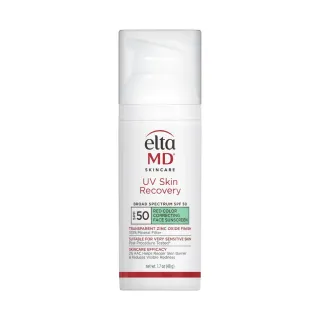
EltaMD UV Skin Recovery Red Color Correcting Green Tint Broad Spectrum SPF 50
Works for
Sun protectionSPF 50 · 2 UV filtersBroad spectrum
This product offers a good level of protection against both UVB and UVA rays.
This sunscreen uses organic (so-called "chemical") sunscreen filters. Organic, or "chemical" filters usually provide reliable sun protection and rarely leave a white cast. Sunscreens with organic filters can sting eyes.
This product can be considered "reef safe" because it does not contain the UV filters (oxybenzone and octinoxate) that can be harmful to coral reefs when present in the water in high concentrations.
MoisturizingSalicyloyl phytosphingosine, Ceramide np + 16 moreWorks well
“Introducing EltaMD UV Skin Recovery, a 100% mineral sunscreen powered by patented 2% AA Complex Barrier Repair Technology to protect, recover, and strengthen even the most sensitive skin – like skin prone to rosacea.”
This product can help improve hydration of the skin with the two types of ingredients.
The first type is called “humectants”:
these ingredients help attract water.
When humectants are on the surface of the skin, they “pull in” the moisture from the outside environment, or from
within deeper layers of the skin. The following ingredients in this product do the job:
arginine, glycerin.
This product also contains ingredients called “occlusives”. They help reduce the speed with which our skin loses moisture to the outside environment. These ingredients also help soften the upper layer of the skin, so it feels less tight and nicer to the touch. The following ingredients in this product do the job: arginine, caprylic/capric triglyceride.
The following ingredients in this product are especially good for supporting the skin barrier and helping with the hydration level: ceramide ap, ceramide eop, ceramide np, ceramide ns, salicyloyl phytosphingosine
Anti-agingSide benefit · Centella asiatica leaf extract, Salicyloyl phytosphingosine + 2 moreWorks well
This product can help prevent early signs of skin aging because it offers a good level of broad spectrum sun protection. Sun damage is the main cause of premature skin aging, and protecting your skin from the sun is the best anti-aging strategy.
These ingredients in the product might also be helpful for reducing and preventing fine lines, wrinkles, and skin elasticity, even though there is no conclusive evidence for their effectiveness: centella asiatica leaf extract.
Evens skin toneSide benefit · Taurine, Lactic acidWorks well
This product offers broad spectrum sun protection. It means that it can prevent hyperpigmentation and help keep the skin tone even (sun damage is the main factor causing age spots, darkening of post-acne marks and other discolorations).
Can it cause trouble?
Irritancy20 flagged ingredientsLow risk
Comedogenic2 ingredients rated 2 or more on the 0–5 pore-clogging scale2 flagged
User reviews
Be the first — your take helps the next person decide.
Ingredients
Filter by role to see what each ingredient is doing.
Zinc oxide12.9%
- Irritation risk
- Low
A broad spectrum sunblock (protects from both UVA and UVB rays). Is suitable for most sensitive skins. In small concentrations, can be used as a colorant
More about Zinc oxideWater~45–55%
Dimethicone~6.5–7.9%
- Irritation risk
- Low
A silicone that helps to reduce water loss from the surface of the skin. Can temporarily "fill in" lines and wrinkles, absorb oil, and create a nice product finish
More about DimethiconeButyloctyl salicylate~5.2–6.4%
- Irritation risk
- Medium
A synthetic ester of salicylic acid that is used to help disperse pigments and boost effectiveness of sunscreen ingredients. It is able to absorb UV light (working as an organic, or chemical filter), but is not approved as a sunscreen ingredient on its own
More about Butyloctyl salicylateCaprylic/capric triglyceride~3.3–4%
- Irritation risk
- Medium
A good mix of fatty acids that forms a protective layer on the skin. Improves the shelf life of products. Derived from coconut and glycerin
More about Caprylic/capric triglycerideEthylhexyl methoxycrylene~2.3–2.8%
- Irritation risk
- Medium
Helps improve stability of sunscreen filters and boost their effectiveness
More about Ethylhexyl methoxycryleneOctyldodecyl neopentanoate~2–2.4%
- Irritation risk
- Low
An emollient that helps soften the skin. Often used to stabilize other ingredients, for example, sunscreen
More about Octyldodecyl neopentanoateTaurine~1.6–2%
- Irritation risk
- Medium
Could be helpful in reducing inflammation in skin, evening out the skin tone and neutralizing free radicals, but more research is needed to confirm its effectiveness
More about TaurineHydroxyethyl acrylate/sodium acryloyldimethyl taurate copolymer~1.5–1.8%
- Irritation risk
- Medium
A gelling agent that thickens the product consistency and leaves the skin with a velvety finish
More about Hydroxyethyl acrylate/sodium acryloyldimethyl taurate copolymerButylene glycol~1.3–1.6%
- Irritation risk
- Low
Used to create a nice product texture and help delivery of other ingredients. Might be somewhat helpful in attracting water to the upper layer of the skin
More about Butylene glycolPhenoxyethanol~0.5–1%
- Irritation risk
- Low
A preservative. It helps prevent bacterial growth in cosmetic products
More about PhenoxyethanolCetearyl alcohol~0.95–1.2%
- Irritation risk
- Low
- Comedogenicity
- 2/5
A non-drying alcohol. Works as an emollient. Helps water and oil mix together and creates a nice product texture
More about Cetearyl alcoholArginine~0.6–0.95%
- Irritation risk
- Low
An amino acid that is naturally present in skin and helps keep it hydrated. When used together with AHAs, it can reduce their irritating effect on the skin
More about ArginineTriethoxycaprylylsilane~0.6–0.9%
- Irritation risk
- Low
A type of silicone that helps oil and water mix well together. Helps to disperse other ingredients, e.g. pigments, evenly in a formulation
More about TriethoxycaprylylsilaneOleth-3 phosphate~0.55–0.85%
- Irritation risk
- Medium
- Comedogenicity
- 3/5
Helps water and oil mix together
More about Oleth-3 phosphateOleth-20~0.6–0.9%
Coco-glucoside~0.6–0.85%
- Irritation risk
- High
Used as a cleansing agent (surfactant) in cleansers. Helps water and oil mix together in lotions. Can be irritating
More about Coco-glucosidePolyisobutene~0.55–0.8%
Polyhydroxystearic acid~0.5–0.75%
- Irritation risk
- Medium
Used to create a thicker product consistency and stabilize the formulation
More about Polyhydroxystearic acidPeg-7 trimethylolpropane coconut ether~0.45–0.7%
Salicyloyl phytosphingosine~0.35–0.65%
- Irritation risk
- Low
Helps attract water to the upper layer of the skin. Might have anti-aging benefits but solid study data is lacking
More about Salicyloyl phytosphingosineTocopheryl acetate~0.35–0.65%
- Irritation risk
- Medium
A more stable but less bio-available form of vitamin E compared to Tocopherol. Might help moisturize and protect the skin from free radicals, but mostly used in low concentrations to stabilize other ingredients.
More about Tocopheryl acetateGlycerin~0.4–0.6%
- Irritation risk
- Low
One of the best moisturizing ingredients. Naturally present in skin. It attracts water to the upper layer of the skin working as a humectant
More about GlycerinTocopherol~0.3–0.55%
- Irritation risk
- Low
Pure form of vitamin E. Can help moisturise and protect the skin from free radicals. Often used to help stabilise other ingredients or the formula itself
More about TocopherolEthylhexylglycerin~0.3–0.5%
Pongamia pinnata seed extract~0.25–0.5%
- Irritation risk
- Low
Glycine~0.25–0.5%
- Irritation risk
- Low
Helps to attract water to the upper layer of the skin and can help restore the skin barrier function
More about GlycineLactic acid~0.25–0.5%
- Irritation risk
- Medium
An exfoliating and moisturizing alpha-hydroxy acid (AHA). Typically causes less irritation than other AHAs, for example, glycolic acid. At high concentrations (about 15%), lactic acid can help reduce lines and wrinkles. Recent studies show that lactic acid can support the "good" bacteria living on skin's surface (healthy skin microbiome)
More about Lactic acidPolyglyceryl-10 stearate~0.25–0.5%
- Irritation risk
- Medium
Helps water and oil mix together and softens the upper layer of the skin
More about Polyglyceryl-10 stearateCentella asiatica leaf extract~0.25–0.45%
- Irritation risk
- Medium
A plant extract that has been shown to be able to reduce inflammation in skin, support restoration of skin barrier function, as well as support collagen production. It can be irritating to sensitive skin. Might be helpful in preventing stretch marks. It could, however, itself be irritating.
More about Centella asiatica leaf extractTriethyl citrate~0.2–0.4%
Polyglyceryl-6 behenate~0.25–0.45%
Behenic acid~0.3–0.6%
Ceramide np~0.25–0.5%
- Irritation risk
- Low
A type of lipid similar to ceramides naturally present in skin. Helps to soften the upper layer of the skin and supports the skin barrier function to keep it hydrated. Can help to prevent inflammation in skin
More about Ceramide npCholesterol~0.25–0.5%
- Irritation risk
- Low
An emollient that is naturally found in skin
More about CholesterolGlyceryl stearate~0.25–0.45%
- Irritation risk
- Low
An emollient that softens the skin and forms a protective layer on its surface. Helps water and oil mix together
More about Glyceryl stearateCeramide ns~0.2–0.4%
- Irritation risk
- Low
A type of lipid similar to ceramides naturally present in skin. Helps to soften the upper layer of the skin and supports the skin barrier function to keep it hydrated. Can help to prevent inflammation in skin
More about Ceramide nsCeramide eop~0.2–0.35%
- Irritation risk
- Low
A type of lipid similar to ceramides naturally present in skin. Helps to soften the upper layer of the skin and supports the skin barrier function to keep it hydrated. Can help to prevent inflammation in skin
More about Ceramide eopCeramide ap~0.15–0.3%
- Irritation risk
- Low
A type of lipid similar to ceramides naturally present in skin. Helps to soften the upper layer of the skin and supports the skin barrier function to keep it hydrated. Can help to prevent inflammation in skin
More about Ceramide apSodium cetearyl sulfate~0.2–0.4%
- Irritation risk
- Medium
Helps water and oil mix together and works as a cleansing agent
More about Sodium cetearyl sulfateCi 19140~0.1–0.15%
Ci 42090~0.1–0.15%
Ingredient list view
Zinc oxide, Water, Dimethicone, Butyloctyl salicylate, Caprylic/capric triglyceride, Ethylhexyl methoxycrylene, Octyldodecyl neopentanoate, Taurine, Hydroxyethyl acrylate/sodium acryloyldimethyl taurate copolymer, Butylene glycol, Phenoxyethanol, Cetearyl alcohol, Arginine, Triethoxycaprylylsilane, Oleth-3 phosphate, Oleth-20, Coco-glucoside, Polyisobutene, Polyhydroxystearic acid, Peg-7 trimethylolpropane coconut ether, Salicyloyl phytosphingosine, Tocopheryl acetate, Glycerin, Tocopherol, Ethylhexylglycerin, Pongamia pinnata seed extract, Glycine, Lactic acid, Polyglyceryl-10 stearate, Centella asiatica leaf extract, Triethyl citrate, Polyglyceryl-6 behenate, Behenic acid, Ceramide np, Cholesterol, Glyceryl stearate, Ceramide ns, Ceramide eop, Ceramide ap, Sodium cetearyl sulfate, Ci 19140, Ci 42090
Compare prices
Retailers ranked by price — lowest first.


Worth comparing, line by line.
Match % combines shared ingredients, the first five ingredients, shared actives and hero ingredients, irritancy (lower counts in the alternative's favour), texture and body area. Only products in the same routine step are compared.
| EltaMDUV Skin Recovery Red Color Correcting Green Tint Broad Spectrum SPF 50YOUR PRODUCT | Beekman 1802Solar Milk Mineral SPF 40 PA +++ | ObagiMINERAL UV BARRIER PROTECT BROAD SPECTRUM SPF 40 | CeraVeHydrating Mineral Face Sunscreen Lotion SPF 30 with Zinc Oxide | |
|---|---|---|---|---|
| Match | — | 53% | 46% | 45% |
| Price | $26.50 | $40.00+$13.50 | $65.00+$38.50 | $13.99−$12.51 |
| Shared key ingredients | — | 9 of 17 | 8 of 17 | 7 of 17 |
| Key difference | — | Ceramide As | Phytosphingosine | Niacinamide |
| Irritancy | Low | Low | Low | Low |
| SPF | SPF 50 | SPF 40 | SPF 40 | SPF 30 |
| Drying alcohol | — | — | — | — |
| View product | Shop | Shop | Shop |

More alternatives: Cetaphil Sheer Mineral* Sunscreen Lotion SPF 50Peter Thomas Roth Max Matte Shine Control Sunscreen Broad Spectrum SPF 45
Sources cited in this review
Every concentration estimate and effectiveness label is anchored to one of these 32 studies and safety reviews.
- 1A review of inorganic UV filters zinc oxide and titanium dioxideonlinelibrary.wiley.com
- 2
- 3
- 4
- 5
- 6

Affiliate links · As an Amazon Associate, WIMJ earns from qualifying purchases.