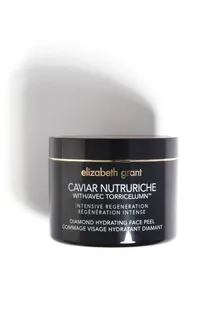
Elizabeth Grant Caviar Nutruriche Diamond Hydrating Face Peel

Elizabeth Grant Caviar Nutruriche Diamond Hydrating Face Peel

Efficacy75/100IrritancyHigh

Works for

Moisturizing
Panthenol, Glycerin + 15 more
Works well
What the product description says
“Caviar Nutruriche Diamond Hydrating Face Peel”
Source: Elizabeth Grant

This product can help improve hydration of the skin with the two types of ingredients.

The first type is called “humectants”:
these ingredients help attract water. When humectants are on the surface of the skin, they “pull in” the moisture from the outside environment, or from within deeper layers of the skin. The following ingredients in this product do the job: algae extract, glycerin.

This product also contains ingredients called “occlusives”. They help reduce the speed with which our skin loses moisture to the outside environment. These ingredients also help soften the upper layer of the skin, so it feels less tight and nicer to the touch. The following ingredients in this product do the job: caprylic/capric triglyceride, cocos nucifera oil.

The following ingredients in this product are especially good for supporting the skin barrier and helping with the hydration level: panthenol

PanthenolHero· HumectantEffect: HighHelps attract water to the upper layer of the skin and can help improve skin barrier function~0.3–0.55%
GlycerinKey active· HumectantEffect: HighOne of the best moisturizing ingredients. Naturally present in skin. It attracts water to the upper layer of the skin working as a humectant~3–3.6%
Caprylic/capric triglycerideKey active· Emollient, OcclusiveEffect: HighA good mix of fatty acids that forms a protective layer on the skin. Improves the shelf life of products. Derived from coconut and glycerin~2–2.4%
Cetearyl alcoholKey active· EmollientEffect: MediumA non-drying alcohol. Works as an emollient. Helps water and oil mix together and creates a nice product texture~1.3–1.6%
Algae extractKey active· Humectant, EmollientEffect: HighPlant extract that helps the skin to attract water and make it more smooth for touch. Also shows promise of anti-aging properties, but research is not extensive yet~0.55–0.8%
Sodium hyaluronateKey active· HumectantEffect: HighOne of the best moisturizing ingredients. Attracts water into the upper layer of the skin~0.5–0.8%
Cocos nucifera oilKey active· Emollient, OcclusiveEffect: HighAn emollient. Found to be as effective as a moisturizer for dry skin as mineral oil. Could be comedogenic~0.45–0.7%
Palmitic acid· EmollientEffect: LowAn emollient that is naturally present in skin and helps soften it~3.7–4.6%
Stearic acid· EmollientEffect: LowHelps oil and water mix together and works as an emollient~2.4–2.9%
Glyceryl stearate· EmollientEffect: LowAn emollient that softens the skin and forms a protective layer on its surface. Helps water and oil mix together~1–1.2%
Caprylyl glycol· Humectant, EmollientEffect: LowHelps preserve products and creates a nice product texture~0.3–0.6%
Butylene glycol· HumectantEffect: LowUsed to create a nice product texture and help delivery of other ingredients. Might be somewhat helpful in attracting water to the upper layer of the skin~0.3–0.55%
Propylene glycol· HumectantEffect: LowHelps oil and water mix together and can enhance the penetration of other ingredients into the skin. It can be irritating~0.3–0.5%
AlginEffect: LowUsed to thicken product formulation. Can help attract water to the upper layer of the skin~0.25–0.5%
Cucumis sativus fruit extractEffect: Low, below effective doseMight be somewhat helpful in reducing hyperpigmentation and neutralizing free radicals but its typical concentration in a product is too low for having an effect~0.4–0.6%
Aloe barbadensis leaf juiceEffect: Low, below effective doseTraditionally used to treat sunburns, dermatitis and inflammation, but evidence for its effectiveness is lacking. The extract can contain humectants that help attract water into the skin~0.3–0.55%
AllantoinUnder-dosedHelps calm down inflammation in skin and can help reduce itching. Helps to repair the skin barrier and keep skin hydrated~0.25–0.5%
Anti-aging
Retinyl palmitate, Algae extract + 1 more
May help
What the product description says
“What it does: Peel away the look of aging and years of skin neglect.”
Source: Elizabeth Grant

This product contains retinyl palmitate. There is some human evidence that this ingredient helps reduce and prevent fine lines and wrinkles and improve skin elasticity and firmness, though it is smaller or less consistent than the evidence for the best anti-aging ingredients.

Retinyl palmitateKey activeEffect: MediumThree steps removed from the active form of vitamin A - retinoic acid. To have an effect in the skin, it first needs to be converted twice to become the retinoic acid. This means it is less potent than retinol, but could also be less irritating. Once converted to the retinoic acid in the skin, it helps against all signs of aging, improves skin cell turnover and helps fight blemishes and clogged pores. However, in many cosmetic formulations, it is used in a concentration that is too low to have the full effect~0.55–0.8%
Algae extractEffect: LowPlant extract that helps the skin to attract water and make it more smooth for touch. Also shows promise of anti-aging properties, but research is not extensive yet~0.55–0.8%
Aloe barbadensis leaf juiceEffect: Low, below effective doseTraditionally used to treat sunburns, dermatitis and inflammation, but evidence for its effectiveness is lacking. The extract can contain humectants that help attract water into the skin~0.3–0.55%
Evens skin tone
Retinyl palmitate, N-hydroxysuccinimide
May help
What the product description says
“Helps reduce the look of large pores and skin discolouration.”
Source: Elizabeth Grant

The following ingredient (ingredients) in this product might be helpful, but there is no evidence to confirm that it actually works: retinyl palmitate.

Retinyl palmitateKey activeEffect: MediumThree steps removed from the active form of vitamin A - retinoic acid. To have an effect in the skin, it first needs to be converted twice to become the retinoic acid. This means it is less potent than retinol, but could also be less irritating. Once converted to the retinoic acid in the skin, it helps against all signs of aging, improves skin cell turnover and helps fight blemishes and clogged pores. However, in many cosmetic formulations, it is used in a concentration that is too low to have the full effect~0.55–0.8%
N-hydroxysuccinimideEffect: LowIs claimed to be able to brighten skin tone by removing some blood-related pigmented compounds in skin (hemoglobin and related elements) but solid research is missing. Can be irritating~0.3–0.55%
Exfoliation
Papain, Retinyl palmitate + 1 more
Not delivered
What the product description says
“Caviar Nutruriche Diamond Hydrating Face Peel”
Source: Elizabeth Grant

This product might help exfoliate the skin with papain, retinyl palmitate, but these ingredients are not the most effective.

PapainEffect: LowAn enzyme extracted from papaya fruit. Can have an exfoliating effect on the skin. Can be irritating~0.6–0.9%
Retinyl palmitateEffect: LowThree steps removed from the active form of vitamin A - retinoic acid. To have an effect in the skin, it first needs to be converted twice to become the retinoic acid. This means it is less potent than retinol, but could also be less irritating. Once converted to the retinoic acid in the skin, it helps against all signs of aging, improves skin cell turnover and helps fight blemishes and clogged pores. However, in many cosmetic formulations, it is used in a concentration that is too low to have the full effect~0.55–0.8%
AllantoinEffect: Low, below effective doseHelps calm down inflammation in skin and can help reduce itching. Helps to repair the skin barrier and keep skin hydrated~0.25–0.5%
Anti-oxidation
Side benefit · Camellia oleifera leaf extract, Cucumis sativus fruit extract + 1 more
Works well

This product contains antioxidants (camellia oleifera leaf extract) that can help neutralize free radicals in skin. By doing so, they can lessen the damage the skin gets from the UV light (sun).

Camellia oleifera leaf extractKey activeEffect: HighA plant extract that can help neutralize free radicals and reduce inflammation, even though it is not usually used in sufficient concentration in cosmetics~0.35–0.6%
Cucumis sativus fruit extractEffect: Low, below effective doseMight be somewhat helpful in reducing hyperpigmentation and neutralizing free radicals but its typical concentration in a product is too low for having an effect~0.4–0.6%
Tocopheryl acetateEffect: Low, below effective doseA more stable but less bio-available form of vitamin E compared to Tocopherol. Might help moisturize and protect the skin from free radicals, but mostly used in low concentrations to stabilize other ingredients.~0.3–0.55%

Can it cause trouble?

Irritancy
3 strong irritants: Retinyl palmitate, Salvia officinalis leaf extract + 1 more — patch-test recommended
High risk
We flagged 24 ingredients with irritancy potential. Severity depends on your sensitivity threshold; the table lists the worst offenders first.
IngredientFunctionIrritationEst. amount
PapainAn enzyme extracted from papaya fruit. Can have an exfoliating effect on the skin. Can be irritatingHigh~0.6–0.9%est.
Retinyl palmitateThree steps removed from the active form of vitamin A - retinoic acid. To have an effect in the skin, it first needs to be converted twice to become the retinoic acid. This means it is less potent than retinol, but could also be less irritating. Once converted to the retinoic acid in the skin, it helps against all signs of aging, improves skin cell turnover and helps fight blemishes and clogged pores. However, in many cosmetic formulations, it is used in a concentration that is too low to have the full effectHigh~0.55–0.8%est.
Chamomilla recutita flower extractPlant extract that can have healing and anti-inflammatory properties. It is a potential allergen and can be irritatingHigh~0.45–0.7%est.
Salvia officinalis leaf extractSage leaf extract. It can be irritatingHigh~0.5–0.75%est.
N-hydroxysuccinimideIs claimed to be able to brighten skin tone by removing some blood-related pigmented compounds in skin (hemoglobin and related elements) but solid research is missing. Can be irritatingHigh~0.3–0.55%est.
Propylene glycolHelps oil and water mix together and can enhance the penetration of other ingredients into the skin. It can be irritatingHigh~0.3–0.5%est.
ParfumAn aromatic blend of unspecified and possibly irritating ingredientsHigh~0.1–0.2%est.
Ci 16035A red dyeHigh~0.15–0.25%est.
Ci 19140A yellow dyeHigh~0.05–0.15%est.
Caprylic/capric triglycerideA good mix of fatty acids that forms a protective layer on the skin. Improves the shelf life of products. Derived from coconut and glycerinMedium~2–2.4%est.
Cucumis sativus fruit extractMight be somewhat helpful in reducing hyperpigmentation and neutralizing free radicals but its typical concentration in a product is too low for having an effectMedium~0.4–0.6%est.
Aloe barbadensis leaf juiceTraditionally used to treat sunburns, dermatitis and inflammation, but evidence for its effectiveness is lacking. The extract can contain humectants that help attract water into the skinMedium~0.3–0.55%est.
Ceteareth-20Helps oil and water mix together. Has some emollient propertiesMedium~0.45–0.65%est.
Caprylyl glycolHelps preserve products and creates a nice product textureMedium~0.3–0.6%est.
Disodium edtaStabilizes the product formulationMedium~0.3–0.55%est.
EthylhexylglycerinA preservativeMedium~0.3–0.55%est.
Myristic acidHelps oil and water mix together. Could be comedogenicMedium~0.35–0.6%est.
Tocopheryl acetateA more stable but less bio-available form of vitamin E compared to Tocopherol. Might help moisturize and protect the skin from free radicals, but mostly used in low concentrations to stabilize other ingredients.Medium~0.3–0.55%est.
1,2-hexanediolA preservativeMedium~0.25–0.5%est.
Citric acidCan work as an exfoliant but is typically used to adjust the product pHMedium~0.25–0.45%est.
Calcium sodium borosilicateUsed to add shimmerMedium~0.25–0.45%est.
TriethanolamineUsed to adjust pH of the product and can help improve the product's smellMedium~0.25–0.4%est.
Potassium sorbateA preservativeMedium~0.15–0.3%est.
Ci 42090A colorant (dye)Medium~0.05–0.15%est.
Comedogenic
7 ingredients rated 2 or more on the 0–5 pore-clogging scale
7 flagged
These ingredients have a comedogenic rating of 2 or more on a 0–5 scale; the table shows each one's rating. In leave-on products they can clog pores in acne-prone skin.
IngredientFunctionRatingEst. amount
Cocos nucifera oilAn emollient. Found to be as effective as a moisturizer for dry skin as mineral oil. Could be comedogenic3/5~0.45–0.7%est.
Algae extractPlant extract that helps the skin to attract water and make it more smooth for touch. Also shows promise of anti-aging properties, but research is not extensive yet3/5~0.55–0.8%est.
Myristic acidHelps oil and water mix together. Could be comedogenic3/5~0.35–0.6%est.
AlginUsed to thicken product formulation. Can help attract water to the upper layer of the skin3/5~0.25–0.5%est.
Ci 16035A red dye3/5~0.15–0.25%est.
Cetearyl alcoholA non-drying alcohol. Works as an emollient. Helps water and oil mix together and creates a nice product texture2/5~1.3–1.6%est.
Ceteareth-20Helps oil and water mix together. Has some emollient properties2/5~0.45–0.65%est.
Did this help you decide?

User reviews

Would you recommend?
No community reviews yet.

Be the first — your take helps the next person decide.

Ingredients

Filter by role to see what each ingredient is doing.

Water~45–55%
Formula
Irritation risk
Low

Plain old water

More about Water
Pumice~4.8–5.9%
Formula
Irritation risk
Low

Milled volcanic rock. Used as an abrasive for physical exfoliation

More about Pumice
Palmitic acid~3.7–4.6%
Formula
Irritation risk
Low
Works for
CleansingMoisturizing

An emollient that is naturally present in skin and helps soften it

More about Palmitic acid
Glycerin~3–3.6%
Key active
Irritation risk
Low
Works for
Moisturizing

One of the best moisturizing ingredients. Naturally present in skin. It attracts water to the upper layer of the skin working as a humectant

More about Glycerin
Stearic acid~2.4–2.9%
Formula
Irritation risk
Low
Works for
CleansingMoisturizing

Helps oil and water mix together and works as an emollient

More about Stearic acid
Caprylic/capric triglyceride~2–2.4%
Key activeIrritant · medium
Irritation risk
Medium
Works for
Moisturizing

A good mix of fatty acids that forms a protective layer on the skin. Improves the shelf life of products. Derived from coconut and glycerin

More about Caprylic/capric triglyceride
Hectorite~1.7–2.1%
Formula
Irritation risk
Low
More about Hectorite
Solum diatomeae~1.7–2%
Formula
Cetearyl alcohol~1.3–1.6%
Key activeComedogenic 2/5
Irritation risk
Low
Comedogenicity
2/5
Works for
CleansingMoisturizing

A non-drying alcohol. Works as an emollient. Helps water and oil mix together and creates a nice product texture

More about Cetearyl alcohol
Glyceryl stearate~1–1.2%
Formula
Irritation risk
Low
Works for
CleansingMoisturizing

An emollient that softens the skin and forms a protective layer on its surface. Helps water and oil mix together

More about Glyceryl stearate
Caviar extract~0.7–1.05%
Formula
Irritation risk
Low
More about Caviar extract
Papain~0.6–0.9%
Irritant · high
Irritation risk
High
Works for
Exfoliation

An enzyme extracted from papaya fruit. Can have an exfoliating effect on the skin. Can be irritating

More about Papain
Retinyl palmitate~0.55–0.8%
Key activeIrritant · high
Irritation risk
High
Works for
Anti-blemishEvens skin toneAnti-agingExfoliation

Three steps removed from the active form of vitamin A - retinoic acid. To have an effect in the skin, it first needs to be converted twice to become the retinoic acid. This means it is less potent than retinol, but could also be less irritating. Once converted to the retinoic acid in the skin, it helps against all signs of aging, improves skin cell turnover and helps fight blemishes and clogged pores. However, in many cosmetic formulations, it is used in a concentration that is too low to have the full effect

More about Retinyl palmitate
Sodium hyaluronate~0.5–0.8%
Key active
Irritation risk
Low
Works for
Moisturizing

One of the best moisturizing ingredients. Attracts water into the upper layer of the skin

More about Sodium hyaluronate
Cocos nucifera oil~0.45–0.7%
Key activeComedogenic 3/5
Irritation risk
Low
Comedogenicity
3/5
Works for
Moisturizing

An emollient. Found to be as effective as a moisturizer for dry skin as mineral oil. Could be comedogenic

More about Cocos nucifera oil
Algae extract~0.55–0.8%
Key activeComedogenic 3/5
Irritation risk
Low
Comedogenicity
3/5
Works for
MoisturizingAnti-aging

Plant extract that helps the skin to attract water and make it more smooth for touch. Also shows promise of anti-aging properties, but research is not extensive yet

More about Algae extract
Chamomilla recutita flower extract~0.45–0.7%
Irritant · high
Irritation risk
High
Works for
Anti-inflammatory

Plant extract that can have healing and anti-inflammatory properties. It is a potential allergen and can be irritating

More about Chamomilla recutita flower extract
Salvia officinalis leaf extract~0.5–0.75%
Irritant · high
Irritation risk
High

Sage leaf extract. It can be irritating

More about Salvia officinalis leaf extract
Cucumis sativus fruit extract~0.4–0.6%
Irritant · medium
Irritation risk
Medium
Works for
MoisturizingAnti-oxidation

Might be somewhat helpful in reducing hyperpigmentation and neutralizing free radicals but its typical concentration in a product is too low for having an effect

More about Cucumis sativus fruit extract
Camellia oleifera leaf extract~0.35–0.6%
Key active
Irritation risk
Low
Works for
Anti-oxidationAnti-inflammatory

A plant extract that can help neutralize free radicals and reduce inflammation, even though it is not usually used in sufficient concentration in cosmetics

More about Camellia oleifera leaf extract
Dioscorea villosa root extract~0.3–0.6%
Formula
Trifolium pratense leaf extract~0.3–0.55%
Formula
N-hydroxysuccinimide~0.3–0.55%
Irritant · high
Irritation risk
High
Works for
Evens skin tone

Is claimed to be able to brighten skin tone by removing some blood-related pigmented compounds in skin (hemoglobin and related elements) but solid research is missing. Can be irritating

More about N-hydroxysuccinimide
Aloe barbadensis leaf juice~0.3–0.55%
Irritant · medium
Irritation risk
Medium
Works for
MoisturizingAnti-inflammatoryAntibacterialReduces rednessReduces irritationAnti-blemishAnti-aging

Traditionally used to treat sunburns, dermatitis and inflammation, but evidence for its effectiveness is lacking. The extract can contain humectants that help attract water into the skin

More about Aloe barbadensis leaf juice
Allantoin~0.25–0.5%
Under-dosed
Irritation risk
Low
Works for
Anti-inflammatoryMoisturizingReduces irritationReduces rednessAnti-blemishExfoliation

Helps calm down inflammation in skin and can help reduce itching. Helps to repair the skin barrier and keep skin hydrated

More about Allantoin
Panthenol~0.3–0.55%
Hero · Moisturizing
Irritation risk
Low
Works for
Reduces rednessMoisturizingReduces irritation

Helps attract water to the upper layer of the skin and can help improve skin barrier function

More about Panthenol
Ceteareth-20~0.45–0.65%
Comedogenic 2/5Irritant · medium
Irritation risk
Medium
Comedogenicity
2/5
Works for
Cleansing

Helps oil and water mix together. Has some emollient properties

More about Ceteareth-20
Phenoxyethanol~0.3–0.55%
Formula
Irritation risk
Low

A preservative. It helps prevent bacterial growth in cosmetic products

More about Phenoxyethanol
Propylene glycol~0.3–0.5%
Irritant · high
Irritation risk
High
Works for
Moisturizing

Helps oil and water mix together and can enhance the penetration of other ingredients into the skin. It can be irritating

More about Propylene glycol
Caprylyl glycol~0.3–0.6%
Irritant · medium
Irritation risk
Medium
Works for
Moisturizing

Helps preserve products and creates a nice product texture

More about Caprylyl glycol
Carbomer~0.3–0.55%
Formula
Irritation risk
Low
Works for
Cleansing

Helps create a thicker or gel-like product texture. It is not a surfactant but can be used in gentle cleansing formulations

More about Carbomer
Disodium edta~0.3–0.55%
Irritant · medium
Irritation risk
Medium

Stabilizes the product formulation

More about Disodium edta
Ethylhexylglycerin~0.3–0.55%
Irritant · medium
Irritation risk
Medium

A preservative

More about Ethylhexylglycerin
Myristic acid~0.35–0.6%
Comedogenic 3/5Irritant · medium
Irritation risk
Medium
Comedogenicity
3/5
Works for
Cleansing

Helps oil and water mix together. Could be comedogenic

More about Myristic acid
Arachidic acid~0.45–0.65%
Formula
Irritation risk
Low
Works for
Cleansing
More about Arachidic acid
Tocopheryl acetate~0.3–0.55%
Irritant · medium
Irritation risk
Medium
Works for
Anti-oxidation

A more stable but less bio-available form of vitamin E compared to Tocopherol. Might help moisturize and protect the skin from free radicals, but mostly used in low concentrations to stabilize other ingredients.

More about Tocopheryl acetate
Butylene glycol~0.3–0.55%
Formula
Irritation risk
Low
Works for
Moisturizing

Used to create a nice product texture and help delivery of other ingredients. Might be somewhat helpful in attracting water to the upper layer of the skin

More about Butylene glycol
1,2-hexanediol~0.25–0.5%
Irritant · medium
Irritation risk
Medium

A preservative

More about 1,2-hexanediol
Tin oxide~0.4–0.65%
Formula
Irritation risk
Low

A colorant that can add a pearl-like appearance to the formulation

More about Tin oxide
Algin~0.25–0.5%
Comedogenic 3/5
Irritation risk
Low
Comedogenicity
3/5
Works for
Moisturizing

Used to thicken product formulation. Can help attract water to the upper layer of the skin

More about Algin
Citric acid~0.25–0.45%
Irritant · medium
Irritation risk
Medium

Can work as an exfoliant but is typically used to adjust the product pH

More about Citric acid
Calcium sodium borosilicate~0.25–0.45%
Irritant · medium
Irritation risk
Medium

Used to add shimmer

More about Calcium sodium borosilicate
Triethanolamine~0.25–0.4%
Irritant · medium
Irritation risk
Medium
Works for
Cleansing

Used to adjust pH of the product and can help improve the product's smell

More about Triethanolamine
Potassium sorbate~0.15–0.3%
Irritant · medium
Irritation risk
Medium

A preservative

More about Potassium sorbate
Sodium benzoate~0.15–0.25%
Formula
Irritation risk
Low

A preservative

More about Sodium benzoate
Parfum~0.1–0.2%
Irritant · high
Irritation risk
High

An aromatic blend of unspecified and possibly irritating ingredients

More about Parfum
Titanium dioxide~0.25–0.45%
Formula
Irritation risk
Low
Works for
Sun protection

Works as a UV filter when used in high concentrations. It is photostable and is effective mostly against the UVB light, with some protection in the UVA range. In small concentrations, used for its ability to improve the color of cosmetic products. Is usually well tolerated by the skin

More about Titanium dioxide
Ci 16035~0.15–0.25%
Comedogenic 3/5Irritant · high
Irritation risk
High
Comedogenicity
3/5

A red dye

More about Ci 16035
Ci 42090~0.05–0.15%
Irritant · medium
Irritation risk
Medium

A colorant (dye)

More about Ci 42090
Ci 19140~0.05–0.15%
Irritant · high
Irritation risk
High

A yellow dye

More about Ci 19140
Ingredient list view

Water, Pumice, Palmitic acid, Glycerin, Stearic acid, Caprylic/capric triglyceride, Hectorite, Solum diatomeae, Cetearyl alcohol, Glyceryl stearate, Caviar extract, Papain, Retinyl palmitate, Sodium hyaluronate, Cocos nucifera oil, Algae extract, Chamomilla recutita flower extract, Salvia officinalis leaf extract, Cucumis sativus fruit extract, Camellia oleifera leaf extract, Dioscorea villosa root extract, Trifolium pratense leaf extract, N-hydroxysuccinimide, Aloe barbadensis leaf juice, Allantoin, Panthenol, Ceteareth-20, Phenoxyethanol, Propylene glycol, Caprylyl glycol, Carbomer, Disodium edta, Ethylhexylglycerin, Myristic acid, Arachidic acid, Tocopheryl acetate, Butylene glycol, 1,2-hexanediol, Tin oxide, Algin, Citric acid, Calcium sodium borosilicate, Triethanolamine, Potassium sorbate, Sodium benzoate, Parfum, Titanium dioxide, Ci 16035, Ci 42090, Ci 19140

Compare prices

Retailers ranked by price — lowest first.

No pricing data available yet for this product.

Worth comparing, line by line.

Match % combines shared ingredients, the first five ingredients, shared actives and hero ingredients, irritancy (lower counts in the alternative's favour), texture and body area. Only products in the same routine step are compared.

Side-by-side comparison of this product against its closest alternatives
Elizabeth GrantCaviar Nutruriche Diamond Hydrating Face PeelYOUR PRODUCTZiajaonlineZiaja Sensitive Skin Enzyme PeelingDr. Jart+Pore Remedy Multi-Acid Radiance PeelRéViveLe Polish Micro-Resurfacing Treatment
Match—57%53%52%
Price—$7.26$42.00$15.29
Shared key ingredients—4 of 104 of 105 of 10
Key difference—Laminaria Ochroleuca ExtractSalicylic AcidButyrospermum Parkii Butter
Irritancy High Low High Medium
Drying alcohol————
View product Shop Shop Shop

More alternatives: Dr Dennis Gross Alpha Beta Glow Pad - Gradual GlowSKIN 1004. Madagascar Centella Tea-Trica Spot Cream

Cheaper alternatives? Browse formulas in the same category.
We compare ingredient profiles across our catalog — pick the closest match for your budget.
Open dupe finder
Elizabeth Grant Caviar Nutruriche Diamond Hydrating Face Peel
Elizabeth GrantCaviar Nutruriche Diamond Hydrating Face Peel

Affiliate links · As an Amazon Associate, WIMJ earns from qualifying purchases.

As an Amazon Associate, WIMJ earns from qualifying purchases.