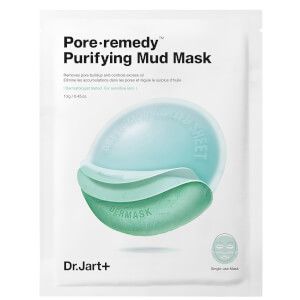
Dr. Jart+ Pore Remedy Multi-Acid Radiance Peel
Works for
2 of 5 advertised claims delivered
Moisturizing24 ingredients credited for this claimStrong support
“The formula is supported by hyaluronic acid to encourage cooling hydration, while the AHAs and BHAs work to decongest the skin, revealing a renewed and radiant-looking complexion.”
This product can help improve hydration of the skin with the two types of ingredients.
The first type is called “humectants”:
these ingredients help attract water.
When humectants are on the surface of the skin, they “pull in” the moisture from the outside environment, or from
within deeper layers of the skin. The following ingredients in this product do the job:
alanine, arginine.
This product also contains ingredients called “occlusives”. They help reduce the speed with which our skin loses moisture to the outside environment. These ingredients also help soften the upper layer of the skin, so it feels less tight and nicer to the touch. The following ingredients in this product do the job: arginine, helianthus annuus seed oil.
The following ingredients in this product are especially good for supporting the skin barrier and helping with the hydration level: panthenol
Anti-aging7 ingredients credited for this claimModerate support
“With regular use, the skin’s tone and texture become more unified and fine lines appear softened.”
This product contains aspartic acid, lysine, serine, threonine. These ingredients might be able to help reduce and prevent fine lines and wrinkles, improve skin elasticity and firmness, but there is not enough evidence that it actually works.
Evens skin tone4 ingredients credited for this claimLimited support
“With regular use, the skin’s tone and texture become more unified and fine lines appear softened.”
This product contains ingredients (alanine) that could help reduce hyperpigmentation (for example, post-acne marks or age spots) in theory, but there is not enough evidence that they actually work.
Exfoliation3 ingredients credited for this claimLimited support
“Pore Remedy Multi-Acid Radiance Peel”
This product might help exfoliate the skin with tartaric acid, but This ingredient is not the most effective.
Anti-blemish2 ingredients credited for this claimWeak support
“and Beta-Hydroxy Acids (AHAs and BHAs), the Pore Remedy Multi-Acid Radiance Peel by Dr. Jart+ exfoliates the skin and removes dirt and debris from the pores to minimise their appearance.”
Effective ingredients missing or their concentration is too low.
Anti-oxidationNot advertised by the brand · 4 ingredients credited for this claimModerate support
This product contains antioxidants (tartaric acid) that might be able to help neutralize free radicals in skin to lessen the damage it gets from the UV light (sun). There is not enough evidence to confirm their effectiveness in skin though.
Can it cause trouble?
Irritancy6 strong irritants: Parfum, Limonene + 4 more — patch-test recommendedHigh risk
Comedogenic2 ingredients rated 2 or more on the 0–5 pore-clogging scale2 flagged


User reviews
Be the first — your take helps the next person decide.
Ingredients
Filter by role to see what each ingredient is doing.
Water~45–55%
C9-12 alkane~6.3–7.7%
Butylene glycol~4.3–5.2%
- Irritation risk
- Low
Used to create a nice product texture and help delivery of other ingredients. Might be somewhat helpful in attracting water to the upper layer of the skin
More about Butylene glycolGlycerin~3.2–3.9%
- Irritation risk
- Low
One of the best moisturizing ingredients. Naturally present in skin. It attracts water to the upper layer of the skin working as a humectant
More about GlycerinCitric acid~2.4–3%
- Irritation risk
- Medium
Can work as an exfoliant but is typically used to adjust the product pH
More about Citric acidSodium hydroxide~2–2.5%
Lactic acid~1.7–2.1%
- Irritation risk
- Medium
An exfoliating and moisturizing alpha-hydroxy acid (AHA). Typically causes less irritation than other AHAs, for example, glycolic acid. At high concentrations (about 15%), lactic acid can help reduce lines and wrinkles. Recent studies show that lactic acid can support the "good" bacteria living on skin's surface (healthy skin microbiome)
More about Lactic acidHelianthus annuus seed oil~1.5–1.9%
- Irritation risk
- Low
A great emollient due to its high linoleic acid content. One of the most effective plant oils in helping skin hydration and repairing skin barrier function
More about Helianthus annuus seed oilTartaric acid~1.2–1.4%
- Irritation risk
- Medium
An AHA (alpha-hydroxy acid). It oxidizes quickly which makes it less effective in skincare formulations. It can support skin's barrier and moisture levels
More about Tartaric acidIsononyl isononanoate~1–1.2%
- Irritation risk
- Low
Forms a protective film on the surface of the skin to prevent moisture loss. Gives a velvety feel to products while reducing tackiness
More about Isononyl isononanoateLactobacillus ferment lysate extract~0.75–1.1%
- Irritation risk
- Low
Honey~0.55–0.85%
- Irritation risk
- Low
Helps attract water to the skin and might have some anti-bacterial properties. Can be an allergen
More about HoneyMel~0.55–0.8%
- Irritation risk
- Low
Helps to soften the upper layer of the skin and attract water to it
More about MelHoney~0.45–0.7%
- Irritation risk
- Low
Helps attract water to the skin and might have some anti-bacterial properties. Can be an allergen
More about HoneyCaffeine~0.45–0.65%
- Irritation risk
- Medium
Might be helpful in neutralizing free radicals. Can have a dehydration effect that might somewhat decrease the look of puffy eyes
More about CaffeineCamellia sinensis leaf extract~0.45–0.65%
- Irritation risk
- Low
Can contain potent anti-oxidant compounds (abbreviated ECG, GCG, EGC, and EGCG) that might help protect the skin from free radicals. Can help calm down inflammation and has some anti-bacterial properties. Unfortunately, these antioxidants are unstable and lose their effectiveness very quickly in products. The concentration of the antioxidant compounds in the extract also tends to be low to be effective in topical formulation
More about Camellia sinensis leaf extractCurcuma longa root extract~0.35–0.65%
- Irritation risk
- High
A plant extract that can contain an active compound curcumin, that may have some anti-inflammatory properties when applied to the skin, but solid research is lacking and the typical concentration used in skincare products is too low. Can be an irritant
More about Curcuma longa root extractChamomilla recutita extract~0.35–0.6%
- Irritation risk
- High
Plant extract that can have healing and anti-inflammatory properties. It is a potential allergen and can be irritating
More about Chamomilla recutita extractLaminaria saccharina extract~0.3–0.6%
- Irritation risk
- Low
- Comedogenicity
- 3/5
A seaweed extract that contains sugars and can be helpful in attracting water to the upper layers of the skin if used in high enough concentrations
More about Laminaria saccharina extractPanthenol~0.3–0.55%
- Irritation risk
- Low
Helps attract water to the upper layer of the skin and can help improve skin barrier function
More about PanthenolSodium hyaluronate~0.25–0.5%
- Irritation risk
- Low
One of the best moisturizing ingredients. Attracts water into the upper layer of the skin
More about Sodium hyaluronateXanthan gum~0.3–0.5%
- Irritation risk
- Low
Used to create a thicker product consistency
More about Xanthan gumCarbomer~0.25–0.45%
- Irritation risk
- Low
Helps create a thicker or gel-like product texture. It is not a surfactant but can be used in gentle cleansing formulations
More about CarbomerSalicylic acid~0.25–0.4%
- Irritation risk
- High
Used for skin exfoliation. It has an anti-inflammatory and anti-bacterial effect, helps to unclog pores, prevent blemishes and speed up healing of the existing ones. Sometimes referred to as a BHA (beta-hydroxy acid)
More about Salicylic acidDi-c12-18 alkyl dimonium chloride~0.25–0.45%
- Irritation risk
- Medium
Creates a nice, smooth skin finish
More about Di-c12-18 alkyl dimonium chlorideHydrogenated lecithin~0.25–0.5%
- Irritation risk
- Low
Helps to retain moisture by creating a protective barrier on the skin. Rich in fatty acids. Improves product texture and helps with the penetration of other ingredients.
More about Hydrogenated lecithinLaureth-4~0.25–0.45%
- Irritation risk
- Medium
- Comedogenicity
- 2/5
Helps water and oil mix together
More about Laureth-4Glycine~0.25–0.4%
- Irritation risk
- Low
Helps to attract water to the upper layer of the skin and can help restore the skin barrier function
More about GlycineSerine~0.25–0.4%
- Irritation risk
- Low
An amino-acid that helps to attract water to the upper layer of the skin. In combination with other amino-acids, might help to reduce fine lines and wrinkles
More about SerineGlutamic acid~0.25–0.45%
- Irritation risk
- Low
An amino-acid that helps attract water to the upper layer of the skin
More about Glutamic acidAspartic acid~0.25–0.4%
- Irritation risk
- Low
An amino-acid that helps increase skin hydration and might help to slightly improve skin firmness, potentially reducing lines and wrinkles
More about Aspartic acidLeucine~0.25–0.4%
- Irritation risk
- Low
Alanine~0.25–0.4%
- Irritation risk
- Low
An amino-acid that helps to attract water to the upper layer of the skin and might help to lighten the skin, but solid evidence is lacking
More about AlanineTyrosine~0.25–0.4%
Arginine~0.2–0.4%
- Irritation risk
- Low
An amino acid that is naturally present in skin and helps keep it hydrated. When used together with AHAs, it can reduce their irritating effect on the skin
More about ArginineLysine~0.25–0.4%
- Irritation risk
- Low
An amino-acid that helps to attract water to the upper layer of the skin. In combination with other amino-acids, might help to reduce fine lines and wrinkles
More about LysineProline~0.25–0.45%
Phenylalanine~0.25–0.45%
- Irritation risk
- Low
Threonine~0.25–0.45%
- Irritation risk
- Low
An amino-acid that helps to attract water to the upper layer of the skin. In combination with other amino-acids, might help to reduce fine lines and wrinkles
More about ThreonineIsoleucine~0.25–0.4%
- Irritation risk
- Low
An amino acid that can help attract water to the upper layer of the skin and support skin's barrier function
More about IsoleucineValine~0.25–0.45%
- Irritation risk
- Low
Histidine~0.2–0.4%
Parfum~0.2–0.4%
- Irritation risk
- High
An aromatic blend of unspecified and possibly irritating ingredients
More about ParfumLimonene~0.2–0.4%
- Irritation risk
- High
A common frangrance that can easily irritate skin, especially if exposed to air, light or heat
More about LimoneneCitronellol~0.2–0.35%
Geraniol~0.2–0.35%
Linalool~0.2–0.35%
Citral~0.15–0.3%
Disodium edta~0.2–0.35%
Sodium citrate~0.15–0.3%
- Irritation risk
- Medium
Helps to control the skin's pH level. Maintains the skin's natural film of amino-lactic acids and oils. Helps to preserve products
More about Sodium citrateTocopheryl acetate~0.2–0.35%
- Irritation risk
- Medium
A more stable but less bio-available form of vitamin E compared to Tocopherol. Might help moisturize and protect the skin from free radicals, but mostly used in low concentrations to stabilize other ingredients.
More about Tocopheryl acetateBht~0.15–0.25%
Phenoxyethanol~0.15–0.3%
- Irritation risk
- Low
A preservative. It helps prevent bacterial growth in cosmetic products
More about PhenoxyethanolPotassium sorbate~0.15–0.3%
Ingredient list view
Water, C9-12 alkane, Butylene glycol, Glycerin, Citric acid, Sodium hydroxide, Lactic acid, Helianthus annuus seed oil, Tartaric acid, Isononyl isononanoate, Lactobacillus ferment lysate extract, Honey, Mel, Honey, Caffeine, Camellia sinensis leaf extract, Curcuma longa root extract, Chamomilla recutita extract, Laminaria saccharina extract, Panthenol, Sodium hyaluronate, Xanthan gum, Carbomer, Salicylic acid, Di-c12-18 alkyl dimonium chloride, Hydrogenated lecithin, Laureth-4, Glycine, Serine, Glutamic acid, Aspartic acid, Leucine, Alanine, Tyrosine, Arginine, Lysine, Proline, Phenylalanine, Threonine, Isoleucine, Valine, Histidine, Parfum, Limonene, Citronellol, Geraniol, Linalool, Citral, Disodium edta, Sodium citrate, Tocopheryl acetate, Bht, Phenoxyethanol, Potassium sorbate
Compare prices
Retailers ranked by price — lowest first.
Affiliate links · prices updated regularly · As an Amazon Associate, WIMJ earns from qualifying purchases.
Worth comparing, line by line.
Match % combines shared ingredients, the first five ingredients, shared actives and hero ingredients, irritancy (lower counts in the alternative's favour), texture and body area. Only products in the same routine step are compared.
| Dr. Jart+Pore Remedy Multi-Acid Radiance PeelYOUR PRODUCT | bioClarityTreat Acne Clearing Gel | B. KaminsLactic-10 | Beauty DropsAHA 30% + BHA 2% Peeling | |
|---|---|---|---|---|
| Match | — | 82% | 79% | 77% |
| Price | $40.01 | $14.00−$26.01 | $28.00−$12.01 | — |
| Shared key ingredients | — | 5 of 21 | 4 of 21 | 5 of 21 |
| Key difference | — | Oatmeal Extract | Zinc Pca | Glycolic Acid |
| Irritancy | High | Low | Low | Medium |
| Drying alcohol | — | — | — | — |
| View product | Shop | Shop | Shop |


Product summary
"Dr. Jart+ - Pore Remedy Multi-Acid Radiance Peel" has a good moisturizing formula. The formulation is based on a combination of good humectants and emollients. Both are needed to increase the skin hydration level. Panthenol, alanine, arginine, aspartic acid and glutamic acid in this product (humectants) attract water molecules to the upper layer of the skin (the water comes from the outside air or from the deeper layers of the skin if the air is dry). Arginine, helianthus annuus seed oil, mel and isononyl isononanoate in this product help decrease the water evoporation from the skin, so that it stays hydrated for longer. These ingredients also soften the skin and take away the feeling of tightness and dryness.
Irritation risk
There are quite a few common irritants in this product, including ingredients without particular skin benefits. We would not recommend it for sensitive skin. We assess the overall irritancy of this moisturizer to be high. For a detailed overview of all potential irritants: click here
You can see the detailed formula review with the breakdown of all actives in the product and the full ingredient list with estimated concentrations in the tables below.
Price
The product retails for 41.40$ in the United States, for 52.50CA$ in Canada and for 30.00£ in the United Kingdom.
For a detailed price comparison: click here.
Sources cited in this review
Every concentration estimate and effectiveness label is anchored to one of these 33 studies and safety reviews.
- 1
- 2Epidermal and dermal effects of topical lactic acidncbi.nlm.nih.gov
- 3Dual Effects of Alpha-Hydroxy Acids on the Skinpdfs.semanticscholar.org
- 4
- 5
- 6Effect of topically applied lipids on surfactant-irritated skinonlinelibrary.wiley.com

Affiliate links · As an Amazon Associate, WIMJ earns from qualifying purchases.