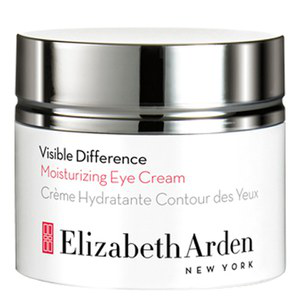
Elizabeth Arden Visible Difference Moisturising Eye Cream
Works for
2 of 2 advertised claims delivered
Moisturizing28 ingredients credited for this claimStrong support
“Visible Difference Moisturising Eye Cream”
This product can help improve hydration of the skin with the two types of ingredients.
The first type is called “humectants”:
these ingredients help attract water.
When humectants are on the surface of the skin, they “pull in” the moisture from the outside environment, or from
within deeper layers of the skin. The following ingredients in this product do the job:
anhydroxylitol, arginine.
This product also contains ingredients called “occlusives”. They help reduce the speed with which our skin loses moisture to the outside environment. These ingredients also help soften the upper layer of the skin, so it feels less tight and nicer to the touch. The following ingredients in this product do the job: arginine, squalene.
The following ingredients in this product are especially good for supporting the skin barrier and helping with the hydration level: ceramide 6 ii, oligopeptide-4, oligopeptide-5, palmitoyl oligopeptide, palmitoyl tetrapeptide-7
Anti-aging8 ingredients credited for this claimModerate support
“targets dark circles under eyes”
This product contains lysine, oligopeptide-4, oligopeptide-5, palmitoyl oligopeptide, palmitoyl tetrapeptide-7. These ingredients might be able to help reduce and prevent fine lines and wrinkles, improve skin elasticity and firmness, but there is not enough evidence that it actually works.
Anti-oxidationNot advertised by the brand · 8 ingredients credited for this claimModerate support
This product contains antioxidants (chrysin, squalene, tocopheryl linoleate) that might be able to help neutralize free radicals in skin to lessen the damage it gets from the UV light (sun). There is not enough evidence to confirm their effectiveness in skin though.
Evens skin toneNot advertised by the brand · 4 ingredients credited for this claimModerate support
The following ingredient (ingredients) in this product might be helpful, but there is no evidence to confirm that it actually works: chrysin.
Can it cause trouble?
Irritancy1 strong irritant: Salvia officinalis extractMedium risk
Comedogenic3 ingredients rated 2 or more on the 0–5 pore-clogging scale3 flagged
User reviews
Be the first — your take helps the next person decide.
Ingredients
Filter by role to see what each ingredient is doing.
Water~45–55%
Cyclopentasiloxane~5.9–7.2%
- Irritation risk
- Low
A silicone that helps improve the product texture and spreadability. Can absorb oil creating a short-term mattifying effect on the skin
More about CyclopentasiloxaneCetearyl glucoside~3.6–4.4%
- Irritation risk
- Medium
Helps water and oil in the product mix well together and improves product texture
More about Cetearyl glucosideGlycerin~3.1–3.7%
- Irritation risk
- Low
One of the best moisturizing ingredients. Naturally present in skin. It attracts water to the upper layer of the skin working as a humectant
More about GlycerinCetyl ricinoleate~2.4–2.9%
- Irritation risk
- Low
An emollient that helps soften the upper layer of the skin
More about Cetyl ricinoleateCetearyl methicone~1.9–2.3%
- Irritation risk
- Low
Butylene glycol~1.6–2%
- Irritation risk
- Low
Used to create a nice product texture and help delivery of other ingredients. Might be somewhat helpful in attracting water to the upper layer of the skin
More about Butylene glycolSqualene~1.4–1.8%
- Irritation risk
- Low
- Comedogenicity
- 2/5
An oil that is naturally part of skin sebum that helps to soften its upper layer, reduce water loss and neutralize free radicals. It might be comedogenic. Avoid applying large concentrations (or pure oil) before sun exposure as oxidized squalene can clog pores and lead to skin irritation. Today squalene is mostly derived from vegetable oils or synthetized by yeast
More about SqualeneCucumis sativus fruit extract~1.1–1.3%
- Irritation risk
- Medium
Might be somewhat helpful in reducing hyperpigmentation and neutralizing free radicals but its typical concentration in a product is too low for having an effect
More about Cucumis sativus fruit extractAscorbyl glucoside~0.8–1.15%
- Irritation risk
- Medium
A vitamin C derivative that is more stable but less potent than pure form of vitamin C. Has a potential to boost collagen production, nutralise free radicals and reduce hyperpigmentation, but the required concentration is likely to be much higher than for the pure form of vitamin C, limiting the ingredient's effectiveness in products
More about Ascorbyl glucosideCeramide 6 ii~0.65–1%
- Irritation risk
- Low
A type of lipid similar to ceramides naturally present in skin. Helps to soften the upper layer of the skin and supports the skin barrier function to keep it hydrated. Can help to prevent inflammation in skin
More about Ceramide 6 iiChondrus crispus~0.5–0.75%
- Irritation risk
- Low
- Comedogenicity
- 3/5
Red algae extract that helps attract water to the upper layer of the skin and create a nicer product consistency
More about Chondrus crispusGlycine soja extract~0.45–0.65%
- Irritation risk
- Low
Melissa officinalis extract~0.45–0.65%
- Irritation risk
- Low
Olea europaea fruit extract~0.4–0.6%
- Irritation risk
- Low
An emollient that helps soften the skin but is not effective for restoring its barrier function. Might be helpful to calm down inflammation
More about Olea europaea fruit extractPollen extract~0.4–0.6%
- Irritation risk
- Low
Salvia officinalis extract~0.4–0.6%
- Irritation risk
- High
Triticum vulgare germ extract~0.3–0.55%
- Irritation risk
- Medium
- Comedogenicity
- 3/5
Plant extract that might have moisturizing properties. Avoid if you suffer from wheat or gluten intolerance
More about Triticum vulgare germ extractChrysin~0.25–0.45%
- Irritation risk
- Medium
Might be helpful in reducing fine lines and wrinkles, as well as lightening the skin, but solid evidence is missing. Could somewhat help in reducing the darkness of the under-eye area. Helps to neutralise free radicals in skin
More about ChrysinSodium hyaluronate~0.25–0.4%
- Irritation risk
- Low
One of the best moisturizing ingredients. Attracts water into the upper layer of the skin
More about Sodium hyaluronateRetinyl linoleate~0.25–0.45%
- Irritation risk
- High
An ester of a retinoid and linoleic acid. Three steps removed from the bioactive form of retinoid, retinoic acid. Once converted to retinoic acid in skin, it can help reduce wrinkles, stimulate collagen production, even out skin tone and reduce blemishes. The concentrations used in cosmetic products are often not high enough to have a positive effect in skin.
More about Retinyl linoleateTocopheryl acetate~0.25–0.45%
- Irritation risk
- Medium
A more stable but less bio-available form of vitamin E compared to Tocopherol. Might help moisturize and protect the skin from free radicals, but mostly used in low concentrations to stabilize other ingredients.
More about Tocopheryl acetateTocopheryl linoleate~0.2–0.4%
- Irritation risk
- Medium
A relative of vitamin E (Tocopherol). It can have an anti-oxidant effect in skin and/or to stabilize the product fromulation. It could be irritating but most of the reported allergy and irritation cases appeared in one geographic location (Switzerland) in 1992, and might be due to the quality issues in manufacturing of a particular batch of the ingredient
More about Tocopheryl linoleateArginine~0.2–0.35%
- Irritation risk
- Low
An amino acid that is naturally present in skin and helps keep it hydrated. When used together with AHAs, it can reduce their irritating effect on the skin
More about ArginineGlycine~0.2–0.4%
- Irritation risk
- Low
Helps to attract water to the upper layer of the skin and can help restore the skin barrier function
More about GlycineLysine~0.2–0.4%
- Irritation risk
- Low
An amino-acid that helps to attract water to the upper layer of the skin. In combination with other amino-acids, might help to reduce fine lines and wrinkles
More about LysineProline~0.2–0.4%
Behenyl behenate~0.25–0.45%
- Irritation risk
- Low
C30-45 olefin~0.2–0.4%
- Irritation risk
- Low
Isohexadecane~0.3–0.6%
- Irritation risk
- Low
Improves the texture of the product and helps soften the skin. Helps oil and water mix together and can be used as a cleansing agent
More about IsohexadecanePropylene glycol~0.2–0.4%
- Irritation risk
- High
Helps oil and water mix together and can enhance the penetration of other ingredients into the skin. It can be irritating
More about Propylene glycolSodium pca~0.2–0.4%
- Irritation risk
- Low
Naturally present in skin and helps to attract water to its upper layer
More about Sodium pcaAnhydroxylitol~0.2–0.4%
- Irritation risk
- Low
Helps attract water to the upper layer of the skin and repair the skin barrir function
More about AnhydroxylitolButylphthalimide~0.2–0.4%
- Irritation risk
- Low
Hydrolyzed hazelnut protein~0.2–0.4%
- Irritation risk
- Low
Isopropylphthalimide~0.2–0.4%
- Irritation risk
- Low
Oligopeptide-4~0.2–0.4%
- Irritation risk
- Low
A type of peptide. Peptides are excellent moisturizers and might be able support collagen production reducing fine lines and wrinkles
More about Oligopeptide-4Oligopeptide-5~0.2–0.4%
- Irritation risk
- Low
A type of peptide. Peptides are excellent moisturizers and might be able support collagen production reducing fine lines and wrinkles
More about Oligopeptide-5Palmitoyl oligopeptide~0.3–0.55%
- Irritation risk
- Low
A type of peptide. Peptides are excellent moisturizers and might be able support collagen production reducing fine lines and wrinkles
More about Palmitoyl oligopeptidePalmitoyl tetrapeptide-7~0.25–0.5%
- Irritation risk
- Low
A type of peptide. Peptides are excellent moisturizers and might be able support collagen production reducing fine lines and wrinkles
More about Palmitoyl tetrapeptide-7Panthenol~0.2–0.4%
- Irritation risk
- Low
Helps attract water to the upper layer of the skin and can help improve skin barrier function
More about PanthenolPhospholipids~0.2–0.4%
- Irritation risk
- Low
Emollients that are naturaly present in skin. In addition, they help water and oil mix together in the product
More about PhospholipidsXylitol~0.2–0.4%
- Irritation risk
- Low
Helps attract water to the upper layer of the skin and repair the skin barrier function
More about XylitolXylitylglucoside~0.2–0.4%
- Irritation risk
- Low
Helps attract water to the upper layer of the skin and repair the skin barrier function
More about XylitylglucosideAcrylamide/sodium acryloyldimethyltaurate copolymer~0.25–0.4%
- Irritation risk
- Low
Helps water and oil mix together and create gel-like textures
More about Acrylamide/sodium acryloyldimethyltaurate copolymerPolysorbate 80~0.25–0.45%
Steareth-20~0.3–0.55%
Dimethicone/vinyl dimethicone crosspolymer~0.25–0.4%
- Irritation risk
- Low
Used to stabilize product formulations and create a nice product texture
More about Dimethicone/vinyl dimethicone crosspolymerPeg-8~0.25–0.45%
- Irritation risk
- Medium
Used to create a nice product consistency
More about Peg-8Acrylates/c10-30 alkyl acrylate crosspolymer~0.25–0.45%
- Irritation risk
- Medium
Maintains the texture of skincare products. Allows the product to spread evenly. Helps oil and water mix together
More about Acrylates/c10-30 alkyl acrylate crosspolymerPolymethyl methacrylate~0.25–0.45%
- Irritation risk
- Low
Is used to enhance product texture and can help to optically mask skin imperfections
More about Polymethyl methacrylateXanthan gum~0.25–0.45%
- Irritation risk
- Low
Used to create a thicker product consistency
More about Xanthan gumCitric acid~0.2–0.4%
- Irritation risk
- Medium
Can work as an exfoliant but is typically used to adjust the product pH
More about Citric acidTriethanolamine~0.25–0.45%
- Irritation risk
- Medium
Used to adjust pH of the product and can help improve the product's smell
More about TriethanolamineBht~0.2–0.4%
Disodium edta~0.2–0.4%
N-hydroxysuccinimide~0.2–0.4%
- Irritation risk
- High
Is claimed to be able to brighten skin tone by removing some blood-related pigmented compounds in skin (hemoglobin and related elements) but solid research is missing. Can be irritating
More about N-hydroxysuccinimideC30-45 alkyl dimethicone~0.2–0.4%
- Irritation risk
- Low
Cyclohexasiloxane~0.25–0.45%
- Irritation risk
- Low
A silicone that serves as an emollient. Helps create a nice non-greasy feels
More about CyclohexasiloxaneBenzoic acid~0.2–0.4%
Butylparaben~0.2–0.4%
Ethylparaben~0.2–0.4%
Isobutylparaben~0.2–0.4%
Methylparaben~0.15–0.3%
Phenoxyethanol~0.2–0.35%
- Irritation risk
- Low
A preservative. It helps prevent bacterial growth in cosmetic products
More about PhenoxyethanolPotassium sorbate~0.15–0.3%
Propylparaben~0.1–0.2%
Sodium dehydroacetate~0.15–0.3%
Sorbic acid~0.15–0.3%
Chlorhexidine digluconate~0.15–0.3%
Chlorphenesin~0.15–0.25%
Ingredient list view
Water, Cyclopentasiloxane, Cetearyl glucoside, Glycerin, Cetyl ricinoleate, Cetearyl methicone, Butylene glycol, Squalene, Cucumis sativus fruit extract, Ascorbyl glucoside, Ceramide 6 ii, Chondrus crispus, Glycine soja extract, Melissa officinalis extract, Olea europaea fruit extract, Pollen extract, Salvia officinalis extract, Triticum vulgare germ extract, Chrysin, Sodium hyaluronate, Retinyl linoleate, Tocopheryl acetate, Tocopheryl linoleate, Arginine, Glycine, Lysine, Proline, Behenyl behenate, C30-45 olefin, Isohexadecane, Propylene glycol, Sodium pca, Anhydroxylitol, Butylphthalimide, Hydrolyzed hazelnut protein, Isopropylphthalimide, Oligopeptide-4, Oligopeptide-5, Palmitoyl oligopeptide, Palmitoyl tetrapeptide-7, Panthenol, Phospholipids, Xylitol, Xylitylglucoside, Acrylamide/sodium acryloyldimethyltaurate copolymer, Polysorbate 80, Steareth-20, Dimethicone/vinyl dimethicone crosspolymer, Peg-8, Acrylates/c10-30 alkyl acrylate crosspolymer, Polymethyl methacrylate, Xanthan gum, Citric acid, Triethanolamine, Bht, Disodium edta, N-hydroxysuccinimide, C30-45 alkyl dimethicone, Cyclohexasiloxane, Benzoic acid, Butylparaben, Ethylparaben, Isobutylparaben, Methylparaben, Phenoxyethanol, Potassium sorbate, Propylparaben, Sodium dehydroacetate, Sorbic acid, Chlorhexidine digluconate, Chlorphenesin
Compare prices
Retailers ranked by price — lowest first.
Affiliate links · prices updated regularly · As an Amazon Associate, WIMJ earns from qualifying purchases.
Product summary
Based on the ingredient list, "Elizabeth Arden - Visible Difference Moisturising Eye Cream" can work well for skin moisturization. To work well, any moisturizer needs to include a combination of water-binding and emollient ingredients. Elizabeth Arden - Visible Difference Moisturising Eye Cream ticks this box. Anhydroxylitol, arginine, glycerin, glycine and sodium hyaluronate in this product (humectants) attract water molecules to the upper layer of the skin (the water comes from the outside air or from the deeper layers of the skin if the air is dry). Ceramide 6 ii, palmitoyl tetrapeptide-7, arginine, squalene and cetyl ricinoleate in this product help decrease the water evoporation from the skin, so that it stays hydrated for longer. These ingredients also soften the skin and take away the feeling of tightness and dryness.
Ingredient callouts
- this moisturizer contains an effective form of Retinoids (vitamin A): retinyl linoleate 0.25% - 0.40%. Retinoids are potent multitasking actives. They work to improve and prevent early signs of aging, reduce hyperpigmentation (age spots and post-acne marks), and prevent inflamed blemishes and clogged pores. The downside of Retinoids is that they can be irritating. If you are not already using a Retinoid in your routine, it is best to start slowly and apply the Retinoid product only a few times per week. If your skin tolerates it well, you can gradually increase the frequency to daily. Because of the irritation risk of Retinoids, we recommend to have another, retinoid-free moisturizer in your routine to use on the alternate days or when your skin feels dry.
- As a plus, this moisturizer also contains Ceramides (ceramide 6 ii 0.65% - 1.00%). Ceramides are a type of lipids that our skin produces itself. They are a building block of the skin's barrier. Ceramides used in skincare are synthetic or extracted from plants. They work well for softening the skin surface and "patch holes" in the skin's barrier.
- This moisturizer also contains Peptides (palmitoyl tetrapeptide-7 0.25% - 0.50%, palmitoyl oligopeptide 0.30% - 0.55%, oligopeptide-5 0.20% - 0.40% and oligopeptide-4 0.20% - 0.40%). Peptides are a very big group of ingredients. They all consist of a different combination of aminoacids. Our skin produces Peptides naturally. Some of them work as natural antibiotics, promote wound-healing and production of collagen. The scientists are still studying how effective the topical application of Peptides is, but it is very likely that they are helpful. Peptides might be able to support skin barrier restoration and even have an anti-aging benefit. At the very least, they certainly help attract water to the skin and support the hydration in this way.
Irritation risk
This formulation includes some common irritants, including ingredients that do not provide a benefit for the skin. We assess the overall irritancy of this moisturizer to be medium. For a detailed overview of all potential irritants: click here
You can see the detailed formula review with the breakdown of all actives in the product and the full ingredient list with estimated concentrations in the tables below.
Price
The product retails for 34.00$ in the United States and from 24.80£ up to 33.00£ in the United Kingdom.
For a detailed price comparison: click here.
Sources cited in this review
Every concentration estimate and effectiveness label is anchored to one of these 28 studies and safety reviews.
- 1
- 2Squalene and its potential clinical useseuropepmc.org
- 3
- 4Enhanced comedo formation in rabbit ear skin by squalene and oleic acid peroxidesonlinelibrary.wiley.com
- 5The Roles of Vitamin C in Skin Healthncbi.nlm.nih.gov
- 6

Affiliate links · As an Amazon Associate, WIMJ earns from qualifying purchases.