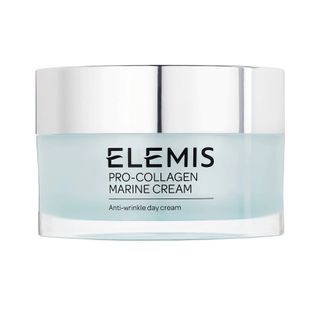
ELEMIS Pro-Collagen Marine Cream by Elemis
Works for
1 of 3 advertised claims delivered
Moisturizing18 ingredients credited for this claimGood support
“The iconic marine-powered, wrinkle-smoothing day cream, ELEMIS Pro-Collagen Marine Cream, is a rejuvenating moisturizer that significantly reduces the look of fine lines and wrinkles in just 2 weeks.”
This product can help improve hydration of the skin with the two types of ingredients.
The first type is called “humectants”:
these ingredients help attract water.
When humectants are on the surface of the skin, they “pull in” the moisture from the outside environment, or from
within deeper layers of the skin. The following ingredients in this product do the job:
glycerin, glyceryl acrylate/acrylic acid copolymer.
This product also contains ingredients called “occlusives”. They help reduce the speed with which our skin loses moisture to the outside environment. These ingredients also help soften the upper layer of the skin, so it feels less tight and nicer to the touch. The following ingredients in this product do the job: dimethicone, simmondsia chinensis seed oil.
Anti-aging1 ingredient credited for this claimLimited support
“The iconic marine-powered, wrinkle-smoothing day cream, ELEMIS Pro-Collagen Marine Cream, is a rejuvenating moisturizer that significantly reduces the look of fine lines and wrinkles in just 2 weeks.”
This product does not contain ingredients that are able to reduce fine lines and wrinkles or help with skin elasticity, but it can improve the look of the skin temporarily through moisturization. Well-moisturized skin might also be able to repair the sun damage better.
This ingredient ginkgo biloba leaf extract might be able to help neutralize free radicals in skin and help it fight off some of the sun damage.
Evens skin toneNo ingredient credited for this claimNo support
“The appearance of fine lines are reduced and skin’s firmness, tone and hydration is improved.”
Effective ingredients missing or their concentration is too low
Anti-oxidationNot advertised by the brand · 10 ingredients credited for this claimModerate support
This product contains antioxidants (ginkgo biloba leaf extract) that might be able to help neutralize free radicals in skin to lessen the damage it gets from the UV light (sun). There is not enough evidence to confirm their effectiveness in skin though.
Can it cause trouble?
Irritancy10 strong irritants: Parfum, Hydroxyisohexyl 3-cyclohexene carboxaldehyde + 8 more — patch-test recommendedHigh risk
Comedogenic7 ingredients rated 2 or more on the 0–5 pore-clogging scale7 flagged
User reviews
Ingredients
Filter by role to see what each ingredient is doing.
Water~45–55%
Glycerin~4.6–5.6%
- Irritation risk
- Low
One of the best moisturizing ingredients. Naturally present in skin. It attracts water to the upper layer of the skin working as a humectant
More about GlycerinGlyceryl stearate se~3.8–4.7%
- Irritation risk
- Low
- Comedogenicity
- 2/5
Used to stabilize the product formulations and works as an emollient
More about Glyceryl stearate seSimmondsia chinensis seed oil~3.2–3.9%
- Irritation risk
- Medium
Softens the upper layer of skin and helps restore the healthy skin barrier. Has shown to help calm down inflammation in skin. It is a stable oil, meaning that it retains its properties even when exposed to air.
More about Simmondsia chinensis seed oilHelianthus annuus seed oil unsaponifiables~2.4–2.9%
- Irritation risk
- Low
A great emollient due to its high linoleic acid content. One of the most effective plant oils in helping skin hydration and repairing skin barrier function
More about Helianthus annuus seed oil unsaponifiablesDicaprylyl carbonate~1.9–2.4%
- Irritation risk
- Low
Helps products spread more easily and works as an emollient to soften skin
More about Dicaprylyl carbonateIsononyl isononanoate~1.7–2%
- Irritation risk
- Low
Forms a protective film on the surface of the skin to prevent moisture loss. Gives a velvety feel to products while reducing tackiness
More about Isononyl isononanoateDimethicone~1.5–1.8%
- Irritation risk
- Low
A silicone that helps to reduce water loss from the surface of the skin. Can temporarily "fill in" lines and wrinkles, absorb oil, and create a nice product finish
More about DimethiconeCetearyl alcohol~1.2–1.5%
- Irritation risk
- Low
- Comedogenicity
- 2/5
A non-drying alcohol. Works as an emollient. Helps water and oil mix together and creates a nice product texture
More about Cetearyl alcoholCoco-caprylate/caprate~0.95–1.15%
- Irritation risk
- Low
Helps to soften the upper layer of the skin without creating a greasy texture
More about Coco-caprylate/capratePolyacrylate-13~0.7–1.1%
- Irritation risk
- Low
Used to create a thicker product consistency and stabilize the product formulation
More about Polyacrylate-13Phenoxyethanol~0.55–0.8%
- Irritation risk
- Low
A preservative. It helps prevent bacterial growth in cosmetic products
More about PhenoxyethanolTocopheryl acetate~0.5–0.75%
- Irritation risk
- Medium
A more stable but less bio-available form of vitamin E compared to Tocopherol. Might help moisturize and protect the skin from free radicals, but mostly used in low concentrations to stabilize other ingredients.
More about Tocopheryl acetateStearic acid~0.6–0.85%
- Irritation risk
- Low
Helps oil and water mix together and works as an emollient
More about Stearic acidParfum~0.35–0.65%
- Irritation risk
- High
An aromatic blend of unspecified and possibly irritating ingredients
More about ParfumLauryl laurate~0.4–0.6%
- Irritation risk
- Medium
Helps soften the upper layer of the skin
More about Lauryl laurateSodium benzoate~0.25–0.5%
Xanthan gum~0.35–0.65%
- Irritation risk
- Low
Used to create a thicker product consistency
More about Xanthan gumGlyceryl polyacrylate~0.3–0.6%
- Irritation risk
- Low
Helps to create a nice product texture and spread the product more easily on the skin
More about Glyceryl polyacrylatePolyisobutene~0.3–0.6%
Theobroma cacao seed butter~0.3–0.55%
- Irritation risk
- Low
- Comedogenicity
- 3/5
Helps soften the upper layer of the skin and can be helpful in restoring the skin barrier function. Might have some anti-oxidant effect
More about Theobroma cacao seed butterPotassium sorbate~0.3–0.55%
Triticum vulgare germ oil~0.3–0.55%
- Irritation risk
- Low
- Comedogenicity
- 3/5
A good emoillient. Contains vitamin E which can help neutralise free radicals, however the oil is unstable. Avoid if you have gluten or wheat sensitivity (including food allergies).
More about Triticum vulgare germ oilCitric acid~0.25–0.5%
- Irritation risk
- Medium
Can work as an exfoliant but is typically used to adjust the product pH
More about Citric acidDaucus carota sativa root extract~0.25–0.45%
- Irritation risk
- Low
Carrot extract. Might have anti-oxidant properties and be used to add orange color
More about Daucus carota sativa root extractTocopherol~0.25–0.5%
- Irritation risk
- Low
Pure form of vitamin E. Can help moisturise and protect the skin from free radicals. Often used to help stabilise other ingredients or the formula itself
More about TocopherolChlorella vulgaris extract~0.25–0.45%
- Irritation risk
- Medium
- Comedogenicity
- 3/5
A plant extract that can help to attract water to the upper layer of the skin and might have some anti-oxidant and anti-inflammatory properties
More about Chlorella vulgaris extractGlyceryl acrylate/acrylic acid copolymer~0.25–0.5%
- Irritation risk
- Medium
Helps attract water to the upper layer of the skin and provide a longer-lasting hydration. Can create a thicker product consistency
More about Glyceryl acrylate/acrylic acid copolymerPadina pavonica thallus extract~0.25–0.45%
- Irritation risk
- Low
- Comedogenicity
- 3/5
Might help to soften the upper layer of the skin. Is claimed to have anti-oxidant properties, but evidence in missing
More about Padina pavonica thallus extractDisodium edta~0.25–0.45%
Polysorbate 20~0.3–0.5%
Sorbitan isostearate~0.25–0.5%
- Irritation risk
- Low
Helps oil and water mix together
More about Sorbitan isostearateGinkgo biloba leaf extract~0.25–0.45%
- Irritation risk
- High
A plant extract that might help neutralize free radicals and reduce inflammation in skin. It can be irritating
More about Ginkgo biloba leaf extractHydroxyisohexyl 3-cyclohexene carboxaldehyde~0.2–0.4%
- Irritation risk
- High
A fragrance. Can be irritating
More about Hydroxyisohexyl 3-cyclohexene carboxaldehydeRosa centifolia flower extract~0.25–0.45%
- Irritation risk
- High
Contains essential oil. Can be irritating
More about Rosa centifolia flower extractAcacia decurrens flower extract~0.2–0.4%
- Irritation risk
- High
A plant extract that might have some anti-oxidant benefits but research on effectiveness in skin is lacking
More about Acacia decurrens flower extractPorphyridium cruentum extract~0.25–0.45%
- Irritation risk
- Low
- Comedogenicity
- 3/5
A red algae extract. Can help attract water to the upper layer of the skin and might have an antioxidant effect
More about Porphyridium cruentum extractButylphenyl methylpropional~0.2–0.35%
- Irritation risk
- High
A fragrance. Can trigger allergic reactions and be irritating
More about Butylphenyl methylpropionalLinalool~0.2–0.35%
Citronellol~0.2–0.35%
Cedrus atlantica bark oil~0.15–0.25%
- Irritation risk
- Low
Cuminum cyminum seed oil~0.1–0.2%
- Irritation risk
- Low
Citrus limon peel oil~0.15–0.25%
Limonene~0.15–0.25%
- Irritation risk
- High
A common frangrance that can easily irritate skin, especially if exposed to air, light or heat
More about LimoneneGeraniol~0.05–0.15%
Hydroxycitronellal~0.05–0.15%
- Irritation risk
- High
A fragrance. A likely allergen and can be irritating
More about HydroxycitronellalIngredient list view
Water, Glycerin, Glyceryl stearate se, Simmondsia chinensis seed oil, Helianthus annuus seed oil unsaponifiables, Dicaprylyl carbonate, Isononyl isononanoate, Dimethicone, Cetearyl alcohol, Coco-caprylate/caprate, Polyacrylate-13, Phenoxyethanol, Tocopheryl acetate, Stearic acid, Parfum, Lauryl laurate, Sodium benzoate, Xanthan gum, Glyceryl polyacrylate, Polyisobutene, Theobroma cacao seed butter, Potassium sorbate, Triticum vulgare germ oil, Citric acid, Daucus carota sativa root extract, Tocopherol, Chlorella vulgaris extract, Glyceryl acrylate/acrylic acid copolymer, Padina pavonica thallus extract, Disodium edta, Polysorbate 20, Sorbitan isostearate, Ginkgo biloba leaf extract, Hydroxyisohexyl 3-cyclohexene carboxaldehyde, Rosa centifolia flower extract, Acacia decurrens flower extract, Porphyridium cruentum extract, Butylphenyl methylpropional, Linalool, Citronellol, Cedrus atlantica bark oil, Cuminum cyminum seed oil, Citrus limon peel oil, Limonene, Geraniol, Hydroxycitronellal
Compare prices
Retailers ranked by price — lowest first.


Sources cited in this review
Every concentration estimate and effectiveness label is anchored to one of these 12 studies and safety reviews.
- 1
- 2
- 3Final Report on the Safety Assessment of Dimethicone Copolyoljournals.sagepub.com
- 4Safety Assessment of Alkyl Esters as Used in Cosmeticscir-safety.org
- 5
- 6

Affiliate links · As an Amazon Associate, WIMJ earns from qualifying purchases.