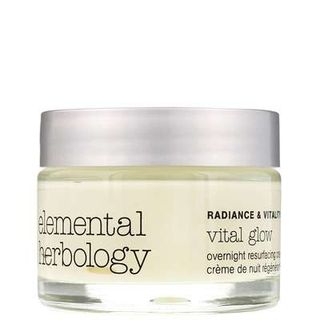
Elemental Herbology Facial Moisturisers Vital Glow Overnight Resurfacing Cream

Elemental Herbology Facial Moisturisers Vital Glow Overnight Resurfacing Cream

Efficacy100/100IrritancyHigh
Edit

Works for

4 of 4 advertised claims delivered

Moisturizing
16 ingredients credited for this claim
Strong support
What the product description says
“Facial Moisturisers Vital Glow Overnight Resurfacing Cream”
From product name

This product can help improve hydration of the skin with the two types of ingredients.

The first type is called “humectants”:
these ingredients help attract water. When humectants are on the surface of the skin, they “pull in” the moisture from the outside environment, or from within deeper layers of the skin. The following ingredients in this product do the job: arginine, glycerin.

This product also contains ingredients called “occlusives”. They help reduce the speed with which our skin loses moisture to the outside environment. These ingredients also help soften the upper layer of the skin, so it feels less tight and nicer to the touch. The following ingredients in this product do the job: arginine, caprylic/capric triglyceride.

The following ingredients in this product are especially good for supporting the skin barrier and helping with the hydration level: panthenol

GlycerinKey active· HumectantEffect: HighOne of the best moisturizing ingredients. Naturally present in skin. It attracts water to the upper layer of the skin working as a humectant~4.4–5.3%
Myristyl myristateKey active· Emollient, OcclusiveEffect: HighAn emollient. Is not recommended for acne-prone skin as it can be comedogenic~2–2.4%
Argania spinosa kernel oilKey active· EmollientEffect: HighAn emollient that helps soften the upper layer of the skin. Might have some weak anti-oxidant properties~1.2–1.4%
ArginineKey active· Humectant, OcclusiveEffect: HighAn amino acid that is naturally present in skin and helps keep it hydrated. When used together with AHAs, it can reduce their irritating effect on the skin~0.25–0.45%
Caprylic/capric triglycerideKey active· Emollient, OcclusiveEffect: HighA good mix of fatty acids that forms a protective layer on the skin. Improves the shelf life of products. Derived from coconut and glycerin~4.1–5.1%
PanthenolHero· HumectantEffect: HighHelps attract water to the upper layer of the skin and can help improve skin barrier function~0.5–0.75%
Plukenetia volubilis seed oilKey active· Emollient, OcclusiveEffect: HighA plant oil that works as a good moisturizer by softening the upper layer of the skin. Might be helpful in reducing inflammation in skin and reducing blemishes due to the large content of linoleic acid~3.1–3.8%
Prunus armeniaca kernel oilKey active· EmollientEffect: HighAn emollient that helps soften the skin~1.5–1.8%
SqualaneKey active· Emollient, OcclusiveEffect: HighAn oil naturally present in skin. Works as an emollient to soften the skin and form a protective layer on its surface without a greasy feeling.~1.7–2%
Theobroma cacao seed butterKey active· EmollientEffect: HighHelps soften the upper layer of the skin and can be helpful in restoring the skin barrier function. Might have some anti-oxidant effect~0.95–1.15%
Cetearyl alcoholKey active· EmollientEffect: MediumA non-drying alcohol. Works as an emollient. Helps water and oil mix together and creates a nice product texture~2.3–2.8%
Brassica oleracea italica seed oilKey active· EmollientEffect: MediumA plant seed oil that consists mainly of erucic acid and used to help soften the upper layer of the skin. This fatty acid can enhance penetration of other ingredients into the skin but it is not a good moisturizer on its own~0.3–0.6%
Lactic acidUnder-dosedEffect: HighAn exfoliating and moisturizing alpha-hydroxy acid (AHA). Typically causes less irritation than other AHAs, for example, glycolic acid. At high concentrations (about 15%), lactic acid can help reduce lines and wrinkles. Recent studies show that lactic acid can support the "good" bacteria living on skin's surface (healthy skin microbiome)~0.2–0.4%
Pyrus malus fruit extractUnder-dosedEffect: MediumCan have some moisturizing properties due to its sugar content~0.2–0.4%
TocopherolEffect: Low, below effective dosePure form of vitamin E. Can help moisturise and protect the skin from free radicals. Often used to help stabilise other ingredients or the formula itself~0.35–0.6%
LecithinEffect: Low, below effective doseUsed mostly for creating emulsions - helping oil and water mix together. Helps soften the upper layer of the skin~0.3–0.6%
Anti-aging
4 ingredients credited for this claim
Strong support
What the product description says
“Plant C-Stem in the formula acts as an anti-inflammatory, repairing exposed skin and increasing the skin's natural collagen production.”
Source: Allbeauty

This product can help reduce and prevent fine lines and wrinkles, improve skin elasticity and firmness because it contains hydroxypinacolone retinoate, glycolic acid.

Keep in mind that it typically takes at least 6 weeks to notice any results because the changes that are needed to improve fine lines and elasticity happen in the deeper layers of the skin. No topical anti-aging product can “erase” wrinkles or fully reverse signs of aging.

Glycolic acidKey activeEffect: HighAn alpha-hydroxy acid (AHA) that helps to remove the dead skin cells on the surface of the skin reveling a more even, smoother complexation. It is also able to stimulate collagen production with long-term use. Could help to reduce pore congestion. It can be irritating to the skin. Apply sunscreen daily if using products with glycolic acid~0.2–0.4%
Hydroxypinacolone retinoateHeroEffect: HighA derivative of the most potent form of vitamin A, retinoic acid. The ingredient can be sold under name Granactive Retinoid. Note that if a skincare brand discloses the concentration of Granactive Retinoid in a product, the concentration refers to a diluted form of Hydroxypinacolone Retinoate: 1% of Granactive Retinoid corresponds to 0.1% of Hydroxypinacolone Retinoate. Hydroxypinacolone Retinoate (HPR) is a unique derivative of retinoic acid because it can directly work in the skin and does not require additional conversion steps. According to studies done by the manufacturer on models of human skin (not real people), this derivative is more effective than other cosmetic versions of retinoids (such as retinol, retinaldehyde, and retinyl palmitate), and, at the same time, causes less irritation. It has been also demonstrated to be more stable than retinol which makes formulating with easier and increases the chances that a product with it will maintain its effectiveness after opening. The packaging should still ideally be air-tight. HPR is available over the counter in the EU, UK, Asia, Australia and New Zealand, but is only with a prescription in Canada.~0.01–0.05%
Lactic acidUnder-dosedEffect: MediumAn exfoliating and moisturizing alpha-hydroxy acid (AHA). Typically causes less irritation than other AHAs, for example, glycolic acid. At high concentrations (about 15%), lactic acid can help reduce lines and wrinkles. Recent studies show that lactic acid can support the "good" bacteria living on skin's surface (healthy skin microbiome)~0.2–0.4%
TocopherolEffect: Low, below effective dosePure form of vitamin E. Can help moisturise and protect the skin from free radicals. Often used to help stabilise other ingredients or the formula itself~0.35–0.6%
Exfoliation
3 ingredients credited for this claim
Strong support
What the product description says
“Natural AHAs formed from sugar, apples and lactic acid enable a brighter appearance, helping to further improve dull skin.”
Source: Allbeauty

This product can help exfoliate the skin. In other words, it helps break down the bonds between dead cells on the surface of the skin and speed up the skin turnover. Skin often appears softer and brighter after exfoliation, but overdoing it can result in disrupted skin barrier. The following ingredient is doing the exfoliating job in this product: glycolic acid.

Glycolic acidKey activeEffect: HighAn alpha-hydroxy acid (AHA) that helps to remove the dead skin cells on the surface of the skin reveling a more even, smoother complexation. It is also able to stimulate collagen production with long-term use. Could help to reduce pore congestion. It can be irritating to the skin. Apply sunscreen daily if using products with glycolic acid~0.2–0.4%
Hydroxypinacolone retinoateKey activeEffect: MediumA derivative of the most potent form of vitamin A, retinoic acid. The ingredient can be sold under name Granactive Retinoid. Note that if a skincare brand discloses the concentration of Granactive Retinoid in a product, the concentration refers to a diluted form of Hydroxypinacolone Retinoate: 1% of Granactive Retinoid corresponds to 0.1% of Hydroxypinacolone Retinoate. Hydroxypinacolone Retinoate (HPR) is a unique derivative of retinoic acid because it can directly work in the skin and does not require additional conversion steps. According to studies done by the manufacturer on models of human skin (not real people), this derivative is more effective than other cosmetic versions of retinoids (such as retinol, retinaldehyde, and retinyl palmitate), and, at the same time, causes less irritation. It has been also demonstrated to be more stable than retinol which makes formulating with easier and increases the chances that a product with it will maintain its effectiveness after opening. The packaging should still ideally be air-tight. HPR is available over the counter in the EU, UK, Asia, Australia and New Zealand, but is only with a prescription in Canada.~0.01–0.05%
Lactic acidUnder-dosedEffect: HighAn exfoliating and moisturizing alpha-hydroxy acid (AHA). Typically causes less irritation than other AHAs, for example, glycolic acid. At high concentrations (about 15%), lactic acid can help reduce lines and wrinkles. Recent studies show that lactic acid can support the "good" bacteria living on skin's surface (healthy skin microbiome)~0.2–0.4%
Evens skin tone
3 ingredients credited for this claim
Strong support
What the product description says
“Stimulates cell turnover, reduces pigmentation and the appearance of pore size, improves elasticity and helps to plump fine lines and wrinkles.”
Source: Allbeauty

This product can help reduce hypepigmentation and even out the skin tone because it contains the following effective ingredients: hydroxypinacolone retinoate.

In addition, this product contains glycolic acid. This ingredient (ingredients) might help reduce hyperpigmentation, but the effect, if any, is likely to be small.

Keep in mind that you would need to apply any topical skincare targetted at hypigmentation consistently for a couple of months to get a result. No topical skincare product can help get rid of hyperpigmentation (including post-acne marks and age spots) instantly.

Glycolic acidKey activeEffect: HighAn alpha-hydroxy acid (AHA) that helps to remove the dead skin cells on the surface of the skin reveling a more even, smoother complexation. It is also able to stimulate collagen production with long-term use. Could help to reduce pore congestion. It can be irritating to the skin. Apply sunscreen daily if using products with glycolic acid~0.2–0.4%
Hydroxypinacolone retinoateHeroEffect: HighA derivative of the most potent form of vitamin A, retinoic acid. The ingredient can be sold under name Granactive Retinoid. Note that if a skincare brand discloses the concentration of Granactive Retinoid in a product, the concentration refers to a diluted form of Hydroxypinacolone Retinoate: 1% of Granactive Retinoid corresponds to 0.1% of Hydroxypinacolone Retinoate. Hydroxypinacolone Retinoate (HPR) is a unique derivative of retinoic acid because it can directly work in the skin and does not require additional conversion steps. According to studies done by the manufacturer on models of human skin (not real people), this derivative is more effective than other cosmetic versions of retinoids (such as retinol, retinaldehyde, and retinyl palmitate), and, at the same time, causes less irritation. It has been also demonstrated to be more stable than retinol which makes formulating with easier and increases the chances that a product with it will maintain its effectiveness after opening. The packaging should still ideally be air-tight. HPR is available over the counter in the EU, UK, Asia, Australia and New Zealand, but is only with a prescription in Canada.~0.01–0.05%
Lactic acidUnder-dosedEffect: HighAn exfoliating and moisturizing alpha-hydroxy acid (AHA). Typically causes less irritation than other AHAs, for example, glycolic acid. At high concentrations (about 15%), lactic acid can help reduce lines and wrinkles. Recent studies show that lactic acid can support the "good" bacteria living on skin's surface (healthy skin microbiome)~0.2–0.4%
Anti-blemish
Not advertised by the brand · 2 ingredients credited for this claim
Strong support

This product can help reduce breakouts and clogged pores because it contains the following ingredient: hydroxypinacolone retinoate. This ingredient is used for treating acne and can have a noticeable effect.

The following ingredient (ingredients) in this product might be helpful, but there is no evidence to confirm that it actually works: glycolic acid

Hydroxypinacolone retinoateHeroEffect: HighA derivative of the most potent form of vitamin A, retinoic acid. The ingredient can be sold under name Granactive Retinoid. Note that if a skincare brand discloses the concentration of Granactive Retinoid in a product, the concentration refers to a diluted form of Hydroxypinacolone Retinoate: 1% of Granactive Retinoid corresponds to 0.1% of Hydroxypinacolone Retinoate. Hydroxypinacolone Retinoate (HPR) is a unique derivative of retinoic acid because it can directly work in the skin and does not require additional conversion steps. According to studies done by the manufacturer on models of human skin (not real people), this derivative is more effective than other cosmetic versions of retinoids (such as retinol, retinaldehyde, and retinyl palmitate), and, at the same time, causes less irritation. It has been also demonstrated to be more stable than retinol which makes formulating with easier and increases the chances that a product with it will maintain its effectiveness after opening. The packaging should still ideally be air-tight. HPR is available over the counter in the EU, UK, Asia, Australia and New Zealand, but is only with a prescription in Canada.~0.01–0.05%
Glycolic acidKey activeEffect: MediumAn alpha-hydroxy acid (AHA) that helps to remove the dead skin cells on the surface of the skin reveling a more even, smoother complexation. It is also able to stimulate collagen production with long-term use. Could help to reduce pore congestion. It can be irritating to the skin. Apply sunscreen daily if using products with glycolic acid~0.2–0.4%

Can it cause trouble?

Irritancy
10 strong irritants: Limonene, Citrus aurantium dulcis peel oil + 8 more — patch-test recommended
High risk
We flagged 24 ingredients with irritancy potential. Severity depends on your sensitivity threshold; the table lists the worst offenders first.
IngredientFunctionIrritationEst. amount
LimoneneA common frangrance that can easily irritate skin, especially if exposed to air, light or heatHigh~0.55–0.8%est.
Citrus aurantium dulcis peel oilAn essentil oil from orange peel. Potential allergen and can be irritatingHigh~0.35–0.65%est.
Citrus nobilis peel oilA plant oil with high content of volatile compounds that, especially when exposed to air, can cause allergic reactions and irritate the skinHigh~0.25–0.45%est.
Hydroxypinacolone retinoateA derivative of the most potent form of vitamin A, retinoic acid. The ingredient can be sold under name Granactive Retinoid. Note that if a skincare brand discloses the concentration of Granactive Retinoid in a product, the concentration refers to a diluted form of Hydroxypinacolone Retinoate: 1% of Granactive Retinoid corresponds to 0.1% of Hydroxypinacolone Retinoate. Hydroxypinacolone Retinoate (HPR) is a unique derivative of retinoic acid because it can directly work in the skin and does not require additional conversion steps. According to studies done by the manufacturer on models of human skin (not real people), this derivative is more effective than other cosmetic versions of retinoids (such as retinol, retinaldehyde, and retinyl palmitate), and, at the same time, causes less irritation. It has been also demonstrated to be more stable than retinol which makes formulating with easier and increases the chances that a product with it will maintain its effectiveness after opening. The packaging should still ideally be air-tight. HPR is available over the counter in the EU, UK, Asia, Australia and New Zealand, but is only with a prescription in Canada.High~0.01–0.05%est.
Commiphora myrrha oilUsed as a fragranceHigh~0.2–0.4%est.
Glycolic acidAn alpha-hydroxy acid (AHA) that helps to remove the dead skin cells on the surface of the skin reveling a more even, smoother complexation. It is also able to stimulate collagen production with long-term use. Could help to reduce pore congestion. It can be irritating to the skin. Apply sunscreen daily if using products with glycolic acidHigh~0.2–0.4%est.
Citrus paradisi peel oilUsed as a fragrance. Can be irritatingHigh~0.2–0.35%est.
Rosmarinus officinalis leaf oilA plant oil with high content of volatile compounds that can irritate the skin. Can be used as a fragrance. Has anti-bacterial properties and might help neutralize free radicals on the surface of the skinHigh~0.2–0.4%est.
Alcohol denat.Produces temporary toning effect. Can help dissolve other ingredients or preserve productsHigh~0.15–0.3%est.
LinaloolA fragrance. Can be irritatingHigh~0.1–0.15%est.
CitralA fragrance with a lemon scent. A likely irritantHigh~0.05–0.15%est.
Caprylic/capric triglycerideA good mix of fatty acids that forms a protective layer on the skin. Improves the shelf life of products. Derived from coconut and glycerinMedium~4.1–5.1%est.
Myristyl myristateAn emollient. Is not recommended for acne-prone skin as it can be comedogenicMedium~2–2.4%est.
Prunus armeniaca kernel oilAn emollient that helps soften the skinMedium~1.5–1.8%est.
Argania spinosa kernel oilAn emollient that helps soften the upper layer of the skin. Might have some weak anti-oxidant propertiesMedium~1.2–1.4%est.
Isostearyl isostearateHelps soften the upper layer of the skin and improve the product texture. It can be comedogenicMedium~0.45–0.7%est.
Terminalia ferdinandiana fruit extractA plant extract that might have some anti-oxidant effect in skin, but evidence is lackingMedium~0.4–0.65%est.
Brassica oleracea italica seed oilA plant seed oil that consists mainly of erucic acid and used to help soften the upper layer of the skin. This fatty acid can enhance penetration of other ingredients into the skin but it is not a good moisturizer on its ownMedium~0.3–0.6%est.
Pyrus malus fruit extractCan have some moisturizing properties due to its sugar contentMedium~0.2–0.4%est.
Malpighia glabra fruit extractA plant extract that might help neutralize free radicals in skin, but research on its effectiveness is lackingMedium~0.2–0.4%est.
Lactic acidAn exfoliating and moisturizing alpha-hydroxy acid (AHA). Typically causes less irritation than other AHAs, for example, glycolic acid. At high concentrations (about 15%), lactic acid can help reduce lines and wrinkles. Recent studies show that lactic acid can support the "good" bacteria living on skin's surface (healthy skin microbiome)Medium~0.2–0.4%est.
Cetearyl glucosideHelps water and oil in the product mix well together and improves product textureMedium~0.25–0.4%est.
Potassium sorbateA preservativeMedium~0.15–0.3%est.
Citric acidCan work as an exfoliant but is typically used to adjust the product pHMedium~0.15–0.25%est.
Comedogenic
4 ingredients rated 2 or more on the 0–5 pore-clogging scale
4 flagged
These ingredients have a comedogenic rating of 2 or more on a 0–5 scale; the table shows each one's rating. In leave-on products they can clog pores in acne-prone skin.
IngredientFunctionRatingEst. amount
Myristyl myristateAn emollient. Is not recommended for acne-prone skin as it can be comedogenic3/5~2–2.4%est.
Theobroma cacao seed butterHelps soften the upper layer of the skin and can be helpful in restoring the skin barrier function. Might have some anti-oxidant effect3/5~0.95–1.15%est.
Isostearyl isostearateHelps soften the upper layer of the skin and improve the product texture. It can be comedogenic3/5~0.45–0.7%est.
Cetearyl alcoholA non-drying alcohol. Works as an emollient. Helps water and oil mix together and creates a nice product texture2/5~2.3–2.8%est.
Edit

User reviews

Would you recommend?
No community reviews yet.

Be the first — your take helps the next person decide.

Write a review · ~30s

Ingredients

Filter by role to see what each ingredient is doing.

Water~45–55%
Formula
Irritation risk
Low

Plain old water

More about Water
Glycerin~4.4–5.3%
Key active
Irritation risk
Low
Works for
Moisturizing

One of the best moisturizing ingredients. Naturally present in skin. It attracts water to the upper layer of the skin working as a humectant

More about Glycerin
Caprylic/capric triglyceride~4.1–5.1%
Key activeIrritant · medium
Irritation risk
Medium
Works for
Moisturizing

A good mix of fatty acids that forms a protective layer on the skin. Improves the shelf life of products. Derived from coconut and glycerin

More about Caprylic/capric triglyceride
Plukenetia volubilis seed oil~3.1–3.8%
Key active
Irritation risk
Low
Works for
Moisturizing

A plant oil that works as a good moisturizer by softening the upper layer of the skin. Might be helpful in reducing inflammation in skin and reducing blemishes due to the large content of linoleic acid

More about Plukenetia volubilis seed oil
Cetearyl alcohol~2.3–2.8%
Key activeComedogenic 2/5
Irritation risk
Low
Comedogenicity
2/5
Works for
CleansingMoisturizing

A non-drying alcohol. Works as an emollient. Helps water and oil mix together and creates a nice product texture

More about Cetearyl alcohol
Myristyl myristate~2–2.4%
Key activeComedogenic 3/5Irritant · medium
Irritation risk
Medium
Comedogenicity
3/5
Works for
Moisturizing

An emollient. Is not recommended for acne-prone skin as it can be comedogenic

More about Myristyl myristate
Squalane~1.7–2%
Key active
Irritation risk
Low
Works for
Moisturizing

An oil naturally present in skin. Works as an emollient to soften the skin and form a protective layer on its surface without a greasy feeling.

More about Squalane
Prunus armeniaca kernel oil~1.5–1.8%
Key activeIrritant · medium
Irritation risk
Medium
Works for
MoisturizingAnti-oxidation

An emollient that helps soften the skin

More about Prunus armeniaca kernel oil
Argania spinosa kernel oil~1.2–1.4%
Key activeIrritant · medium
Irritation risk
Medium
Works for
MoisturizingAnti-oxidation

An emollient that helps soften the upper layer of the skin. Might have some weak anti-oxidant properties

More about Argania spinosa kernel oil
Theobroma cacao seed butter~0.95–1.15%
Key activeComedogenic 3/5
Irritation risk
Low
Comedogenicity
3/5
Works for
MoisturizingAnti-oxidationAnti-dandruff

Helps soften the upper layer of the skin and can be helpful in restoring the skin barrier function. Might have some anti-oxidant effect

More about Theobroma cacao seed butter
Cetearyl olivate~0.65–1%
Formula
Irritation risk
Low
Works for
Cleansing

Helps oil and water mix together

More about Cetearyl olivate
Limonene~0.55–0.8%
Irritant · high
Irritation risk
High

A common frangrance that can easily irritate skin, especially if exposed to air, light or heat

More about Limonene
Panthenol~0.5–0.75%
Hero · Moisturizing
Irritation risk
Low
Works for
Reduces rednessMoisturizingReduces irritation

Helps attract water to the upper layer of the skin and can help improve skin barrier function

More about Panthenol
Isostearyl isostearate~0.45–0.7%
Comedogenic 3/5Irritant · medium
Irritation risk
Medium
Comedogenicity
3/5

Helps soften the upper layer of the skin and improve the product texture. It can be comedogenic

More about Isostearyl isostearate
Sorbitan olivate~0.45–0.65%
Formula
Irritation risk
Low
Works for
Cleansing

Helps oil and water mix together

More about Sorbitan olivate
Terminalia ferdinandiana fruit extract~0.4–0.65%
Irritant · medium
Irritation risk
Medium
Works for
Anti-oxidation

A plant extract that might have some anti-oxidant effect in skin, but evidence is lacking

More about Terminalia ferdinandiana fruit extract
Citrus aurantium dulcis peel oil~0.35–0.65%
Irritant · high
Irritation risk
High

An essentil oil from orange peel. Potential allergen and can be irritating

More about Citrus aurantium dulcis peel oil
Tocopherol~0.35–0.6%
Formula
Irritation risk
Low
Works for
Anti-oxidationMoisturizingAnti-inflammatoryAnti-aging

Pure form of vitamin E. Can help moisturise and protect the skin from free radicals. Often used to help stabilise other ingredients or the formula itself

More about Tocopherol
Brassica oleracea italica seed oil~0.3–0.6%
Key activeIrritant · medium
Irritation risk
Medium
Works for
Moisturizing

A plant seed oil that consists mainly of erucic acid and used to help soften the upper layer of the skin. This fatty acid can enhance penetration of other ingredients into the skin but it is not a good moisturizer on its own

More about Brassica oleracea italica seed oil
Lecithin~0.3–0.6%
Formula
Irritation risk
Low
Works for
CleansingMoisturizing

Used mostly for creating emulsions - helping oil and water mix together. Helps soften the upper layer of the skin

More about Lecithin
Arginine~0.25–0.45%
Key active
Irritation risk
Low
Works for
Moisturizing

An amino acid that is naturally present in skin and helps keep it hydrated. When used together with AHAs, it can reduce their irritating effect on the skin

More about Arginine
Citrus nobilis peel oil~0.25–0.45%
Irritant · high
Irritation risk
High

A plant oil with high content of volatile compounds that, especially when exposed to air, can cause allergic reactions and irritate the skin

More about Citrus nobilis peel oil
Malic acid~0.25–0.4%
Formula
Irritation risk
Low

Helps adjust the product pH

More about Malic acid
Oryzanol~0.2–0.4%
Formula
Irritation risk
Low
Works for
Anti-oxidation

An anti-oxidant that helps stabilize product formulations. Might help neutralise free radicals in skin

More about Oryzanol
Pyrus malus fruit extract~0.2–0.4%
Under-dosedIrritant · medium
Irritation risk
Medium
Works for
MoisturizingAnti-oxidation

Can have some moisturizing properties due to its sugar content

More about Pyrus malus fruit extract
Malpighia glabra fruit extract~0.2–0.4%
Irritant · medium
Irritation risk
Medium
Works for
Anti-oxidation

A plant extract that might help neutralize free radicals in skin, but research on its effectiveness is lacking

More about Malpighia glabra fruit extract
Hydroxypinacolone retinoate~0.01–0.05%
Hero · Anti-aging, Evens skin tone, Anti-blemishIrritant · high
Irritation risk
High
Works for
Evens skin toneAnti-blemishAnti-agingExfoliation

A derivative of the most potent form of vitamin A, retinoic acid. The ingredient can be sold under name Granactive Retinoid. Note that if a skincare brand discloses the concentration of Granactive Retinoid in a product, the concentration refers to a diluted form of Hydroxypinacolone Retinoate: 1% of Granactive Retinoid corresponds to 0.1% of Hydroxypinacolone Retinoate. Hydroxypinacolone Retinoate (HPR) is a unique derivative of retinoic acid because it can directly work in the skin and does not require additional conversion steps. According to studies done by the manufacturer on models of human skin (not real people), this derivative is more effective than other cosmetic versions of retinoids (such as retinol, retinaldehyde, and retinyl palmitate), and, at the same time, causes less irritation. It has been also demonstrated to be more stable than retinol which makes formulating with easier and increases the chances that a product with it will maintain its effectiveness after opening. The packaging should still ideally be air-tight. HPR is available over the counter in the EU, UK, Asia, Australia and New Zealand, but is only with a prescription in Canada.

More about Hydroxypinacolone retinoate
Commiphora myrrha oil~0.2–0.4%
Irritant · high
Irritation risk
High

Used as a fragrance

More about Commiphora myrrha oil
Glycolic acid~0.2–0.4%
Key activeIrritant · high
Irritation risk
High
Works for
ExfoliationEvens skin toneAnti-agingAnti-blemish

An alpha-hydroxy acid (AHA) that helps to remove the dead skin cells on the surface of the skin reveling a more even, smoother complexation. It is also able to stimulate collagen production with long-term use. Could help to reduce pore congestion. It can be irritating to the skin. Apply sunscreen daily if using products with glycolic acid

More about Glycolic acid
Lactic acid~0.2–0.4%
Under-dosedIrritant · medium
Irritation risk
Medium
Works for
Evens skin toneMoisturizingExfoliationAnti-aging

An exfoliating and moisturizing alpha-hydroxy acid (AHA). Typically causes less irritation than other AHAs, for example, glycolic acid. At high concentrations (about 15%), lactic acid can help reduce lines and wrinkles. Recent studies show that lactic acid can support the "good" bacteria living on skin's surface (healthy skin microbiome)

More about Lactic acid
Citrus paradisi peel oil~0.2–0.35%
Irritant · high
Irritation risk
High

Used as a fragrance. Can be irritating

More about Citrus paradisi peel oil
Rosmarinus officinalis leaf oil~0.2–0.4%
Irritant · high
Irritation risk
High
Works for
AntibacterialAnti-oxidation

A plant oil with high content of volatile compounds that can irritate the skin. Can be used as a fragrance. Has anti-bacterial properties and might help neutralize free radicals on the surface of the skin

More about Rosmarinus officinalis leaf oil
Phaseolus radiatus meristem cell culture extract~0.25–0.45%
Formula
Cetearyl glucoside~0.25–0.4%
Irritant · medium
Irritation risk
Medium
Works for
Cleansing

Helps water and oil in the product mix well together and improves product texture

More about Cetearyl glucoside
Sorbitan stearate~0.25–0.4%
Formula
Irritation risk
Low
Works for
Cleansing

Helps water and oil mix together

More about Sorbitan stearate
Maltodextrin~0.2–0.4%
Formula
Irritation risk
Low
Works for
Mattifying

Used to stabilize the product formulation and can help absorb oil

More about Maltodextrin
Inulin lauryl carbamate~0.2–0.35%
Formula
Irritation risk
Low
Works for
Cleansing
More about Inulin lauryl carbamate
Xanthan gum~0.2–0.35%
Formula
Irritation risk
Low
Works for
Cleansing

Used to create a thicker product consistency

More about Xanthan gum
Tetrasodium glutamate diacetate~0.2–0.35%
Formula
Irritation risk
Low

Helps stabilize the product formulation

More about Tetrasodium glutamate diacetate
Dimethyl isosorbide~0.2–0.35%
Formula
Irritation risk
Low

Used to dissolve other ingredients in a product and can enhance their ability to penetrate the skin

More about Dimethyl isosorbide
Alcohol denat.~0.15–0.3%
Irritant · high
Irritation risk
High

Produces temporary toning effect. Can help dissolve other ingredients or preserve products

More about Alcohol denat.
Phenoxyethanol~0.15–0.25%
Formula
Irritation risk
Low

A preservative. It helps prevent bacterial growth in cosmetic products

More about Phenoxyethanol
Potassium sorbate~0.15–0.3%
Irritant · medium
Irritation risk
Medium

A preservative

More about Potassium sorbate
Citric acid~0.15–0.25%
Irritant · medium
Irritation risk
Medium

Can work as an exfoliant but is typically used to adjust the product pH

More about Citric acid
Linalool~0.1–0.15%
Irritant · high
Irritation risk
High

A fragrance. Can be irritating

More about Linalool
Citral~0.05–0.15%
Irritant · high
Irritation risk
High

A fragrance with a lemon scent. A likely irritant

More about Citral
Ingredient list view

Water, Glycerin, Caprylic/capric triglyceride, Plukenetia volubilis seed oil, Cetearyl alcohol, Myristyl myristate, Squalane, Prunus armeniaca kernel oil, Argania spinosa kernel oil, Theobroma cacao seed butter, Cetearyl olivate, Limonene, Panthenol, Isostearyl isostearate, Sorbitan olivate, Terminalia ferdinandiana fruit extract, Citrus aurantium dulcis peel oil, Tocopherol, Brassica oleracea italica seed oil, Lecithin, Arginine, Citrus nobilis peel oil, Malic acid, Oryzanol, Pyrus malus fruit extract, Malpighia glabra fruit extract, Hydroxypinacolone retinoate, Commiphora myrrha oil, Glycolic acid, Lactic acid, Citrus paradisi peel oil, Rosmarinus officinalis leaf oil, Phaseolus radiatus meristem cell culture extract, Cetearyl glucoside, Sorbitan stearate, Maltodextrin, Inulin lauryl carbamate, Xanthan gum, Tetrasodium glutamate diacetate, Dimethyl isosorbide, Alcohol denat., Phenoxyethanol, Potassium sorbate, Citric acid, Linalool, Citral

Compare prices

Retailers ranked by price — lowest first.

No pricing data available yet for this product.

Worth comparing, line by line.

Match % combines shared ingredients, the first five ingredients, shared actives and hero ingredients, irritancy (lower counts in the alternative's favour), texture and body area. Only products in the same routine step are compared.

Side-by-side comparison of this product against its closest alternatives
Elemental HerbologyFacial Moisturisers Vital Glow Overnight Resurfacing CreamYOUR PRODUCTHickapBedtime Magic Repairing Night CreamDr. David JackGood Night Retinoid Night CreamStripesEvening Wear Firming Cream with Retinoid and Hyaluronic Acid
Match—82%76%75%
Price$75.36—$134.85+$59.49$80.00+$4.64
Shared key ingredients—6 of 134 of 136 of 13
Key difference—BakuchiolNiacinamideEctoin
Irritancy High Medium Medium High
Drying alcohol Contains drying alcohol ———
View product Shop Shop Shop
Cheaper alternatives? See how this stacks up against similar formulas.
We compare ingredient profiles across our catalog — pick the closest match for your budget.
Open dupe finder

Product summary

"Elemental Herbology - Facial Moisturisers Vital Glow Overnight Resurfacing Cream" is effective for: Moisturizing, Anti-aging, Exfoliation, Evens skin tone and Anti-blemish

Ingredient callouts

  • this moisturizer contains an effective form of Retinoids (vitamin A): hydroxypinacolone retinoate 0.01% - 0.05%. Retinoids are potent multitasking actives. They work to improve and prevent early signs of aging, reduce hyperpigmentation (age spots and post-acne marks), and prevent inflamed blemishes and clogged pores. The downside of Retinoids is that they can be irritating. If you are not already using a Retinoid in your routine, it is best to start slowly and apply the Retinoid product only a few times per week. If your skin tolerates it well, you can gradually increase the frequency to daily. Because of the irritation risk of Retinoids, we recommend to have another, retinoid-free moisturizer in your routine to use on the alternate days or when your skin feels dry.

Sources cited in this review

Every concentration estimate and effectiveness label is anchored to one of these 30 studies and safety reviews.

  1. 1
  2. 2
  3. 3
  4. 4
  5. 5
  6. 6
Elemental Herbology Facial Moisturisers Vital Glow Overnight Resurfacing Cream
Elemental HerbologyFacial Moisturisers Vital Glow Overnight Resurfacing Cream

Affiliate links · As an Amazon Associate, WIMJ earns from qualifying purchases.

As an Amazon Associate, WIMJ earns from qualifying purchases.