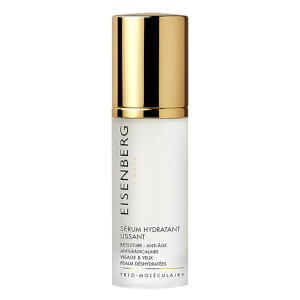
Works for
1 of 2 advertised claims delivered
Moisturizing22 ingredients credited for this claimGood support
“Moisturising Smoothing Serum”
This product can help improve hydration of the skin with the two types of ingredients.
The first type is called “humectants”:
these ingredients help attract water.
When humectants are on the surface of the skin, they “pull in” the moisture from the outside environment, or from
within deeper layers of the skin. The following ingredients in this product do the job:
glycerin, mannitol.
This product also contains ingredients called “occlusives”. They help reduce the speed with which our skin loses moisture to the outside environment. These ingredients also help soften the upper layer of the skin, so it feels less tight and nicer to the touch. The following ingredients in this product do the job: caprylic/capric triglyceride, beta-sitosterol.
Anti-aging6 ingredients credited for this claimWeak support
“Fortified with an anti-wrinkle Super Peptide and Vitamins A, E, and F, the Trio-Molecular® formula regenerates and revitalises lack-lustre skin, whilst fighting the appearance of fine lines and wrinkles.”
Effective ingredients missing or their concentration is too low.
Can it cause trouble?
Irritancy5 strong irritants: Limonene, Alcohol + 3 more — patch-test recommendedHigh risk
Comedogenic2 ingredients rated 2 or more on the 0–5 pore-clogging scale2 flagged


User reviews
Be the first — your take helps the next person decide.
Ingredients
Filter by role to see what each ingredient is doing.
Water~45–55%
Butylene glycol~5.6–6.8%
- Irritation risk
- Low
Used to create a nice product texture and help delivery of other ingredients. Might be somewhat helpful in attracting water to the upper layer of the skin
More about Butylene glycolCaprylic/capric triglyceride~4.3–5.3%
- Irritation risk
- Medium
A good mix of fatty acids that forms a protective layer on the skin. Improves the shelf life of products. Derived from coconut and glycerin
More about Caprylic/capric triglycerideVp/va copolymer~2.9–3.6%
- Irritation risk
- Low
Used to stabilize product formulation and create a nice product consistency
More about Vp/va copolymerCoco-caprylate/caprate~2.1–2.6%
- Irritation risk
- Low
Helps to soften the upper layer of the skin without creating a greasy texture
More about Coco-caprylate/caprateC12-20 acid peg-8 ester~1.6–2%
- Irritation risk
- Medium
Helps oil and water mix together
More about C12-20 acid peg-8 esterPotassium cetyl phosphate~1.4–1.7%
- Irritation risk
- Medium
Helps oil and water mix together
More about Potassium cetyl phosphateTriethanolamine~1–1.3%
- Irritation risk
- Medium
Used to adjust pH of the product and can help improve the product's smell
More about TriethanolamineCarbomer~0.6–0.9%
- Irritation risk
- Low
Helps create a thicker or gel-like product texture. It is not a surfactant but can be used in gentle cleansing formulations
More about CarbomerPhenoxyethanol~0.4–0.65%
- Irritation risk
- Low
A preservative. It helps prevent bacterial growth in cosmetic products
More about PhenoxyethanolCi 77891~0.5–0.75%
- Irritation risk
- Low
Titanium dioxide~0.6–0.9%
- Irritation risk
- Low
Works as a UV filter when used in high concentrations. It is photostable and is effective mostly against the UVB light, with some protection in the UVA range. In small concentrations, used for its ability to improve the color of cosmetic products. Is usually well tolerated by the skin
More about Titanium dioxideVitis vinifera seed oil~0.3–0.55%
- Irritation risk
- Medium
A great emollient that can also have anti-oxidant properties
More about Vitis vinifera seed oilEthylhexylglycerin~0.25–0.45%
Mannitol~0.2–0.35%
- Irritation risk
- Low
Helps to attract water to the upper layer of the skin
More about MannitolSaccharide isomerate~0.2–0.4%
- Irritation risk
- Low
Helps attract water to the upper layer of the skin
More about Saccharide isomeratePanthenol~0.2–0.4%
- Irritation risk
- Low
Helps attract water to the upper layer of the skin and can help improve skin barrier function
More about PanthenolChondrus crispus powder~0.25–0.5%
- Irritation risk
- Low
- Comedogenicity
- 3/5
A powder from red algae extract that helps attract water to the upper layer of the skin and create a nicer product consistency
More about Chondrus crispus powderCarrageenan~0.2–0.35%
- Irritation risk
- Medium
- Comedogenicity
- 3/5
Helps thicken the product formula and create a nice product formulation
More about CarrageenanDisodium edta~0.15–0.3%
Glycerin~0.15–0.3%
- Irritation risk
- Low
One of the best moisturizing ingredients. Naturally present in skin. It attracts water to the upper layer of the skin working as a humectant
More about GlycerinTocopheryl acetate~0.15–0.3%
- Irritation risk
- Medium
A more stable but less bio-available form of vitamin E compared to Tocopherol. Might help moisturize and protect the skin from free radicals, but mostly used in low concentrations to stabilize other ingredients.
More about Tocopheryl acetateCaffeine~0.1–0.2%
- Irritation risk
- Medium
Might be helpful in neutralizing free radicals. Can have a dehydration effect that might somewhat decrease the look of puffy eyes
More about CaffeineCamellia sinensis leaf extract~0.15–0.25%
- Irritation risk
- Low
Can contain potent anti-oxidant compounds (abbreviated ECG, GCG, EGC, and EGCG) that might help protect the skin from free radicals. Can help calm down inflammation and has some anti-bacterial properties. Unfortunately, these antioxidants are unstable and lose their effectiveness very quickly in products. The concentration of the antioxidant compounds in the extract also tends to be low to be effective in topical formulation
More about Camellia sinensis leaf extractCellulose~0.2–0.35%
- Irritation risk
- Low
Can be used to help absorb oil as well as add volume and imporve texture of products.
More about CelluloseLimonene~0.1–0.2%
- Irritation risk
- High
A common frangrance that can easily irritate skin, especially if exposed to air, light or heat
More about LimonenePhospholipids~0.1–0.2%
- Irritation risk
- Low
Emollients that are naturaly present in skin. In addition, they help water and oil mix together in the product
More about PhospholipidsPropylene glycol~0.15–0.25%
- Irritation risk
- High
Helps oil and water mix together and can enhance the penetration of other ingredients into the skin. It can be irritating
More about Propylene glycolFagus sylvatica bud extract~0.15–0.25%
- Irritation risk
- Low
Alcohol~0.15–0.3%
- Irritation risk
- High
Can be drying and contribute to skin irritation. Used in formulars to dissolve other ingredients, create a thinner product consistency or for its antibacterial properties
More about AlcoholCitrus aurantium dulcis peel oil~0.15–0.25%
- Irritation risk
- High
An essentil oil from orange peel. Potential allergen and can be irritating
More about Citrus aurantium dulcis peel oilCitrus limon peel oil~0.15–0.25%
Pentadecalactone~0.15–0.3%
- Irritation risk
- Low
Peg-8~0.15–0.3%
- Irritation risk
- Medium
Used to create a nice product consistency
More about Peg-8Escin~0.15–0.3%
- Irritation risk
- High
A compound obtained from horse chestnut. It is claimed that this chemical can improve circulation, but there is no evidence available that it works in skin
More about EscinPentylene glycol~0.2–0.4%
- Irritation risk
- Medium
Used to preserve products, dissolve other ingredients and create a nice product texture
More about Pentylene glycolSodium hyaluronate~0.15–0.3%
- Irritation risk
- Low
One of the best moisturizing ingredients. Attracts water into the upper layer of the skin
More about Sodium hyaluronateHydrolyzed rice protein~0.15–0.3%
- Irritation risk
- Low
Helps attract water to the upper layer of the skin. Might have some anti-oxidant properties
More about Hydrolyzed rice proteinBacillus ferment~0.15–0.3%
- Irritation risk
- Low
A product of bacterial fermentation. Can help attract water to the upper layer of the skin
More about Bacillus fermentChlorhexidine digluconate~0.15–0.3%
Leuconostoc/radish root ferment filtrate~0.15–0.3%
- Irritation risk
- Medium
A preservative that comes from radishes fermented by a bacteria. New research suggests that the preservation properties in the ingredient come from an ammonium salt that is not present naturally in radish root but used in its cultivation. Is problematic because the exact amount of the preservative agents is difficult to determine
More about Leuconostoc/radish root ferment filtrateBenzyl alcohol~0.15–0.3%
- Irritation risk
- High
A preservative. Can be used to mask unpleasant smell. Can be irritating
More about Benzyl alcoholBeta-sitosterol~0.2–0.35%
- Irritation risk
- Low
A phytosterol that can support skin's barrier function and help the skin stay hydrated
More about Beta-sitosterolRetinyl palmitate~0.15–0.25%
- Irritation risk
- High
Three steps removed from the active form of vitamin A - retinoic acid. To have an effect in the skin, it first needs to be converted twice to become the retinoic acid. This means it is less potent than retinol, but could also be less irritating. Once converted to the retinoic acid in the skin, it helps against all signs of aging, improves skin cell turnover and helps fight blemishes and clogged pores. However, in many cosmetic formulations, it is used in a concentration that is too low to have the full effect
More about Retinyl palmitateTocopherol~0.2–0.35%
- Irritation risk
- Low
Pure form of vitamin E. Can help moisturise and protect the skin from free radicals. Often used to help stabilise other ingredients or the formula itself
More about TocopherolAscorbyl palmitate~0.15–0.3%
- Irritation risk
- Medium
Being a lipid soluble form of vitamin C, it is more stable and can penetrate the skin better than L-Ascorbic acid. It is effective in protecting the skin from free radicals, as well as evening the skin tone, but is less effective in stimulating collagen production compared to L-Ascorbic acid.
More about Ascorbyl palmitateCitric acid~0.15–0.3%
- Irritation risk
- Medium
Can work as an exfoliant but is typically used to adjust the product pH
More about Citric acidBeta-carotene~0.15–0.3%
Sodium citrate~0.15–0.3%
- Irritation risk
- Medium
Helps to control the skin's pH level. Maintains the skin's natural film of amino-lactic acids and oils. Helps to preserve products
More about Sodium citrateCi 77007~0.15–0.3%
Ultramarines~0.2–0.4%
- Irritation risk
- Low
Hydroxypropyl methylcellulose~0.15–0.3%
- Irritation risk
- Medium
Used to create a thicker product consistency and stabilize the formulation
More about Hydroxypropyl methylcelluloseLactose~0.2–0.35%
- Irritation risk
- Low
Helps attract water to the upper layer of the skin
More about LactosePotassium sorbate~0.2–0.35%
Lactis proteinum~0.2–0.35%
- Irritation risk
- Low
Whey protein~0.2–0.35%
- Irritation risk
- Low
A protein derived from milk. In skincare products, might help to soften the upper layer of the skin
More about Whey proteinBenzoic acid~0.1–0.2%
Ci 19140~0.15–0.25%
Ascorbic acid~0.1–0.2%
- Irritation risk
- High
The most well-researched antioxidant that works in skin. Helps neutralize free radicals supporting collagen production, helping to even out the skin tone and preventing early signs of aging
More about Ascorbic acidLactic acid~0.05–0.15%
- Irritation risk
- Medium
An exfoliating and moisturizing alpha-hydroxy acid (AHA). Typically causes less irritation than other AHAs, for example, glycolic acid. At high concentrations (about 15%), lactic acid can help reduce lines and wrinkles. Recent studies show that lactic acid can support the "good" bacteria living on skin's surface (healthy skin microbiome)
More about Lactic acidCi 42090~0.05–0.1%
Ingredient list view
Water, Butylene glycol, Caprylic/capric triglyceride, Vp/va copolymer, Coco-caprylate/caprate, C12-20 acid peg-8 ester, Potassium cetyl phosphate, Triethanolamine, Carbomer, Phenoxyethanol, Ci 77891, Titanium dioxide, Vitis vinifera seed oil, Ethylhexylglycerin, Mannitol, Saccharide isomerate, Panthenol, Chondrus crispus powder, Carrageenan, Disodium edta, Glycerin, Tocopheryl acetate, Caffeine, Camellia sinensis leaf extract, Cellulose, Limonene, Phospholipids, Propylene glycol, Fagus sylvatica bud extract, Alcohol, Citrus aurantium dulcis peel oil, Citrus limon peel oil, Pentadecalactone, Peg-8, Escin, Pentylene glycol, Sodium hyaluronate, Hydrolyzed rice protein, Bacillus ferment, Chlorhexidine digluconate, Leuconostoc/radish root ferment filtrate, Benzyl alcohol, Beta-sitosterol, Retinyl palmitate, Tocopherol, Ascorbyl palmitate, Citric acid, Beta-carotene, Sodium citrate, Ci 77007, Ultramarines, Hydroxypropyl methylcellulose, Lactose, Potassium sorbate, Lactis proteinum, Whey protein, Benzoic acid, Ci 19140, Ascorbic acid, Lactic acid, Ci 42090
Compare prices
Retailers ranked by price — lowest first.
Affiliate links · prices updated regularly · As an Amazon Associate, WIMJ earns from qualifying purchases.
Worth comparing, line by line.
Match % combines shared ingredients, the first five ingredients, shared actives and hero ingredients, irritancy (lower counts in the alternative's favour), texture and body area. Only products in the same routine step are compared.
| EISENBERGMoisturising Smoothing SerumYOUR PRODUCT | Elizabeth GrantCollagen Re-Inforce Triple Strength Miracle Concentrate | IntraceuticalsRejuvenate Daily Serum | Pure & CareSerum Oil-Cocktail Night Repair- 1 pcs | |
|---|---|---|---|---|
| Match | — | 58% | 57% | 57% |
| Price | $34.27 | $60.00+$25.73 | $139.00+$104.73 | $69.00+$34.73 |
| Shared key ingredients | — | 4 of 14 | 7 of 14 | 6 of 14 |
| Key difference | — | Palmitoyl Pentapeptide-4 | Dimethicone | Oligopeptide-5 |
| Irritancy | High | Medium | Medium | Medium |
| Drying alcohol | Contains drying alcohol | — | — | — |
| View product | Shop | Shop | Shop |


Sources cited in this review
Every concentration estimate and effectiveness label is anchored to one of these 19 studies and safety reviews.
- 1Safety Assessment of Alkyl Esters as Used in Cosmeticscir-safety.org
- 2Skin moisturizing effects of panthenol-based formulationspdfs.semanticscholar.org
- 3
- 4
- 5Surfactants and experimental irritant contact dermatitisncbi.nlm.nih.gov
- 6Propylene Glycolpubmed.ncbi.nlm.nih.gov

Affiliate links · As an Amazon Associate, WIMJ earns from qualifying purchases.