Works for
1 of 2 advertised claims delivered
Moisturizing16 ingredients credited for this claimGood support
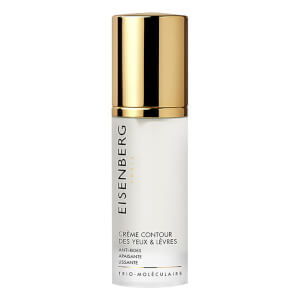
“Eye and Lip Contour Cream”
This product can help improve hydration of the skin with the two types of ingredients.
The first type is called “humectants”:
these ingredients help attract water.
When humectants are on the surface of the skin, they “pull in” the moisture from the outside environment, or from
within deeper layers of the skin. The following ingredients in this product do the job:
glycerin, lactose.
This product also contains ingredients called “occlusives”. They help reduce the speed with which our skin loses moisture to the outside environment. These ingredients also help soften the upper layer of the skin, so it feels less tight and nicer to the touch. The following ingredients in this product do the job: caprylic/capric triglyceride, dimethicone.
Anti-aging4 ingredients credited for this claimWeak support
“Smoothen and refine skin with the EISENBERG Eye and Lip Contour Cream ; a deeply moisturising formula that works to fight signs of ageing.”
Effective ingredients missing or their concentration is too low.
Can it cause trouble?
Irritancy13 flagged ingredientsMedium risk
Comedogenic1 ingredient rated 2 or more on the 0–5 pore-clogging scale1 flagged
User reviews
Be the first — your take helps the next person decide.
Ingredients
Filter by role to see what each ingredient is doing.
Water~45–55%
Caprylic/capric triglyceride~6.3–7.7%
- Irritation risk
- Medium
A good mix of fatty acids that forms a protective layer on the skin. Improves the shelf life of products. Derived from coconut and glycerin
More about Caprylic/capric triglycerideButylene glycol~4.1–5%
- Irritation risk
- Low
Used to create a nice product texture and help delivery of other ingredients. Might be somewhat helpful in attracting water to the upper layer of the skin
More about Butylene glycolIsostearyl alcohol~3.3–4%
- Irritation risk
- Low
Helps soften the upper layer of the skin
More about Isostearyl alcoholCetearyl ethylhexanoate~2.5–3%
- Irritation risk
- Low
An emollient that helps soften the skin
More about Cetearyl ethylhexanoateDicaprylyl ether~2.1–2.5%
- Irritation risk
- Low
Helps soften the upper layer of the skin while creating a non-greasy feel on the skin. Helps to dissolve other ingredients
More about Dicaprylyl etherGlyceryl stearate citrate~1.7–2.1%
- Irritation risk
- Low
Helps oil and water mix together while softening the upper layer of the skin
More about Glyceryl stearate citrateSesamum indicum seed oil~1.5–1.8%
- Irritation risk
- Low
A good moisturizing plant oil. Due to the high linoleic acid content, it helps soften the upper layer of the skin, reduce water loss and support skin barrier function
More about Sesamum indicum seed oilCetearyl alcohol~1.3–1.5%
- Irritation risk
- Low
- Comedogenicity
- 2/5
A non-drying alcohol. Works as an emollient. Helps water and oil mix together and creates a nice product texture
More about Cetearyl alcoholRubus idaeus leaf cell culture~0.95–1.15%
- Irritation risk
- Low
Boswellia serrata gum~0.75–1.1%
- Irritation risk
- Low
Fagus sylvatica bud extract~0.55–0.85%
- Irritation risk
- Low
Lactis proteinum~0.5–0.75%
- Irritation risk
- Low
Whey protein~0.5–0.75%
- Irritation risk
- Low
A protein derived from milk. In skincare products, might help to soften the upper layer of the skin
More about Whey proteinBacillus ferment~0.4–0.65%
- Irritation risk
- Low
A product of bacterial fermentation. Can help attract water to the upper layer of the skin
More about Bacillus fermentTocopherol~0.45–0.65%
- Irritation risk
- Low
Pure form of vitamin E. Can help moisturise and protect the skin from free radicals. Often used to help stabilise other ingredients or the formula itself
More about TocopherolAscorbyl palmitate~0.4–0.6%
- Irritation risk
- Medium
Being a lipid soluble form of vitamin C, it is more stable and can penetrate the skin better than L-Ascorbic acid. It is effective in protecting the skin from free radicals, as well as evening the skin tone, but is less effective in stimulating collagen production compared to L-Ascorbic acid.
More about Ascorbyl palmitateAscorbic acid~0.35–0.6%
- Irritation risk
- High
The most well-researched antioxidant that works in skin. Helps neutralize free radicals supporting collagen production, helping to even out the skin tone and preventing early signs of aging
More about Ascorbic acidGlycerin~0.35–0.65%
- Irritation risk
- Low
One of the best moisturizing ingredients. Naturally present in skin. It attracts water to the upper layer of the skin working as a humectant
More about GlycerinDimethicone~0.35–0.65%
- Irritation risk
- Low
A silicone that helps to reduce water loss from the surface of the skin. Can temporarily "fill in" lines and wrinkles, absorb oil, and create a nice product finish
More about DimethiconeLactose~0.25–0.5%
- Irritation risk
- Low
Helps attract water to the upper layer of the skin
More about LactoseEthylhexylglycerin~0.25–0.5%
Sodium polyacrylate~0.25–0.5%
- Irritation risk
- Low
Used to create a gel-like product texture, as well as to stabilize emulsions
More about Sodium polyacrylateXanthan gum~0.25–0.45%
- Irritation risk
- Low
Used to create a thicker product consistency
More about Xanthan gumPentadecalactone~0.2–0.4%
- Irritation risk
- Low
Benzyl alcohol~0.2–0.35%
- Irritation risk
- High
A preservative. Can be used to mask unpleasant smell. Can be irritating
More about Benzyl alcoholLactic acid~0.2–0.4%
- Irritation risk
- Medium
An exfoliating and moisturizing alpha-hydroxy acid (AHA). Typically causes less irritation than other AHAs, for example, glycolic acid. At high concentrations (about 15%), lactic acid can help reduce lines and wrinkles. Recent studies show that lactic acid can support the "good" bacteria living on skin's surface (healthy skin microbiome)
More about Lactic acidPropylene glycol~0.2–0.4%
- Irritation risk
- High
Helps oil and water mix together and can enhance the penetration of other ingredients into the skin. It can be irritating
More about Propylene glycolPeg-8~0.2–0.4%
- Irritation risk
- Medium
Used to create a nice product consistency
More about Peg-8Benzoic acid~0.2–0.35%
Citric acid~0.15–0.3%
- Irritation risk
- Medium
Can work as an exfoliant but is typically used to adjust the product pH
More about Citric acidPotassium sorbate~0.15–0.25%
Sodium hydroxide~0.15–0.25%
Phenoxyethanol~0.15–0.25%
- Irritation risk
- Low
A preservative. It helps prevent bacterial growth in cosmetic products
More about PhenoxyethanolChlorphenesin~0.1–0.2%
Disodium edta~0.05–0.1%
Ingredient list view
Water, Caprylic/capric triglyceride, Butylene glycol, Isostearyl alcohol, Cetearyl ethylhexanoate, Dicaprylyl ether, Glyceryl stearate citrate, Sesamum indicum seed oil, Cetearyl alcohol, Rubus idaeus leaf cell culture, Boswellia serrata gum, Fagus sylvatica bud extract, Lactis proteinum, Whey protein, Bacillus ferment, Tocopherol, Ascorbyl palmitate, Ascorbic acid, Glycerin, Dimethicone, Lactose, Ethylhexylglycerin, Sodium polyacrylate, Xanthan gum, Pentadecalactone, Benzyl alcohol, Lactic acid, Propylene glycol, Peg-8, Benzoic acid, Citric acid, Potassium sorbate, Sodium hydroxide, Phenoxyethanol, Chlorphenesin, Disodium edta
Compare prices
Retailers ranked by price — lowest first.
Affiliate links · prices updated regularly · As an Amazon Associate, WIMJ earns from qualifying purchases.
Sources cited in this review
Every concentration estimate and effectiveness label is anchored to one of these 14 studies and safety reviews.
- 1
- 2Triglyceride composition of Sesamum indicum seed oilonlinelibrary.wiley.com
- 3
- 4TOPICAL COMPOSITIONS CONTAINING WHEY PROTEINS patentimages.storage.googleapis.com
- 5Vitamin E in dermatologyncbi.nlm.nih.gov
- 6Vitamin E and Skin Healthlpi.oregonstate.edu

Affiliate links · As an Amazon Associate, WIMJ earns from qualifying purchases.