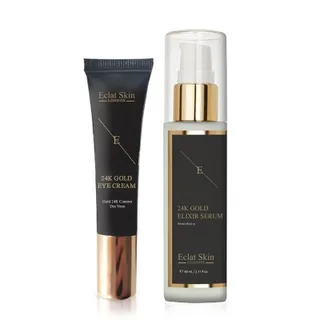
Eclat Skin London ANTI-WRINKLE ELIXIR SERUM 24K GOLD + UNDER EYE CREAM 24K GOLD
Works for
MoisturizingPanthenol, Urea + 33 moreWorks well
“Macadamia and Argan oils are both lightweight quickly absorbing oils with great fatty acids ratio that moisturises the skin and boosts skin softness.”
This product can help improve hydration of the skin with the two types of ingredients.
The first type is called “humectants”:
these ingredients help attract water.
When humectants are on the surface of the skin, they “pull in” the moisture from the outside environment, or from
within deeper layers of the skin. The following ingredients in this product do the job:
glycerin, saccharomyces/copper ferment.
This product also contains ingredients called “occlusives”. They help reduce the speed with which our skin loses moisture to the outside environment. These ingredients also help soften the upper layer of the skin, so it feels less tight and nicer to the touch. The following ingredients in this product do the job: cera alba, squalane.
The following ingredients in this product are especially good for supporting the skin barrier and helping with the hydration level: panthenol, urea
Anti-agingUbiquinone, Butyrospermum parkii butter + 4 moreMay help
“ANTI-WRINKLE ELIXIR SERUM 24K GOLD + UNDER EYE CREAM 24K GOLD”
This product contains ubiquinone. This ingredient help neutralize free radicals in skin. By doing so, they might be able to prevent early signs of aging (like fine lines and wrinkles), at least to some extent. These ingredients will not be able to "reverse" signs of aging.
Anti-oxidationSide benefit · Ubiquinone, Borago officinalis seed oil + 7 moreWorks well
This product contains antioxidants (ubiquinone) that can help neutralize free radicals in skin. By doing so, they can lessen the damage the skin gets from the UV light (sun).
Can it cause trouble?
Irritancy9 strong irritants: Retinyl palmitate, Arnica montana flower extract + 7 more — patch-test recommendedHigh risk
Comedogenic3 ingredients rated 2 or more on the 0–5 pore-clogging scale3 flagged


User reviews
Be the first — your take helps the next person decide.
Ingredients
Filter by role to see what each ingredient is doing.
Macadamia ternifolia seed oil~22–33%
- Irritation risk
- Medium
Plant oil from nuts that helps soften the upper layer of the skin. Contains a high concentration of oleic acid that can weaken skin's barrier function and increase water-loss while enhancing penetration of other ingredients
More about Macadamia ternifolia seed oilArgania spinosa kernel oil~4.3–6.5%
- Irritation risk
- Medium
An emollient that helps soften the upper layer of the skin. Might have some weak anti-oxidant properties
More about Argania spinosa kernel oilGold~4.4–6.6%
Water~3.4–5.1%
Panthenol~2.4–3.6%
- Irritation risk
- Low
Helps attract water to the upper layer of the skin and can help improve skin barrier function
More about PanthenolPropylene glycol~1.6–2.4%
- Irritation risk
- High
Helps oil and water mix together and can enhance the penetration of other ingredients into the skin. It can be irritating
More about Propylene glycolGlycerin~1.3–1.9%
- Irritation risk
- Low
One of the best moisturizing ingredients. Naturally present in skin. It attracts water to the upper layer of the skin working as a humectant
More about GlycerinPeg-12 dimethicone~0.9–1.4%
- Irritation risk
- Low
Helps soften the upper layer of the skin and create a nice product texture
More about Peg-12 dimethiconeSaccharomyces/magnesium ferment~0.5–1.2%
- Irritation risk
- Low
Yeast extract that contains magnesium. Can help to attract water to the upper layer of the skin. Evidence of effectiveness for other benefits is missing
More about Saccharomyces/magnesium fermentSaccharomyces/iron ferment~0.35–0.8%
- Irritation risk
- Low
Yeast extract that contains iron. Can help to attract water to the upper layer of the skin. Evidence of effectiveness for other benefits is missing
More about Saccharomyces/iron fermentSaccharomyces/copper ferment~0.3–0.7%
- Irritation risk
- Low
Yeast extract that contains copper. Can help to attract water to the upper layer of the skin and can help in skin wound healing
More about Saccharomyces/copper fermentSaccharomyces/silicon ferment~0.15–0.65%
- Irritation risk
- Low
Yeast extract that contains silicon. Can help to attract water to the upper layer of the skin. Evidence of effectiveness for other benefits is missing
More about Saccharomyces/silicon fermentSaccharomyces/zinc ferment~0.15–0.55%
- Irritation risk
- Low
Yeast extract that contains zinc. Can help to attract water to the upper layer of the skin. Evidence of effectiveness for other benefits is missing
More about Saccharomyces/zinc fermentGold~0.15–0.5%
Tocopheryl acetate~0.1–0.45%
- Irritation risk
- Medium
A more stable but less bio-available form of vitamin E compared to Tocopherol. Might help moisturize and protect the skin from free radicals, but mostly used in low concentrations to stabilize other ingredients.
More about Tocopheryl acetateRetinyl palmitate~0.1–0.35%
- Irritation risk
- High
Three steps removed from the active form of vitamin A - retinoic acid. To have an effect in the skin, it first needs to be converted twice to become the retinoic acid. This means it is less potent than retinol, but could also be less irritating. Once converted to the retinoic acid in the skin, it helps against all signs of aging, improves skin cell turnover and helps fight blemishes and clogged pores. However, in many cosmetic formulations, it is used in a concentration that is too low to have the full effect
More about Retinyl palmitateTocopherol~0.1–0.45%
- Irritation risk
- Low
Pure form of vitamin E. Can help moisturise and protect the skin from free radicals. Often used to help stabilise other ingredients or the formula itself
More about TocopherolAllantoin~0.05–0.3%
- Irritation risk
- Low
Helps calm down inflammation in skin and can help reduce itching. Helps to repair the skin barrier and keep skin hydrated
More about AllantoinTripeptide-31~0.05–0.3%
- Irritation risk
- Low
Ubiquinone~0.05–0.3%
- Irritation risk
- Low
Coenzyme Q10. It helps neutralize free radicals in skin, improves skin hydration and might be helpful agains fine lines and wrinkles. It can be an allergen
More about UbiquinoneCamellia sinensis leaf extract~0.1–0.3%
- Irritation risk
- Low
Can contain potent anti-oxidant compounds (abbreviated ECG, GCG, EGC, and EGCG) that might help protect the skin from free radicals. Can help calm down inflammation and has some anti-bacterial properties. Unfortunately, these antioxidants are unstable and lose their effectiveness very quickly in products. The concentration of the antioxidant compounds in the extract also tends to be low to be effective in topical formulation
More about Camellia sinensis leaf extractOlea europaea leaf extract~0.05–0.2%
- Irritation risk
- Medium
A plant extract that might have some anti-oxidant and anti-inflammatory properties but evidence for effectiveness in skin is missing
More about Olea europaea leaf extractDaucus carota sativa extract~0.05–0.15%
- Irritation risk
- Medium
Caviar extract~0.05–0.2%
- Irritation risk
- Low
Arnica montana flower extract~0.05–0.15%
- Irritation risk
- High
A plant extract that can be irritating. It can have some anti-bacterial properties, but there are no evidence of a beneficial effect for skin
More about Arnica montana flower extractPaeonia albiflora flower extract~0.05–0.25%
- Irritation risk
- Low
Sodium hyaluronate~0.05–0.2%
- Irritation risk
- Low
One of the best moisturizing ingredients. Attracts water into the upper layer of the skin
More about Sodium hyaluronateSqualane~0.1–0.4%
- Irritation risk
- Low
An oil naturally present in skin. Works as an emollient to soften the skin and form a protective layer on its surface without a greasy feeling.
More about SqualaneCollagen amino acids~0.05–0.2%
- Irritation risk
- Low
Help attract water to the upper layer of the skin, soften it and support the skin barrier function
More about Collagen amino acidsLactose~0.05–0.2%
- Irritation risk
- Low
Helps attract water to the upper layer of the skin
More about LactoseParfum~0.05–0.15%
- Irritation risk
- High
An aromatic blend of unspecified and possibly irritating ingredients
More about ParfumPeg-75 lanolin~0.1–0.4%
Acrylates/c10-30 alkyl acrylate crosspolymer~0.15–0.55%
- Irritation risk
- Medium
Maintains the texture of skincare products. Allows the product to spread evenly. Helps oil and water mix together
More about Acrylates/c10-30 alkyl acrylate crosspolymerButylene glycol~0.05–0.25%
- Irritation risk
- Low
Used to create a nice product texture and help delivery of other ingredients. Might be somewhat helpful in attracting water to the upper layer of the skin
More about Butylene glycolTriethanolamine~0.05–0.25%
- Irritation risk
- Medium
Used to adjust pH of the product and can help improve the product's smell
More about TriethanolamineDisodium edta~0.05–0.25%
Synthetic fluorphlogopite~0.1–0.3%
- Irritation risk
- Low
A mineral that is used as an optical filter (makes the skin looks nicer through light reflection) and to improve the texture of cosmetic products
More about Synthetic fluorphlogopitePhenoxyethanol~0.05–0.25%
- Irritation risk
- Low
A preservative. It helps prevent bacterial growth in cosmetic products
More about PhenoxyethanolEthylhexylglycerin~0.05–0.2%
Potassium sorbate~0.05–0.25%
Potassium silicate~0.05–0.25%
- Irritation risk
- Low
Aluminum silicate~0.15–0.5%
- Irritation risk
- Low
Butylphenyl methylpropional~0.05–0.15%
- Irritation risk
- High
A fragrance. Can trigger allergic reactions and be irritating
More about Butylphenyl methylpropionalHexyl cinnamal~0.05–0.15%
Hydroxycitronellal~0.05–0.15%
- Irritation risk
- High
A fragrance. A likely allergen and can be irritating
More about HydroxycitronellalHydroxyisohexyl 3-cyclohexene carboxaldehyde~0.05–0.15%
- Irritation risk
- High
A fragrance. Can be irritating
More about Hydroxyisohexyl 3-cyclohexene carboxaldehydeLimonene~0.05–0.15%
- Irritation risk
- High
A common frangrance that can easily irritate skin, especially if exposed to air, light or heat
More about LimoneneLinalool~0.05–0.15%
Ci 77891~0.05–0.15%
- Irritation risk
- Low
Ci 77491~0.05–0.2%
- Irritation risk
- Low
A red colorant made of iron oxide. Typically is not irritating
More about Ci 77491Cream~0.1–0.4%
- Irritation risk
- Low
Gold~0.05–0.25%
Water~0.05–0.25%
Cetyl alcohol~0.1–0.45%
- Irritation risk
- Low
A non-drying alcohol that works to soften the skin and stabilize product formulations helping oil and water mix together
More about Cetyl alcoholUrea~0.05–0.2%
- Irritation risk
- Low
Naturally present in skin (urea makes up about 7% of natural moisturizing factors in skin). Attracts water to the upper layer of the skin. Also has a positive effect on the skin barrier beyond the humectant action. Can enhance penetration of other ingredients. Is an exfoliating ingredient when used in high concentrations
More about UreaGlyceryl stearate~0.1–0.4%
- Irritation risk
- Low
An emollient that softens the skin and forms a protective layer on its surface. Helps water and oil mix together
More about Glyceryl stearateGlyceryl stearate citrate~0.1–0.4%
- Irritation risk
- Low
Helps oil and water mix together while softening the upper layer of the skin
More about Glyceryl stearate citrateCaprylic/capric triglyceride~0.1–0.45%
- Irritation risk
- Medium
A good mix of fatty acids that forms a protective layer on the skin. Improves the shelf life of products. Derived from coconut and glycerin
More about Caprylic/capric triglyceridePropylene glycol~0.05–0.25%
- Irritation risk
- High
Helps oil and water mix together and can enhance the penetration of other ingredients into the skin. It can be irritating
More about Propylene glycolGlycerin~0.1–0.3%
- Irritation risk
- Low
One of the best moisturizing ingredients. Naturally present in skin. It attracts water to the upper layer of the skin working as a humectant
More about GlycerinStearic acid~0.15–0.55%
- Irritation risk
- Low
Helps oil and water mix together and works as an emollient
More about Stearic acidIsopropyl myristate~0.1–0.4%
- Irritation risk
- Low
- Comedogenicity
- 3/5
An emollient that helps soften the skin. Could be comedogenic
More about Isopropyl myristateSodium lactate~0.05–0.25%
- Irritation risk
- Medium
Helps attract water to the upper layer of the skin. Is often used to adjust the pH level of the product
More about Sodium lactateBetaine~0.05–0.3%
- Irritation risk
- Low
Helps attract water to the upper layer of the skin and improves the product texture
More about BetaineSaccharomyces cerevisiae extract~0.05–0.25%
- Irritation risk
- Medium
A moisturizing ingredient that works as a humectant to attract water to the upper layer of the skin.
More about Saccharomyces cerevisiae extractRhodiola rosea root extract~0.1–0.5%
- Irritation risk
- Low
Sodium hyaluronate~0.1–0.3%
- Irritation risk
- Low
One of the best moisturizing ingredients. Attracts water into the upper layer of the skin
More about Sodium hyaluronateMacadamia integrifolia seed oil~0.1–0.5%
- Irritation risk
- Low
A plant oil that helps soften the upper layer of the skin
More about Macadamia integrifolia seed oilDiisopropyl adipate~0.1–0.5%
- Irritation risk
- Low
Helps soften the upper layer of the skin
More about Diisopropyl adipateArgania spinosa kernel oil~0.1–0.5%
- Irritation risk
- Medium
An emollient that helps soften the upper layer of the skin. Might have some weak anti-oxidant properties
More about Argania spinosa kernel oilSoluble collagen~0.15–0.55%
- Irritation risk
- Low
A typically plant-derived compound that is supposed mimic human collagen. Cannot penetrate the skin barrier so is not particularly useful in skincare products beyond attracting water to the upper layer of the skin
More about Soluble collagenButyrospermum parkii butter~0.15–0.6%
- Irritation risk
- Low
- Comedogenicity
- 3/5
A great moisturising ingredient that softens the skin and reduces water loss from its upper layer. It also can be helpful in protecting skin from free radicals
More about Butyrospermum parkii butterTocopheryl acetate~0.1–0.4%
- Irritation risk
- Medium
A more stable but less bio-available form of vitamin E compared to Tocopherol. Might help moisturize and protect the skin from free radicals, but mostly used in low concentrations to stabilize other ingredients.
More about Tocopheryl acetateRetinyl palmitate~0.05–0.3%
- Irritation risk
- High
Three steps removed from the active form of vitamin A - retinoic acid. To have an effect in the skin, it first needs to be converted twice to become the retinoic acid. This means it is less potent than retinol, but could also be less irritating. Once converted to the retinoic acid in the skin, it helps against all signs of aging, improves skin cell turnover and helps fight blemishes and clogged pores. However, in many cosmetic formulations, it is used in a concentration that is too low to have the full effect
More about Retinyl palmitateAscorbic acid~0.1–0.35%
- Irritation risk
- High
The most well-researched antioxidant that works in skin. Helps neutralize free radicals supporting collagen production, helping to even out the skin tone and preventing early signs of aging
More about Ascorbic acidLactose~0.1–0.35%
- Irritation risk
- Low
Helps attract water to the upper layer of the skin
More about LactoseGold~0.1–0.35%
Potassium silicate~0.1–0.35%
- Irritation risk
- Low
Aluminum silicate~0.15–0.6%
- Irritation risk
- Low
Allantoin~0.05–0.3%
- Irritation risk
- Low
Helps calm down inflammation in skin and can help reduce itching. Helps to repair the skin barrier and keep skin hydrated
More about AllantoinCamellia sinensis leaf extract~0.1–0.4%
- Irritation risk
- Low
Can contain potent anti-oxidant compounds (abbreviated ECG, GCG, EGC, and EGCG) that might help protect the skin from free radicals. Can help calm down inflammation and has some anti-bacterial properties. Unfortunately, these antioxidants are unstable and lose their effectiveness very quickly in products. The concentration of the antioxidant compounds in the extract also tends to be low to be effective in topical formulation
More about Camellia sinensis leaf extractBorago officinalis seed oil~0.1–0.5%
- Irritation risk
- Low
A plant oil that is effective in reducing irritation in skin, restore the barrier function and support its hydration
More about Borago officinalis seed oilCera alba~0.2–0.8%
- Irritation risk
- Medium
Forms a protective barrier that holds water and keeps dry skin hydrated. Keeps an emulsion from separating into its oil and liquid components, and increases the thickness of a product. Can be an allergen
More about Cera albaXanthan gum~0.1–0.4%
- Irritation risk
- Low
Used to create a thicker product consistency
More about Xanthan gumDisodium edta~0.1–0.4%
Phenoxyethanol~0.1–0.4%
- Irritation risk
- Low
A preservative. It helps prevent bacterial growth in cosmetic products
More about PhenoxyethanolEthylhexylglycerin~0.1–0.4%
Parfum~0.1–0.35%
- Irritation risk
- High
An aromatic blend of unspecified and possibly irritating ingredients
More about ParfumButylphenyl methylpropional~0.05–0.25%
- Irritation risk
- High
A fragrance. Can trigger allergic reactions and be irritating
More about Butylphenyl methylpropionalHexyl cinnamal~0.05–0.2%
Hydroxycitronellal~0.05–0.25%
- Irritation risk
- High
A fragrance. A likely allergen and can be irritating
More about HydroxycitronellalHydroxyisohexyl 3-cyclohexene carboxaldehyde~0.05–0.2%
- Irritation risk
- High
A fragrance. Can be irritating
More about Hydroxyisohexyl 3-cyclohexene carboxaldehydeLimonene~0.05–0.15%
- Irritation risk
- High
A common frangrance that can easily irritate skin, especially if exposed to air, light or heat
More about LimoneneLinalool~0.05–0.1%
Ingredient list view
Macadamia ternifolia seed oil, Argania spinosa kernel oil, Unknown, Gold, Water, Panthenol, Propylene glycol, Glycerin, Peg-12 dimethicone, Saccharomyces/magnesium ferment, Saccharomyces/iron ferment, Saccharomyces/copper ferment, Saccharomyces/silicon ferment, Saccharomyces/zinc ferment, Gold, Tocopheryl acetate, Retinyl palmitate, Tocopherol, Allantoin, Tripeptide-31, Ubiquinone, Camellia sinensis leaf extract, Olea europaea leaf extract, Daucus carota sativa extract, Caviar extract, Arnica montana flower extract, Paeonia albiflora flower extract, Sodium hyaluronate, Squalane, Collagen amino acids, Lactose, Parfum, Peg-75 lanolin, Acrylates/c10-30 alkyl acrylate crosspolymer, Butylene glycol, Triethanolamine, Disodium edta, Synthetic fluorphlogopite, Phenoxyethanol, Ethylhexylglycerin, Potassium sorbate, Potassium silicate, Aluminum silicate, Butylphenyl methylpropional, Hexyl cinnamal, Hydroxycitronellal, Hydroxyisohexyl 3-cyclohexene carboxaldehyde, Limonene, Linalool, Ci 77891, Ci 77491, Cream, Gold, Water, Cetyl alcohol, Urea, Glyceryl stearate, Glyceryl stearate citrate, Caprylic/capric triglyceride, Propylene glycol, Glycerin, Stearic acid, Isopropyl myristate, Sodium lactate, Betaine, Saccharomyces cerevisiae extract, Rhodiola rosea root extract, Sodium hyaluronate, Macadamia integrifolia seed oil, Diisopropyl adipate, Argania spinosa kernel oil, Soluble collagen, Butyrospermum parkii butter, Tocopheryl acetate, Retinyl palmitate, Ascorbic acid, Lactose, Gold, Potassium silicate, Aluminum silicate, Allantoin, Camellia sinensis leaf extract, Borago officinalis seed oil, Cera alba, Xanthan gum, Disodium edta, Phenoxyethanol, Ethylhexylglycerin, Parfum, Butylphenyl methylpropional, Hexyl cinnamal, Hydroxycitronellal, Hydroxyisohexyl 3-cyclohexene carboxaldehyde, Limonene, Linalool
Compare prices
Retailers ranked by price — lowest first.
Worth comparing, line by line.
Match % combines shared ingredients, the first five ingredients, shared actives and hero ingredients, irritancy (lower counts in the alternative's favour), texture and body area. Only products in the same routine step are compared.
| Eclat Skin LondonANTI-WRINKLE ELIXIR SERUM 24K GOLD + UNDER EYE CREAM 24K GOLDYOUR PRODUCT | Sea MagikDiamond Age Response Eye Cream | DermalogicaAge Reversal Eye Complex | BABORLIFTING RX Dual Eye Solution | |
|---|---|---|---|---|
| Match | — | 54% | 54% | 53% |
| Price | — | $23.92 | $75.00 | $110.00 |
| Shared key ingredients | — | 6 of 23 | 6 of 23 | 7 of 23 |
| Key difference | — | Lactic Acid | Arginine/Lysine Polypeptide | Niacinamide |
| Irritancy | High | Medium | Medium | Medium |
| Drying alcohol | — | — | — | — |
| View product | Shop | Shop | Shop |


More alternatives: M-61 Hydraboost Eye CreamBepanthol Face and eye cream
Sources cited in this review
Every concentration estimate and effectiveness label is anchored to one of these 22 studies and safety reviews.
- 1
- 2
- 3Skin moisturizing effects of panthenol-based formulationspdfs.semanticscholar.org
- 4
- 5Surfactants and experimental irritant contact dermatitisncbi.nlm.nih.gov
- 6Propylene Glycolpubmed.ncbi.nlm.nih.gov

Affiliate links · As an Amazon Associate, WIMJ earns from qualifying purchases.