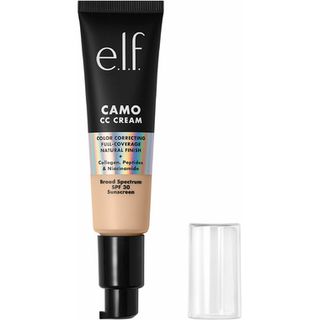
e.l.f. Cosmetics Camo CC Cream SPF 30
Works for
2 of 3 advertised claims delivered
Sun protectionSPF 30 · 2 UV filters · Partial spectrumWeak protectionLow filter dose
This product does not offer good protection against UVA rays.
This product can be considered "reef safe" because it does not contain the UV filters (oxybenzone and octinoxate) that can be harmful to coral reefs when present in the water in high concentrations.
Moisturizing19 ingredients credited for this claimStrong support
“A multitasking dream CC cream infused with collagen, peptides and niacinamide known to plump, hydrate and smooth the appearance of your skin while protecting with SPF 30. Great for all skin types All e.l.f.”
This product can help improve hydration of the skin with the two types of ingredients.
The first type is called “humectants”:
these ingredients help attract water.
When humectants are on the surface of the skin, they “pull in” the moisture from the outside environment, or from
within deeper layers of the skin. The following ingredients in this product do the job:
glycerin, sodium hyaluronate.
This product also contains ingredients called “occlusives”. They help reduce the speed with which our skin loses moisture to the outside environment. These ingredients also help soften the upper layer of the skin, so it feels less tight and nicer to the touch. The following ingredients in this product do the job: dimethicone, helianthus annuus seed oil.
The following ingredients in this product are especially good for supporting the skin barrier and helping with the hydration level: palmitoyl tetrapeptide-7, palmitoyl tripeptide-1
Anti-aging4 ingredients credited for this claimModerate support
“A multitasking dream CC cream infused with collagen, peptides and niacinamide known to plump, hydrate and smooth the appearance of your skin while protecting with SPF 30. Great for all skin types All e.l.f.”
This product contains palmitoyl tetrapeptide-7, palmitoyl tripeptide-1. These ingredients might be able to help reduce and prevent fine lines and wrinkles, improve skin elasticity and firmness, but there is not enough evidence that it actually works. The biggest anti-aging effect in this product comes from sun protection. Sun damage is the main factor causing early signs of skin aging. We, however, do not recommend using this product as a sunscreen because the protection it offers is not strong enough).
Can it cause trouble?
Irritancy11 flagged ingredientsMedium risk
ComedogenicClean of flagged comedogenic ingredientsNone flagged


User reviews
Be the first — your take helps the next person decide.
Ingredients
Filter by role to see what each ingredient is doing.
Water~45–55%
Dimethicone~5.8–7.1%
- Irritation risk
- Low
A silicone that helps to reduce water loss from the surface of the skin. Can temporarily "fill in" lines and wrinkles, absorb oil, and create a nice product finish
More about DimethiconeCyclopentasiloxane~4.4–5.4%
- Irritation risk
- Low
A silicone that helps improve the product texture and spreadability. Can absorb oil creating a short-term mattifying effect on the skin
More about CyclopentasiloxaneButylene glycol~3.1–3.8%
- Irritation risk
- Low
Used to create a nice product texture and help delivery of other ingredients. Might be somewhat helpful in attracting water to the upper layer of the skin
More about Butylene glycolPhenyl trimethicone~2.4–3%
- Irritation risk
- Low
A type of silicone that can decrease loss of moisture from the skin surface. It helps create a nice product texture
More about Phenyl trimethiconeCetyl peg/ppg-10/1 dimethicone~1.9–2.3%
- Irritation risk
- Low
A type of silicone that helps water and oil mix together. Can help to soften upper layer of the skin
More about Cetyl peg/ppg-10/1 dimethiconeButylene glycol dicaprylate/dicaprate~1.7–2%
- Irritation risk
- Low
Helps soften the upper layer of the skin
More about Butylene glycol dicaprylate/dicaprateButyloctyl salicylate~1.4–1.7%
- Irritation risk
- Medium
A synthetic ester of salicylic acid that is used to help disperse pigments and boost effectiveness of sunscreen ingredients. It is able to absorb UV light (working as an organic, or chemical filter), but is not approved as a sunscreen ingredient on its own
More about Butyloctyl salicylatePolyglyceryl-4 isostearate~1.2–1.4%
- Irritation risk
- Medium
Helps water and oil mix together
More about Polyglyceryl-4 isostearateMethyl methacrylate crosspolymer~1–1.2%
- Irritation risk
- Low
Helps thicken the product consistency
More about Methyl methacrylate crosspolymerCyclohexasiloxane~0.75–1.1%
- Irritation risk
- Low
A silicone that serves as an emollient. Helps create a nice non-greasy feels
More about CyclohexasiloxaneAcrylates/polytrimethylsiloxymethacrylate copolymer~0.6–0.9%
- Irritation risk
- Low
Hexyl laurate~0.55–0.8%
- Irritation risk
- Medium
Helps soften the upper layer of the skin and create a nice product consistency
More about Hexyl laurateMagnesium sulfate~0.55–0.8%
Phenoxyethanol~0.45–0.65%
- Irritation risk
- Low
A preservative. It helps prevent bacterial growth in cosmetic products
More about PhenoxyethanolTriethoxycaprylylsilane~0.45–0.65%
- Irritation risk
- Low
A type of silicone that helps oil and water mix well together. Helps to disperse other ingredients, e.g. pigments, evenly in a formulation
More about TriethoxycaprylylsilaneDisteardimonium hectorite~0.4–0.65%
- Irritation risk
- Low
A type of clay that is used to thicken the product consistency
More about Disteardimonium hectoriteHydrated silica~0.5–0.75%
Aluminum hydroxide~0.35–0.65%
- Irritation risk
- Low
Is used to add opaque (non-transparent) appearance to formulations. Can be used to coat other ingredients for even dispersion. This is a different ingredient compared to the ones used in antipersperants (aluminium chloride and aluminium chlorohydrate)
More about Aluminum hydroxidePropylene carbonate~0.3–0.6%
- Irritation risk
- Low
Is used to dissolve other ingredients and create nice product texture
More about Propylene carbonateDimethicone/methicone copolymer~0.3–0.5%
- Irritation risk
- Low
Caprylyl glycol~0.3–0.55%
- Irritation risk
- Medium
Helps preserve products and creates a nice product texture
More about Caprylyl glycolEthylhexylglycerin~0.25–0.45%
Disodium edta~0.25–0.45%
Tocopheryl acetate~0.25–0.5%
- Irritation risk
- Medium
A more stable but less bio-available form of vitamin E compared to Tocopherol. Might help moisturize and protect the skin from free radicals, but mostly used in low concentrations to stabilize other ingredients.
More about Tocopheryl acetateSodium hyaluronate~0.25–0.45%
- Irritation risk
- Low
One of the best moisturizing ingredients. Attracts water into the upper layer of the skin
More about Sodium hyaluronateNiacinamide~0.25–0.45%
- Irritation risk
- Low
Is proven to be effective in reducing blemishes, evening out skin tone and helping to improve lines and wrinkles. It helps the skin to repair sun damage, calm down inflammation and keep maintain good levels of moisture. The concentration of about 2% is effective for supporting the skin barrier and evening out the skin tone. Concentration of 4-6% is better for helping with acne and balancing the sebum production
More about NiacinamidePanthenol~0.25–0.45%
- Irritation risk
- Low
Helps attract water to the upper layer of the skin and can help improve skin barrier function
More about PanthenolAscorbyl palmitate~0.25–0.45%
- Irritation risk
- Medium
Being a lipid soluble form of vitamin C, it is more stable and can penetrate the skin better than L-Ascorbic acid. It is effective in protecting the skin from free radicals, as well as evening the skin tone, but is less effective in stimulating collagen production compared to L-Ascorbic acid.
More about Ascorbyl palmitateSoluble collagen~0.25–0.45%
- Irritation risk
- Low
A typically plant-derived compound that is supposed mimic human collagen. Cannot penetrate the skin barrier so is not particularly useful in skincare products beyond attracting water to the upper layer of the skin
More about Soluble collagenCanola oil~0.25–0.5%
- Irritation risk
- Medium
A plant oil that can help soften the upper layer of the skin
More about Canola oilGlycerin~0.3–0.55%
- Irritation risk
- Low
One of the best moisturizing ingredients. Naturally present in skin. It attracts water to the upper layer of the skin working as a humectant
More about GlycerinDaucus carota sativa seed oil~0.25–0.5%
- Irritation risk
- Low
A plant oil that might help neutralize free radicals and have an anti-bacterial effect
More about Daucus carota sativa seed oilCarbomer~0.25–0.45%
- Irritation risk
- Low
Helps create a thicker or gel-like product texture. It is not a surfactant but can be used in gentle cleansing formulations
More about CarbomerDaucus carota sativa root extract~0.25–0.45%
- Irritation risk
- Low
Carrot extract. Might have anti-oxidant properties and be used to add orange color
More about Daucus carota sativa root extractHelianthus annuus seed oil~0.25–0.5%
- Irritation risk
- Low
A great emollient due to its high linoleic acid content. One of the most effective plant oils in helping skin hydration and repairing skin barrier function
More about Helianthus annuus seed oilBeta-carotene~0.25–0.4%
Polysorbate 20~0.25–0.5%
Palmitoyl tripeptide-1~0.25–0.5%
- Irritation risk
- Low
A type of peptide. Peptides are excellent moisturizers and might be able support collagen production reducing fine lines and wrinkles
More about Palmitoyl tripeptide-1Palmitoyl tetrapeptide-7~0.25–0.45%
- Irritation risk
- Low
A type of peptide. Peptides are excellent moisturizers and might be able support collagen production reducing fine lines and wrinkles
More about Palmitoyl tetrapeptide-71,2-hexanediol~0.2–0.35%
Titanium dioxide~0.3–0.55%
- Irritation risk
- Low
Works as a UV filter when used in high concentrations. It is photostable and is effective mostly against the UVB light, with some protection in the UVA range. In small concentrations, used for its ability to improve the color of cosmetic products. Is usually well tolerated by the skin
More about Titanium dioxideCi 77891~0.15–0.3%
- Irritation risk
- Low
Ci 19140~0.15–0.25%
Ci 77492~0.15–0.25%
Ci 77491~0.1–0.15%
- Irritation risk
- Low
A red colorant made of iron oxide. Typically is not irritating
More about Ci 77491Ci 77499~0.1–0.15%
Ingredient list view
Water, Dimethicone, Cyclopentasiloxane, Butylene glycol, Phenyl trimethicone, Cetyl peg/ppg-10/1 dimethicone, Butylene glycol dicaprylate/dicaprate, Butyloctyl salicylate, Polyglyceryl-4 isostearate, Methyl methacrylate crosspolymer, Cyclohexasiloxane, Acrylates/polytrimethylsiloxymethacrylate copolymer, Hexyl laurate, Magnesium sulfate, Phenoxyethanol, Triethoxycaprylylsilane, Disteardimonium hectorite, Hydrated silica, Aluminum hydroxide, Propylene carbonate, Dimethicone/methicone copolymer, Caprylyl glycol, Ethylhexylglycerin, Disodium edta, Tocopheryl acetate, Sodium hyaluronate, Niacinamide, Panthenol, Ascorbyl palmitate, Soluble collagen, Canola oil, Glycerin, Daucus carota sativa seed oil, Carbomer, Daucus carota sativa root extract, Helianthus annuus seed oil, Beta-carotene, Polysorbate 20, Palmitoyl tripeptide-1, Palmitoyl tetrapeptide-7, 1,2-hexanediol, Titanium dioxide, Ci 77891, Ci 19140, Unknown, Ci 77492, Ci 77491, Ci 77499
Compare prices
Retailers ranked by price — lowest first.
Affiliate links · prices updated regularly · As an Amazon Associate, WIMJ earns from qualifying purchases.
Worth comparing, line by line.
Match % combines shared ingredients, the first five ingredients, shared actives and hero ingredients, irritancy (lower counts in the alternative's favour), texture and body area. Only products in the same routine step are compared.
| e.l.f. CosmeticsCamo CC Cream SPF 30YOUR PRODUCT | VichyLiftActiv Specialist B3 Dark Spot Serum + B3 Anti-Dark Spots Cream SPF50 Free | ROVECTINSkin Essentials Deep Moisture UV Protector SPF50+ PA++++ | BaleaNiacinamide Tagescreme LSF30 | |
|---|---|---|---|---|
| Match | — | 79% | 73% | 72% |
| Price | $12.53 | $46.79+$34.26 | — | — |
| Shared key ingredients | — | 6 of 15 | 6 of 15 | 3 of 15 |
| Key difference | — | Ascorbyl Glucoside | Adenosine | Uvinul T |
| Irritancy | Medium | Medium | Medium | Low |
| SPF | SPF 30 | SPF 50 | SPF 50 | SPF 30 |
| Drying alcohol | — | Contains drying alcohol | — | — |
| View product | Shop | Shop | Shop |


Product summary
"e. L. F. Cosmetics - Camo CC Cream SPF 30" does not provide enough UVA protection. UVA rays do not cause sunburn, but still damage the skin, leading to early signs of aging and pigmentation issues.
This product should also be hydrating enough to use without an additional moisturizer during the day.
Sunscreen filters
This sunscreen uses so-called "chemical", or organic UV filters (organic simply means that their molecules contain atoms of carbon). These filters typically give good sun protection and rarely leave a white cast, but they can be irritating for sensitive skin. These are the sun protection ingredients in this sunscreen: butyloctyl salicylate 1.40% - 1.70%.
Irritation risk
There are some common irritants in this product, including ingredients that do not have benefits for the skin. We assess the overall irritancy of it to be medium. For a detailed overview of all potential irritants: click here
You can see the detailed formula review with the breakdown of all actives in the product and the full ingredient list with estimated concentrations in the tables below.
Price
The product retails for 17.99CA$ in Canada and for 17.86£ in the United Kingdom.
For a detailed price comparison: click here.
Sources cited in this review
Every concentration estimate and effectiveness label is anchored to one of these 20 studies and safety reviews.
- 1
- 2Final Report on the Safety Assessment of Dimethicone Copolyoljournals.sagepub.com
- 3
- 4Safety Assessment of Magnesium Sulfate as Used in Cosmeticsncbi.nlm.nih.gov
- 5
- 6Hyaluronic acid: A key molecule in skin agingncbi.nlm.nih.gov

Affiliate links · As an Amazon Associate, WIMJ earns from qualifying purchases.