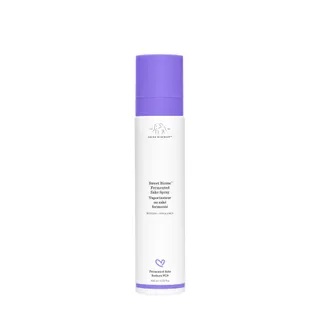
Drunk Elephant Sweet Biome Fermented Sake Spray
Works for
MoisturizingLinoleic acid, Phytosphingosine + 32 moreWorks well
“A cocktail of fermented sake extract, kombucha and hops 'feeds' your skin cells with restorative nutrients, while coconut water and sodium PCA (both powerful electrolytes) deliver a big dose of hydration.”
This product can help improve hydration of the skin with the two types of ingredients.
The first type is called “humectants”:
these ingredients help attract water.
When humectants are on the surface of the skin, they “pull in” the moisture from the outside environment, or from
within deeper layers of the skin. The following ingredients in this product do the job:
alanine, arginine.
This product also contains ingredients called “occlusives”. They help reduce the speed with which our skin loses moisture to the outside environment. These ingredients also help soften the upper layer of the skin, so it feels less tight and nicer to the touch. The following ingredients in this product do the job: arginine, cholesterol.
The following ingredients in this product are especially good for supporting the skin barrier and helping with the hydration level: ceramide ap, ceramide eop, ceramide np, linoleic acid, phytosphingosine
Anti-agingGalactomyces ferment filtrate, Aspartic acid + 7 moreMay help
“Coconut water and sodium PCA provide hydration and antioxidant protection, while copper, zinc and calcium gluconate help to support the skin's natural collagen and reduce the look of redness.”
This product contains aspartic acid, galactomyces ferment filtrate, serine, threonine. These ingredients might be able to help reduce and prevent fine lines and wrinkles, improve skin elasticity and firmness, but there is not enough evidence that it actually works.
Anti-oxidationSide benefit · Galactomyces ferment filtrate, Sclerocarya birrea seed oil + 4 moreWorks well
This product contains antioxidants (galactomyces ferment filtrate) that can help neutralize free radicals in skin. By doing so, they can lessen the damage the skin gets from the UV light (sun).
Evens skin toneSide benefit · Galactomyces ferment filtrate, Alanine + 3 moreMay help
The following ingredient (ingredients) in this product might be helpful, but there is no evidence to confirm that it actually works: alanine, galactomyces ferment filtrate.
Can it cause trouble?
Irritancy1 strong irritant: Humulus lupulus extractMedium risk
ComedogenicClean of flagged comedogenic ingredientsNone flagged
User reviews
Be the first — your take helps the next person decide.
Ingredients
Filter by role to see what each ingredient is doing.
Water~45–55%
Sodium pca~6.2–7.5%
- Irritation risk
- Low
Naturally present in skin and helps to attract water to its upper layer
More about Sodium pcaPropanediol~4.1–5%
- Irritation risk
- Low
Acts as a solvent for other ingredients. Speeds up the absorption of other ingredients into the skin
More about PropanediolGalactomyces ferment filtrate~3.1–3.7%
- Irritation risk
- Low
A yeast ferment filtrate (also known as Pitera - a trademarked name for the filtrate reserved by the SK-II brand). It helps attract water to the upper layer of the skin, can help neutralize antioxidants and can be helpful in evening out the skin tone. It might be somewhat helpful in preventing premature skin aging but solid evidence is lacking. A small manufacturer study also shows that, when used in high concentrations, it can help reduce sebum production and help against blocked pores
More about Galactomyces ferment filtrateGlycerin~2.4–2.9%
- Irritation risk
- Low
One of the best moisturizing ingredients. Naturally present in skin. It attracts water to the upper layer of the skin working as a humectant
More about GlycerinBeta vulgaris root extract~1.9–2.3%
- Irritation risk
- Medium
A plant extract that might have some antioxidant properties, but mostly used in cosmetics for its color
More about Beta vulgaris root extractFructooligosaccharides~1.6–2%
- Irritation risk
- Low
Help attract water to the upper layer of the skin
More about FructooligosaccharidesSaccharomyces/xylinum/black tea ferment~1.4–1.7%
- Irritation risk
- Low
A fermented sweet black tea. There is no studies on particular benefits of this ingredient in skin. It can help attract water to the upper layer of the skin, and might have some anti-oxidant effect. It is used in skincare for mostly marketing purposes because of the popularity of kombucha drinks
More about Saccharomyces/xylinum/black tea fermentCocos nucifera fruit juice~1.2–1.4%
- Irritation risk
- Low
Sclerocarya birrea seed oil~1–1.2%
- Irritation risk
- Medium
An emollient that helps to soften the skin. It has a high contetn of oleic acid that might weaken the skin barrier. Might have some anti-oxidant properties. It might be somewhat helpful against hyperpigmentation.
More about Sclerocarya birrea seed oilLactic acid~0.7–1.05%
- Irritation risk
- Medium
An exfoliating and moisturizing alpha-hydroxy acid (AHA). Typically causes less irritation than other AHAs, for example, glycolic acid. At high concentrations (about 15%), lactic acid can help reduce lines and wrinkles. Recent studies show that lactic acid can support the "good" bacteria living on skin's surface (healthy skin microbiome)
More about Lactic acidPentylene glycol~0.65–1%
- Irritation risk
- Medium
Used to preserve products, dissolve other ingredients and create a nice product texture
More about Pentylene glycolSodium hyaluronate crosspolymer~0.55–0.85%
- Irritation risk
- Medium
Attracts water into the upper layer of the skin
More about Sodium hyaluronate crosspolymerZinc gluconate~0.5–0.75%
- Irritation risk
- Medium
Typically used to stabilize the product formulations. It is a salt of a polyhydroxy acid (PHA) and in larger concentrations, can help shed the dead cells from the skin surface revealing smoother skin. It can help attract water to the upper layer of the skin. Might to be helpful against acne and clogged pores. Could be helpful in neutralizing free radicals, but solid research is missing. Due to the zinc content, might help calm down inflammation in skin
More about Zinc gluconateSodium lactate~0.5–0.75%
- Irritation risk
- Medium
Helps attract water to the upper layer of the skin. Is often used to adjust the pH level of the product
More about Sodium lactateMagnesium aspartate~0.5–0.7%
- Irritation risk
- Low
Might be helpful in restoring skin barrier function and calm down inflammation in skin
More about Magnesium aspartatePca~0.5–0.7%
- Irritation risk
- Low
Naturally present in skin and helps to attract water to its upper layer
More about PcaAlanine~0.45–0.65%
- Irritation risk
- Low
An amino-acid that helps to attract water to the upper layer of the skin and might help to lighten the skin, but solid evidence is lacking
More about AlanineArginine~0.35–0.65%
- Irritation risk
- Low
An amino acid that is naturally present in skin and helps keep it hydrated. When used together with AHAs, it can reduce their irritating effect on the skin
More about ArginineGlycine~0.35–0.6%
- Irritation risk
- Low
Helps to attract water to the upper layer of the skin and can help restore the skin barrier function
More about GlycineHistidine~0.3–0.6%
Isoleucine~0.3–0.6%
- Irritation risk
- Low
An amino acid that can help attract water to the upper layer of the skin and support skin's barrier function
More about IsoleucinePhenylalanine~0.3–0.55%
- Irritation risk
- Low
Proline~0.3–0.6%
Serine~0.3–0.55%
- Irritation risk
- Low
An amino-acid that helps to attract water to the upper layer of the skin. In combination with other amino-acids, might help to reduce fine lines and wrinkles
More about SerineThreonine~0.3–0.55%
- Irritation risk
- Low
An amino-acid that helps to attract water to the upper layer of the skin. In combination with other amino-acids, might help to reduce fine lines and wrinkles
More about ThreonineValine~0.3–0.55%
- Irritation risk
- Low
Aspartic acid~0.3–0.55%
- Irritation risk
- Low
An amino-acid that helps increase skin hydration and might help to slightly improve skin firmness, potentially reducing lines and wrinkles
More about Aspartic acidCalcium gluconate~0.35–0.6%
- Irritation risk
- Low
Helps attract water to the upper layer of the skin and helps to improve appearance of the product
More about Calcium gluconateCopper gluconate~0.3–0.55%
- Irritation risk
- Medium
Typically used to stabilize the product formulations. It is a salt of polyhydroxy acid (PHA) and in larger concentrations, can help shed the dead cells from the skin surface revealing smoother skin. It can help attract water to the upper layer of the skin. Might to be helpful against acne and clogged pores. Could be helpful in neutralizing free radicals, but solid research is missing
More about Copper gluconateTrehalose~0.3–0.55%
- Irritation risk
- Low
A sugar that attracts water to the upper layer of the skin
More about TrehaloseLinoleic acid~0.45–0.7%
- Irritation risk
- Low
An excellent emollient. Helps soften the skin, restore its barrier function, and can help to calm down inflammation. It can be helpful to prevent blemishes and clogged pores
More about Linoleic acidLinolenic acid~0.45–0.65%
- Irritation risk
- Medium
An emollient that helps soften the skin and calm down inflammation
More about Linolenic acidCeramide ap~0.35–0.6%
- Irritation risk
- Low
A type of lipid similar to ceramides naturally present in skin. Helps to soften the upper layer of the skin and supports the skin barrier function to keep it hydrated. Can help to prevent inflammation in skin
More about Ceramide apCeramide eop~0.35–0.6%
- Irritation risk
- Low
A type of lipid similar to ceramides naturally present in skin. Helps to soften the upper layer of the skin and supports the skin barrier function to keep it hydrated. Can help to prevent inflammation in skin
More about Ceramide eopCeramide np~0.35–0.65%
- Irritation risk
- Low
A type of lipid similar to ceramides naturally present in skin. Helps to soften the upper layer of the skin and supports the skin barrier function to keep it hydrated. Can help to prevent inflammation in skin
More about Ceramide npPhytosphingosine~0.35–0.65%
- Irritation risk
- Low
A type of lipid that is naturally present in skin. It might help in repairing skin barrier function and has anti-bacterial effect
More about PhytosphingosineCholesterol~0.4–0.6%
- Irritation risk
- Low
An emollient that is naturally found in skin
More about CholesterolXylitol~0.3–0.55%
- Irritation risk
- Low
Helps attract water to the upper layer of the skin and repair the skin barrier function
More about XylitolHumulus lupulus extract~0.3–0.55%
- Irritation risk
- High
Hops extract. Can contain common irritants and allergens geraniol, limonene, linalool
More about Humulus lupulus extractHyaluronic acid~0.3–0.55%
- Irritation risk
- Low
One of the best moisturizing ingredients. Attracts water into the upper layer of the skin. Naturally present in skin. Typically has large molecule size unless advertised otherwise on the product label. Helps support skin's barrier function and may help to reduce inflammation
More about Hyaluronic acidSodium lauroyl lactylate~0.3–0.6%
- Irritation risk
- Medium
Helps water and oil mix together
More about Sodium lauroyl lactylateTapioca starch~0.3–0.55%
Tetrasodium glutamate diacetate~0.25–0.5%
- Irritation risk
- Low
Helps stabilize the product formulation
More about Tetrasodium glutamate diacetateXanthan gum~0.25–0.5%
- Irritation risk
- Low
Used to create a thicker product consistency
More about Xanthan gumPotassium lactate~0.25–0.5%
- Irritation risk
- Low
Polysorbate 20~0.25–0.45%
Citric acid~0.2–0.35%
- Irritation risk
- Medium
Can work as an exfoliant but is typically used to adjust the product pH
More about Citric acidCarbomer~0.2–0.35%
- Irritation risk
- Low
Helps create a thicker or gel-like product texture. It is not a surfactant but can be used in gentle cleansing formulations
More about CarbomerPhenoxyethanol~0.15–0.25%
- Irritation risk
- Low
A preservative. It helps prevent bacterial growth in cosmetic products
More about PhenoxyethanolSodium benzoate~0.1–0.2%
Tocopherol~0.15–0.3%
- Irritation risk
- Low
Pure form of vitamin E. Can help moisturise and protect the skin from free radicals. Often used to help stabilise other ingredients or the formula itself
More about TocopherolSodium hydroxide~0.15–0.25%
Potassium sorbate~0.15–0.25%
Ethylhexylglycerin~0.05–0.15%
Ingredient list view
Water, Sodium pca, Propanediol, Galactomyces ferment filtrate, Glycerin, Beta vulgaris root extract, Fructooligosaccharides, Saccharomyces/xylinum/black tea ferment, Cocos nucifera fruit juice, Sclerocarya birrea seed oil, Lactic acid, Pentylene glycol, Sodium hyaluronate crosspolymer, Zinc gluconate, Sodium lactate, Magnesium aspartate, Pca, Alanine, Arginine, Glycine, Histidine, Isoleucine, Phenylalanine, Proline, Serine, Threonine, Valine, Aspartic acid, Calcium gluconate, Copper gluconate, Trehalose, Linoleic acid, Linolenic acid, Ceramide ap, Ceramide eop, Ceramide np, Phytosphingosine, Cholesterol, Xylitol, Humulus lupulus extract, Hyaluronic acid, Sodium lauroyl lactylate, Tapioca starch, Tetrasodium glutamate diacetate, Xanthan gum, Potassium lactate, Polysorbate 20, Citric acid, Carbomer, Phenoxyethanol, Sodium benzoate, Tocopherol, Sodium hydroxide, Potassium sorbate, Ethylhexylglycerin
Compare prices
Retailers ranked by price — lowest first.

Worth comparing, line by line.
Match % combines shared ingredients, the first five ingredients, shared actives and hero ingredients, irritancy (lower counts in the alternative's favour), texture and body area. Only products in the same routine step are compared.
| Drunk ElephantSweet Biome Fermented Sake SprayYOUR PRODUCT | Rhodeglazing mist | ARZTINA-Cera Barrier Ampoule Toner | CeraVeHydrating Toner | |
|---|---|---|---|---|
| Match | — | 48% | 45% | 43% |
| Price | — | — | $6.96 | $10.87 |
| Shared key ingredients | — | 6 of 29 | 8 of 29 | 6 of 29 |
| Key difference | — | Panthenol | Niacinamide | Niacinamide |
| Irritancy | Medium | Low | Low | Low |
| Drying alcohol | — | — | — | — |
| View product | Shop | Shop | Shop |



More alternatives: hellobubble Cosmic Silk TonerThe Saem Urban Eco Waratah Toner
Product summary
"Drunk Elephant - Sweet Biome™ Fermented Sake Spray" is effective for: Moisturizing and Anti-oxidation
This product could be helpful for: Anti-aging and Evens skin tone, but its actives are not the most effective or are not well-studied.
Ingredient callouts
- This product contains acids (lactic acid 0.70% - 1.05%). Their concentration is low, and they will not have a strong exfoliating effect. Instead, they work to support the skin natural acid mantle and to attract water (as humectants). Lactic acid is particularly good in attracting water to the upper layer of the skin and improving the skin barrier.
- Ceramides (ceramide np 0.35% - 0.65%, ceramide eop 0.35% - 0.60%, phytosphingosine 0.35% - 0.65% and ceramide ap 0.30% - 0.55%). Ceramides are an important part of our natural skin barrier. The Ceramides used in skincare are synthetic or come from plants. They help soften the skin and can help "fill the gaps" in the skin barrier, keeping the skin hydrated and resilient for longer.
- Humectants (pca 0.50% - 0.70%, hyaluronic acid 0.30% - 0.55%, histidine 0.30% - 0.60%, glycine 0.35% - 0.60%, glycerin 2.40% - 2.90%, pitera 3.10% - 3.70%, aspartic acid 0.30% - 0.55%, arginine 0.35% - 0.65%, alanine 0.45% - 0.65%, trehalose 0.30% - 0.55%, sodium pca 6.20% - 7.50%, sodium lactate 0.50% - 0.75%, sodium hyaluronate crosspolymer 0.55% - 0.85% and fructooligosaccharides 1.60% - 2.00%). These ingredients help attract water to the upper layer of the skin and improve the skin hydration.
About the brand
According to Cruelty-Free Kitty "Drunk Elephant" is cruelty free and so is its parent company.
Price
The product retails from 55.00CA$ up to 79.99CA$ in Canada, for 85.05A$ in Australia, for 42.00$ in the United States, from 35.00£ up to 40.00£ in the United Kingdom and for 330.00HK$ in Hong Kong.
For a detailed price comparison: click here.
Sources cited in this review
Every concentration estimate and effectiveness label is anchored to one of these 37 studies and safety reviews.
- 1
- 2
- 3
- 4
- 5
- 6

Affiliate links · As an Amazon Associate, WIMJ earns from qualifying purchases.