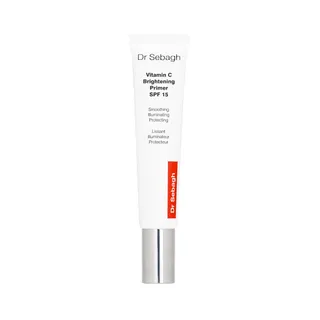
Dr Sebagh Vitamin C Brightening Primer SPF 15
Works for
Sun protectionSPF 15 · 4 UV filters · Broad spectrumWeak protectionSPF under 30
This product offers broad spectrum sun protection, but it is weak. We recommend to use a broad spectrum sunscreen with at least SPF 30.
MoisturizingGlycerin, Diisopropyl sebacate + 11 moreWorks
“Read More Once applied to skin, this primer has an immediate effect, leaving skin looking brighter, smoother and fresh with a combination of Vitamin C, Hyaluronic Acid and three deeply moisturising fruit acids (watermelon, apple and lentil) that support cellular detoxification and regeneration.”
This product can help improve hydration of the skin with the two types of ingredients.
The first type is called “humectants”:
these ingredients help attract water.
When humectants are on the surface of the skin, they “pull in” the moisture from the outside environment, or from
within deeper layers of the skin. The following ingredients in this product do the job:
glycerin, hydrolyzed algae extract.
This product also contains ingredients called “occlusives”. They help reduce the speed with which our skin loses moisture to the outside environment. These ingredients also help soften the upper layer of the skin, so it feels less tight and nicer to the touch. The following ingredients in this product do the job: dimethicone, cetearyl alcohol.
Evens skin tone3-o-ethyl ascorbic acidNot delivered
“Smart Pearl Pigments erase dullness and boost radiance whilst Sea fern extract helps to reduce the appearance of age spots and pigmentation.”
This product contains ingredients () that could help reduce hyperpigmentation (for example, post-acne marks or age spots) in theory, but there is not enough evidence that they actually work.
The biggest effect for evening out skin tone in this product comes from sun protection. Sun damage is the main factor causing age spots, darkening of post-acne marks and other discolorations. This is why sun protection is the best strategy for maintaining an even skin tone. We, however, do not recommend using this product as a sunscreen because the protection it offers is not strong enough).
Anti-aging3-o-ethyl ascorbic acidNot delivered
“The lightweight cream brightens skin with Vitamin C, fills lines, conceals wrinkles and absorbs sebum, allowing makeup to apply seamlessly.”
This product does not contain ingredients that are able to reduce fine lines and wrinkles or help with skin elasticity, but it can improve the look of the skin temporarily through moisturization. Well-moisturized skin might also be able to repair the sun damage better.
The biggest anti-aging effect in this product comes from sun protection. Sun damage is the main factor causing early signs of skin aging. We, however, do not recommend using this product as a sunscreen because the protection it offers is not strong enough).
Can it cause trouble?
Irritancy10 strong irritants: Parfum, Benzyl salicylate + 8 more — patch-test recommendedHigh risk
Comedogenic3 ingredients rated 2 or more on the 0–5 pore-clogging scale3 flagged


User reviews
Be the first — your take helps the next person decide.
Ingredients
Filter by role to see what each ingredient is doing.
Water~45–55%
Octocrylene~4.9–6%
- Irritation risk
- Medium
A weak sunscreen that protects against the sun rays that cause sunburn (UVB) and is somewhat effective against the UVA rays. It is quite stable and can help stabilize other, more vulnerable, sunscreen ingredients like Avobenzone. It is an organic, or so called "chemical" sunscreen
More about OctocryleneEthylhexyl methoxycinnamate~4.5–5.5%
- Irritation risk
- High
Octinoxate. When used in higher concentrations, works as a sunscreen protecting the skin from UVB rays. When used in lower concentration, helps to preserve the product formulation. Is shown to be harmful to coral reefs - consider avoiding bathing in coral reef areas when wearing a product with this ingredient. It can be irritating
More about Ethylhexyl methoxycinnamateGlycerin~3.1–3.7%
- Irritation risk
- Low
One of the best moisturizing ingredients. Naturally present in skin. It attracts water to the upper layer of the skin working as a humectant
More about GlycerinDiisopropyl sebacate~2.4–2.9%
- Irritation risk
- Low
Helps soften the upper layer of the skin without creatng a greasy finish
More about Diisopropyl sebacateButyl methoxydibenzoylmethane~2.6–3.1%
- Irritation risk
- Medium
Avobenzone. An organic, or so-called "chemical" UV filter. Protects against both UVA and UVB rays. Needs to be combined with other filters in a formulation to be stable.
More about Butyl methoxydibenzoylmethaneCetearyl alcohol~1.7–2.1%
- Irritation risk
- Low
- Comedogenicity
- 2/5
A non-drying alcohol. Works as an emollient. Helps water and oil mix together and creates a nice product texture
More about Cetearyl alcoholNylon-6/12~1.6–1.9%
- Irritation risk
- Low
Polyglyceryl-6 laurate~1.2–1.5%
- Irritation risk
- Medium
Helps oil and water mix together
More about Polyglyceryl-6 lauratePolyglyceryl-10 oleate~1–1.2%
- Irritation risk
- Low
Helps soften the upper layer of the skin
More about Polyglyceryl-10 oleateDimethicone~0.8–1.2%
- Irritation risk
- Low
A silicone that helps to reduce water loss from the surface of the skin. Can temporarily "fill in" lines and wrinkles, absorb oil, and create a nice product finish
More about DimethiconeHydroxyethyl acrylate/sodium acryloyldimethyl taurate copolymer~0.6–0.95%
- Irritation risk
- Medium
A gelling agent that thickens the product consistency and leaves the skin with a velvety finish
More about Hydroxyethyl acrylate/sodium acryloyldimethyl taurate copolymerPhenoxyethanol~0.55–0.85%
- Irritation risk
- Low
A preservative. It helps prevent bacterial growth in cosmetic products
More about PhenoxyethanolAmmonium acryloyldimethyltaurate/vp copolymer~0.55–0.8%
- Irritation risk
- Low
Increases thickness of a product. Texture enhancer for oil-in-water emulsions
More about Ammonium acryloyldimethyltaurate/vp copolymerCetearyl glucoside~0.5–0.8%
- Irritation risk
- Medium
Helps water and oil in the product mix well together and improves product texture
More about Cetearyl glucosideCitrullus lanatus fruit extract~0.5–0.75%
- Irritation risk
- Medium
A plant extract that can contain an antioxidant compound
More about Citrullus lanatus fruit extractSorbitan palmitate~0.5–0.75%
- Irritation risk
- Medium
Helps water and oil mix together and stabilize the product formulation
More about Sorbitan palmitatePalmaria palmata extract~0.45–0.7%
- Irritation risk
- Low
- Comedogenicity
- 3/5
Red algae extract that helps attract water to the upper layer of the skin
More about Palmaria palmata extractParfum~0.35–0.65%
- Irritation risk
- High
An aromatic blend of unspecified and possibly irritating ingredients
More about ParfumLens esculenta fruit extract~0.35–0.6%
- Irritation risk
- Medium
A plant extract containing sugars that might help attract water to the upper layer of the skin. Is claimed by the manufacturer to help reduce pore size but evidence is lacking
More about Lens esculenta fruit extractPyrus malus fruit extract~0.3–0.6%
- Irritation risk
- Medium
Can have some moisturizing properties due to its sugar content
More about Pyrus malus fruit extractMica~0.4–0.6%
- Irritation risk
- Low
Creates an illusion of smoother and more radiant skin tone. Adds shimmer to the skin by reflecting light
More about Mica3-o-ethyl ascorbic acid~0.3–0.55%
- Irritation risk
- High
A vitamin C derivative that is more stable but less potent than pure form of vitamin C. Can help neutralize free radicals and help reduce hyperpigmentation, but the required concentration is likely to be much higher than for the pure form of vitamin C, limiting the ingredient's effectiveness in products
More about 3-o-ethyl ascorbic acidTitanium dioxide~0.45–0.7%
- Irritation risk
- Low
Works as a UV filter when used in high concentrations. It is photostable and is effective mostly against the UVB light, with some protection in the UVA range. In small concentrations, used for its ability to improve the color of cosmetic products. Is usually well tolerated by the skin
More about Titanium dioxideDisodium cocoyl glutamate~0.45–0.65%
- Irritation risk
- Medium
Helps water and oil mix together and works as a cleansing agent
More about Disodium cocoyl glutamateSodium cocoyl glutamate~0.45–0.65%
- Irritation risk
- Medium
Helps oil and water mix together
More about Sodium cocoyl glutamateEthylhexylglycerin~0.3–0.55%
Disodium edta~0.3–0.55%
Sodium lactate~0.3–0.55%
- Irritation risk
- Medium
Helps attract water to the upper layer of the skin. Is often used to adjust the pH level of the product
More about Sodium lactateHonokiol~0.3–0.55%
- Irritation risk
- Low
Magnolol~0.3–0.6%
- Irritation risk
- Low
Tocopheryl acetate~0.3–0.6%
- Irritation risk
- Medium
A more stable but less bio-available form of vitamin E compared to Tocopherol. Might help moisturize and protect the skin from free radicals, but mostly used in low concentrations to stabilize other ingredients.
More about Tocopheryl acetateRhizobian gum~0.3–0.6%
- Irritation risk
- Medium
Can temporarily tighten the skin right after application of the product. The effect will be short-lived. Helps improve the product considtency
More about Rhizobian gumSodium hyaluronate~0.3–0.55%
- Irritation risk
- Low
One of the best moisturizing ingredients. Attracts water into the upper layer of the skin
More about Sodium hyaluronateSodium hydroxide~0.3–0.55%
Hydrolyzed algae extract~0.3–0.55%
- Irritation risk
- Low
- Comedogenicity
- 3/5
Helps attract water to the upper layer of the skin
More about Hydrolyzed algae extractSodium pca~0.3–0.55%
- Irritation risk
- Low
Naturally present in skin and helps to attract water to its upper layer
More about Sodium pcaGlucose~0.3–0.55%
- Irritation risk
- Low
Helps attract water to the upper layer of the skin. Could be helpful in restoring the skin barrier function
More about GlucoseChlorphenesin~0.16–0.32%
Potassium sorbate~0.3–0.55%
Sodium benzoate~0.25–0.5%
Bht~0.25–0.45%
Benzyl salicylate~0.2–0.4%
Benzyl benzoate~0.2–0.35%
- Irritation risk
- High
Fragrance with sweet balsamic smell. Help to preserve products and dissolve other ingredients. Could trigger allergic reactions and be irritating
More about Benzyl benzoateHexyl cinnamal~0.15–0.3%
Linalool~0.15–0.25%
Limonene~0.15–0.25%
- Irritation risk
- High
A common frangrance that can easily irritate skin, especially if exposed to air, light or heat
More about LimoneneButylphenyl methylpropional~0.15–0.25%
- Irritation risk
- High
A fragrance. Can trigger allergic reactions and be irritating
More about Butylphenyl methylpropionalCitronellol~0.15–0.25%
Geraniol~0.1–0.15%
Alpha-isomethyl ionone~0.1–0.15%
- Irritation risk
- High
A fragrance. Potential allergen and can be irritating
More about Alpha-isomethyl iononeIngredient list view
Water, Octocrylene, Ethylhexyl methoxycinnamate, Glycerin, Diisopropyl sebacate, Butyl methoxydibenzoylmethane, Cetearyl alcohol, Nylon-6/12, Polyglyceryl-6 laurate, Polyglyceryl-10 oleate, Dimethicone, Hydroxyethyl acrylate/sodium acryloyldimethyl taurate copolymer, Phenoxyethanol, Ammonium acryloyldimethyltaurate/vp copolymer, Cetearyl glucoside, Citrullus lanatus fruit extract, Sorbitan palmitate, Palmaria palmata extract, Parfum, Lens esculenta fruit extract, Pyrus malus fruit extract, Mica, 3-o-ethyl ascorbic acid, Titanium dioxide, Disodium cocoyl glutamate, Sodium cocoyl glutamate, Ethylhexylglycerin, Disodium edta, Sodium lactate, Honokiol, Magnolol, Tocopheryl acetate, Rhizobian gum, Sodium hyaluronate, Sodium hydroxide, Hydrolyzed algae extract, Sodium pca, Glucose, Chlorphenesin, Potassium sorbate, Sodium benzoate, Bht, Benzyl salicylate, Benzyl benzoate, Hexyl cinnamal, Linalool, Limonene, Butylphenyl methylpropional, Citronellol, Geraniol, Alpha-isomethyl ionone
Compare prices
Retailers ranked by price — lowest first.
Affiliate links · As an Amazon Associate, WIMJ earns from qualifying purchases.
Worth comparing, line by line.
Match % combines shared ingredients, the first five ingredients, shared actives and hero ingredients, irritancy (lower counts in the alternative's favour), texture and body area. Only products in the same routine step are compared.
| Dr SebaghVitamin C Brightening Primer SPF 15YOUR PRODUCT | Paula's choiceC+ 5% Vitamin C Sheer Moisturizer SPF 50 | Skin LaneSunny More UV Sunscreen Silky Essence SPF 50+ PA++++ | DermaticaSPF 50 PhotoAge Reverse UV Shield | |
|---|---|---|---|---|
| Match | — | 56% | 52% | 49% |
| Price | $80.99 | $21.66−$59.33 | $36.80−$44.19 | — |
| Shared key ingredients | — | 7 of 12 | 6 of 12 | 4 of 12 |
| Key difference | — | Tetrahexyldecyl Ascorbate | Tinosorb S | Tinosorb S |
| Irritancy | High | Low | High | Low |
| SPF | SPF 15 | SPF 50 | SPF 50 | SPF 50 |
| Drying alcohol | — | — | Contains drying alcohol | — |
| View product | Shop | Shop | Shop |


More alternatives: Supergoop! Daily Dose Vitamin C + SPF 40 SerumShiseido Synchro Skin Self-Refreshing Tint SPF 20
Product summary
"Dr Sebagh - Vitamin C Brightening Primer SPF 15" offers broad spectrum protection. It means that it protects from both UVA and UVB rays (you can remember UVB as "burning" sunlight - they cause sunburn. You can remember UVA rays as "aging" - they do not lead to sunburn, but they cause photodamage and contribute to early signs of skin aging and hyperpigmentation). On the negative side, the SPF of this product is not high enough. We recommend to use a sunscreen with at least SPF 30 daily.
Its formula is also hydrating, so you might not need an additional moistruizer during the day.
Sunscreen filters
This sunscreen uses so-called "chemical", or organic UV filters (organic simply means that their molecules contain atoms of carbon). These filters typically give good sun protection and rarely leave a white cast, but they can be irritating for sensitive skin. Here are the exact UV filters in this sunscreen: avobenzone 2.60% - 3.10%, octinoxate 4.50% - 5.50% and octocrylene 4.90% - 6.00%.
Irritation risk
There are quite a few common irritants in this product, including ingredients without particular skin benefits. We would not recommend it for sensitive skin. We assess the overall irritancy of this sunscreen to be high. For a detailed overview of all potential irritants: click here
You can see the detailed formula review with the breakdown of all actives in the product and the full ingredient list with estimated concentrations in the tables below.
Sources cited in this review
Every concentration estimate and effectiveness label is anchored to one of these 11 studies and safety reviews.
- 1
- 2
- 3Final Report on the Safety Assessment of Dimethicone Copolyoljournals.sagepub.com
- 4Analyzing Lycopene Content in Fruitssciencedirect.com
- 5
- 6

Affiliate links · As an Amazon Associate, WIMJ earns from qualifying purchases.