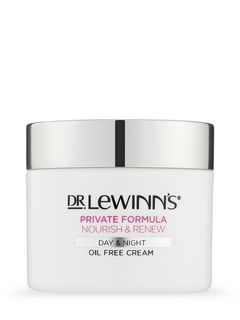
Dr. LeWinns Private Formula Oil Free Day and Night Cream
Works for
2 of 2 advertised claims delivered
Anti-aging7 ingredients credited for this claimModerate support
“Vitamins A (Retinyl Palmitate), C and E. Enriched with CoQ10 (Coenzyme Q10), Sodium Hyaluronate to help slow down the visible signs of ageing skin.”
This product contains ubiquinone. This ingredient help neutralize free radicals in skin. By doing so, they might be able to prevent early signs of aging (like fine lines and wrinkles), at least to some extent. These ingredients will not be able to "reverse" signs of aging.
Moisturizing25 ingredients credited for this claimGood support
“Antioxidants, Vitamins and Hydrators .”
This product can help improve hydration of the skin with the two types of ingredients.
The first type is called “humectants”:
these ingredients help attract water.
When humectants are on the surface of the skin, they “pull in” the moisture from the outside environment, or from
within deeper layers of the skin. The following ingredients in this product do the job:
glycerin, glycine.
This product also contains ingredients called “occlusives”. They help reduce the speed with which our skin loses moisture to the outside environment. These ingredients also help soften the upper layer of the skin, so it feels less tight and nicer to the touch. The following ingredients in this product do the job: caprylic/capric triglyceride, dimethicone.
Anti-oxidationNot advertised by the brand · 10 ingredients credited for this claimStrong support
This product contains antioxidants (ubiquinone) that can help neutralize free radicals in skin. By doing so, they can lessen the damage the skin gets from the UV light (sun).
Can it cause trouble?
Irritancy9 strong irritants: Retinyl palmitate, Parfum + 7 more — patch-test recommendedHigh risk
ComedogenicClean of flagged comedogenic ingredientsNone flagged
User reviews
Be the first — your take helps the next person decide.
Ingredients
Filter by role to see what each ingredient is doing.
Water~45–55%
Caprylic/capric triglyceride~5.8–7.1%
- Irritation risk
- Medium
A good mix of fatty acids that forms a protective layer on the skin. Improves the shelf life of products. Derived from coconut and glycerin
More about Caprylic/capric triglycerideGlycerin~4.2–5.1%
- Irritation risk
- Low
One of the best moisturizing ingredients. Naturally present in skin. It attracts water to the upper layer of the skin working as a humectant
More about GlycerinGlyceryl stearate~2.8–3.5%
- Irritation risk
- Low
An emollient that softens the skin and forms a protective layer on its surface. Helps water and oil mix together
More about Glyceryl stearatePeg-100 stearate~2.4–3%
- Irritation risk
- Low
Helps oil and water mix togehter and creates a nice product texture
More about Peg-100 stearateHexyl laurate~1.9–2.4%
- Irritation risk
- Medium
Helps soften the upper layer of the skin and create a nice product consistency
More about Hexyl laurateButylene glycol~1.6–2%
- Irritation risk
- Low
Used to create a nice product texture and help delivery of other ingredients. Might be somewhat helpful in attracting water to the upper layer of the skin
More about Butylene glycolStearic acid~1.5–1.8%
- Irritation risk
- Low
Helps oil and water mix together and works as an emollient
More about Stearic acidCetyl alcohol~1.2–1.5%
- Irritation risk
- Low
A non-drying alcohol that works to soften the skin and stabilize product formulations helping oil and water mix together
More about Cetyl alcoholSorbitol~0.95–1.15%
- Irritation risk
- Low
Helps attract water to the upper layer of the skin and improves the product texture
More about SorbitolPolysorbate 60~0.7–1.05%
Sorbitan stearate~0.55–0.85%
Dimethicone~0.55–0.85%
- Irritation risk
- Low
A silicone that helps to reduce water loss from the surface of the skin. Can temporarily "fill in" lines and wrinkles, absorb oil, and create a nice product finish
More about DimethiconeStyrene~0.45–0.65%
- Irritation risk
- Low
Magnesium aluminum silicate~0.45–0.65%
- Irritation risk
- Low
Might be helpful in restoring skin barrier function and, when combined with zinc carbonate and malonic acid, reducing fine lines and wrinkles by stimulating elastin production. Also helps stabilize the product formulation
More about Magnesium aluminum silicateXanthan gum~0.45–0.65%
- Irritation risk
- Low
Used to create a thicker product consistency
More about Xanthan gumPhenoxyethanol~0.45–0.65%
- Irritation risk
- Low
A preservative. It helps prevent bacterial growth in cosmetic products
More about PhenoxyethanolCaprylyl glycol~0.4–0.6%
- Irritation risk
- Medium
Helps preserve products and creates a nice product texture
More about Caprylyl glycolEthylhexylglycerin~0.3–0.6%
Hexylene glycol~0.3–0.5%
- Irritation risk
- Medium
Helps create a more spreadable product texture
More about Hexylene glycolRetinyl palmitate~0.25–0.5%
- Irritation risk
- High
Three steps removed from the active form of vitamin A - retinoic acid. To have an effect in the skin, it first needs to be converted twice to become the retinoic acid. This means it is less potent than retinol, but could also be less irritating. Once converted to the retinoic acid in the skin, it helps against all signs of aging, improves skin cell turnover and helps fight blemishes and clogged pores. However, in many cosmetic formulations, it is used in a concentration that is too low to have the full effect
More about Retinyl palmitateParfum~0.25–0.45%
- Irritation risk
- High
An aromatic blend of unspecified and possibly irritating ingredients
More about ParfumLinalool~0.25–0.4%
Geraniol~0.25–0.4%
Benzyl salicylate~0.25–0.4%
Benzyl alcohol~0.2–0.4%
- Irritation risk
- High
A preservative. Can be used to mask unpleasant smell. Can be irritating
More about Benzyl alcoholEugenol~0.2–0.4%
Limonene~0.25–0.4%
- Irritation risk
- High
A common frangrance that can easily irritate skin, especially if exposed to air, light or heat
More about LimoneneAmyl cinnamal~0.25–0.4%
- Irritation risk
- High
Glycosaminoglycans~0.3–0.55%
- Irritation risk
- Low
Long sugars that help attract water to the upper layer of the skin
More about GlycosaminoglycansDipalmitoyl hydroxyproline~0.25–0.45%
- Irritation risk
- Low
Is claimed to stimulate collagen and elastin production, as well as work as an anti-oxidant. There is however not enough evidence for its effectiveness
More about Dipalmitoyl hydroxyprolinePeg-8~0.25–0.5%
- Irritation risk
- Medium
Used to create a nice product consistency
More about Peg-8Tocopherol~0.25–0.45%
- Irritation risk
- Low
Pure form of vitamin E. Can help moisturise and protect the skin from free radicals. Often used to help stabilise other ingredients or the formula itself
More about TocopherolTocopheryl acetate~0.25–0.5%
- Irritation risk
- Medium
A more stable but less bio-available form of vitamin E compared to Tocopherol. Might help moisturize and protect the skin from free radicals, but mostly used in low concentrations to stabilize other ingredients.
More about Tocopheryl acetateAscorbyl palmitate~0.25–0.45%
- Irritation risk
- Medium
Being a lipid soluble form of vitamin C, it is more stable and can penetrate the skin better than L-Ascorbic acid. It is effective in protecting the skin from free radicals, as well as evening the skin tone, but is less effective in stimulating collagen production compared to L-Ascorbic acid.
More about Ascorbyl palmitateAscorbic acid~0.25–0.45%
- Irritation risk
- High
The most well-researched antioxidant that works in skin. Helps neutralize free radicals supporting collagen production, helping to even out the skin tone and preventing early signs of aging
More about Ascorbic acidCitric acid~0.25–0.45%
- Irritation risk
- Medium
Can work as an exfoliant but is typically used to adjust the product pH
More about Citric acidLinoleic acid~0.4–0.6%
- Irritation risk
- Low
An excellent emollient. Helps soften the skin, restore its barrier function, and can help to calm down inflammation. It can be helpful to prevent blemishes and clogged pores
More about Linoleic acidGlycine soja sterols~0.3–0.5%
- Irritation risk
- Low
An emollient that helps soften the skin
More about Glycine soja sterolsPhospholipids~0.25–0.45%
- Irritation risk
- Low
Emollients that are naturaly present in skin. In addition, they help water and oil mix together in the product
More about PhospholipidsUbiquinone~0.25–0.45%
- Irritation risk
- Low
Coenzyme Q10. It helps neutralize free radicals in skin, improves skin hydration and might be helpful agains fine lines and wrinkles. It can be an allergen
More about UbiquinoneSqualane~0.3–0.55%
- Irritation risk
- Low
An oil naturally present in skin. Works as an emollient to soften the skin and form a protective layer on its surface without a greasy feeling.
More about SqualaneAlthaea officinalis root extract~0.25–0.45%
- Irritation risk
- High
A plant extract that can help attract water to the upper layer of the skin and might help to reduce inflammation
More about Althaea officinalis root extractArnica montana flower extract~0.2–0.35%
- Irritation risk
- High
A plant extract that can be irritating. It can have some anti-bacterial properties, but there are no evidence of a beneficial effect for skin
More about Arnica montana flower extractCucumis sativus fruit extract~0.2–0.4%
- Irritation risk
- Medium
Might be somewhat helpful in reducing hyperpigmentation and neutralizing free radicals but its typical concentration in a product is too low for having an effect
More about Cucumis sativus fruit extractHedera helix extract~0.2–0.35%
- Irritation risk
- High
A plant extract that has an anti-bacterial effect
More about Hedera helix extractSambucus nigra flower extract~0.2–0.35%
- Irritation risk
- High
A plant extract that might help neutralize free radicals in skin
More about Sambucus nigra flower extractHydrolyzed rice protein~0.2–0.35%
- Irritation risk
- Low
Helps attract water to the upper layer of the skin. Might have some anti-oxidant properties
More about Hydrolyzed rice proteinHydrolyzed pea protein~0.2–0.4%
- Irritation risk
- Low
Glycine~0.15–0.3%
- Irritation risk
- Low
Helps to attract water to the upper layer of the skin and can help restore the skin barrier function
More about GlycineProline~0.2–0.35%
Hydrolyzed sodium hyaluronate~0.15–0.25%
- Irritation risk
- Low
Attracts water into the upper layer of the skin
More about Hydrolyzed sodium hyaluronateCi 19140~0.1–0.15%
Ci 15985~0.1–0.15%
Ingredient list view
Water, Caprylic/capric triglyceride, Glycerin, Glyceryl stearate, Peg-100 stearate, Hexyl laurate, Butylene glycol, Stearic acid, Cetyl alcohol, Sorbitol, Polysorbate 60, Sorbitan stearate, Dimethicone, Styrene, Unknown, Magnesium aluminum silicate, Xanthan gum, Phenoxyethanol, Caprylyl glycol, Ethylhexylglycerin, Hexylene glycol, Retinyl palmitate, Parfum, Linalool, Geraniol, Benzyl salicylate, Benzyl alcohol, Eugenol, Limonene, Amyl cinnamal, Glycosaminoglycans, Dipalmitoyl hydroxyproline, Peg-8, Tocopherol, Tocopheryl acetate, Ascorbyl palmitate, Ascorbic acid, Citric acid, Linoleic acid, Glycine soja sterols, Phospholipids, Ubiquinone, Squalane, Althaea officinalis root extract, Arnica montana flower extract, Cucumis sativus fruit extract, Hedera helix extract, Sambucus nigra flower extract, Hydrolyzed rice protein, Hydrolyzed pea protein, Glycine, Proline, Hydrolyzed sodium hyaluronate, Ci 19140, Ci 15985
Compare prices
Retailers ranked by price — lowest first.

Affiliate links · prices updated regularly
Worth comparing, line by line.
Match % combines shared ingredients, the first five ingredients, shared actives and hero ingredients, irritancy (lower counts in the alternative's favour), texture and body area. Only products in the same routine step are compared.
| Dr. LeWinnsPrivate Formula Oil Free Day and Night CreamYOUR PRODUCT | NaturiumRetinol Cream 2.5% | HydroPeptideTravel-Size Nimni Cream | EmbryolisseEmbryoderme Face Cream | |
|---|---|---|---|---|
| Match | — | 61% | 58% | 58% |
| Price | — | $15.99 | $45.00 | $32.95 |
| Shared key ingredients | — | 7 of 14 | 7 of 14 | 6 of 14 |
| Key difference | — | Retinol | Retinol | Mineral Oil |
| Irritancy | High | Medium | Medium | Medium |
| Drying alcohol | — | — | — | — |
| View product | Shop | Shop | Shop |


Sources cited in this review
Every concentration estimate and effectiveness label is anchored to one of these 22 studies and safety reviews.
- 1
- 2
- 3Final Report on the Safety Assessment of Dimethicone Copolyoljournals.sagepub.com
- 4
- 5
- 6

Affiliate links · As an Amazon Associate, WIMJ earns from qualifying purchases.