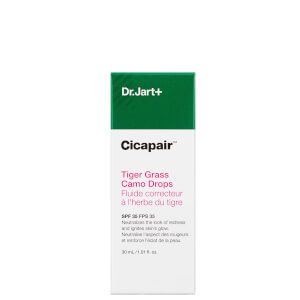
Dr. Jart+ + Cicapair Tiger Grass Camo Drops SPF35

Dr. Jart+ + Cicapair Tiger Grass Camo Drops SPF35

SPF 35Efficacy60/100IrritancyHigh·3 UV filters
Edit

Works for

1 of 3 advertised claims delivered

Sun protection
SPF 35 · 3 UV filters · Partial spectrum
Weak protectionLow filter dose
SPF 35Partial spectrumChemical filtersNano filters

This product does not offer good protection against UVA rays.

This product can be considered "reef safe" because it does not contain the UV filters (oxybenzone and octinoxate) that can be harmful to coral reefs when present in the water in high concentrations.

UV spectrum
UVB290–320 nmUVA II320–340 nmUVA I340–400 nm
Butyloctyl Salicylate
Titanium Dioxide
Zinc Oxide
FilterCoverageWhat it doesEst. amount
Butyloctyl SalicylateUVBA synthetic ester of salicylic acid that is used to help disperse pigments and boost effectiveness of sunscreen ingredients. It is able to absorb UV light (working as an organic, or chemical filter), but is not approved as a sunscreen ingredient on its own~2.3–2.9%
Titanium Dioxide Mineral UVBUVA2 Photo-stable Works as a UV filter when used in high concentrations. It is photostable and is effective mostly against the UVB light, with some protection in the UVA range. In small concentrations, used for its ability to improve the color of cosmetic products. Is usually well tolerated by the skin~0.45–0.7%
Zinc Oxide Mineral UVBUVA Photo-stable A broad spectrum sunblock (protects from both UVA and UVB rays). Is suitable for most sensitive skins. In small concentrations, can be used as a colorant~1.2–1.4%
~ marks concentrations estimated from label position and typical use levels
Reef-safe
No oxybenzone or octinoxate — the two filters banned in Hawaii, Florida Keys and Aruba.
Moisturizing
Madecassoside, Ceramide np + 25 more
Strong evidence
What the product description says
“Lending a soothing effect to the skin, the hydrating formula creates the illusion of a glowing, dewy visage, and can be used under makeup as an illuminating primer.”
Source: Lookfantastic

This product can help improve hydration of the skin with the two types of ingredients.

The first type is called “humectants”:
these ingredients help attract water. When humectants are on the surface of the skin, they “pull in” the moisture from the outside environment, or from within deeper layers of the skin. The following ingredients in this product do the job: glycerin, butylene glycol.

This product also contains ingredients called “occlusives”. They help reduce the speed with which our skin loses moisture to the outside environment. These ingredients also help soften the upper layer of the skin, so it feels less tight and nicer to the touch. The following ingredients in this product do the job: beeswax, cera alba.

The following ingredients in this product are especially good for supporting the skin barrier and helping with the hydration level: ceramide np, madecassoside

BeeswaxKey active· Emollient, OcclusiveEffect: HighForms a protective barrier that holds water and keeps dry skin hydrated. Keeps an emulsion from separating into its oil and liquid components, and increases the thickness of a product. Can be an allergen~0.2–0.4%
MadecassosideHeroEffect: HighAn antioxidant that is typically derived from plant Centella Asiatica. It can help neutralize free radicals in skin and support skin barrier function. It could, however, itself be irritating. It is often unstable in formulations~0.2–0.35%
GlycerinKey active· HumectantEffect: HighOne of the best moisturizing ingredients. Naturally present in skin. It attracts water to the upper layer of the skin working as a humectant~0.25–0.4%
Cera albaKey active· Emollient, OcclusiveEffect: HighForms a protective barrier that holds water and keeps dry skin hydrated. Keeps an emulsion from separating into its oil and liquid components, and increases the thickness of a product. Can be an allergen~0.3–0.55%
Helianthus annuus seed oilKey active· Emollient, OcclusiveEffect: HighA great emollient due to its high linoleic acid content. One of the most effective plant oils in helping skin hydration and repairing skin barrier function~0.2–0.35%
Ceramide npHero· EmollientEffect: HighA type of lipid similar to ceramides naturally present in skin. Helps to soften the upper layer of the skin and supports the skin barrier function to keep it hydrated. Can help to prevent inflammation in skin~0.25–0.4%
PolymethylsilsesquioxaneKey activeEffect: HighA silicone that improves product texture and helps dissolve other ingredients. Can form a non-greasy film on the skin to prevent moisture loss~0.35–0.65%
CyclopentasiloxaneKey active· EmollientEffect: MediumA silicone that helps improve the product texture and spreadability. Can absorb oil creating a short-term mattifying effect on the skin~6.3–7.7%
IsododecaneKey active· Emollient, OcclusiveEffect: MediumAn emollient that helps soften the skin and can decrease moisture loss. Helps create a nice product texture~1.6–2%
AdenosineKey activeEffect: MediumMight help improve cell turnover and reduce inflammation in skin. One study shows that the ingredients might be able to help reduce dynamic wrinkles (for example, in the corners of the eyes or on the forehead)~0.15–0.3%
Brassica campestris sterolsKey active· EmollientEffect: MediumHelp soften the upper layer of the skin~0.2–0.4%
Magnesium aspartateKey activeEffect: MediumMight be helpful in restoring skin barrier function and calm down inflammation in skin~0.2–0.35%
Butylene glycol· HumectantEffect: LowUsed to create a nice product texture and help delivery of other ingredients. Might be somewhat helpful in attracting water to the upper layer of the skin~0.15–0.3%
LysolecithinEffect: LowLecithin derivative. It helps oil and water mix together and can enhance penetration of other ingredients. It helps soften the upper layer of the skin~0.2–0.4%
Caprylyl glycol· Humectant, EmollientEffect: LowHelps preserve products and creates a nice product texture~0.2–0.35%
Pentylene glycol· EmollientEffect: LowUsed to preserve products, dissolve other ingredients and create a nice product texture~0.25–0.45%
Glyceryl caprylate· EmollientEffect: LowAn emollient that can also help water and oil mix together, as well as prevent bacteria growth in products~0.2–0.4%
Isononyl isononanoate· Emollient, OcclusiveEffect: LowForms a protective film on the surface of the skin to prevent moisture loss. Gives a velvety feel to products while reducing tackiness~4.3–5.3%
Diphenylsiloxy phenyl trimethiconeEffect: LowHelp improve the product's texture~1.1–1.3%
Caprylic/capric triglycerideUnder-dosedEffect: HighA good mix of fatty acids that forms a protective layer on the skin. Improves the shelf life of products. Derived from coconut and glycerin~0.25–0.4%
NiacinamideUnder-dosedEffect: HighIs proven to be effective in reducing blemishes, evening out skin tone and helping to improve lines and wrinkles. It helps the skin to repair sun damage, calm down inflammation and keep maintain good levels of moisture. The concentration of about 2% is effective for supporting the skin barrier and evening out the skin tone. Concentration of 4-6% is better for helping with acne and balancing the sebum production~0.35–0.65%
PanthenolUnder-dosedEffect: HighHelps attract water to the upper layer of the skin and can help improve skin barrier function~0.15–0.3%
Zinc gluconateUnder-dosedEffect: HighTypically used to stabilize the product formulations. It is a salt of a polyhydroxy acid (PHA) and in larger concentrations, can help shed the dead cells from the skin surface revealing smoother skin. It can help attract water to the upper layer of the skin. Might to be helpful against acne and clogged pores. Could be helpful in neutralizing free radicals, but solid research is missing. Due to the zinc content, might help calm down inflammation in skin~0.2–0.35%
Centella asiatica extractUnder-dosedEffect: HighA plant extract that has been shown to be able to reduce inflammation in skin, support restoration of skin barrier function, as well as support collagen production. Contains active compounds called centelloids: asiaticoside, madecasosside, asiatic acid and madecassic acid. Might be helpful in preventing stretch marks. It can be itself be irritating though.~0.2–0.4%
Copper gluconateUnder-dosedEffect: HighTypically used to stabilize the product formulations. It is a salt of polyhydroxy acid (PHA) and in larger concentrations, can help shed the dead cells from the skin surface revealing smoother skin. It can help attract water to the upper layer of the skin. Might to be helpful against acne and clogged pores. Could be helpful in neutralizing free radicals, but solid research is missing~0.2–0.35%
TocopherolEffect: Low, below effective dosePure form of vitamin E. Can help moisturise and protect the skin from free radicals. Often used to help stabilise other ingredients or the formula itself~0.2–0.35%
LecithinEffect: Low, below effective doseUsed mostly for creating emulsions - helping oil and water mix together. Helps soften the upper layer of the skin~0.25–0.45%
Evens skin tone
Madecassoside, Copper gluconate + 2 more
Limited evidence
What the product description says
“Suitable for even the most sensitive of skin types, the drops are formed with a proprietary complex of cica and herbs to promote the look of a unified skin tone.”
Source: Lookfantastic

This product contains ingredients (madecassoside) that could help reduce hyperpigmentation (for example, post-acne marks or age spots) in theory, but there is not enough evidence that they actually work.

The biggest effect for evening out skin tone in this product comes from sun protection. Sun damage is the main factor causing age spots, darkening of post-acne marks and other discolorations. This is why sun protection is the best strategy for maintaining an even skin tone. We, however, do not recommend using this product as a sunscreen because the protection it offers is not strong enough).

MadecassosideEffect: LowAn antioxidant that is typically derived from plant Centella Asiatica. It can help neutralize free radicals in skin and support skin barrier function. It could, however, itself be irritating. It is often unstable in formulations~0.2–0.35%
NiacinamideUnder-dosedEffect: HighIs proven to be effective in reducing blemishes, evening out skin tone and helping to improve lines and wrinkles. It helps the skin to repair sun damage, calm down inflammation and keep maintain good levels of moisture. The concentration of about 2% is effective for supporting the skin barrier and evening out the skin tone. Concentration of 4-6% is better for helping with acne and balancing the sebum production~0.35–0.65%
Copper gluconateEffect: Low, below effective doseTypically used to stabilize the product formulations. It is a salt of polyhydroxy acid (PHA) and in larger concentrations, can help shed the dead cells from the skin surface revealing smoother skin. It can help attract water to the upper layer of the skin. Might to be helpful against acne and clogged pores. Could be helpful in neutralizing free radicals, but solid research is missing~0.2–0.35%
Zinc gluconateEffect: Low, below effective doseTypically used to stabilize the product formulations. It is a salt of a polyhydroxy acid (PHA) and in larger concentrations, can help shed the dead cells from the skin surface revealing smoother skin. It can help attract water to the upper layer of the skin. Might to be helpful against acne and clogged pores. Could be helpful in neutralizing free radicals, but solid research is missing. Due to the zinc content, might help calm down inflammation in skin~0.2–0.35%
Anti-aging
Not advertised by the brand · Adenosine, Centella asiatica leaf extract + 7 more
Strong evidence

This product can help reduce and prevent fine lines and wrinkles, improve skin elasticity and firmness because it contains adenosine.

These ingredients in the product can also be helpful, even though there is less evidence for their effectiveness: centella asiatica leaf extract, madecassoside.

Keep in mind that it typically takes at least 6 weeks to notice any results because the changes that are needed to improve fine lines and elasticity happen in the deeper layers of the skin. No topical anti-aging product can “erase” wrinkles or fully reverse signs of aging.

AdenosineKey activeEffect: HighMight help improve cell turnover and reduce inflammation in skin. One study shows that the ingredients might be able to help reduce dynamic wrinkles (for example, in the corners of the eyes or on the forehead)~0.15–0.3%
Centella asiatica leaf extractKey activeEffect: MediumA plant extract that has been shown to be able to reduce inflammation in skin, support restoration of skin barrier function, as well as support collagen production. It can be irritating to sensitive skin. Might be helpful in preventing stretch marks. It could, however, itself be irritating.~0.2–0.35%
MadecassosideKey activeEffect: MediumAn antioxidant that is typically derived from plant Centella Asiatica. It can help neutralize free radicals in skin and support skin barrier function. It could, however, itself be irritating. It is often unstable in formulations~0.2–0.35%
NiacinamideUnder-dosedEffect: HighIs proven to be effective in reducing blemishes, evening out skin tone and helping to improve lines and wrinkles. It helps the skin to repair sun damage, calm down inflammation and keep maintain good levels of moisture. The concentration of about 2% is effective for supporting the skin barrier and evening out the skin tone. Concentration of 4-6% is better for helping with acne and balancing the sebum production~0.35–0.65%
Centella asiatica extractUnder-dosedEffect: MediumA plant extract that has been shown to be able to reduce inflammation in skin, support restoration of skin barrier function, as well as support collagen production. Contains active compounds called centelloids: asiaticoside, madecasosside, asiatic acid and madecassic acid. Might be helpful in preventing stretch marks. It can be itself be irritating though.~0.2–0.4%
Copper gluconateEffect: Low, below effective doseTypically used to stabilize the product formulations. It is a salt of polyhydroxy acid (PHA) and in larger concentrations, can help shed the dead cells from the skin surface revealing smoother skin. It can help attract water to the upper layer of the skin. Might to be helpful against acne and clogged pores. Could be helpful in neutralizing free radicals, but solid research is missing~0.2–0.35%
Sodium ascorbyl phosphateEffect: Low, below effective doseA stable derivative of vitamin C. It is oil-soluble which means it is more likely to penetrate the skin compared to the pure form of vitamin C (which is water-soluble), but it is less bio-available and is way less effective in stimulating collagen and reducing wrinkles compared to the pure form of vitamin C (L-ascorbic acid) and its other derivatives (for example, magnesium ascorbyl phosphate). At the same time, this vitamin C derivative has been shown in studies to be effective in reducing acne, blemishes and clogged pores. It is less irritating then the pure form of vitamin C~0.2–0.35%
TocopherolEffect: Low, below effective dosePure form of vitamin E. Can help moisturise and protect the skin from free radicals. Often used to help stabilise other ingredients or the formula itself~0.2–0.35%
Zinc gluconateEffect: Low, below effective doseTypically used to stabilize the product formulations. It is a salt of a polyhydroxy acid (PHA) and in larger concentrations, can help shed the dead cells from the skin surface revealing smoother skin. It can help attract water to the upper layer of the skin. Might to be helpful against acne and clogged pores. Could be helpful in neutralizing free radicals, but solid research is missing. Due to the zinc content, might help calm down inflammation in skin~0.2–0.35%
Anti-oxidation
Not advertised by the brand · Madecassoside, Adenosine + 8 more
Strong evidence

This product contains antioxidants (madecassoside) that can help neutralize free radicals in skin. By doing so, they can lessen the damage the skin gets from the UV light (sun).

MadecassosideKey activeEffect: HighAn antioxidant that is typically derived from plant Centella Asiatica. It can help neutralize free radicals in skin and support skin barrier function. It could, however, itself be irritating. It is often unstable in formulations~0.2–0.35%
AdenosineEffect: LowMight help improve cell turnover and reduce inflammation in skin. One study shows that the ingredients might be able to help reduce dynamic wrinkles (for example, in the corners of the eyes or on the forehead)~0.15–0.3%
Fragaria vesca fruit extractEffect: LowA plant extract that might help neutralize free radicals in skin, but research on its effectiveness is lacking~0.2–0.35%
TocopherolUnder-dosedEffect: HighPure form of vitamin E. Can help moisturise and protect the skin from free radicals. Often used to help stabilise other ingredients or the formula itself~0.2–0.35%
Centella asiatica extractUnder-dosedEffect: MediumA plant extract that has been shown to be able to reduce inflammation in skin, support restoration of skin barrier function, as well as support collagen production. Contains active compounds called centelloids: asiaticoside, madecasosside, asiatic acid and madecassic acid. Might be helpful in preventing stretch marks. It can be itself be irritating though.~0.2–0.4%
Sodium ascorbyl phosphateUnder-dosedEffect: MediumA stable derivative of vitamin C. It is oil-soluble which means it is more likely to penetrate the skin compared to the pure form of vitamin C (which is water-soluble), but it is less bio-available and is way less effective in stimulating collagen and reducing wrinkles compared to the pure form of vitamin C (L-ascorbic acid) and its other derivatives (for example, magnesium ascorbyl phosphate). At the same time, this vitamin C derivative has been shown in studies to be effective in reducing acne, blemishes and clogged pores. It is less irritating then the pure form of vitamin C~0.2–0.35%
Rosmarinus officinalis leaf oilEffect: Low, below effective doseA plant oil with high content of volatile compounds that can irritate the skin. Can be used as a fragrance. Has anti-bacterial properties and might help neutralize free radicals on the surface of the skin~0.15–0.3%
Zinc gluconateEffect: Low, below effective doseTypically used to stabilize the product formulations. It is a salt of a polyhydroxy acid (PHA) and in larger concentrations, can help shed the dead cells from the skin surface revealing smoother skin. It can help attract water to the upper layer of the skin. Might to be helpful against acne and clogged pores. Could be helpful in neutralizing free radicals, but solid research is missing. Due to the zinc content, might help calm down inflammation in skin~0.2–0.35%
Copper gluconateEffect: Low, below effective doseTypically used to stabilize the product formulations. It is a salt of polyhydroxy acid (PHA) and in larger concentrations, can help shed the dead cells from the skin surface revealing smoother skin. It can help attract water to the upper layer of the skin. Might to be helpful against acne and clogged pores. Could be helpful in neutralizing free radicals, but solid research is missing~0.2–0.35%
Anthemis nobilis flower oilEffect: Low, below effective doseAn essential oil that is used as a fragrance and can be irritating. It might have some anti-oxidant effect in skin~0.15–0.25%

Can it cause trouble?

Irritancy
8 strong irritants: Lavandula angustifolia oil, Citrus paradisi peel oil + 6 more — patch-test recommended
High risk
We flagged 30 ingredients with irritancy potential. Severity depends on your sensitivity threshold; the table lists the worst offenders first.
IngredientFunctionIrritationEst. amount
Lavandula angustifolia oilAn essential oil. Potential allergen and can be irritating. It has some anti-bacterial propertiesHigh~0.15–0.3%est.
Citrus paradisi peel oilUsed as a fragrance. Can be irritatingHigh~0.15–0.25%est.
Rosmarinus officinalis leaf oilA plant oil with high content of volatile compounds that can irritate the skin. Can be used as a fragrance. Has anti-bacterial properties and might help neutralize free radicals on the surface of the skinHigh~0.15–0.3%est.
Anthemis nobilis flower oilAn essential oil that is used as a fragrance and can be irritating. It might have some anti-oxidant effect in skinHigh~0.15–0.25%est.
Aniba rosaeodora wood oil—High~0.15–0.25%est.
AlcoholCan be drying and contribute to skin irritation. Used in formulars to dissolve other ingredients, create a thinner product consistency or for its antibacterial propertiesHigh~0.2–0.35%est.
Arnica montana flower extractA plant extract that can be irritating. It can have some anti-bacterial properties, but there are no evidence of a beneficial effect for skinHigh~0.15–0.3%est.
LimoneneA common frangrance that can easily irritate skin, especially if exposed to air, light or heatHigh~0.15–0.3%est.
LinaloolA fragrance. Can be irritatingHigh~0.2–0.35%est.
CitralA fragrance with a lemon scent. A likely irritantHigh~0.15–0.3%est.
Pentaerythrityl tetraisostearateUsed to create a thicker product consistencyMedium~2.9–3.5%est.
Butyloctyl salicylateA synthetic ester of salicylic acid that is used to help disperse pigments and boost effectiveness of sunscreen ingredients. It is able to absorb UV light (working as an organic, or chemical filter), but is not approved as a sunscreen ingredient on its ownMedium~2.3–2.9%est.
Acrylates/dimethicone copolymerUsed to stabilize product formulation, help create an even product layer over skin (for example, in sunscreen), evenly disperse pigements and create a nice product consistencyMedium~0.45–0.65%est.
Polyglyceryl-4 isostearateHelps water and oil mix togetherMedium~0.3–0.55%est.
Cera albaForms a protective barrier that holds water and keeps dry skin hydrated. Keeps an emulsion from separating into its oil and liquid components, and increases the thickness of a product. Can be an allergenMedium~0.3–0.55%est.
1,2-hexanediolA preservativeMedium~0.15–0.3%est.
Centella asiatica extractA plant extract that has been shown to be able to reduce inflammation in skin, support restoration of skin barrier function, as well as support collagen production. Contains active compounds called centelloids: asiaticoside, madecasosside, asiatic acid and madecassic acid. Might be helpful in preventing stretch marks. It can be itself be irritating though.Medium~0.2–0.4%est.
Caprylyl glycolHelps preserve products and creates a nice product textureMedium~0.2–0.35%est.
EthylhexylglycerinA preservativeMedium~0.15–0.3%est.
Zea mays starchUsed to thicken the product's consistencyMedium~0.15–0.3%est.
Caprylic/capric triglycerideA good mix of fatty acids that forms a protective layer on the skin. Improves the shelf life of products. Derived from coconut and glycerinMedium~0.25–0.4%est.
Pentylene glycolUsed to preserve products, dissolve other ingredients and create a nice product textureMedium~0.25–0.45%est.
Zinc gluconateTypically used to stabilize the product formulations. It is a salt of a polyhydroxy acid (PHA) and in larger concentrations, can help shed the dead cells from the skin surface revealing smoother skin. It can help attract water to the upper layer of the skin. Might to be helpful against acne and clogged pores. Could be helpful in neutralizing free radicals, but solid research is missing. Due to the zinc content, might help calm down inflammation in skinMedium~0.2–0.35%est.
Sodium ascorbyl phosphateA stable derivative of vitamin C. It is oil-soluble which means it is more likely to penetrate the skin compared to the pure form of vitamin C (which is water-soluble), but it is less bio-available and is way less effective in stimulating collagen and reducing wrinkles compared to the pure form of vitamin C (L-ascorbic acid) and its other derivatives (for example, magnesium ascorbyl phosphate). At the same time, this vitamin C derivative has been shown in studies to be effective in reducing acne, blemishes and clogged pores. It is less irritating then the pure form of vitamin CMedium~0.2–0.35%est.
Leuconostoc/radish root ferment filtrateA preservative that comes from radishes fermented by a bacteria. New research suggests that the preservation properties in the ingredient come from an ammonium salt that is not present naturally in radish root but used in its cultivation. Is problematic because the exact amount of the preservative agents is difficult to determineMedium~0.2–0.35%est.
Centella asiatica leaf extractA plant extract that has been shown to be able to reduce inflammation in skin, support restoration of skin barrier function, as well as support collagen production. It can be irritating to sensitive skin. Might be helpful in preventing stretch marks. It could, however, itself be irritating.Medium~0.2–0.35%est.
Fragaria vesca fruit extractA plant extract that might help neutralize free radicals in skin, but research on its effectiveness is lackingMedium~0.2–0.35%est.
Copper gluconateTypically used to stabilize the product formulations. It is a salt of polyhydroxy acid (PHA) and in larger concentrations, can help shed the dead cells from the skin surface revealing smoother skin. It can help attract water to the upper layer of the skin. Might to be helpful against acne and clogged pores. Could be helpful in neutralizing free radicals, but solid research is missingMedium~0.2–0.35%est.
Caprylhydroxamic acidA preservativeMedium~0.2–0.35%est.
MadecassosideAn antioxidant that is typically derived from plant Centella Asiatica. It can help neutralize free radicals in skin and support skin barrier function. It could, however, itself be irritating. It is often unstable in formulationsMedium~0.2–0.35%est.
Comedogenic
2 ingredients rated 2 or more on the 0–5 pore-clogging scale
2 flagged
These ingredients have a comedogenic rating of 2 or more on a 0–5 scale; the table shows each one's rating. In leave-on products they can clog pores in acne-prone skin.
IngredientFunctionRatingEst. amount
Zea mays starchUsed to thicken the product's consistency3/5~0.15–0.3%est.
Gossypium herbaceum seed oilCottonseed oil. It is used as an emollient and occlusive in products. It is rich palmitic, oleic acid, and linoleic fatty acids.3/5~0.15–0.3%est.
Edit

User reviews

Would you recommend?
No community reviews yet.

Be the first — your take helps the next person decide.

Write a review · ~30s

Ingredients

Filter by role to see what each ingredient is doing.

Water~45–55%
Formula
Irritation risk
Low

Plain old water

More about Water
Cyclopentasiloxane~6.3–7.7%
Key active
Irritation risk
Low
Works for
MoisturizingMattifying

A silicone that helps improve the product texture and spreadability. Can absorb oil creating a short-term mattifying effect on the skin

More about Cyclopentasiloxane
Isononyl isononanoate~4.3–5.3%
Formula
Irritation risk
Low
Works for
Moisturizing

Forms a protective film on the surface of the skin to prevent moisture loss. Gives a velvety feel to products while reducing tackiness

More about Isononyl isononanoate
Pentaerythrityl tetraisostearate~2.9–3.5%
Irritant · medium
Irritation risk
Medium
Works for
Cleansing

Used to create a thicker product consistency

More about Pentaerythrityl tetraisostearate
Butyloctyl salicylate~2.3–2.9%
UV filterKey activeIrritant · medium
Irritation risk
Medium
Works for
Sun protection

A synthetic ester of salicylic acid that is used to help disperse pigments and boost effectiveness of sunscreen ingredients. It is able to absorb UV light (working as an organic, or chemical filter), but is not approved as a sunscreen ingredient on its own

More about Butyloctyl salicylate
Methyl trimethicone~1.9–2.3%
Formula
Irritation risk
Low

A type of silicone that helps create a silky product finish and dissolve other ingredients

More about Methyl trimethicone
Isododecane~1.6–2%
Key active
Irritation risk
Low
Works for
Moisturizing

An emollient that helps soften the skin and can decrease moisture loss. Helps create a nice product texture

More about Isododecane
Dipropylene glycol~1.3–1.6%
Formula
Irritation risk
Low

Helps to dissolve other ingredients in a formulation. Slows down the rate of product drying

More about Dipropylene glycol
Diphenylsiloxy phenyl trimethicone~1.1–1.3%
Formula
Irritation risk
Low
Works for
Moisturizing

Help improve the product's texture

More about Diphenylsiloxy phenyl trimethicone
Lauryl peg-10 tris(trimethylsiloxy)silylethyl dimethicone~0.75–1.15%
Formula
Zinc oxide~1.2–1.4%
UV filterUnder-dosed
Irritation risk
Low
Works for
Sun protection

A broad spectrum sunblock (protects from both UVA and UVB rays). Is suitable for most sensitive skins. In small concentrations, can be used as a colorant

More about Zinc oxide
Methyl methacrylate crosspolymer~0.55–0.8%
Formula
Irritation risk
Low
Works for
Mattifying

Helps thicken the product consistency

More about Methyl methacrylate crosspolymer
Acrylates/dimethicone copolymer~0.45–0.65%
Irritant · medium
Irritation risk
Medium

Used to stabilize product formulation, help create an even product layer over skin (for example, in sunscreen), evenly disperse pigements and create a nice product consistency

More about Acrylates/dimethicone copolymer
Niacinamide~0.35–0.65%
Under-dosed
Irritation risk
Low
Works for
Anti-agingEvens skin toneMoisturizingAnti-blemishReduces irritationAnti-inflammatoryReduces rednessAntibacterial

Is proven to be effective in reducing blemishes, evening out skin tone and helping to improve lines and wrinkles. It helps the skin to repair sun damage, calm down inflammation and keep maintain good levels of moisture. The concentration of about 2% is effective for supporting the skin barrier and evening out the skin tone. Concentration of 4-6% is better for helping with acne and balancing the sebum production

More about Niacinamide
Titanium dioxide~0.45–0.7%
UV filterUnder-dosed
Irritation risk
Low
Works for
Sun protection

Works as a UV filter when used in high concentrations. It is photostable and is effective mostly against the UVB light, with some protection in the UVA range. In small concentrations, used for its ability to improve the color of cosmetic products. Is usually well tolerated by the skin

More about Titanium dioxide
Polymethylsilsesquioxane~0.35–0.65%
Key active
Irritation risk
Low
Works for
Moisturizing

A silicone that improves product texture and helps dissolve other ingredients. Can form a non-greasy film on the skin to prevent moisture loss

More about Polymethylsilsesquioxane
Disteardimonium hectorite~0.3–0.55%
Formula
Irritation risk
Low

A type of clay that is used to thicken the product consistency

More about Disteardimonium hectorite
Polyglyceryl-4 isostearate~0.3–0.55%
Irritant · medium
Irritation risk
Medium
Works for
Cleansing

Helps water and oil mix together

More about Polyglyceryl-4 isostearate
Magnesium sulfate~0.25–0.5%
Formula
Irritation risk
Low

Used to create a thicker product consistency

More about Magnesium sulfate
Dipentaerythrityl hexahydroxystearate/hexastearate/hexarosinate~0.2–0.4%
Formula
Beeswax~0.25–0.45%
Key active
Irritation risk
Low
Works for
Moisturizing

Forms a protective barrier that holds water and keeps dry skin hydrated. Keeps an emulsion from separating into its oil and liquid components, and increases the thickness of a product. Can be an allergen

More about Beeswax
Cera alba~0.3–0.55%
Key activeIrritant · medium
Irritation risk
Medium
Works for
MoisturizingCleansing

Forms a protective barrier that holds water and keeps dry skin hydrated. Keeps an emulsion from separating into its oil and liquid components, and increases the thickness of a product. Can be an allergen

More about Cera alba
Beeswax~0.2–0.4%
Key active
Irritation risk
Low
Works for
Moisturizing

Forms a protective barrier that holds water and keeps dry skin hydrated. Keeps an emulsion from separating into its oil and liquid components, and increases the thickness of a product. Can be an allergen

More about Beeswax
1,2-hexanediol~0.15–0.3%
Irritant · medium
Irritation risk
Medium

A preservative

More about 1,2-hexanediol
Triethoxycaprylylsilane~0.15–0.3%
Formula
Irritation risk
Low

A type of silicone that helps oil and water mix well together. Helps to disperse other ingredients, e.g. pigments, evenly in a formulation

More about Triethoxycaprylylsilane
Centella asiatica extract~0.2–0.4%
Under-dosedIrritant · medium
Irritation risk
Medium
Works for
Anti-inflammatoryReduces rednessMoisturizingReduces irritationAnti-oxidationAnti-agingAnti-blemish

A plant extract that has been shown to be able to reduce inflammation in skin, support restoration of skin barrier function, as well as support collagen production. Contains active compounds called centelloids: asiaticoside, madecasosside, asiatic acid and madecassic acid. Might be helpful in preventing stretch marks. It can be itself be irritating though.

More about Centella asiatica extract
Caprylyl glycol~0.2–0.35%
Irritant · medium
Irritation risk
Medium
Works for
Moisturizing

Helps preserve products and creates a nice product texture

More about Caprylyl glycol
Synthetic fluorphlogopite~0.2–0.35%
Formula
Irritation risk
Low

A mineral that is used as an optical filter (makes the skin looks nicer through light reflection) and to improve the texture of cosmetic products

More about Synthetic fluorphlogopite
Glyceryl caprylate~0.2–0.4%
Formula
Irritation risk
Low
Works for
CleansingMoisturizing

An emollient that can also help water and oil mix together, as well as prevent bacteria growth in products

More about Glyceryl caprylate
Zein~0.15–0.3%
Formula
Irritation risk
Low
More about Zein
Ethylhexylglycerin~0.15–0.3%
Irritant · medium
Irritation risk
Medium

A preservative

More about Ethylhexylglycerin
Silica dimethyl silylate~0.2–0.35%
Formula
Irritation risk
Low

Used to create a thicker product consistency

More about Silica dimethyl silylate
Aluminum hydroxide~0.2–0.35%
Formula
Irritation risk
Low

Is used to add opaque (non-transparent) appearance to formulations. Can be used to coat other ingredients for even dispersion. This is a different ingredient compared to the ones used in antipersperants (aluminium chloride and aluminium chlorohydrate)

More about Aluminum hydroxide
Adenosine~0.15–0.3%
Key active
Irritation risk
Low
Works for
Anti-agingMoisturizingAnti-oxidation

Might help improve cell turnover and reduce inflammation in skin. One study shows that the ingredients might be able to help reduce dynamic wrinkles (for example, in the corners of the eyes or on the forehead)

More about Adenosine
Lavandula angustifolia oil~0.15–0.3%
Irritant · high
Irritation risk
High

An essential oil. Potential allergen and can be irritating. It has some anti-bacterial properties

More about Lavandula angustifolia oil
Zea mays starch~0.15–0.3%
Comedogenic 3/5Irritant · medium
Irritation risk
Medium
Comedogenicity
3/5
Works for
Mattifying

Used to thicken the product's consistency

More about Zea mays starch
Citrus paradisi peel oil~0.15–0.25%
Irritant · high
Irritation risk
High

Used as a fragrance. Can be irritating

More about Citrus paradisi peel oil
Hydrogenated lecithin~0.2–0.35%
Formula
Irritation risk
Low
Works for
Cleansing

Helps to retain moisture by creating a protective barrier on the skin. Rich in fatty acids. Improves product texture and helps with the penetration of other ingredients.

More about Hydrogenated lecithin
Rosmarinus officinalis leaf oil~0.15–0.3%
Irritant · high
Irritation risk
High
Works for
AntibacterialAnti-oxidation

A plant oil with high content of volatile compounds that can irritate the skin. Can be used as a fragrance. Has anti-bacterial properties and might help neutralize free radicals on the surface of the skin

More about Rosmarinus officinalis leaf oil
Caprylic/capric triglyceride~0.25–0.4%
Under-dosedIrritant · medium
Irritation risk
Medium
Works for
Moisturizing

A good mix of fatty acids that forms a protective layer on the skin. Improves the shelf life of products. Derived from coconut and glycerin

More about Caprylic/capric triglyceride
Helianthus annuus seed oil~0.2–0.35%
Key active
Irritation risk
Low
Works for
Moisturizing

A great emollient due to its high linoleic acid content. One of the most effective plant oils in helping skin hydration and repairing skin barrier function

More about Helianthus annuus seed oil
Sodium chloride~0.2–0.4%
Formula
Irritation risk
Low

Used to stabilize mixtures of oil and water, and create thicker, gel-like product textures

More about Sodium chloride
Dipotassium phosphate~0.2–0.35%
Formula
Irritation risk
Low

Used to adjust the pH of the product

More about Dipotassium phosphate
Calcium stearate~0.2–0.35%
Formula
Gossypium herbaceum seed oil~0.15–0.3%
Comedogenic 3/5
Irritation risk
Low
Comedogenicity
3/5
Works for
Moisturizing

Cottonseed oil. It is used as an emollient and occlusive in products. It is rich palmitic, oleic acid, and linoleic fatty acids.

More about Gossypium herbaceum seed oil
Anthemis nobilis flower oil~0.15–0.25%
Irritant · high
Irritation risk
High
Works for
Anti-inflammatoryAnti-oxidation

An essential oil that is used as a fragrance and can be irritating. It might have some anti-oxidant effect in skin

More about Anthemis nobilis flower oil
Panthenol~0.15–0.3%
Under-dosed
Irritation risk
Low
Works for
Reduces rednessMoisturizingReduces irritation

Helps attract water to the upper layer of the skin and can help improve skin barrier function

More about Panthenol
Butylene glycol~0.15–0.3%
Formula
Irritation risk
Low
Works for
Moisturizing

Used to create a nice product texture and help delivery of other ingredients. Might be somewhat helpful in attracting water to the upper layer of the skin

More about Butylene glycol
Anastatica hierochuntica extract~0.15–0.3%
Formula
Houttuynia cordata extract~0.15–0.3%
Formula
Aniba rosaeodora wood oil~0.15–0.25%
Irritant · high
Pentylene glycol~0.25–0.45%
Irritant · medium
Irritation risk
Medium
Works for
Moisturizing

Used to preserve products, dissolve other ingredients and create a nice product texture

More about Pentylene glycol
Zinc gluconate~0.2–0.35%
Under-dosedIrritant · medium
Irritation risk
Medium
Works for
MoisturizingAnti-inflammatoryAnti-agingEvens skin toneAnti-oxidationExfoliationAnti-blemish

Typically used to stabilize the product formulations. It is a salt of a polyhydroxy acid (PHA) and in larger concentrations, can help shed the dead cells from the skin surface revealing smoother skin. It can help attract water to the upper layer of the skin. Might to be helpful against acne and clogged pores. Could be helpful in neutralizing free radicals, but solid research is missing. Due to the zinc content, might help calm down inflammation in skin

More about Zinc gluconate
Magnesium aspartate~0.2–0.35%
Key active
Irritation risk
Low
Works for
Anti-inflammatoryMoisturizing

Might be helpful in restoring skin barrier function and calm down inflammation in skin

More about Magnesium aspartate
Lecithin~0.25–0.45%
Formula
Irritation risk
Low
Works for
CleansingMoisturizing

Used mostly for creating emulsions - helping oil and water mix together. Helps soften the upper layer of the skin

More about Lecithin
Glycerin~0.25–0.4%
Key active
Irritation risk
Low
Works for
Moisturizing

One of the best moisturizing ingredients. Naturally present in skin. It attracts water to the upper layer of the skin working as a humectant

More about Glycerin
Brassica campestris sterols~0.2–0.4%
Key active
Irritation risk
Low
Works for
Moisturizing

Help soften the upper layer of the skin

More about Brassica campestris sterols
Alcohol~0.2–0.35%
Irritant · high
Irritation risk
High
Works for
Antibacterial

Can be drying and contribute to skin irritation. Used in formulars to dissolve other ingredients, create a thinner product consistency or for its antibacterial properties

More about Alcohol
Sodium ascorbyl phosphate~0.2–0.35%
Under-dosedIrritant · medium
Irritation risk
Medium
Works for
Anti-blemishAnti-oxidationAnti-aging

A stable derivative of vitamin C. It is oil-soluble which means it is more likely to penetrate the skin compared to the pure form of vitamin C (which is water-soluble), but it is less bio-available and is way less effective in stimulating collagen and reducing wrinkles compared to the pure form of vitamin C (L-ascorbic acid) and its other derivatives (for example, magnesium ascorbyl phosphate). At the same time, this vitamin C derivative has been shown in studies to be effective in reducing acne, blemishes and clogged pores. It is less irritating then the pure form of vitamin C

More about Sodium ascorbyl phosphate
Sucrose laurate~0.25–0.4%
Formula
Irritation risk
Low
Works for
Cleansing

Helps oil and water mix together. Can be used as a cleansing agent

More about Sucrose laurate
Polyglyceryl-2 caprate~0.2–0.4%
Formula
Irritation risk
Low
Works for
Cleansing
More about Polyglyceryl-2 caprate
Leuconostoc/radish root ferment filtrate~0.2–0.35%
Irritant · medium
Irritation risk
Medium

A preservative that comes from radishes fermented by a bacteria. New research suggests that the preservation properties in the ingredient come from an ammonium salt that is not present naturally in radish root but used in its cultivation. Is problematic because the exact amount of the preservative agents is difficult to determine

More about Leuconostoc/radish root ferment filtrate
Arnica montana flower extract~0.15–0.3%
Irritant · high
Irritation risk
High

A plant extract that can be irritating. It can have some anti-bacterial properties, but there are no evidence of a beneficial effect for skin

More about Arnica montana flower extract
Centella asiatica leaf extract~0.2–0.35%
Key activeIrritant · medium
Irritation risk
Medium
Works for
Anti-inflammatoryReduces irritationReduces rednessAnti-agingAnti-blemish

A plant extract that has been shown to be able to reduce inflammation in skin, support restoration of skin barrier function, as well as support collagen production. It can be irritating to sensitive skin. Might be helpful in preventing stretch marks. It could, however, itself be irritating.

More about Centella asiatica leaf extract
Fragaria vesca fruit extract~0.2–0.35%
Irritant · medium
Irritation risk
Medium
Works for
Anti-oxidation

A plant extract that might help neutralize free radicals in skin, but research on its effectiveness is lacking

More about Fragaria vesca fruit extract
Copper gluconate~0.2–0.35%
Under-dosedIrritant · medium
Irritation risk
Medium
Works for
MoisturizingEvens skin toneExfoliationAnti-oxidationAnti-agingAnti-blemish

Typically used to stabilize the product formulations. It is a salt of polyhydroxy acid (PHA) and in larger concentrations, can help shed the dead cells from the skin surface revealing smoother skin. It can help attract water to the upper layer of the skin. Might to be helpful against acne and clogged pores. Could be helpful in neutralizing free radicals, but solid research is missing

More about Copper gluconate
Lysolecithin~0.2–0.4%
Formula
Irritation risk
Low
Works for
CleansingMoisturizing

Lecithin derivative. It helps oil and water mix together and can enhance penetration of other ingredients. It helps soften the upper layer of the skin

More about Lysolecithin
Ceramide np~0.25–0.4%
Hero · Moisturizing
Irritation risk
Low
Works for
MoisturizingReduces irritationAnti-inflammatory

A type of lipid similar to ceramides naturally present in skin. Helps to soften the upper layer of the skin and supports the skin barrier function to keep it hydrated. Can help to prevent inflammation in skin

More about Ceramide np
Limonene~0.15–0.3%
Irritant · high
Irritation risk
High

A common frangrance that can easily irritate skin, especially if exposed to air, light or heat

More about Limonene
Linalool~0.2–0.35%
Irritant · high
Irritation risk
High

A fragrance. Can be irritating

More about Linalool
Citral~0.15–0.3%
Irritant · high
Irritation risk
High

A fragrance with a lemon scent. A likely irritant

More about Citral
Caprylhydroxamic acid~0.2–0.35%
Irritant · medium
Irritation risk
Medium

A preservative

More about Caprylhydroxamic acid
Madecassoside~0.2–0.35%
Hero · MoisturizingIrritant · medium
Irritation risk
Medium
Works for
Anti-oxidationMoisturizingAnti-agingEvens skin tone

An antioxidant that is typically derived from plant Centella Asiatica. It can help neutralize free radicals in skin and support skin barrier function. It could, however, itself be irritating. It is often unstable in formulations

More about Madecassoside
Tocopherol~0.2–0.35%
Under-dosed
Irritation risk
Low
Works for
Anti-oxidationMoisturizingAnti-inflammatoryAnti-aging

Pure form of vitamin E. Can help moisturise and protect the skin from free radicals. Often used to help stabilise other ingredients or the formula itself

More about Tocopherol
Phenoxyethanol~0.2–0.35%
Formula
Irritation risk
Low

A preservative. It helps prevent bacterial growth in cosmetic products

More about Phenoxyethanol
Titanium dioxide~0.25–0.5%
UV filterUnder-dosed
Irritation risk
Low
Works for
Sun protection

Works as a UV filter when used in high concentrations. It is photostable and is effective mostly against the UVB light, with some protection in the UVA range. In small concentrations, used for its ability to improve the color of cosmetic products. Is usually well tolerated by the skin

More about Titanium dioxide
Ci 77891~0.15–0.25%
Formula
Irritation risk
Low
More about Ci 77891
Iron oxides~0.15–0.25%
Formula
Irritation risk
Low
Works for
Sun protection

An umbrella term for the following three colorants: CI 77491, CI 77492, CI 77499. They might be able to offer some protection against visible light, but the degree of the protection is not clear

More about Iron oxides
Ci 77491~0.15–0.25%
Formula
Irritation risk
Low

A red colorant made of iron oxide. Typically is not irritating

More about Ci 77491
Iron oxides~0.15–0.25%
Formula
Irritation risk
Low
Works for
Sun protection

An umbrella term for the following three colorants: CI 77491, CI 77492, CI 77499. They might be able to offer some protection against visible light, but the degree of the protection is not clear

More about Iron oxides
Ci 77492~0.15–0.25%
Formula
Irritation risk
Low

A colorant. Usually well-tolerated

More about Ci 77492
Chromium oxide greens~0.1–0.15%
Formula
Ci 77288~0.1–0.15%
Formula
Irritation risk
Low
More about Ci 77288
Ingredient list view

Water, Cyclopentasiloxane, Isononyl isononanoate, Pentaerythrityl tetraisostearate, Butyloctyl salicylate, Methyl trimethicone, Isododecane, Dipropylene glycol, Diphenylsiloxy phenyl trimethicone, Lauryl peg-10 tris(trimethylsiloxy)silylethyl dimethicone, Zinc oxide, Methyl methacrylate crosspolymer, Acrylates/dimethicone copolymer, Niacinamide, Titanium dioxide, Polymethylsilsesquioxane, Disteardimonium hectorite, Polyglyceryl-4 isostearate, Magnesium sulfate, Dipentaerythrityl hexahydroxystearate/hexastearate/hexarosinate, Beeswax, Cera alba, Beeswax, 1,2-hexanediol, Triethoxycaprylylsilane, Centella asiatica extract, Caprylyl glycol, Synthetic fluorphlogopite, Glyceryl caprylate, Zein, Ethylhexylglycerin, Silica dimethyl silylate, Aluminum hydroxide, Adenosine, Lavandula angustifolia oil, Zea mays starch, Citrus paradisi peel oil, Hydrogenated lecithin, Rosmarinus officinalis leaf oil, Caprylic/capric triglyceride, Helianthus annuus seed oil, Sodium chloride, Dipotassium phosphate, Calcium stearate, Gossypium herbaceum seed oil, Anthemis nobilis flower oil, Panthenol, Butylene glycol, Anastatica hierochuntica extract, Houttuynia cordata extract, Aniba rosaeodora wood oil, Pentylene glycol, Zinc gluconate, Magnesium aspartate, Lecithin, Glycerin, Brassica campestris sterols, Alcohol, Sodium ascorbyl phosphate, Sucrose laurate, Polyglyceryl-2 caprate, Leuconostoc/radish root ferment filtrate, Arnica montana flower extract, Centella asiatica leaf extract, Fragaria vesca fruit extract, Copper gluconate, Lysolecithin, Ceramide np, Limonene, Linalool, Citral, Caprylhydroxamic acid, Madecassoside, Tocopherol, Phenoxyethanol, Titanium dioxide, Ci 77891, Iron oxides, Ci 77491, Iron oxides, Ci 77492, Chromium oxide greens, Ci 77288

Compare prices

Retailers ranked by price — lowest first.

Lookfantastic
≈ $46.90
Buy

Affiliate links · prices updated regularly

Worth comparing, line by line.

Match % combines shared ingredients, the first five ingredients, shared actives and hero ingredients, irritancy (lower counts in the alternative's favour), texture and body area. Only products in the same routine step are compared.

Side-by-side comparison of this product against its closest alternatives
Dr. Jart++ Cicapair Tiger Grass Camo Drops SPF35YOUR PRODUCTChasin’ RabbitsG'day Mate SunscreenSKIN 1004.Madagascar Centella Probio-Cica Glow Sun Ampoule PA++++ SPF50+P.CALMWater Barrier Sun Cream
Match—67%67%66%
Price$46.79$28.10−$18.69$12.82−$33.97$14.40−$32.39
Shared key ingredients—9 of 228 of 226 of 22
Key difference—Camellia Sinensis Leaf ExtractMadecassic AcidUvinul A Plus
Irritancy High Medium Low Low
SPFSPF 35SPF 50SPF 50SPF 50
Drying alcohol Contains drying alcohol ———
View product Shop Shop Shop
Cheaper alternatives? See how this stacks up against similar formulas.
We compare ingredient profiles across our catalog — pick the closest match for your budget.
Open dupe finder

Product summary

We do not recommend "Dr. Jart+ - + Cicapair Tiger Grass Camo Drops SPF35" because it does not provide good UVA protection. UVA sun rays don't burn the skin, but they still lead to photoaging and hyperpigmentation.

This sunscreen should also be hydrating enough to use without an additional moisturizer during the day. This product prevents early signs of aging by protecting against sun damage (all broad spectrum sunscreens do that).

Sunscreen filters

This sunscreen uses so-called "chemical", or organic UV filters (organic simply means that their molecules contain atoms of carbon). These filters typically give good sun protection and rarely leave a white cast, but they can be irritating for sensitive skin. These are the sun protection ingredients in this sunscreen: butyloctyl salicylate 2.30% - 2.90%.

Irritation risk

This sunscreen contains a bunch of common irritants, including ingredients that do not provide any known benefit for the skin. It might not be the best choice if your skin is sensitive. We assess the overall irritancy of this sunscreen to be high. For a detailed overview of all potential irritants: click here

You can see the detailed formula review with the breakdown of all actives in the product and the full ingredient list with estimated concentrations in the tables below.

Price

The product retails for 35.00£ in the United Kingdom.

For a detailed price comparison: click here.

Sources cited in this review

Every concentration estimate and effectiveness label is anchored to one of these 63 studies and safety reviews.

  1. 1
  2. 2
  3. 3
  4. 4
  5. 5
  6. 6
Dr. Jart+ + Cicapair Tiger Grass Camo Drops SPF35
Dr. Jart++ Cicapair Tiger Grass Camo Drops SPF35

Affiliate links · As an Amazon Associate, WIMJ earns from qualifying purchases.

As an Amazon Associate, WIMJ earns from qualifying purchases.