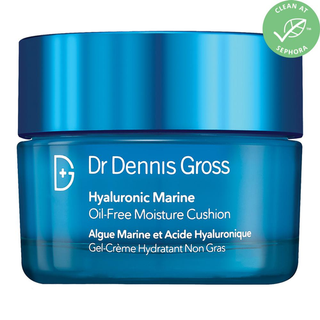
Dr Dennis Gross Hyaluronic Marine Moisture Cushion
Works for
2 of 2 advertised claims delivered
Anti-aging2 ingredients credited for this claimStrong support
“Rich in amino acids and B vitamins, marine algae enhances skins elasticity, while hyaluronic acid provides time-released hydration and glycolic acid reduces the appearance of fine lines.”
This product can help reduce and prevent fine lines and wrinkles, improve skin elasticity and firmness because it contains glycolic acid.
Keep in mind that it typically takes at least 6 weeks to notice any results because the changes that are needed to improve fine lines and elasticity happen in the deeper layers of the skin. No topical anti-aging product can “erase” wrinkles or fully reverse signs of aging.
Moisturizing18 ingredients credited for this claimGood support
“Hyaluronic Marine Moisture Cushion”
This product can help improve hydration of the skin with the two types of ingredients.
The first type is called “humectants”:
these ingredients help attract water.
When humectants are on the surface of the skin, they “pull in” the moisture from the outside environment, or from
within deeper layers of the skin. The following ingredients in this product do the job:
lactobacillus ferment, saccharide isomerate.
This product also contains ingredients called “occlusives”. They help reduce the speed with which our skin loses moisture to the outside environment. These ingredients also help soften the upper layer of the skin, so it feels less tight and nicer to the touch. The following ingredients in this product do the job: caprylic/capric triglyceride, dimethicone.
Evens skin toneNot advertised by the brand · 3 ingredients credited for this claimStrong support
This product can help reduce hypepigmentation and even out the skin tone because it contains the following effective ingredients: glycolic acid
Keep in mind that you would need to apply any topical skincare targetted at hypigmentation consistently for a couple of months to get a result. No topical skincare product can help get rid of hyperpigmentation (including post-acne marks and age spots) instantly.
ExfoliationNot advertised by the brand · 2 ingredients credited for this claimStrong support
This product can help exfoliate the skin. In other words, it helps break down the bonds between dead cells on the surface of the skin and speed up the skin turnover. Skin often appears softer and brighter after exfoliation, but overdoing it can result in disrupted skin barrier. The following ingredient is doing the exfoliating job in this product: glycolic acid.
Can it cause trouble?
Irritancy11 strong irritants: Citrus sinensis fruit extract, Cinnamomum cassia bark extract + 9 more — patch-test recommendedHigh risk
Comedogenic3 ingredients rated 2 or more on the 0–5 pore-clogging scale3 flagged
User reviews
Be the first — your take helps the next person decide.
Ingredients
Filter by role to see what each ingredient is doing.
Water~45–55%
Cyclopentasiloxane~5.8–7.1%
- Irritation risk
- Low
A silicone that helps improve the product texture and spreadability. Can absorb oil creating a short-term mattifying effect on the skin
More about CyclopentasiloxaneStearyl dimethicone~4.4–5.4%
- Irritation risk
- Low
Helps soften the upper layer of the skin
More about Stearyl dimethiconeCetearyl alcohol~2.6–3.2%
- Irritation risk
- Low
- Comedogenicity
- 2/5
A non-drying alcohol. Works as an emollient. Helps water and oil mix together and creates a nice product texture
More about Cetearyl alcoholDimethicone~2.5–3%
- Irritation risk
- Low
A silicone that helps to reduce water loss from the surface of the skin. Can temporarily "fill in" lines and wrinkles, absorb oil, and create a nice product finish
More about DimethiconeButylene glycol~1.9–2.4%
- Irritation risk
- Low
Used to create a nice product texture and help delivery of other ingredients. Might be somewhat helpful in attracting water to the upper layer of the skin
More about Butylene glycolCaprylic/capric triglyceride~1.8–2.2%
- Irritation risk
- Medium
A good mix of fatty acids that forms a protective layer on the skin. Improves the shelf life of products. Derived from coconut and glycerin
More about Caprylic/capric triglycerideOctadecene~1.4–1.8%
- Irritation risk
- Low
Glyceryl behenate~1.2–1.5%
- Irritation risk
- Medium
Used to create a thicker product consistency and help soften the upper layer of the skin
More about Glyceryl behenateSodium acrylate/sodium acryloyldimethyl taurate copolymer~1–1.3%
- Irritation risk
- Low
Used to create a thicker product consistency
More about Sodium acrylate/sodium acryloyldimethyl taurate copolymerCollagen amino acids~0.7–1.05%
- Irritation risk
- Low
Help attract water to the upper layer of the skin, soften it and support the skin barrier function
More about Collagen amino acidsSodium hyaluronate~0.6–0.9%
- Irritation risk
- Low
One of the best moisturizing ingredients. Attracts water into the upper layer of the skin
More about Sodium hyaluronateAloe barbadensis leaf extract~0.6–0.9%
- Irritation risk
- Medium
Traditionally used to treat sunburns, dermatitis and inflammation, but evidence for its effectiveness is lacking. The extract can contain humectants that help attract water into the skin
More about Aloe barbadensis leaf extractPhospholipids~0.5–0.75%
- Irritation risk
- Low
Emollients that are naturaly present in skin. In addition, they help water and oil mix together in the product
More about PhospholipidsCitrullus lanatus fruit extract~0.45–0.7%
- Irritation risk
- Medium
A plant extract that can contain an antioxidant compound
More about Citrullus lanatus fruit extractCocos nucifera fruit extract~0.5–0.75%
- Irritation risk
- Low
- Comedogenicity
- 3/5
An emollient. Found to be as effective as a moisturizer for dry skin as mineral oil. Could be comedogenic
More about Cocos nucifera fruit extractCitrus sinensis fruit extract~0.45–0.65%
- Irritation risk
- High
Cinnamomum cassia bark extract~0.45–0.7%
Saccharide isomerate~0.35–0.65%
- Irritation risk
- Low
Helps attract water to the upper layer of the skin
More about Saccharide isomerateVaccinium myrtillus fruit/leaf extract~0.3–0.55%
- Irritation risk
- Low
Glycolic acid~0.3–0.55%
- Irritation risk
- High
An alpha-hydroxy acid (AHA) that helps to remove the dead skin cells on the surface of the skin reveling a more even, smoother complexation. It is also able to stimulate collagen production with long-term use. Could help to reduce pore congestion. It can be irritating to the skin. Apply sunscreen daily if using products with glycolic acid
More about Glycolic acidLactic acid~0.3–0.55%
- Irritation risk
- Medium
An exfoliating and moisturizing alpha-hydroxy acid (AHA). Typically causes less irritation than other AHAs, for example, glycolic acid. At high concentrations (about 15%), lactic acid can help reduce lines and wrinkles. Recent studies show that lactic acid can support the "good" bacteria living on skin's surface (healthy skin microbiome)
More about Lactic acidSaccharum officinarum extract~0.25–0.5%
- Irritation risk
- Low
Sugar extract that helps attract water to the upper layer of the skin
More about Saccharum officinarum extractCitrus aurantium dulcis fruit extract~0.25–0.5%
- Irritation risk
- High
A plant extract that is used as a fragrance. Can be irritating and lead to photosensitivity
More about Citrus aurantium dulcis fruit extractCitrus limon fruit extract~0.25–0.5%
- Irritation risk
- High
Used as a fragrance. Can be irritating and cause photosensitivity
More about Citrus limon fruit extractAcer saccharum extract~0.25–0.5%
- Irritation risk
- Medium
A plant extract that contains small percentage of AHAs. Is unlikely to have any skin benefit due the small concentration of the active compounds
More about Acer saccharum extractHydrolyzed soy protein~0.3–0.5%
- Irritation risk
- Low
Helps attract water to the upper layer of the skin. Might have some anti-aging, anti-oxidant, and skin lightening properties, but solid evidence is missing
More about Hydrolyzed soy proteinLeuconostoc/radish root ferment filtrate~0.3–0.5%
- Irritation risk
- Medium
A preservative that comes from radishes fermented by a bacteria. New research suggests that the preservation properties in the ingredient come from an ammonium salt that is not present naturally in radish root but used in its cultivation. Is problematic because the exact amount of the preservative agents is difficult to determine
More about Leuconostoc/radish root ferment filtrateLactobacillus ferment~0.25–0.5%
- Irritation risk
- Low
A fermentation product created by bacteria Lactobacillus. The fermented product has anti-bacterial properties and might be helpful in calming down inflammation, but studies are lacking. Helps attract water to the upper layer of the skin. Can be used as a preservative
More about Lactobacillus fermentAcrylates/carbamate copolymer~0.25–0.5%
- Irritation risk
- Low
Isohexadecane~0.45–0.65%
- Irritation risk
- Low
Improves the texture of the product and helps soften the skin. Helps oil and water mix together and can be used as a cleansing agent
More about IsohexadecanePolysorbate 80~0.3–0.55%
Dimethicone crosspolymer-3~0.25–0.5%
- Irritation risk
- Low
Ethylhexylglycerin~0.3–0.5%
Isododecane~0.25–0.5%
- Irritation risk
- Low
An emollient that helps soften the skin and can decrease moisture loss. Helps create a nice product texture
More about IsododecaneBehenic acid~0.45–0.65%
Ceteareth-20~0.35–0.65%
- Irritation risk
- Medium
- Comedogenicity
- 2/5
Helps oil and water mix together. Has some emollient properties
More about Ceteareth-20Potassium cetyl phosphate~0.3–0.5%
- Irritation risk
- Medium
Helps oil and water mix together
More about Potassium cetyl phosphateLinalool~0.2–0.4%
Limonene~0.2–0.4%
- Irritation risk
- High
A common frangrance that can easily irritate skin, especially if exposed to air, light or heat
More about LimoneneHydroxyisohexyl 3-cyclohexene carboxaldehyde~0.2–0.35%
- Irritation risk
- High
A fragrance. Can be irritating
More about Hydroxyisohexyl 3-cyclohexene carboxaldehydeCitronellol~0.2–0.35%
Hydroxycitronellal~0.2–0.35%
- Irritation risk
- High
A fragrance. A likely allergen and can be irritating
More about HydroxycitronellalCitral~0.15–0.3%
Citric acid~0.15–0.3%
- Irritation risk
- Medium
Can work as an exfoliant but is typically used to adjust the product pH
More about Citric acidSodium citrate~0.15–0.3%
- Irritation risk
- Medium
Helps to control the skin's pH level. Maintains the skin's natural film of amino-lactic acids and oils. Helps to preserve products
More about Sodium citratePhenoxyethanol~0.2–0.35%
- Irritation risk
- Low
A preservative. It helps prevent bacterial growth in cosmetic products
More about PhenoxyethanolParfum~0.1–0.15%
- Irritation risk
- High
An aromatic blend of unspecified and possibly irritating ingredients
More about ParfumDisodium edta-copper~0.1–0.15%
- Irritation risk
- Low
Ingredient list view
Water, Cyclopentasiloxane, Stearyl dimethicone, Cetearyl alcohol, Dimethicone, Butylene glycol, Caprylic/capric triglyceride, Octadecene, Glyceryl behenate, Sodium acrylate/sodium acryloyldimethyl taurate copolymer, Collagen amino acids, Sodium hyaluronate, Aloe barbadensis leaf extract, Phospholipids, Citrullus lanatus fruit extract, Cocos nucifera fruit extract, Citrus sinensis fruit extract, Cinnamomum cassia bark extract, Saccharide isomerate, Vaccinium myrtillus fruit/leaf extract, Glycolic acid, Lactic acid, Saccharum officinarum extract, Citrus aurantium dulcis fruit extract, Citrus limon fruit extract, Acer saccharum extract, Hydrolyzed soy protein, Leuconostoc/radish root ferment filtrate, Lactobacillus ferment, Acrylates/carbamate copolymer, Isohexadecane, Polysorbate 80, Dimethicone crosspolymer-3, Ethylhexylglycerin, Isododecane, Behenic acid, Ceteareth-20, Potassium cetyl phosphate, Linalool, Limonene, Hydroxyisohexyl 3-cyclohexene carboxaldehyde, Citronellol, Hydroxycitronellal, Citral, Citric acid, Sodium citrate, Phenoxyethanol, Parfum, Disodium edta-copper
Compare prices
Retailers ranked by price — lowest first.

Sources cited in this review
Every concentration estimate and effectiveness label is anchored to one of these 19 studies and safety reviews.
- 1
- 2Final Report on the Safety Assessment of Dimethicone Copolyoljournals.sagepub.com
- 3Hyaluronic acid: A key molecule in skin agingncbi.nlm.nih.gov
- 4
- 5Analyzing Lycopene Content in Fruitssciencedirect.com
- 6

Affiliate links · As an Amazon Associate, WIMJ earns from qualifying purchases.