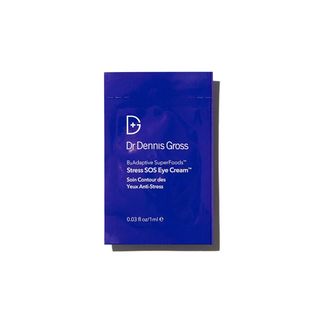
Dr Dennis Gross B₃Adaptive SuperFoods™ Stress SOS Eye Cream™ Packette
Works for
2 of 2 advertised claims delivered
Anti-aging13 ingredients credited for this claimStrong support
“Reduce the visible signs of stress around the eye with this potent, nourishing eye cream .”
This product can help reduce and prevent fine lines and wrinkles, improve skin elasticity and firmness because it contains adenosine, niacinamide, palmitoyl hexapeptide-12.
These ingredients in the product can also be helpful, even though there is less evidence for their effectiveness: dipeptide-2, palmitoyl tetrapeptide-7, palmitoyl tripeptide-1.
Keep in mind that it typically takes at least 6 weeks to notice any results because the changes that are needed to improve fine lines and elasticity happen in the deeper layers of the skin. No topical anti-aging product can “erase” wrinkles or fully reverse signs of aging.
Moisturizing30 ingredients credited for this claimStrong support
“Strengthen the moisture barrier while smoothing away worry lines and crepiness for a renewed, firmed, and youthful appearance.”
This product can help improve hydration of the skin with the two types of ingredients.
The first type is called “humectants”:
these ingredients help attract water.
When humectants are on the surface of the skin, they “pull in” the moisture from the outside environment, or from
within deeper layers of the skin. The following ingredients in this product do the job:
aminobutyric acid, arginine.
This product also contains ingredients called “occlusives”. They help reduce the speed with which our skin loses moisture to the outside environment. These ingredients also help soften the upper layer of the skin, so it feels less tight and nicer to the touch. The following ingredients in this product do the job: arginine, caprylic/capric triglyceride.
The following ingredients in this product are especially good for supporting the skin barrier and helping with the hydration level: ceramide ng, dipeptide-2, niacinamide, palmitoyl hexapeptide-12, palmitoyl tetrapeptide-7, palmitoyl tripeptide-1
Evens skin toneNot advertised by the brand · 9 ingredients credited for this claimStrong support
This product can help reduce hypepigmentation and even out the skin tone because it contains the following effective ingredients: niacinamide
The following ingredient (ingredients) in this product might be helpful, but there is no evidence to confirm that it actually can help even out the skin tone: chrysin, glycyrrhiza glabra root extract.
Keep in mind that you would need to apply any topical skincare targetted at hypigmentation consistently for a couple of months to get a result. No topical skincare product can help get rid of hyperpigmentation (including post-acne marks and age spots) instantly.
Anti-oxidationNot advertised by the brand · 14 ingredients credited for this claimModerate support
This product contains antioxidants (chrysin, lycium barbarum fruit extract) that might be able to help neutralize free radicals in skin to lessen the damage it gets from the UV light (sun). There is not enough evidence to confirm their effectiveness in skin though.
Can it cause trouble?
Irritancy2 strong irritants: Echinacea angustifolia extract, Arnica montana flower extractMedium risk
Comedogenic2 ingredients rated 2 or more on the 0–5 pore-clogging scale2 flagged
User reviews
Be the first — your take helps the next person decide.
Ingredients
Filter by role to see what each ingredient is doing.
Sucrose~29–36%
- Irritation risk
- Low
Can help attract water to the upper layer of the skin. In crystal form, it can work as a gentle exfoliant, gentler than the salt scrub. Helps stabilize the emulsion
More about SucroseWater~12–15%
Glycerin~5.4–6.6%
- Irritation risk
- Low
One of the best moisturizing ingredients. Naturally present in skin. It attracts water to the upper layer of the skin working as a humectant
More about GlycerinC12-15 alkyl benzoate~3.8–4.6%
- Irritation risk
- Low
Enhances the product texture and makes it more spreadable. Helps reduce water loss from the outer layer of skin. Extands the shelf life by preventing bacteria growth
More about C12-15 alkyl benzoatePentylene glycol~2.6–3.2%
- Irritation risk
- Medium
Used to preserve products, dissolve other ingredients and create a nice product texture
More about Pentylene glycolCaprylic/capric triglyceride~2.3–2.9%
- Irritation risk
- Medium
A good mix of fatty acids that forms a protective layer on the skin. Improves the shelf life of products. Derived from coconut and glycerin
More about Caprylic/capric triglycerideNiacinamide~1.8–2.1%
- Irritation risk
- Low
Is proven to be effective in reducing blemishes, evening out skin tone and helping to improve lines and wrinkles. It helps the skin to repair sun damage, calm down inflammation and keep maintain good levels of moisture. The concentration of about 2% is effective for supporting the skin barrier and evening out the skin tone. Concentration of 4-6% is better for helping with acne and balancing the sebum production
More about NiacinamideAminobutyric acid~1.6–1.9%
- Irritation risk
- Low
Has been shown to support wound healing and skin barrier function when used topically in rats. Is likely to be effective in supporting skin's hydration and barrier function, but research for human skin is missing. Might have some anti-aging properties but the research is missing
More about Aminobutyric acidGlyceryl stearate~1.4–1.8%
- Irritation risk
- Low
An emollient that softens the skin and forms a protective layer on its surface. Helps water and oil mix together
More about Glyceryl stearateLepidium meyenii root extract~1.1–1.4%
- Irritation risk
- Low
Lycium barbarum fruit extract~0.9–1.1%
- Irritation risk
- Medium
A plant extract that can help neutralize free radicals in skin and attract water to its upper layer
More about Lycium barbarum fruit extractCordyceps sinensis extract~0.75–1.1%
- Irritation risk
- Low
Euterpe oleracea fruit extract~0.65–1%
- Irritation risk
- Medium
A plant extract that can have some anti-oxidant effect in skin
More about Euterpe oleracea fruit extractCucumis sativus fruit extract~0.6–0.9%
- Irritation risk
- Medium
Might be somewhat helpful in reducing hyperpigmentation and neutralizing free radicals but its typical concentration in a product is too low for having an effect
More about Cucumis sativus fruit extractGlycyrrhiza glabra root extract~0.6–0.85%
- Irritation risk
- Medium
A plant extract that can help lighten the skin and calm down inflammation. Might be helpful in neutralizing free radicals
More about Glycyrrhiza glabra root extractRhodiola rosea root extract~0.65–0.95%
- Irritation risk
- Low
Asparagus racemosus root extract~0.65–1%
- Irritation risk
- Low
Trametes versicolor extract~0.55–0.85%
- Irritation risk
- Medium
A mushroom extract that might have some skin-lightening and moisturizing properties, but solid research is lacking. It is unlikely to be effective in the concentration used in skincare products
More about Trametes versicolor extractCoffea arabica seed extract~0.55–0.8%
- Irritation risk
- Low
Might be helpful in neutralizing free radicals in skin
More about Coffea arabica seed extractEchinacea angustifolia extract~0.5–0.75%
- Irritation risk
- High
Plant extract that might contain antioxidants, have antibacterial effect and help reduce inflammation, but solid evidence is lacking. Can be irritating
More about Echinacea angustifolia extractPhyllanthus emblica fruit extract~0.5–0.75%
- Irritation risk
- Medium
A plant extract that might be helpful in neutralizing free radicals and have a skin lightening effect if used in high enough concentrations
More about Phyllanthus emblica fruit extractArnica montana flower extract~0.45–0.65%
- Irritation risk
- High
A plant extract that can be irritating. It can have some anti-bacterial properties, but there are no evidence of a beneficial effect for skin
More about Arnica montana flower extractSqualane~0.55–0.85%
- Irritation risk
- Low
An oil naturally present in skin. Works as an emollient to soften the skin and form a protective layer on its surface without a greasy feeling.
More about SqualaneBiotin~0.45–0.7%
- Irritation risk
- Low
Might have some moisturising properties. Is not effective when applied topically beyond some moisturizing effect
More about BiotinLecithin~0.55–0.8%
- Irritation risk
- Low
Used mostly for creating emulsions - helping oil and water mix together. Helps soften the upper layer of the skin
More about LecithinHydrogenated phosphatidylcholine~0.5–0.7%
- Irritation risk
- Medium
Helps oil and water mix together
More about Hydrogenated phosphatidylcholineLysolecithin~0.5–0.75%
- Irritation risk
- Low
Lecithin derivative. It helps oil and water mix together and can enhance penetration of other ingredients. It helps soften the upper layer of the skin
More about LysolecithinBeta-sitosterol~0.55–0.8%
- Irritation risk
- Low
A phytosterol that can support skin's barrier function and help the skin stay hydrated
More about Beta-sitosterolEthylhexyl palmitate~0.55–0.8%
- Irritation risk
- Low
- Comedogenicity
- 3/5
An emollient that helps soften the skin and create a nice product texture
More about Ethylhexyl palmitateAdenosine~0.45–0.7%
- Irritation risk
- Low
Might help improve cell turnover and reduce inflammation in skin. One study shows that the ingredients might be able to help reduce dynamic wrinkles (for example, in the corners of the eyes or on the forehead)
More about AdenosineChrysin~0.45–0.7%
- Irritation risk
- Medium
Might be helpful in reducing fine lines and wrinkles, as well as lightening the skin, but solid evidence is missing. Could somewhat help in reducing the darkness of the under-eye area. Helps to neutralise free radicals in skin
More about ChrysinHesperidin methyl chalcone~0.45–0.7%
- Irritation risk
- High
Might help neutralize free radicals in skin. Is claimed to be able to improve the appearance of undereye darkness but evidence is missing. Can be an allergen and cause irritation
More about Hesperidin methyl chalconeN-hydroxysuccinimide~0.45–0.7%
- Irritation risk
- High
Is claimed to be able to brighten skin tone by removing some blood-related pigmented compounds in skin (hemoglobin and related elements) but solid research is missing. Can be irritating
More about N-hydroxysuccinimideDipeptide-2~0.45–0.7%
- Irritation risk
- Low
A type of peptide. Peptides are excellent moisturizers and might be able support collagen production reducing fine lines and wrinkles
More about Dipeptide-2Palmitoyl tetrapeptide-7~0.55–0.8%
- Irritation risk
- Low
A type of peptide. Peptides are excellent moisturizers and might be able support collagen production reducing fine lines and wrinkles
More about Palmitoyl tetrapeptide-7Palmitoyl tripeptide-1~0.55–0.8%
- Irritation risk
- Low
A type of peptide. Peptides are excellent moisturizers and might be able support collagen production reducing fine lines and wrinkles
More about Palmitoyl tripeptide-1Palmitoyl hexapeptide-12~0.45–0.7%
- Irritation risk
- Low
A type of peptide. Peptides are excellent moisturizers and might be able support collagen production reducing fine lines and wrinkles
More about Palmitoyl hexapeptide-12Arginine~0.45–0.65%
- Irritation risk
- Low
An amino acid that is naturally present in skin and helps keep it hydrated. When used together with AHAs, it can reduce their irritating effect on the skin
More about ArginineHydrolyzed soy protein~0.45–0.7%
- Irritation risk
- Low
Helps attract water to the upper layer of the skin. Might have some anti-aging, anti-oxidant, and skin lightening properties, but solid evidence is missing
More about Hydrolyzed soy proteinCeramide ng~0.55–0.8%
- Irritation risk
- Low
A type of lipid similar to ceramides naturally present in skin. Helps to soften the upper layer of the skin and supports the skin barrier function to keep it hydrated. Can help to prevent inflammation in skin
More about Ceramide ngPorphyridium cruentum extract~0.45–0.7%
- Irritation risk
- Low
- Comedogenicity
- 3/5
A red algae extract. Can help attract water to the upper layer of the skin and might have an antioxidant effect
More about Porphyridium cruentum extractAscorbic acid~0.45–0.7%
- Irritation risk
- High
The most well-researched antioxidant that works in skin. Helps neutralize free radicals supporting collagen production, helping to even out the skin tone and preventing early signs of aging
More about Ascorbic acidTocopherol~0.45–0.7%
- Irritation risk
- Low
Pure form of vitamin E. Can help moisturise and protect the skin from free radicals. Often used to help stabilise other ingredients or the formula itself
More about TocopherolCitric acid~0.45–0.7%
- Irritation risk
- Medium
Can work as an exfoliant but is typically used to adjust the product pH
More about Citric acidLactic acid~0.45–0.7%
- Irritation risk
- Medium
An exfoliating and moisturizing alpha-hydroxy acid (AHA). Typically causes less irritation than other AHAs, for example, glycolic acid. At high concentrations (about 15%), lactic acid can help reduce lines and wrinkles. Recent studies show that lactic acid can support the "good" bacteria living on skin's surface (healthy skin microbiome)
More about Lactic acidTribehenin~0.55–0.8%
- Irritation risk
- Low
Used to create a thicker product consistency and soften the upper layer of the skin
More about TribeheninMaltodextrin~0.5–0.75%
- Irritation risk
- Low
Used to stabilize the product formulation and can help absorb oil
More about MaltodextrinHydroxypropyl methylcellulose~0.5–0.75%
- Irritation risk
- Medium
Used to create a thicker product consistency and stabilize the formulation
More about Hydroxypropyl methylcellulosePullulan~0.45–0.7%
- Irritation risk
- High
Creates a thin drying film on the skin resulting in a short-term tightening effect
More about PullulanTrisodium ethylenediamine disuccinate~0.4–0.65%
- Irritation risk
- Medium
Used to improve stability of the formulation
More about Trisodium ethylenediamine disuccinateSodium citrate~0.4–0.6%
- Irritation risk
- Medium
Helps to control the skin's pH level. Maintains the skin's natural film of amino-lactic acids and oils. Helps to preserve products
More about Sodium citratePhytic acid~0.4–0.6%
- Irritation risk
- Medium
An alpha-hydroxy acid (AHA), but is mostly used to stabilize product formulations in cosmetics
More about Phytic acidPolysorbate 60~0.4–0.65%
Peg-10 phytosterol~0.4–0.6%
- Irritation risk
- Medium
Helps oil and water mix together
More about Peg-10 phytosterolAcrylates/c10-30 alkyl acrylate crosspolymer~0.35–0.65%
- Irritation risk
- Medium
Maintains the texture of skincare products. Allows the product to spread evenly. Helps oil and water mix together
More about Acrylates/c10-30 alkyl acrylate crosspolymerHydroxyethyl acrylate/sodium acryloyldimethyl taurate copolymer~0.35–0.6%
- Irritation risk
- Medium
A gelling agent that thickens the product consistency and leaves the skin with a velvety finish
More about Hydroxyethyl acrylate/sodium acryloyldimethyl taurate copolymerGlyceryl polyacrylate~0.35–0.65%
- Irritation risk
- Low
Helps to create a nice product texture and spread the product more easily on the skin
More about Glyceryl polyacrylatePeg-40 stearate~0.35–0.6%
Steareth-20~0.45–0.65%
Butylene glycol~0.25–0.5%
- Irritation risk
- Low
Used to create a nice product texture and help delivery of other ingredients. Might be somewhat helpful in attracting water to the upper layer of the skin
More about Butylene glycolPhenoxyethanol~0.2–0.4%
- Irritation risk
- Low
A preservative. It helps prevent bacterial growth in cosmetic products
More about PhenoxyethanolPotassium sorbate~0.15–0.3%
Sodium benzoate~0.15–0.25%
Mica~0.25–0.45%
- Irritation risk
- Low
Creates an illusion of smoother and more radiant skin tone. Adds shimmer to the skin by reflecting light
More about MicaTitanium dioxide~0.15–0.3%
- Irritation risk
- Low
Works as a UV filter when used in high concentrations. It is photostable and is effective mostly against the UVB light, with some protection in the UVA range. In small concentrations, used for its ability to improve the color of cosmetic products. Is usually well tolerated by the skin
More about Titanium dioxideCi 77891~0.1–0.2%
- Irritation risk
- Low
Ingredient list view
Sucrose, Unknown, Water, Glycerin, C12-15 alkyl benzoate, Pentylene glycol, Caprylic/capric triglyceride, Niacinamide, Aminobutyric acid, Glyceryl stearate, Lepidium meyenii root extract, Lycium barbarum fruit extract, Cordyceps sinensis extract, Euterpe oleracea fruit extract, Cucumis sativus fruit extract, Glycyrrhiza glabra root extract, Rhodiola rosea root extract, Asparagus racemosus root extract, Trametes versicolor extract, Coffea arabica seed extract, Echinacea angustifolia extract, Phyllanthus emblica fruit extract, Arnica montana flower extract, Squalane, Biotin, Lecithin, Hydrogenated phosphatidylcholine, Lysolecithin, Beta-sitosterol, Ethylhexyl palmitate, Adenosine, Chrysin, Hesperidin methyl chalcone, N-hydroxysuccinimide, Dipeptide-2, Palmitoyl tetrapeptide-7, Palmitoyl tripeptide-1, Palmitoyl hexapeptide-12, Arginine, Hydrolyzed soy protein, Ceramide ng, Porphyridium cruentum extract, Ascorbic acid, Tocopherol, Citric acid, Lactic acid, Tribehenin, Maltodextrin, Hydroxypropyl methylcellulose, Pullulan, Trisodium ethylenediamine disuccinate, Sodium citrate, Phytic acid, Polysorbate 60, Peg-10 phytosterol, Acrylates/c10-30 alkyl acrylate crosspolymer, Hydroxyethyl acrylate/sodium acryloyldimethyl taurate copolymer, Glyceryl polyacrylate, Peg-40 stearate, Steareth-20, Butylene glycol, Phenoxyethanol, Potassium sorbate, Sodium benzoate, Mica, Titanium dioxide, Ci 77891
Compare prices
Retailers ranked by price — lowest first.
Worth comparing, line by line.
Match % combines shared ingredients, the first five ingredients, shared actives and hero ingredients, irritancy (lower counts in the alternative's favour), texture and body area. Only products in the same routine step are compared.
| Dr Dennis GrossB₃Adaptive SuperFoods™ Stress SOS Eye Cream™ PacketteYOUR PRODUCT | 3LABWW Eye Cream | COSRXAdvanced Snail Peptide Eye Cream | H. HazelEye Gels | |
|---|---|---|---|---|
| Match | — | 61% | 57% | 57% |
| Price | — | $330.00 | $20.85 | $36.00 |
| Shared key ingredients | — | 9 of 22 | 6 of 22 | 4 of 22 |
| Key difference | — | Sh-Polypeptide-7 | Copper Tripeptide-1 | Arbutin |
| Irritancy | Medium | Medium | Low | Medium |
| Drying alcohol | — | — | — | — |
| View product | Shop | Shop | Shop |



Product summary
Judging from the ingredient list, "Dr Dennis Gross - B₃Adaptive SuperFoods™ Stress SOS Eye Cream™ Packette" works well for improving skin hydration As we expect from a proper moisturizer, the formula includes a combo of effective humectants and emollients. These are the two different types of ingredients that are essential for improving the skin hydration and supporting a healthy skin barrier. Aminobutyric acid, arginine, glycerin, sucrose and hydrolyzed soy protein in this product (humectants) attract water molecules to the upper layer of the skin (the water comes from the outside air or from the deeper layers of the skin if the air is dry). Ceramide ng, palmitoyl tetrapeptide-7, palmitoyl tripeptide-1, beta-sitosterol and arginine in this product help decrease the water evoporation from the skin, so that it stays hydrated for longer. These ingredients also soften the skin and take away the feeling of tightness and dryness.
Ingredient callouts
- We particularly like that there is a good concentration of niacinamide (niacinamide 1.80% - 2.10%) in this moisturizer. Niacinamide is a well-studied multi-tasking active. It is a great ingredient to have in a moisturizer. It is stable, and can work well in almost any hydrating formulation. There is solid evidence that niacinamide can help support skin barrier, regulate oil production and reduce acne and clogged pores. It also helps to fight photodamage and help improve the skin tone, reducing pigmentation marks.
- This product also contains vitamin C (Ascorbic Acid). It can be an effective active for anti-aging and evening out the skin tone, but in this moisturizer it is used for stabilizing other ingredients in the formulation. In this concentration (0.45% - 0.70%) it cannot have a noticeable benefit for the skin.
- As a plus, this moisturizer also contains ceramides (ceramide ng 0.55% - 0.80%). Ceramides are a type of lipids that our skin produces itself. They are a building block of the skin's barrier. Ceramides used in skincare are synthetic or extracted from plants. They work well for softening the skin surface and "patch holes" in the skin's barrier.
- This moistruizer also contains peptides (palmitoyl hexapeptide-12 0.45% - 0.70%, palmitoyl tripeptide-1 0.55% - 0.80%, palmitoyl tetrapeptide-7 0.55% - 0.80% and dipeptide-2 0.45% - 0.70%). Peptides is a very big group of ingredients. They all consist of a different combination of amino-acids. Our skin produces peptides naturally. Some of them work as natural anti-biotics, promote wound-healing and production of collagen. The scientists are still studying how effective the topical application of peptides is, but it is very likely that peptides in skincare are helpful. They might be able to support skin barrier restoration and even have an anti-aging benefit. At the very least, they certainly help attract water to the skin and support the hydration in this way.
- Adenosine 0.45% - 0.70% in this moisturizer adds an anti-aging benefit. Adenosine is a compound that in involved in many biological processes inside the skin cells. According one high-quality clinical trial, topical adenosine in low concentrations can help improve "deep wrinkles" - the wrinkles that appear with age in places where our faces are most dynamic (for example, on the forehead or in the corners of the eyes).
Irritation risk
This moisturizer contains some common irritants, including those without a benefit for the skin. We assess the overall irritancy of this moisturizer to be medium. For a detailed overview of all potential irritants: click here
You can see the detailed formula review with the breakdown of all actives in the product and the full ingredient list with estimated concentrations in the tables below.
About the brand
According to Cruelty-Free Kitty "Dr Dennis Gross" is cruelty free and so is its parent company.
Sources cited in this review
Every concentration estimate and effectiveness label is anchored to one of these 42 studies and safety reviews.
- 1
- 2
- 3
- 4
- 5Wound healing activity of gamma-aminobutyric Acid (GABA) in ratspubmed.ncbi.nlm.nih.gov
- 6Moisturizing effect of Gamma-aminobutyric acid for cosmetic applicationam-2017.weebly.com

Affiliate links · As an Amazon Associate, WIMJ earns from qualifying purchases.