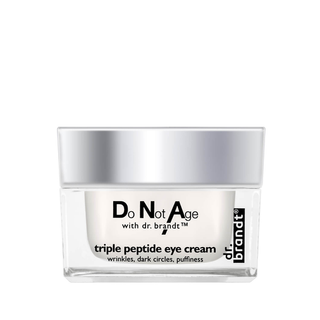
Dr. Brandt Do Not Age with Dr. Brandt Triple Peptide Eye Cream
Works for
2 of 3 advertised claims delivered
Moisturizing12 ingredients credited for this claimStrong support
“A unique cocktail of shea butter, ceramide 3 and phospholipids strengthen and nourish the eye area, whilst its Triple Peptide Complex stimulates collagen and elastin production to reveal a revitalised, hydrated look.”
This product can help improve hydration of the skin with the two types of ingredients.
The first type is called “humectants”:
these ingredients help attract water.
When humectants are on the surface of the skin, they “pull in” the moisture from the outside environment, or from
within deeper layers of the skin. The following ingredients in this product do the job:
glycerin.
This product also contains ingredients called “occlusives”. They help reduce the speed with which our skin loses moisture to the outside environment. These ingredients also help soften the upper layer of the skin, so it feels less tight and nicer to the touch. The following ingredients in this product do the job: butyrospermum parkii butter, helianthus annuus seed oil.
The following ingredients in this product are especially good for supporting the skin barrier and helping with the hydration level: palmitoyl tripeptide-5
Anti-aging3 ingredients credited for this claimModerate support
“Our Dare To Age eye cream powerfully corrects the look of fine lines, dark circles, and sagging skin.”
This product contains palmitoyl tripeptide-5. This ingredient might be able to help reduce and prevent fine lines and wrinkles, improve skin elasticity and firmness, but there is not enough evidence that it actually works.
Evens skin toneNo ingredient credited for this claimNo support
Effective ingredients missing or their concentration is too low
Can it cause trouble?
Irritancy1 strong irritant: Rosa rugosa leaf extractMedium risk
Comedogenic1 ingredient rated 2 or more on the 0–5 pore-clogging scale1 flagged


User reviews
Be the first — your take helps the next person decide.
Ingredients
Filter by role to see what each ingredient is doing.
Water~45–55%
Dicaprylyl ether~6.8–8.4%
- Irritation risk
- Low
Helps soften the upper layer of the skin while creating a non-greasy feel on the skin. Helps to dissolve other ingredients
More about Dicaprylyl etherGlycerin~4–4.9%
- Irritation risk
- Low
One of the best moisturizing ingredients. Naturally present in skin. It attracts water to the upper layer of the skin working as a humectant
More about GlycerinCetyl palmitate~3.2–3.9%
- Irritation risk
- Low
An emollient that helps soften the skin and is used to improve product texture and stability
More about Cetyl palmitateC12-16 alcohols~2.4–3%
- Irritation risk
- Medium
Helps soften the upper layer of the skin and improve the product's texture
More about C12-16 alcoholsPropanediol~2–2.4%
- Irritation risk
- Low
Acts as a solvent for other ingredients. Speeds up the absorption of other ingredients into the skin
More about PropanediolPentylene glycol~1.7–2.1%
- Irritation risk
- Medium
Used to preserve products, dissolve other ingredients and create a nice product texture
More about Pentylene glycolButyrospermum parkii butter~1.6–1.9%
- Irritation risk
- Low
- Comedogenicity
- 3/5
A great moisturising ingredient that softens the skin and reduces water loss from its upper layer. It also can be helpful in protecting skin from free radicals
More about Butyrospermum parkii butterCetyl alcohol~1.3–1.6%
- Irritation risk
- Low
A non-drying alcohol that works to soften the skin and stabilize product formulations helping oil and water mix together
More about Cetyl alcoholPalmitic acid~1–1.2%
- Irritation risk
- Low
An emollient that is naturally present in skin and helps soften it
More about Palmitic acidPalmitoyl tripeptide-5~0.65–1%
- Irritation risk
- Low
A type of peptide. Peptides are excellent moisturizers and might be able support collagen production reducing fine lines and wrinkles
More about Palmitoyl tripeptide-5Jasminum sambac flower extract~0.55–0.8%
- Irritation risk
- Low
Crataegus monogyna flower extract~0.5–0.75%
- Irritation risk
- Low
Rosa rugosa leaf extract~0.45–0.7%
- Irritation risk
- High
Actinidia chinensis fruit extract~0.45–0.7%
- Irritation risk
- High
A plant extract that might have some anti-oxidant properties, but evidence of effectiveness in skin is lacking
More about Actinidia chinensis fruit extractPunica granatum pericarp extract~0.4–0.6%
- Irritation risk
- Low
Caprylic/capric triglyceride~0.45–0.65%
- Irritation risk
- Medium
A good mix of fatty acids that forms a protective layer on the skin. Improves the shelf life of products. Derived from coconut and glycerin
More about Caprylic/capric triglycerideCarbomer~0.25–0.5%
- Irritation risk
- Low
Helps create a thicker or gel-like product texture. It is not a surfactant but can be used in gentle cleansing formulations
More about CarbomerCitric acid~0.25–0.4%
- Irritation risk
- Medium
Can work as an exfoliant but is typically used to adjust the product pH
More about Citric acidHelianthus annuus seed oil~0.25–0.45%
- Irritation risk
- Low
A great emollient due to its high linoleic acid content. One of the most effective plant oils in helping skin hydration and repairing skin barrier function
More about Helianthus annuus seed oilHydrogenated lecithin~0.2–0.4%
- Irritation risk
- Low
Helps to retain moisture by creating a protective barrier on the skin. Rich in fatty acids. Improves product texture and helps with the penetration of other ingredients.
More about Hydrogenated lecithinHydroxyacetophenone~0.15–0.3%
Levulinic acid~0.15–0.25%
Sodium hydroxide~0.15–0.25%
Sodium levulinate~0.1–0.2%
Sorbitan caprylate~0.1–0.2%
- Irritation risk
- Medium
Helps oil and water mix together
More about Sorbitan caprylateTocopherol~0.1–0.15%
- Irritation risk
- Low
Pure form of vitamin E. Can help moisturise and protect the skin from free radicals. Often used to help stabilise other ingredients or the formula itself
More about TocopherolIngredient list view
Water, Dicaprylyl ether, Glycerin, Cetyl palmitate, C12-16 alcohols, Propanediol, Pentylene glycol, Butyrospermum parkii butter, Cetyl alcohol, Palmitic acid, Palmitoyl tripeptide-5, Jasminum sambac flower extract, Crataegus monogyna flower extract, Rosa rugosa leaf extract, Actinidia chinensis fruit extract, Punica granatum pericarp extract, Caprylic/capric triglyceride, Carbomer, Citric acid, Helianthus annuus seed oil, Hydrogenated lecithin, Hydroxyacetophenone, Levulinic acid, Sodium hydroxide, Sodium levulinate, Sorbitan caprylate, Tocopherol
Compare prices
Retailers ranked by price — lowest first.

Worth comparing, line by line.
Match % combines shared ingredients, the first five ingredients, shared actives and hero ingredients, irritancy (lower counts in the alternative's favour), texture and body area. Only products in the same routine step are compared.
| Dr. BrandtDo Not Age with Dr. Brandt Triple Peptide Eye CreamYOUR PRODUCT | Über Youth™Super Eye Energy Peptide-Infusion Cream | Pestle & MortarRecover Eye Cream | SOBEL SKIN RxOligo Peptide Eye Cream | |
|---|---|---|---|---|
| Match | — | 65% | 64% | 63% |
| Price | $61.00 | $17.85−$43.15 | $35.64−$25.36 | $65.00+$4.00 |
| Shared key ingredients | — | 4 of 5 | 4 of 5 | 5 of 5 |
| Key difference | — | Caffeine | Panthenol | Dipeptide-2 |
| Irritancy | Medium | Low | Low | Medium |
| Drying alcohol | — | — | — | — |
| View product | Shop | Shop | Shop |


Product summary
"Dr. Brandt - Do Not Age with Dr. Brandt Triple Peptide Eye Cream" has a good moisturizing formula. The formulation is based on a combination of good humectants and emollients. Both are needed to increase the skin hydration level. Acetyl hexapeptide-8, betaine, glycerin, sodium pca and butylene glycol in this product (humectants) attract water molecules to the upper layer of the skin (the water comes from the outside air or from the deeper layers of the skin if the air is dry). Emollients in this formulation (ceramide 3, butyrospermum parkii butter, dimethicone, helianthus annuus seed oil and cetyl alcohol) help to reduce the moisture loss from the skin. They also soften the skin surface and relieve the feeling of dryness and tightness.
Ingredient callouts
- this moisturizer includes a form of retinoids (vitamin A) - retinyl palmitate 0.20% - 0.40%, but this type of vitamin A is not very effective. It could in theory help with fine lines and wrinkles, but the effect is most likely minimal.
- As a plus, this moisturizer also contains ceramides (ceramide 3 0.20% - 0.40%). Ceramides are a type of lipids that our skin produces itself. They are a building block of the skin's barrier. Ceramides used in skincare are synthetic or extracted from plants. They work well for softening the skin surface and "patch holes" in the skin's barrier.
- We like that this moisturizer contains peptides (palmitoyl oligopeptide 0.30% - 0.60%, acetyl hexapeptide-8 0.45% - 0.65% and ascorbic acid polypeptide 0.25% - 0.45%). There are many different kind of peptides and they are naturally present in our skin. They all are a combination of amino-acids. Some of them work as natural anti-biotics, promote wound-healing and production of collagen. The science is still not settled on how effective peptides in skincare are, but it is very likely that they have a benefit. Peptides might help restore the skin barrier and fight the signs of aging. At the very least, peptides work as humectants: they attract water to the upper layer of the skin and improve its hydration.
Irritation risk
This formulation includes some common irritants, including ingredients that do not provide a benefit for the skin. We assess the overall irritancy of this moisturizer to be medium. For a detailed overview of all potential irritants: click here
You can see the detailed formula review with the breakdown of all actives in the product and the full ingredient list with estimated concentrations in the tables below.
Price
The product retails from 35.35$ up to 84.20$ in the United States, for 96.58A$ in Australia, from 40.66£ up to 63.96£ in the United Kingdom and for 106.80CA$ in Canada.
For a detailed price comparison: click here.
Sources cited in this review
Every concentration estimate and effectiveness label is anchored to one of these 7 studies and safety reviews.
- 1
- 2
- 3
- 4Effect of topically applied lipids on surfactant-irritated skinonlinelibrary.wiley.com
- 5
- 6Vitamin E in dermatologyncbi.nlm.nih.gov

Affiliate links · As an Amazon Associate, WIMJ earns from qualifying purchases.