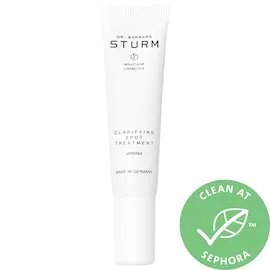
Dr. Barbara Sturm Clarifying Acne Spot Treatment
Works for
Anti-blemishNiacinamideWorks well
“Clarifying Acne Spot Treatment”
This product can help reduce breakouts and clogged pores because it contains the following ingredient: niacinamide. This ingredient is used for treating acne and can have a noticeable effect.
Anti-agingSide benefit the brand mentions · Niacinamide, Sodium salicylate + 1 moreWorks well
“Specialising in non-surgical, age-defying skin solutions, Dr. Barbara Sturm is adored by the skin-savvy for her incredible formulations jam-packed with hardworking antioxidants and designed around her innovative treatments.”
This product can help reduce and prevent fine lines and wrinkles, improve skin elasticity and firmness because it contains niacinamide.
Keep in mind that it typically takes at least 6 weeks to notice any results because the changes that are needed to improve fine lines and elasticity happen in the deeper layers of the skin. No topical anti-aging product can “erase” wrinkles or fully reverse signs of aging.
MoisturizingSide benefit the brand mentions · Niacinamide, Panthenol + 14 moreWorks well
“The three pillars of Dr. Barbara Sturm Molecular Cosmeticshydration, boosting the skin’s natural barrier function, and reducing the visible signs of irritationhelp to promote healthy skin that glows from within over time.”
This product can help improve hydration of the skin with the two types of ingredients.
The first type is called “humectants”:
these ingredients help attract water.
When humectants are on the surface of the skin, they “pull in” the moisture from the outside environment, or from
within deeper layers of the skin. The following ingredients in this product do the job:
pantolactone.
This product also contains ingredients called “occlusives”. They help reduce the speed with which our skin loses moisture to the outside environment. These ingredients also help soften the upper layer of the skin, so it feels less tight and nicer to the touch. The following ingredients in this product do the job: cera alba, cera microcristallina.
The following ingredients in this product are especially good for supporting the skin barrier and helping with the hydration level: niacinamide, panthenol
Evens skin toneSide benefit the brand mentions · NiacinamideWorks well
“Enriched with vitamin B3, the Dr Barbara Sturm Clarifying Spot Treatment aids the skin's natural healing properties.Ideal as an effective part of a skincare routine to remove spot-causing impurities and kept handy as an emergency spot treatment, this treatment will help to reduce redness and spots, encouraging a more even, flawless complexion.”
This product can help reduce hypepigmentation and even out the skin tone because it contains the following effective ingredients: niacinamide
Keep in mind that you would need to apply any topical skincare targetted at hypigmentation consistently for a couple of months to get a result. No topical skincare product can help get rid of hyperpigmentation (including post-acne marks and age spots) instantly.
Can it cause trouble?
Irritancy3 strong irritants: Melaleuca alternifolia leaf oil, Limonene + 1 more — patch-test recommendedHigh risk
Comedogenic5 ingredients rated 2 or more on the 0–5 pore-clogging scale5 flagged


User reviews
Be the first — your take helps the next person decide.
Ingredients
Filter by role to see what each ingredient is doing.
Water~40–60%
Polyglyceryl-3 polyricinoleate~3.2–4.8%
- Irritation risk
- Medium
Helps oil and water mix together
More about Polyglyceryl-3 polyricinoleateTalc~3.8–5.7%
Coco-caprylate~3–4.5%
- Irritation risk
- Medium
An emollient that softens skin and creates a nice product texture
More about Coco-caprylateDicaprylyl ether~2.5–3.7%
- Irritation risk
- Low
Helps soften the upper layer of the skin while creating a non-greasy feel on the skin. Helps to dissolve other ingredients
More about Dicaprylyl etherEthylhexyl palmitate~2–3%
- Irritation risk
- Low
- Comedogenicity
- 3/5
An emollient that helps soften the skin and create a nice product texture
More about Ethylhexyl palmitateZinc oxide~2.3–3.5%
- Irritation risk
- Low
A broad spectrum sunblock (protects from both UVA and UVB rays). Is suitable for most sensitive skins. In small concentrations, can be used as a colorant
More about Zinc oxidePropanediol~1.4–2.2%
- Irritation risk
- Low
Acts as a solvent for other ingredients. Speeds up the absorption of other ingredients into the skin
More about PropanediolC12-15 alkyl benzoate~1.2–1.8%
- Irritation risk
- Low
Enhances the product texture and makes it more spreadable. Helps reduce water loss from the outer layer of skin. Extands the shelf life by preventing bacteria growth
More about C12-15 alkyl benzoateCocoglycerides~1–1.6%
- Irritation risk
- High
Help soften the upper layer of the skin and make it easier for oil and water mix together. Recently, a rising number of allergic reactions to cocoglycerides and other coconut-derived surfactants has been reported. As there is a significant overlap between frequent irritants and allergens, we flag this ingredient for attention of those with very sensitive, reactive skin
More about CocoglyceridesNiacinamide~0.85–1.3%
- Irritation risk
- Low
Is proven to be effective in reducing blemishes, evening out skin tone and helping to improve lines and wrinkles. It helps the skin to repair sun damage, calm down inflammation and keep maintain good levels of moisture. The concentration of about 2% is effective for supporting the skin barrier and evening out the skin tone. Concentration of 4-6% is better for helping with acne and balancing the sebum production
More about NiacinamideSimmondsia chinensis seed oil~0.85–1.25%
- Irritation risk
- Medium
Softens the upper layer of skin and helps restore the healthy skin barrier. Has shown to help calm down inflammation in skin. It is a stable oil, meaning that it retains its properties even when exposed to air.
More about Simmondsia chinensis seed oilPanthenol~0.55–1.3%
- Irritation risk
- Low
Helps attract water to the upper layer of the skin and can help improve skin barrier function
More about PanthenolCera alba~0.85–1.25%
- Irritation risk
- Medium
Forms a protective barrier that holds water and keeps dry skin hydrated. Keeps an emulsion from separating into its oil and liquid components, and increases the thickness of a product. Can be an allergen
More about Cera albaCetyl palmitate~0.55–1.25%
- Irritation risk
- Low
An emollient that helps soften the skin and is used to improve product texture and stability
More about Cetyl palmitateMagnesium stearate~0.5–1.15%
Magnesium sulfate~0.45–1.1%
Cera microcristallina~0.5–1.15%
- Irritation risk
- Low
Helps to soften the upper layer of the skin, reduce water loss from its surface and create a thicker product consistency
More about Cera microcristallinaTocopheryl acetate~0.45–1%
- Irritation risk
- Medium
A more stable but less bio-available form of vitamin E compared to Tocopherol. Might help moisturize and protect the skin from free radicals, but mostly used in low concentrations to stabilize other ingredients.
More about Tocopheryl acetateMelaleuca alternifolia leaf oil~0.4–0.9%
- Irritation risk
- High
An essential oil that can be irritating. Has some anti-bacterial properties
More about Melaleuca alternifolia leaf oilMaclura cochinchinensis leaf prenylflavonoids~0.4–0.95%
- Irritation risk
- Low
Ascorbyl palmitate~0.35–0.85%
- Irritation risk
- Medium
Being a lipid soluble form of vitamin C, it is more stable and can penetrate the skin better than L-Ascorbic acid. It is effective in protecting the skin from free radicals, as well as evening the skin tone, but is less effective in stimulating collagen production compared to L-Ascorbic acid.
More about Ascorbyl palmitateLecithin~0.4–0.9%
- Irritation risk
- Low
Used mostly for creating emulsions - helping oil and water mix together. Helps soften the upper layer of the skin
More about LecithinCitric acid~0.35–0.85%
- Irritation risk
- Medium
Can work as an exfoliant but is typically used to adjust the product pH
More about Citric acidGlyceryl stearate~0.4–0.95%
- Irritation risk
- Low
An emollient that softens the skin and forms a protective layer on its surface. Helps water and oil mix together
More about Glyceryl stearateGlyceryl oleate~0.4–0.9%
- Irritation risk
- High
Helps oil and water mix together. Can be irritating
More about Glyceryl oleatePantolactone~0.35–0.8%
- Irritation risk
- Low
Helps attract water to the upper layer of the skin
More about PantolactoneEthylhexylglycerin~0.35–0.85%
Limonene~0.35–0.8%
- Irritation risk
- High
A common frangrance that can easily irritate skin, especially if exposed to air, light or heat
More about LimonenePhenoxyethanol~0.35–0.85%
- Irritation risk
- Low
A preservative. It helps prevent bacterial growth in cosmetic products
More about PhenoxyethanolIron oxides~0.35–0.8%
- Irritation risk
- Low
An umbrella term for the following three colorants: CI 77491, CI 77492, CI 77499. They might be able to offer some protection against visible light, but the degree of the protection is not clear
More about Iron oxidesTitanium dioxide~0.45–1%
- Irritation risk
- Low
Works as a UV filter when used in high concentrations. It is photostable and is effective mostly against the UVB light, with some protection in the UVA range. In small concentrations, used for its ability to improve the color of cosmetic products. Is usually well tolerated by the skin
More about Titanium dioxideWater~0.35–0.85%
Polyglyceryl-2 dipolyhydroxystearate~0.35–0.85%
- Irritation risk
- Low
Helps to soften the upper layer of the skin
More about Polyglyceryl-2 dipolyhydroxystearateTalc~0.45–1%
Cyclopentasiloxane~0.4–0.9%
- Irritation risk
- Low
A silicone that helps improve the product texture and spreadability. Can absorb oil creating a short-term mattifying effect on the skin
More about CyclopentasiloxaneDicaprylyl ether~0.4–0.9%
- Irritation risk
- Low
Helps soften the upper layer of the skin while creating a non-greasy feel on the skin. Helps to dissolve other ingredients
More about Dicaprylyl etherEthylhexyl palmitate~0.4–0.9%
- Irritation risk
- Low
- Comedogenicity
- 3/5
An emollient that helps soften the skin and create a nice product texture
More about Ethylhexyl palmitateZinc oxide~0.5–1.1%
- Irritation risk
- Low
A broad spectrum sunblock (protects from both UVA and UVB rays). Is suitable for most sensitive skins. In small concentrations, can be used as a colorant
More about Zinc oxideC12-15 alkyl benzoate~0.4–0.9%
- Irritation risk
- Low
Enhances the product texture and makes it more spreadable. Helps reduce water loss from the outer layer of skin. Extands the shelf life by preventing bacteria growth
More about C12-15 alkyl benzoateCocoglycerides~0.4–0.9%
- Irritation risk
- High
Help soften the upper layer of the skin and make it easier for oil and water mix together. Recently, a rising number of allergic reactions to cocoglycerides and other coconut-derived surfactants has been reported. As there is a significant overlap between frequent irritants and allergens, we flag this ingredient for attention of those with very sensitive, reactive skin
More about CocoglyceridesNiacinamide~0.35–0.85%
- Irritation risk
- Low
Is proven to be effective in reducing blemishes, evening out skin tone and helping to improve lines and wrinkles. It helps the skin to repair sun damage, calm down inflammation and keep maintain good levels of moisture. The concentration of about 2% is effective for supporting the skin barrier and evening out the skin tone. Concentration of 4-6% is better for helping with acne and balancing the sebum production
More about NiacinamidePolyglyceryl-3 diisostearate~0.4–0.9%
- Irritation risk
- Medium
- Comedogenicity
- 3/5
Helps oil and water mix together
More about Polyglyceryl-3 diisostearateSimmondsia chinensis seed oil~0.4–0.95%
- Irritation risk
- Medium
Softens the upper layer of skin and helps restore the healthy skin barrier. Has shown to help calm down inflammation in skin. It is a stable oil, meaning that it retains its properties even when exposed to air.
More about Simmondsia chinensis seed oilPanthenol~0.35–0.85%
- Irritation risk
- Low
Helps attract water to the upper layer of the skin and can help improve skin barrier function
More about PanthenolCera alba~0.45–1.05%
- Irritation risk
- Medium
Forms a protective barrier that holds water and keeps dry skin hydrated. Keeps an emulsion from separating into its oil and liquid components, and increases the thickness of a product. Can be an allergen
More about Cera albaMagnesium stearate~0.35–0.85%
Magnesium sulfate~0.35–0.85%
Tocopheryl acetate~0.35–0.85%
- Irritation risk
- Medium
A more stable but less bio-available form of vitamin E compared to Tocopherol. Might help moisturize and protect the skin from free radicals, but mostly used in low concentrations to stabilize other ingredients.
More about Tocopheryl acetatePhenoxyethanol~0.35–0.85%
- Irritation risk
- Low
A preservative. It helps prevent bacterial growth in cosmetic products
More about PhenoxyethanolAlcohol denat.~0.35–0.85%
- Irritation risk
- High
Produces temporary toning effect. Can help dissolve other ingredients or preserve products
More about Alcohol denat.Melaleuca alternifolia leaf oil~0.35–0.8%
- Irritation risk
- High
An essential oil that can be irritating. Has some anti-bacterial properties
More about Melaleuca alternifolia leaf oilCetyl palmitate~0.4–0.9%
- Irritation risk
- Low
An emollient that helps soften the skin and is used to improve product texture and stability
More about Cetyl palmitateEthylhexylglycerin~0.35–0.85%
Cera microcristallina~0.4–0.95%
- Irritation risk
- Low
Helps to soften the upper layer of the skin, reduce water loss from its surface and create a thicker product consistency
More about Cera microcristallinaPlantago lanceolata leaf extract~0.35–0.85%
- Irritation risk
- Medium
A plant extract that might have anti-oxidant properties
More about Plantago lanceolata leaf extractSodium salicylate~0.25–0.5%
- Irritation risk
- Medium
The salt of salicylic acid. Helps exfoliate the upper layer of the skin. Can also work to preserve cosmetic products
More about Sodium salicylateCitric acid~0.35–0.85%
- Irritation risk
- Medium
Can work as an exfoliant but is typically used to adjust the product pH
More about Citric acidLimonene~0.35–0.8%
- Irritation risk
- High
A common frangrance that can easily irritate skin, especially if exposed to air, light or heat
More about LimoneneLecithin~0.4–0.9%
- Irritation risk
- Low
Used mostly for creating emulsions - helping oil and water mix together. Helps soften the upper layer of the skin
More about LecithinAscorbyl palmitate~0.35–0.85%
- Irritation risk
- Medium
Being a lipid soluble form of vitamin C, it is more stable and can penetrate the skin better than L-Ascorbic acid. It is effective in protecting the skin from free radicals, as well as evening the skin tone, but is less effective in stimulating collagen production compared to L-Ascorbic acid.
More about Ascorbyl palmitateGlyceryl stearate~0.4–0.95%
- Irritation risk
- Low
An emollient that softens the skin and forms a protective layer on its surface. Helps water and oil mix together
More about Glyceryl stearateMahonia aquifolium root extract~0.35–0.85%
- Irritation risk
- Low
Pantolactone~0.35–0.8%
- Irritation risk
- Low
Helps attract water to the upper layer of the skin
More about PantolactoneGlyceryl oleate~0.4–0.9%
- Irritation risk
- High
Helps oil and water mix together. Can be irritating
More about Glyceryl oleateTitanium dioxide~0.45–1%
- Irritation risk
- Low
Works as a UV filter when used in high concentrations. It is photostable and is effective mostly against the UVB light, with some protection in the UVA range. In small concentrations, used for its ability to improve the color of cosmetic products. Is usually well tolerated by the skin
More about Titanium dioxideIron oxides~0.35–0.8%
- Irritation risk
- Low
An umbrella term for the following three colorants: CI 77491, CI 77492, CI 77499. They might be able to offer some protection against visible light, but the degree of the protection is not clear
More about Iron oxidesIron oxides~0.35–0.8%
- Irritation risk
- Low
An umbrella term for the following three colorants: CI 77491, CI 77492, CI 77499. They might be able to offer some protection against visible light, but the degree of the protection is not clear
More about Iron oxidesIron oxides~0.35–0.8%
- Irritation risk
- Low
An umbrella term for the following three colorants: CI 77491, CI 77492, CI 77499. They might be able to offer some protection against visible light, but the degree of the protection is not clear
More about Iron oxidesWater~0.35–0.85%
Polyglyceryl-3 polyricinoleate~0.4–0.9%
- Irritation risk
- Medium
Helps oil and water mix together
More about Polyglyceryl-3 polyricinoleateTalc~0.45–1%
Cyclopentasiloxane~0.4–0.9%
- Irritation risk
- Low
A silicone that helps improve the product texture and spreadability. Can absorb oil creating a short-term mattifying effect on the skin
More about CyclopentasiloxaneDicaprylyl ether~0.4–0.9%
- Irritation risk
- Low
Helps soften the upper layer of the skin while creating a non-greasy feel on the skin. Helps to dissolve other ingredients
More about Dicaprylyl etherEthylhexyl palmitate~0.4–0.9%
- Irritation risk
- Low
- Comedogenicity
- 3/5
An emollient that helps soften the skin and create a nice product texture
More about Ethylhexyl palmitateZinc oxide~0.5–1.1%
- Irritation risk
- Low
A broad spectrum sunblock (protects from both UVA and UVB rays). Is suitable for most sensitive skins. In small concentrations, can be used as a colorant
More about Zinc oxidePropanediol~0.35–0.85%
- Irritation risk
- Low
Acts as a solvent for other ingredients. Speeds up the absorption of other ingredients into the skin
More about PropanediolC12-15 alkyl benzoate~0.4–0.9%
- Irritation risk
- Low
Enhances the product texture and makes it more spreadable. Helps reduce water loss from the outer layer of skin. Extands the shelf life by preventing bacteria growth
More about C12-15 alkyl benzoateCocoglycerides~0.4–0.9%
- Irritation risk
- High
Help soften the upper layer of the skin and make it easier for oil and water mix together. Recently, a rising number of allergic reactions to cocoglycerides and other coconut-derived surfactants has been reported. As there is a significant overlap between frequent irritants and allergens, we flag this ingredient for attention of those with very sensitive, reactive skin
More about CocoglyceridesNiacinamide~0.35–0.85%
- Irritation risk
- Low
Is proven to be effective in reducing blemishes, evening out skin tone and helping to improve lines and wrinkles. It helps the skin to repair sun damage, calm down inflammation and keep maintain good levels of moisture. The concentration of about 2% is effective for supporting the skin barrier and evening out the skin tone. Concentration of 4-6% is better for helping with acne and balancing the sebum production
More about NiacinamideSimmondsia chinensis seed oil~0.4–0.95%
- Irritation risk
- Medium
Softens the upper layer of skin and helps restore the healthy skin barrier. Has shown to help calm down inflammation in skin. It is a stable oil, meaning that it retains its properties even when exposed to air.
More about Simmondsia chinensis seed oilPanthenol~0.35–0.85%
- Irritation risk
- Low
Helps attract water to the upper layer of the skin and can help improve skin barrier function
More about PanthenolCera alba~0.45–1.05%
- Irritation risk
- Medium
Forms a protective barrier that holds water and keeps dry skin hydrated. Keeps an emulsion from separating into its oil and liquid components, and increases the thickness of a product. Can be an allergen
More about Cera albaCetyl palmitate~0.4–0.9%
- Irritation risk
- Low
An emollient that helps soften the skin and is used to improve product texture and stability
More about Cetyl palmitateMagnesium stearate~0.35–0.85%
Magnesium sulfate~0.35–0.85%
Cera microcristallina~0.4–0.95%
- Irritation risk
- Low
Helps to soften the upper layer of the skin, reduce water loss from its surface and create a thicker product consistency
More about Cera microcristallinaTocopheryl acetate~0.4–0.95%
- Irritation risk
- Medium
A more stable but less bio-available form of vitamin E compared to Tocopherol. Might help moisturize and protect the skin from free radicals, but mostly used in low concentrations to stabilize other ingredients.
More about Tocopheryl acetatePhenoxyethanol~0.4–0.95%
- Irritation risk
- Low
A preservative. It helps prevent bacterial growth in cosmetic products
More about PhenoxyethanolMelaleuca alternifolia leaf oil~0.4–0.9%
- Irritation risk
- High
An essential oil that can be irritating. Has some anti-bacterial properties
More about Melaleuca alternifolia leaf oilEthylhexylglycerin~0.4–0.9%
Citric acid~0.4–0.9%
- Irritation risk
- Medium
Can work as an exfoliant but is typically used to adjust the product pH
More about Citric acidBioflavonoids~0.35–0.85%
- Irritation risk
- Low
Limonene~0.35–0.85%
- Irritation risk
- High
A common frangrance that can easily irritate skin, especially if exposed to air, light or heat
More about LimoneneLecithin~0.4–1%
- Irritation risk
- Low
Used mostly for creating emulsions - helping oil and water mix together. Helps soften the upper layer of the skin
More about LecithinAscorbyl palmitate~0.4–0.9%
- Irritation risk
- Medium
Being a lipid soluble form of vitamin C, it is more stable and can penetrate the skin better than L-Ascorbic acid. It is effective in protecting the skin from free radicals, as well as evening the skin tone, but is less effective in stimulating collagen production compared to L-Ascorbic acid.
More about Ascorbyl palmitateGlyceryl stearate~0.45–1%
- Irritation risk
- Low
An emollient that softens the skin and forms a protective layer on its surface. Helps water and oil mix together
More about Glyceryl stearatePantolactone~0.4–0.9%
- Irritation risk
- Low
Helps attract water to the upper layer of the skin
More about PantolactoneGlyceryl oleate~0.4–0.95%
- Irritation risk
- High
Helps oil and water mix together. Can be irritating
More about Glyceryl oleateTitanium dioxide~0.45–1.1%
- Irritation risk
- Low
Works as a UV filter when used in high concentrations. It is photostable and is effective mostly against the UVB light, with some protection in the UVA range. In small concentrations, used for its ability to improve the color of cosmetic products. Is usually well tolerated by the skin
More about Titanium dioxideIron oxides~0.4–0.9%
- Irritation risk
- Low
An umbrella term for the following three colorants: CI 77491, CI 77492, CI 77499. They might be able to offer some protection against visible light, but the degree of the protection is not clear
More about Iron oxidesIron oxides~0.4–0.9%
- Irritation risk
- Low
An umbrella term for the following three colorants: CI 77491, CI 77492, CI 77499. They might be able to offer some protection against visible light, but the degree of the protection is not clear
More about Iron oxidesIron oxides~0.4–0.9%
- Irritation risk
- Low
An umbrella term for the following three colorants: CI 77491, CI 77492, CI 77499. They might be able to offer some protection against visible light, but the degree of the protection is not clear
More about Iron oxidesWater~0.4–0.9%
Polyglyceryl-3 polyricinoleate~0.4–0.95%
- Irritation risk
- Medium
Helps oil and water mix together
More about Polyglyceryl-3 polyricinoleateTalc~0.45–1.1%
Cyclopentasiloxane~0.4–1%
- Irritation risk
- Low
A silicone that helps improve the product texture and spreadability. Can absorb oil creating a short-term mattifying effect on the skin
More about CyclopentasiloxaneDicaprylyl ether~0.4–0.95%
- Irritation risk
- Low
Helps soften the upper layer of the skin while creating a non-greasy feel on the skin. Helps to dissolve other ingredients
More about Dicaprylyl etherEthylhexyl palmitate~0.4–1%
- Irritation risk
- Low
- Comedogenicity
- 3/5
An emollient that helps soften the skin and create a nice product texture
More about Ethylhexyl palmitateZinc oxide~0.5–1.2%
- Irritation risk
- Low
A broad spectrum sunblock (protects from both UVA and UVB rays). Is suitable for most sensitive skins. In small concentrations, can be used as a colorant
More about Zinc oxidePropanediol~0.4–0.95%
- Irritation risk
- Low
Acts as a solvent for other ingredients. Speeds up the absorption of other ingredients into the skin
More about PropanediolC12-15 alkyl benzoate~0.4–0.95%
- Irritation risk
- Low
Enhances the product texture and makes it more spreadable. Helps reduce water loss from the outer layer of skin. Extands the shelf life by preventing bacteria growth
More about C12-15 alkyl benzoateCocoglycerides~0.4–1%
- Irritation risk
- High
Help soften the upper layer of the skin and make it easier for oil and water mix together. Recently, a rising number of allergic reactions to cocoglycerides and other coconut-derived surfactants has been reported. As there is a significant overlap between frequent irritants and allergens, we flag this ingredient for attention of those with very sensitive, reactive skin
More about CocoglyceridesNiacinamide~0.4–0.9%
- Irritation risk
- Low
Is proven to be effective in reducing blemishes, evening out skin tone and helping to improve lines and wrinkles. It helps the skin to repair sun damage, calm down inflammation and keep maintain good levels of moisture. The concentration of about 2% is effective for supporting the skin barrier and evening out the skin tone. Concentration of 4-6% is better for helping with acne and balancing the sebum production
More about NiacinamideSimmondsia chinensis seed oil~0.45–1%
- Irritation risk
- Medium
Softens the upper layer of skin and helps restore the healthy skin barrier. Has shown to help calm down inflammation in skin. It is a stable oil, meaning that it retains its properties even when exposed to air.
More about Simmondsia chinensis seed oilPanthenol~0.4–0.9%
- Irritation risk
- Low
Helps attract water to the upper layer of the skin and can help improve skin barrier function
More about PanthenolCera alba~0.45–1.1%
- Irritation risk
- Medium
Forms a protective barrier that holds water and keeps dry skin hydrated. Keeps an emulsion from separating into its oil and liquid components, and increases the thickness of a product. Can be an allergen
More about Cera albaCetyl palmitate~0.4–0.95%
- Irritation risk
- Low
An emollient that helps soften the skin and is used to improve product texture and stability
More about Cetyl palmitateMagnesium stearate~0.4–0.9%
Magnesium sulfate~0.4–0.9%
Cera microcristallina~0.4–0.95%
- Irritation risk
- Low
Helps to soften the upper layer of the skin, reduce water loss from its surface and create a thicker product consistency
More about Cera microcristallinaTocopheryl acetate~0.3–0.75%
- Irritation risk
- Medium
A more stable but less bio-available form of vitamin E compared to Tocopherol. Might help moisturize and protect the skin from free radicals, but mostly used in low concentrations to stabilize other ingredients.
More about Tocopheryl acetatePhenoxyethanol~0.3–0.7%
- Irritation risk
- Low
A preservative. It helps prevent bacterial growth in cosmetic products
More about PhenoxyethanolMelaleuca alternifolia leaf oil~0.2–0.75%
- Irritation risk
- High
An essential oil that can be irritating. Has some anti-bacterial properties
More about Melaleuca alternifolia leaf oilEthylhexylglycerin~0.2–0.75%
Citric acid~0.2–0.7%
- Irritation risk
- Medium
Can work as an exfoliant but is typically used to adjust the product pH
More about Citric acidBioflavonoids~0.15–0.65%
- Irritation risk
- Low
Limonene~0.15–0.55%
- Irritation risk
- High
A common frangrance that can easily irritate skin, especially if exposed to air, light or heat
More about LimoneneLecithin~0.15–0.65%
- Irritation risk
- Low
Used mostly for creating emulsions - helping oil and water mix together. Helps soften the upper layer of the skin
More about LecithinAscorbyl palmitate~0.1–0.5%
- Irritation risk
- Medium
Being a lipid soluble form of vitamin C, it is more stable and can penetrate the skin better than L-Ascorbic acid. It is effective in protecting the skin from free radicals, as well as evening the skin tone, but is less effective in stimulating collagen production compared to L-Ascorbic acid.
More about Ascorbyl palmitateGlyceryl stearate~0.15–0.55%
- Irritation risk
- Low
An emollient that softens the skin and forms a protective layer on its surface. Helps water and oil mix together
More about Glyceryl stearatePantolactone~0.1–0.35%
- Irritation risk
- Low
Helps attract water to the upper layer of the skin
More about PantolactoneGlyceryl oleate~0.1–0.35%
- Irritation risk
- High
Helps oil and water mix together. Can be irritating
More about Glyceryl oleateTitanium dioxide~0.15–0.6%
- Irritation risk
- Low
Works as a UV filter when used in high concentrations. It is photostable and is effective mostly against the UVB light, with some protection in the UVA range. In small concentrations, used for its ability to improve the color of cosmetic products. Is usually well tolerated by the skin
More about Titanium dioxideIron oxides~0.05–0.3%
- Irritation risk
- Low
An umbrella term for the following three colorants: CI 77491, CI 77492, CI 77499. They might be able to offer some protection against visible light, but the degree of the protection is not clear
More about Iron oxidesIron oxides~0.05–0.2%
- Irritation risk
- Low
An umbrella term for the following three colorants: CI 77491, CI 77492, CI 77499. They might be able to offer some protection against visible light, but the degree of the protection is not clear
More about Iron oxidesIron oxides~0.05–0.2%
- Irritation risk
- Low
An umbrella term for the following three colorants: CI 77491, CI 77492, CI 77499. They might be able to offer some protection against visible light, but the degree of the protection is not clear
More about Iron oxidesIngredient list view
Water, Polyglyceryl-3 polyricinoleate, Talc, Coco-caprylate, Dicaprylyl ether, Ethylhexyl palmitate, Zinc oxide, Propanediol, C12-15 alkyl benzoate, Cocoglycerides, Niacinamide, Simmondsia chinensis seed oil, Panthenol, Cera alba, Cetyl palmitate, Magnesium stearate, Magnesium sulfate, Cera microcristallina, Tocopheryl acetate, Melaleuca alternifolia leaf oil, Maclura cochinchinensis leaf prenylflavonoids, Ascorbyl palmitate, Lecithin, Citric acid, Glyceryl stearate, Glyceryl oleate, Pantolactone, Ethylhexylglycerin, Limonene, Phenoxyethanol, Iron oxides, Titanium dioxide, Water, Polyglyceryl-2 dipolyhydroxystearate, Talc, Cyclopentasiloxane, Dicaprylyl ether, Ethylhexyl palmitate, Zinc oxide, C12-15 alkyl benzoate, Cocoglycerides, Niacinamide, Polyglyceryl-3 diisostearate, Simmondsia chinensis seed oil, Panthenol, Cera alba, Magnesium stearate, Magnesium sulfate, Tocopheryl acetate, Phenoxyethanol, Alcohol denat., Melaleuca alternifolia leaf oil, Cetyl palmitate, Ethylhexylglycerin, Cera microcristallina, Plantago lanceolata leaf extract, Sodium salicylate, Citric acid, Limonene, Lecithin, Ascorbyl palmitate, Glyceryl stearate, Mahonia aquifolium root extract, Pantolactone, Glyceryl oleate, Titanium dioxide, Iron oxides, Iron oxides, Iron oxides, Water, Polyglyceryl-3 polyricinoleate, Talc, Cyclopentasiloxane, Dicaprylyl ether, Ethylhexyl palmitate, Zinc oxide, Propanediol, C12-15 alkyl benzoate, Cocoglycerides, Niacinamide, Simmondsia chinensis seed oil, Panthenol, Cera alba, Cetyl palmitate, Magnesium stearate, Magnesium sulfate, Cera microcristallina, Tocopheryl acetate, Phenoxyethanol, Melaleuca alternifolia leaf oil, Ethylhexylglycerin, Citric acid, Bioflavonoids, Limonene, Lecithin, Ascorbyl palmitate, Glyceryl stearate, Pantolactone, Glyceryl oleate, Titanium dioxide, Iron oxides, Iron oxides, Iron oxides, Water, Polyglyceryl-3 polyricinoleate, Talc, Cyclopentasiloxane, Dicaprylyl ether, Ethylhexyl palmitate, Zinc oxide, Propanediol, C12-15 alkyl benzoate, Cocoglycerides, Niacinamide, Simmondsia chinensis seed oil, Panthenol, Cera alba, Cetyl palmitate, Magnesium stearate, Magnesium sulfate, Cera microcristallina, Tocopheryl acetate, Phenoxyethanol, Melaleuca alternifolia leaf oil, Ethylhexylglycerin, Citric acid, Bioflavonoids, Limonene, Lecithin, Ascorbyl palmitate, Glyceryl stearate, Pantolactone, Glyceryl oleate, Titanium dioxide, Iron oxides, Iron oxides, Iron oxides
Compare prices
Retailers ranked by price — lowest first.


Worth comparing, line by line.
Match % combines shared ingredients, the first five ingredients, shared actives and hero ingredients, irritancy (lower counts in the alternative's favour), texture and body area. Only products in the same routine step are compared.
| Dr. Barbara SturmClarifying Acne Spot TreatmentYOUR PRODUCT | REVOLUTION SKINCAREOvernight Targeted Blemish Lotion | innisfreeBrightening Pore Spot Treatment | IntraceuticalsOpulence Brightening Wand | |
|---|---|---|---|---|
| Match | — | 78% | 77% | 76% |
| Price | $55.00 | $6.71−$48.29 | — | $49.22−$5.78 |
| Shared key ingredients | — | 3 of 10 | 3 of 10 | 1 of 10 |
| Key difference | — | Glycerin | 3-O-Ethyl Ascorbic Acid | Nonapeptide-1 |
| Irritancy | High | Low | Medium | Medium |
| Drying alcohol | Contains drying alcohol | Contains drying alcohol | — | — |
| View product | Shop | Shop | Shop |


More alternatives: Heimish Moringa Ceramide BB CreamPretty skin Micro Whitening Spot Cream
Product summary
"Dr. Barbara Sturm - Clarifying Acne Spot Treatment" is effective for: Moisturizing
Ingredient callouts
- Panthenol (pro-vitamin B5) at about 0.40% - 0.90% concentration. In this concentration, Panthenol works effectively to improve the skin barrier and reduce inflammation.
- Humectants (pantolactone 0.15% - 0.60%, pantolactone 0.40% - 0.90%, panthenol 0.40% - 0.90%, panthenol 0.35% - 0.85%, pantolactone 0.35% - 0.80%, panthenol 0.35% - 0.85%, pantolactone 0.35% - 0.80% and panthenol 0.55% - 1.30%). These ingredients help attract water to the upper layer of the skin and improve the skin hydration.
About the brand
According to Cruelty-Free Kitty "Dr. Barbara Sturm" is cruelty free and so is its parent company.
Price
The product retails for 55.00$ in the United States and from 40.00£ up to 56.50£ in the United Kingdom.
For a detailed price comparison: click here.
Sources cited in this review
Every concentration estimate and effectiveness label is anchored to one of these 14 studies and safety reviews.
- 1A review of inorganic UV filters zinc oxide and titanium dioxideonlinelibrary.wiley.com
- 2
- 3
- 4
- 5
- 6

Affiliate links · As an Amazon Associate, WIMJ earns from qualifying purchases.